Accessibility walked so AI could crawl
Introduction: Accessibility and AI Readiness as the Same Problem
Speaker E opens with a scenario contrasting how organizations budget for 'accessibility' versus 'AI readiness' initiatives, arguing these are actually the same problem viewed through different lenses. She sets up her thesis that AI, approached correctly, could be the biggest boost to digital product quality in decades, and that accessibility practitioners are uniquely positioned to lead this work.
About Avian: Working at the Intersection of Strategy, Design, and AI
Speaker E introduces her Canberra-based design agency, Avian, which operates at the intersection of strategy, design, and technology, often ending up doing AI-related consulting for clients in highly regulated industries. She previews the talk's structure: opportunities, problems, a client case study, and practical takeaways.
Accessibility Trees as the API for AI Agents
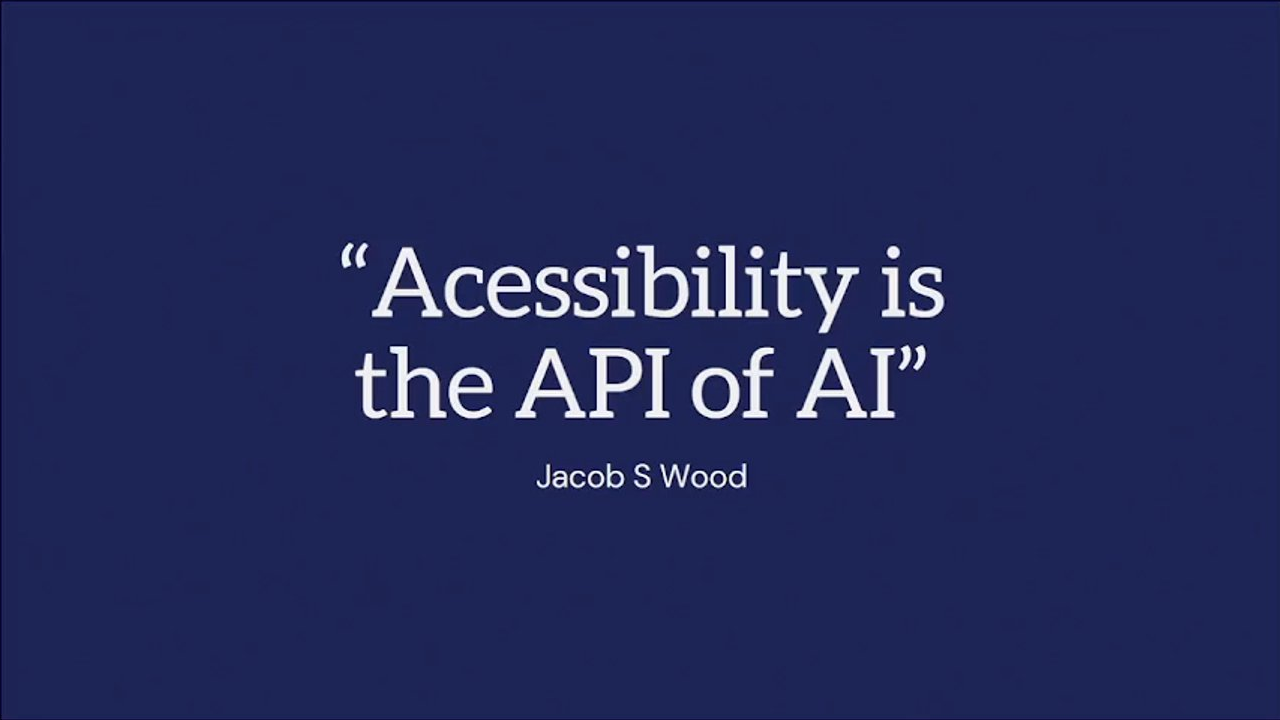
Drawing on Jacob S. Wood's idea that 'accessibility is the API of AI,' Speaker E explains how AI tools like Claude's WebFetch, Microsoft's agent toolkit, Stagehand, Vercel, and Google all rely on the accessibility tree to interpret web content, just as screen readers do for blind users. This convergence demonstrates that building accessible websites and building AI-ready websites are fundamentally the same technical task.
How AI Is Mediating the Web and Reshaping Content Strategy
Speaker E presents data showing AI overviews and chatbots now intercept a huge share of searches, with AI scraping traffic up 597% while referral traffic to source sites remains negligible. She argues content must now be treated as web infrastructure rather than marketing copy, since users increasingly experience AI-summarized content rather than the original text.
Design Principles for AI-Readable and Accessible Content
Speaker E outlines concrete content principles—clarity, real headings and semantic HTML, direct answers, semantic completeness, and proper labeling—that serve both accessibility and AI visibility goals. She emphasizes that although these principles are familiar from accessibility standards, implementing them well remains technically challenging, especially in organizations where subject matter experts publish content directly without design or content mediation.
The Content Exposure Problem: When AI Surfaces Everything
Speaker E describes a new challenge her clients face: AI tools are now exposing vast, poorly maintained content repositories—including outdated pages once hidden in navigation—creating urgent but seemingly unmanageable audit and remediation problems, especially for large organizations in regulated industries. This sets up the question of whether AI itself can help solve the problem it created.
Case Study: Building an AI-Assisted Content Production Engine
Speaker E details an ongoing experiment building a 'content production engine' to help clients scale content projects that would otherwise be too costly or time-consuming, aiming to reduce cost and increase speed without sidelining skilled content teams. She explains the engine's iterative refinement loop: encoding content standards, producing source content, reviewing it with content teams and subject matter experts, and refining inputs based on feedback.
Setting Realistic Quality Expectations: From 70% to 100%
Speaker E clarifies that the engine isn't meant to produce publish-ready content but rather to get output to roughly 60-70% quality, which content designers then refine to completion with subject matter experts. She contrasts this AI-assisted approach with traditional 'from scratch' or 'slow content' creation, which is often infeasible given the scale of content that needs updating.
Measuring the Experiment: Time, Cost, and Quality Findings
Speaker E shares early results from measuring the engine's impact—content production time dropped from six-to-eight hours to about thirty minutes—while cautioning that this excludes downstream subject matter expert and policy review time. She reveals that encoding content standards proved far harder than expected, requiring teams to align on quality definitions they previously understood only implicitly.
The Human Element: When Content Designers Break the Rules
Speaker E describes a striking finding: content designers often edit AI-generated content in ways that break the very rules and guidelines they set for the engine, demonstrating the human judgment and creative friction needed to know when standard rules should be overridden. This highlights the irreplaceable value of human expertise even within a highly systematized AI content process.
Actionable Takeaways: Joining the AI Conversation in Your Organization
Speaker E offers practical next steps for attendees: seek out existing AI experiments in their organizations and insist design and content have a seat at the table, reframe accessibility and human-centered design work as 'AI readiness' to gain executive buy-in, and prioritize designing AI tools for team collaboration rather than solitary use. She closes by predicting a surge in demand for human-centered design and accessibility skills as organizations race to build AI-ready products.
Q&A: The Drift Between Human and Agent Content Preferences
During the Q&A, Lily from Atlassian asks about early signs that best practices for human content design are diverging from what AI agents prefer, citing an example about question-based headings. Speaker E responds by stressing the importance of understanding your primary audience and reports that her government clients haven't yet faced this divergence, though she acknowledges it's an open and evolving question.
Hi, everyone. So great to be here. So I'd like to start by asking you all to imagine two teams, both operating extremely complex digital products in two different organizations, both struggling to get their teams and their wider organization to care about designing for accessibility, designing for inclusion, maybe even just designing to help people get their jobs done.
And so budget time rolls around this time of year, and they put up some budget bids, to run some projects or or initiatives. And one team does what they always do. They think this product really needs some, accessibility work. We're gonna run an accessibility review. We're gonna plan some remediation to do some work on it. And the other team puts up a bid for an AI readiness initiative. And how do you think that goes with the executive?
What is an AI readiness initiative? No one knows. But I'd like to put it to you that, in actual fact, perhaps these two projects could actually be the same thing. Accessibility and AI readiness are currently viewed as two completely separate problems under often two different executives with two very different budgets and and likely two different strategies.
But they're not. They're actually the same problem viewed from different lenses. And despite all the hand wringing and the existential dread, which we have had very little of today, has been really nice. I think it's been a very grounded, realistic discussion on, like, potential opportunity and and limitations. And but but despite, you know, that that you're sort of seeing it out in the market and despite the LinkedIn hype, which we're also seeing, which we haven't seen here today, which has also been I do actually think AI, viewed in the right way, can be one of the best things to happen to digital product quality in maybe twenty years. And I wanna talk a little bit about why I think that and how you can get involved and use some of this hype for good.
Because actually, the people that are best placed to deliver accessible digital products and AI ready digital products are the people in this room because you've actually been doing it for years. So I run a boutique design agency based out of Canberra but operating nationally called Avian. We specialize in the intersection of strategy, design, and technology.
And of course, what sits right smack bang in the middle of those things is AI. I didn't intend to start an AI consultancy. I don't think that's what I've done. But we, we have ended up doing a lot of work with clients who are really grappling with, like, the grounded, constrained, reality of of how to use this technology, in their in their environments.
And we do a lot of work in highly regulated industries, similar to what Alex is talking about, industries where it's it's a little bit more complicated and slower than just sort of jumping on on the latest technology and tools. So I wanna surface today, some opportunities, that I think we, are facing, some big problems, a case study of some of the work that we're doing with clients, to to sort of, deal with and solve some of these these problems, And then a couple of things that maybe you can try, in your organization.
So, Jacob S. Wood is a blind user who writes about digital leadership and accessibility. And he talks about how accessibility is like the API of AI. When he talks about how he, as a blind user, when he deals with the web, he's really using that screen reader as an interface that doesn't look at the visual layer of the web but is reading the underlying code.
So you guys will all know this, document object model, accessibility tree, semantic HTML. And actually, AI is the same. So using Claude as an example, if you're as absolutely addicted to it as I am, It has a tool called WebFetch that goes to a URL. It helps you understand what's on that in that source material by stripping all the visuals out.
It sort of reads the reads the content structure. And what's been interesting is in the last eighteen months, most of the big AI tools, have really converged on, essentially the same, architecture. So many of these tools in fact, all of these ones, really go straight to the accessibility tree to to, interact with the web.
So the accessibility tree is what your browser, builds automatically, to understand a web a website. So Microsoft's official agent toolkit defaults to it. Stagehand, which is leading open source automation SDK. Vercel so Stagehand actually migrated to it about eighteen months ago and, like, wrote a whole big piece about how how effective it is and how cost effective it is, which is really interesting.
Vercel, which is the company behind Next. Js, which a lot of your devs probably use, has built an a AI agent tool, that uses the accessibility tree. And Google, their developer guidance, actually writes about how making websites AI ready is actually about building accessible websites. So we're getting a very clear indicator here from industry that building accessible products and building AI ready products is one and the same.
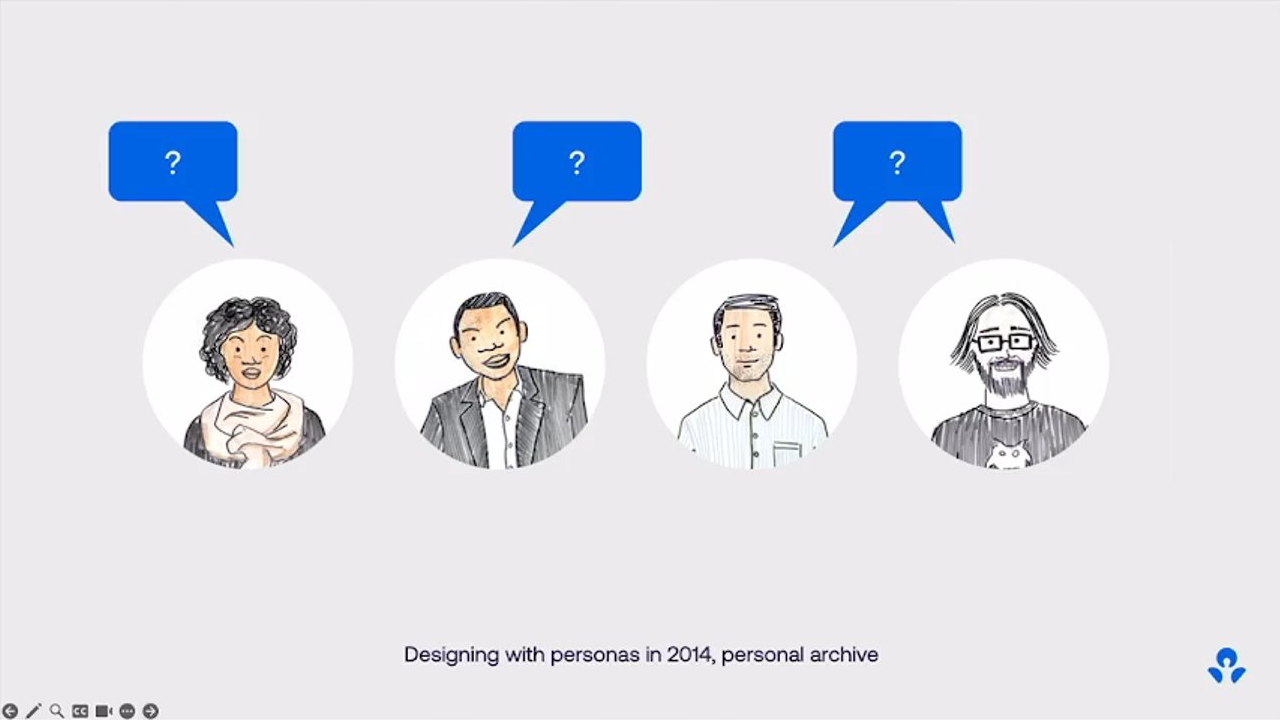
Because increasingly before I go on, shout out to Amanda who called out corporate Memphis this morning. I'm just gonna I'm I'm using this ironically. Right? It's just it's just ironic. So increasingly, we know that, basically, what is happening is that AI tools are mediating your relationship with your customers. Right? So AI overviews appear on over 60% of informational searches.
So that's the questions that your customers are asking before they're before they're heading to you. ChatGPT, Perplexity, and Claude are currently sort of taken over 12% to 18% of questions that used to go to Google. And that is actually doubling every year. And AI scraping traffic last year was up 597%, and only 0.2 of that was, like, referral traffic.
So, information is surfaced to users on an AI tool, and only 0.2% of the traffic is actually going to that source material. So increasingly, web traffic is absolutely mediated through AI tooling. So in 02/2026, we need to be designing our products for AI infrastructure. And if you're not, you're not only design not designing for machine readability. Turns out you're also not designing for human readability.
Right? Like, we know that this is how people are getting information. But the good news is, in all of this, that you can kill two birds with one stone. The same design principles that make your, put excuse me, products work for screen reader users, for example, the same moves that make it work for AI. So here's the big opportunity.
Treating content not like marketing copy, but essentially like the infrastructure layer of the web, which is closer to how users experience it. People aren't reading your carefully chosen words anymore. I have a content background, so I feel that pain as much as anyone. They're seeing AI summaries.
ChatGippity is mediating all that content and packaging it back up for them in a in a custom answer. And so your content really is the substructure of the web experience. It is no longer the facade. So how do we actually do this? How do we design content that performs well in this new machine mediated web? Obviously, through acute acronym, DAA, a lot of this stuff is really interesting, right, because we've known about it from, you know, designing users and human centered design and designing for accessibility perspective for a long time. But there's a really interesting new lens on it as we as we come to sort of AI readable content.
So clarity, no surprises here. We've known for a long time that clear and authoritative language works for people. What's very interesting is that there is a significant visibility boost when you write your content in this way for AI. So I think it's very tempting. And all the organizations that we work with are very complicated, organizations. We do a lot of work with regulators, peak bodies.
There's a temptation to think, actually, this doesn't matter anymore because AI is so good at understanding meaning and kind of packaging it up. But actually, turns out the machines prefer plain language as well. Real answers sorry, real headings is is one that's been encoded in accessibility standards for a very long time. This is talking about real content, so, like, the the meaningful information in your headings, but also semantic HTML.
And this is this is one that's easy, I think, probably for people in this room to think, yep, but yet, we've we've known about this for a while. But if you work in organizations where, design and product maturity is low or, crucially, you work in organizations where subject matter experts are still delivering information directly to, customer facing channels, which is still many, many organizations. So that that isn't mediated by, like, a product or content expert in the middle.
This is actually a really significant challenge because it's sort of more technical, I think, than we give it credit for. We sort of think this is fairly baked in and has been to our jobs for a while, but it requires both content and product expertise. And this is more not less crucial when we're thinking about AI, readable products.
Give direct answers. Again, this is harder than it sounds. This means, building your product around questions that your customers actually have and then actually answering those questions. There's very little evidence that this needs to be frequently asked questions format. I know that was a big thing for a little while that we were like, hey.
FAQs are back. No. The AI does not need you to spoon feed the exact question, the exact answer. That's not what it's doing. But it does prefer you to actually directly answer some questions that your users actually have. Again, we know that this is harder than it first appears. It requires you actually knowing what questions your customers have.
Semantic completeness is one of the best things you can do for generative engine optimization and AI readability. So the key thing here is when you answer your customer's question, have you provided all of the information they need in that one section? For our clients, the challenge here is not to do the, like, for more detail or if, you are in this very specific edge case, please see section f, appendix y.
And, of course, labels are as crucial for AI readability as they as they have been for accessibility for a long time. So this is the backbone of the semantic web, and you do need to get it right, not just for your users with access needs now, but actually for everyone. So yay. There we go. We've got accessible and machine readable content.
We've solved it. AI summaries, here we come. We're all our content's gonna be all over Gemini and ChatGPT and Claude. Nailed it. But if you're anything like some of our clients, you might feel a little bit like, this is actually a really significant problem in and of itself.
Right? Because your content is about to be exposed by AI tooling. Even the content that you, like, hid in some weird navigation tree because it was out of date but you were told you weren't allowed to archive it, yeah, it's now quite exposed. And so our clients are coming to us, like, a little bit concerned, honestly, because they can get a lot of this accessibility stuff right. But in actual fact, if, like our clients, you're operating products with thousands and thousands and thousands of pages, you know, tens of thousands of PDFs, it's this can be a big challenge.
And the the scary thing about it is, right, is that it's a huge amount of work to fix that problem. For many of our clients, they can't even they don't have the time or the budget to even do a proper content audit of the the size of some of their content real estate. If you work in financial services, any regulated industry, government, state, or federal, you'll be very familiar with this problem.
So having this conversation with some of our clients, we started to wonder, actually, can we use AI to solve this problem that AI has created for us? And so I wanna share a, case study of an experiment we are currently running, with a couple of clients and some of the early, some of the early findings.
And so we're we're essentially running an experiment to see whether we can use a well designed AI assisted engine, to do the kind of content project at scale that they otherwise absolutely would not have time or or money to do. So it's still in progress. I'll share some early findings, but, I I was excited to share it just as maybe a prompt for for some some of the things that you can be doing in in your organizations, particularly if you have some of these really significant content problems.
So what we're doing is basically essentially building a a content production engine is what we're calling it. And our test really is, can we use AI to decrease the cost of content projects? The size of some of these content real estates, a big content project is just not feasible. Can we increase the speed of output? Can we produce content at scale?
So not single content entries or components or pages or even segments, but really significantly larger scale pieces of content, so hundreds and hundreds of policy documents and and web pages. And can we do this in a way that supports what are very skilled content teams that work with these organizations to do their job? Because a lot of these teams are so some of our clients have, you know, ten, twelve, 15 dedicated content designers who are very busy. And the the thought of taking all a number of those people offline and doing a big content project is not feasible.
So how can we support them to to design this engine in a way that frees them up to do some of their BAU work while knowing that the content project isn't completely shelved for a decade, which is what usually happens. So here's quick a quick rundown of how it works. So our first step is we work with the content and UX teams to essentially encode content standards.
And I will talk a little bit more about that because that is a whole thing. We then enter what we call the refinement loop, which is is is essentially kind of like a circular iterative process, where we actually just pretty much use the engine straight away to produce a piece of content. And we call that the source content.
It's basically like the first test bit of bit of output that the engine produces. We then review that content. So what we're looking at is both the content team and the subject matter expert looking at that content that the that the engine has output, and and essentially going, like, where has it hit the mark? Where has it not hit the mark?
We're then refining the engine. So what that kicks off is a process where we look then again at the content standards. We look at the, in, you know, in one case, we're using Copilot. Rip us. And so what we're looking at is kinda like the prompt structure and the knowledge files that are attached with that. If you're using Claude, which is another example we're running, it's it's kinda looking at the skills.
And so we're using that review of the content to then refine the engine. And then we're running through that same source content again. So we're saying with the same inputs, more or less, and that refined inputs, then what what's sort of changing in that in that output. And we're able to do that kind of, like, essentially an AB test of, like, the first time we did this with this piece of content, here's what we got.
We've kind of fixed that up a bit. Here's what we get the second time. And then we sort of do that a few times until we get to the point where we confidently can run that engine at scale and produce a a larger amount of content. I think the interesting thing about this process, though, is that this is not nor has it ever intended to be a large scale, let's pump out a whole bunch of content and then publish it.
Because our goal is actually, how do we do this a little bit faster than from scratch? We call this, like, from scratch content, like, idea that you're producing content kind of word for word from 0% to a 100%. One of my team calls it, like, handmade or, like, slow content as opposed to AI assisted content. So our goal really is we wanna be able to do this a little bit faster than we would otherwise because from scratch, content projects are just not feasible.
They're so expensive for the kind of the size of the real estate that we're that we're talking about. So our expectation is never that we're producing content to a 100% quality with this engine. We're expecting to get it to maybe 60 or 70% quality. And then then a content design team then takes that from that 70% through to a 100%, shares it with, like, policy teams or subject matter experts and reviews from there.
So from scratch, slow content for many of our clients is not a reality, particularly for their whole content real estate. But but actually, to look at delivering human and machine readable products, we absolutely need to solve our content. This is an example from a from the sort of Claude version. So it's more about kind of like skills markdown files.
So this is an experiment. As I mentioned, experiments must be measured. So in this case, what we're measuring is we wanna met we wanna assess time to done. So if a piece of content we're we're we're sort of testing this on some of our clients' sort of most complicated, most political, most policy risk risky content. So if a piece of content takes, you know, x number of time x amount of time to do this to to develop typically, then what are we looking at with this engine as an assist?
So we're measuring time to done. We are measuring cost because one of the big drivers for looking at this efficiency is we we cannot afford to do this content project entirely manually. But what does it cost to invest in an engine like this? Get it to a point where it's delivering that 60% content quality, and what's the cost delta between those two initiatives.
We are looking at quality, which I'll talk about in a sec. And then we're also talking as subject matter experts and and policy stakeholders about their so so they usually see and approve and review content that comes out of the design team. And so now they're sort of seeing this AI assisted version. What's the kind of, qualitative experiential difference in what they're seeing?
So how have we done? This has been very interesting. So for some of our clients' most complex content, what was taking sort of between six to eight hours is now taking about thirty minutes, which is a huge efficiency increase. However, we are not tackling what happens once it leaves the content design team and moves to subject expert and policy review because that is a crucial step.
So that is purely just content production time. The other big, measure that we've we've started to see some data on is quality. And the big finding there is that this is much harder than it sounded. So what we're finding so far, is that the input time required in that very first step so remember that kind of workflow with the refinement loop, that very first step where we're encoding content standards.
That process, we knew that would be hard. That process had been much harder than we anticipated. So the the the, alignment that that it takes to get a team from, we've got a bunch of style guides, and we've got a brand guideline, and we kind of know what our reading grade levels should be, and we kind of know how we want to talk about this particular policy outcome.
To get from that, the the team kind of thinks they understand, but actually, they all kind of do their work directly with their stakeholders in a completely different way through to, like, here's our kind of formal guardrails and guidelines and the rules that we need to give the engine through that process and then to, here's the output that the engine has created and what exactly is wrong with that output that we need it to fix for the next time.
And getting the team to agree on that process has been a has been a really long journey, a very fruitful one. So the team without fail will say that they have a much better understanding of what good quality content looks like for the organization now than they did before. But it has been it has been a real journey.
Interestingly, what happens when the engine outputs some content and a content designer reviews it, even if they score it as meeting all the rules and the guidelines, the edits that they are making to then take it to the subject matter expert are often taking it away from those, like, best practice school rules and guidelines.
So they're actually breaking some of the rules that they've set for the age for the AI production engine in that process of getting it, like, to a point where we're happy for someone to review it, which I think is just a beautiful example of, like, some of the things we've been thinking about today around, like, the creativity that humans bring and that, know, that friction that sometimes humans know when to break the rules.
Like, when is this an appropriate time to say, yes, this is this is great quality content. However, in this case, we need to break we need to kind of, like, not meet some of those standards in order for this to make sense in this particular, instance. So it's been a great it's been a great learning. We're still in the midst of it, so come and chat to me if you wanna hear more.
So then things to try. So we've been we've been given this great gift of having some clients who are willing to be on this kind of experimental proof of concept journey with us. But I think there's a lot more opportunity and a lot more in organizations to do this than than many design people realize. And so I wanna leave you with a couple of part parting thoughts around around some things that you can do in various organizations that you work for this week or next week.
First of all, let's find the conversation. So there are absolutely experiments and proof of concepts happening in organizations that you work for. Many of the people on this stage are driving those experiments. But I'm sure many of you would love to be part of of some of those in the organizations you work for and and and maybe currently aren't, or you
have some
ideas. I think the the interesting thing I'm seeing is that most of those conversations don't actually have design or content, if that's your bent, at the table, and they absolutely should. So, I'd love I'd love people to sort of, you know, pull a chair up and sit down and start talking about h semantic HTML and see what happens.
And then reframe that conversation. So if you can get some of your accessibility or, you know, product, human centered design, like product outcomes, like masquerading as AI readiness, I think there's huge gains to be had there. And thirdly, something that's been very clear for us, in these experiments that we've been running, is that the investment that we're making for these organizations is not actually, in the product or the the output from these, these engines that we're working on.
It's actually in the human alignment that it's creating along the way. A single designer tag teaming with Claude does not does not make a great product. I think we've heard a bit of that today as well. And actually, like, the, you know, the big bugbear with consumer AI products is they're really designed for that. They're designed to be this kind of like one on one experience.
They just absolutely crater any potential for collaboration. So as much as possible, if we can be designing our AI products and tooling to be team activities by nature, that's gonna absolutely reap dividends in terms of the the quality of the product output. And then lastly, I just wanna say, like, demand for the demand for human centered design, accessibility, product quality, skills is absolutely about to go through the roof.
And I think we're starting to see that with some of that drive for how do we figure out how to build AI ready products. And and the people in this room are absolutely primed to to benefit from that. So I wish you well. And thank you. Thanks, Thanks, Tory. Questions? No.
Questions and time? No?
We do have time for questions. Okay. Yes. Questions for Tory. Lily.
Hi, Tori. Thanks for your talk. That was great. We noticed something interesting happening at Atlassian where some of the principles of good content design for humans is starting to be walked back when there are fewer human readers and more agent readers. An example of this was, I think there was a principle that we had in our support docs around, you know, headings shouldn't be questions. But actually when agents are reading documentation, they really like it when headings are questions.
And I'm curious if you have any thoughts about that drift about at the moment, there's this really high overlap of human readability and agentic readability. But we don't really know how far that's gonna drift. And I don't know if your team has thought about that drift or if you're preparing for that.
Yeah. It's such a it's such an interesting space. I mean, I think two thoughts. Firstly, like, knowing who your audience is is, you know, like, fairly obvious. But in that case, if if you're designing like, in our world, we're designing for humans with kind of like a sidebar of machines. And we're doing a lot of work with our clients to sort of help them become aware of how much machine mediation is happening, because that's that's often a gap, just in knowledge.
And we do a lot of work with government. And so government is a little bit different in that, I think right now, there's a perception that government will always sort of need to have this kind of, like, authoritative channel. But it but it does need to be human and machine readability. So we're not we're not facing the, like, this content is just for machines yet. It'll be interesting to see whether it comes.
I didn't really answer your question. I like it, though.
People
- Jacob S. Wood
Technologies & Tools
- AI Overviews
- Claude
- Copilot
- Next.js
- Stagehand
- WebFetch
Standards & Specs
- Accessibility Tree
- Document Object Model
- Semantic HTML
Concepts & Methods
- Corporate Memphis
- Generative Engine Optimization
- Human-Centered Design
Organisations & Products
- Atlassian
- Avian
- ChatGPT
- Gemini
- Microsoft
- Perplexity
- Vercel