Tell AI to build a ‘Faster Horse’: Why reframing is the last human advantage
The Faster Horse: An Opening Question
The speaker opens by asking the audience when they last said no at work because something was wrong, not difficult. Using the metaphor of asking AI to build a 'faster horse,' they illustrate how AI excels at optimizing existing paradigms but cannot recognize when the entire premise is flawed, setting up the talk's central tension between optimization and questioning.
Inherited Constraints and the AI Coin
The speaker explores how every generation inherits invisible constraints—'horses'—so embedded they become mistaken for reality itself. They introduce the metaphor of AI as a coin with potential on one side and harm on the other, arguing that most people are trained to optimize rather than question, meaning a better answer to the wrong question still leads to the wrong future.
Susan's Story: When Optimization Becomes Invisible Harm
The speaker tells the story of Susan, a cancer patient whose insurance claim was denied in 1.2 seconds by a crude algorithm, one of 300,000 similar denials. They argue that making such systems more accurate with AI doesn't fix the underlying problem—it makes the flawed system invisible and harder to fight, illustrating how brilliant AI applied to the wrong question creates widespread, quiet harm.
Reframing in Practice: The Children's Cancer Platform
The speaker shares a personal story of leading design for a children's cancer platform, where the initial brief was simply to digitize and speed up enrollment. By bringing clinicians and scientists into the room and witnessing their emotional stakes, the team reframed the project from mere digital transformation to genuinely 'getting it right,' demonstrating how reframing begins by refusing to solve a problem only at the level it was handed.
Rebellion as the Root of Reframing
The speaker examines why people rarely challenge flawed systems even when they can see the problems, distinguishing between seeing a problem and having the courage to challenge it. They introduce 'rebellion' not as loud defiance but as quietly refusing a story too small for reality and acting on that refusal, rooted in embodied experience and frustration.
A Childhood Act of Rebellion: The Grade Book
The speaker recounts a personal story from age 14, when they secretly altered grade averages in a class grade book so families could receive needed financial support, revealing this act publicly for the first time. This anecdote illustrates how empathy and frustration with broken measurement systems can drive quiet, personal acts of moral courage.
Why AI Cannot Truly Rebel
The speaker addresses the counterargument that AI can already reframe problems, conceding it can recombine and simulate creativity but arguing it remains one step behind the 'living edge' of human experience. They explain that AI reframes only from past written knowledge and can be prompted to rebel, but true rebellion requires a body, stakes, and history that AI fundamentally lacks—describing a wound is not the same as having one.
Will, Embodiment, and the Cost of Conviction
The speaker introduces 'will' as distinct from motivation—a persistent commitment to a self one refuses to betray despite pressure or cost. They argue humans can hold ideas for decades despite ridicule and failure because they have a body, relationships, and finite mornings, while AI has no stake in its past statements and thus can be corrected but never humbled.
Design as the Arrangement of Power
The speaker reframes design as fundamentally about governance and power, arguing that every system embeds decisions about who gets access, clarity, or bears costs—whether designers are present or not. As AI shifts from tool to autonomous actor pursuing given goals, the speaker warns that flawed assumptions handed to AI mean humans are no longer automating workflows but automating worldviews.
The Rising Value of Beautiful, Rebellious Questions
The speaker argues that in an age of infinite AI-generated answers, the value of asking the right questions is rising even as childhood curiosity is trained out of people by age eleven. They introduce the concept of 'beautiful questions'—those that probe deeper consequences rather than surface optimization, such as questioning what happens to someone who cannot stop engaging with a product.
Killing the Fast Horse: A Practical Reframing Exercise
Using a hypothetical HR brief about predicting employee attrition, the speaker walks through a step-by-step method for uncovering hidden costs and buried assumptions by removing optimization from the table. They demonstrate how asking who becomes 'faster' or 'predictable' and what future is being reinforced can transform a surveillance-like tool into a genuine inquiry into employee wellbeing.
Closing: Protecting the Right Question
The speaker delivers a closing call to action, insisting that the most powerful thing a designer can do is ask 'should this exist at all?' and protect the right question rather than fear AI's growing capabilities. They return to the opening question about courage versus jobs, urging listeners to trust the feeling that something is wrong and act on it, concluding that humans—not AI—are responsible for deciding what future deserves to exist.
Yep. You're you're online. Hello, everyone. I want to start with a question. When was the last time you said no at work? Not because the task was difficult, because it was wrong.
Right now, we have one of the most powerful technologies humanity has ever created, and we are using it to optimize the past. We keep asking AI to build us faster horses. So I asked it too, how do I build a faster horse?
And it delivered, genuinely told me, this is the terrains, this is the genetic optimization you can do, this is the nutrition you can provide to your horse to get faster. And I kind of half expected it to deliver the horse to me.
And, genuinely, it was impressive, all done before my coffee cools down. But it was still trapped inside the horse. It could make the horse faster. It could not tell me the horse is the wrong thing for me to use.
So I'd like you to hold onto one question for me for the next twenty minutes. What if the greatest thing AI takes from us is not our jobs but our courage to question? Because every generation inherits a horse, constrained so deeply embedded into our society, into our daily life, that it stops looking like a constraint, and it starts looking like reality?
I think it goes to sleep. And you don't question the horse. You ask how to make it faster. AI is like a coin.
One side is full of potential, the other side harm. And which side we get, it depends entirely on the hand that it holds it. And the person holding it, whether they will be willing to ask the question, why? Yet, most of us get trained for the wrong side of that coin. We get trained to make the horse comfortable, faster.
And that's the line I want to draw today. AI can optimize anything you give it, even when what you hand it is wrong. It cannot tell you, though, what the wrong thing is, what you shouldn't be doing.
And a better answer to the wrong question is still the wrong future. I want to tell you about Susan. In 2022 in California, Susan walked in for a scan.
They were suspecting ovarian cancer. And some of you here would have taken that walk too. You would have went into rooms where you didn't know what to expect, where you waited for results that could change everything. And you know that feeling when something is holding on to your throat and you cannot breathe out of the tension.
So imagine Susan. She's waited. She's sat with the fear. And then a letter arrives. Your insurance claim has been denied. Not by a doctor, by a system that took one point two seconds to decide Susan's care was not necessary.
One point two seconds. And Susan was one of 300,000 people whose claims were denied. One director signed off 60,000 claims without even opening a single file in a month.
And the system was not even some intelligent AI system, it was a crude, simple algorithm. Now, you're thinking AI is going to fix this. It will read the files, be more careful, and you're right. And that's the trap.
Because a more accurate version of the wrong question is still the wrong question if our goal is to minimize the amount of claims. When the system becomes extremely good, it becomes invisible, and you cannot fight what you cannot see.
The danger isn't evil AI. It's a brilliant one applied to the wrong question. And this is the shape of the future if we are not paying attention, if we are not mindful. Not one cinematic disaster, but millions of small ones, each a confident answer to the wrong question no one had the courage to challenge.
A world so optimized, we forget to think differently. But I stood in a room where it went the other way. I was leading the design of a platform for children with cancer.
And the obvious horse was optimize the process, digitize the process so we can onboard more kids. And that mattered. So I brought everyone into the room, clinicians, curation scientists, everyone who will have to live with the consequences of what we built. And I watched scientists light up when they confirmed a mutation in child samples.
For me, it felt heavy. For them, it meant that child had a chance. Same room, same data, completely different worlds. And the longer we sat together, the more digital transformation started looking way too small. Because this was never about just enrollments and onboarding of all the kids.
It was about getting it right. So we asked a different question, the one the brief never asked. That's where reframing begins.
In the moment, you refuse to solve the problem at the level that it was handed to you. And you don't need life and death on the table to do that. You need one ordinary brief and the nerve to ask, what's this really for?
So why don't we ask more questions like this? Why do we stay silent? Because seeing a problem and challenging it are two completely different things. You be the smartest person in the room.
You can see what's broken and still comply. Most of us have. These questions are born in the spaces between curiosity and refusal. What lets you refuse, though, is the one thing that gets rarer as intelligence becomes cheap.
It's the one thing almost no room supports or encourages. Rebellion. Not the loud kind, not the one where you go and rebel on LinkedIn or socials, not being difficult in a meeting.
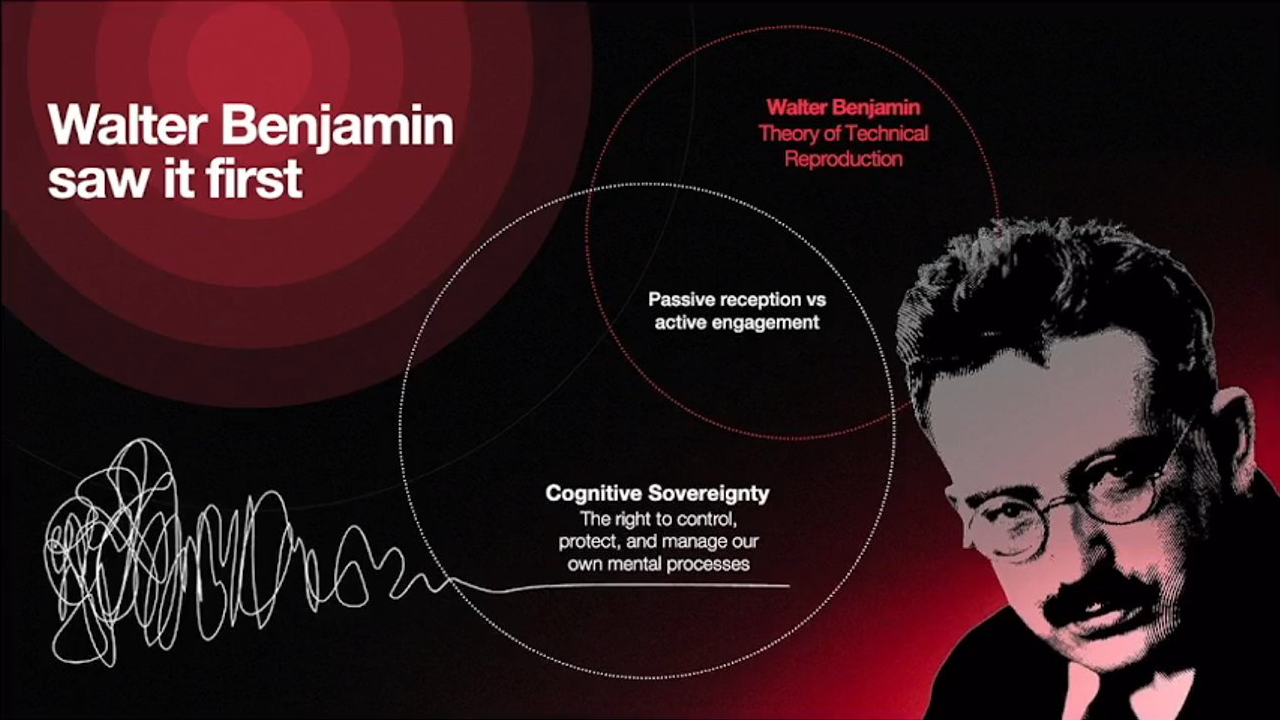
The other kind, rebellion as refusing a story that's too small for the reality it's supposed to describe, and holding that refusal long enough to act on it. It comes from embodied experience, from embodied friction, frustration, love, contradiction.
When I was 14, I kept the class grade book, and the grades inside determined whether some kids' families are going to get the needed support they they had. Kids I knew defined by a number that was supposed to describe their smartness, their worth.
So I fixed it. I changed the averages so the families can get the money. And no one knew until now. Because the way we measure success has been broken.
I was driven by frustration, by empathy and the nerve to act. And you felt it too, maybe not a great book, but a moment where everything in you said, this isn't right. Think of what it costs to speak up or what it costs to stay silent.
Now, someone here is already thinking AI reframes. I've seen it. And you are right, it does. AI can do a lot of things, recombine brilliantly, simulate taste, find patterns we've never seen, even potentially find breakthroughs.
But in a way also can reframe when prompted to. I'm not going to tell you AI cannot do something just so it does it three years down the line. So let's assume it's already out reframing everyone here in this room.
Let's assume it's asking the sharpest questions we have ever asked. It's still one step behind the living edge. Here is the thing.
AI reframes from the past, from everything we've already written down. It inherits the assumptions and the frictions we have already named. But the reframe that changes reality was never written down.
It comes from a person, someone who feels something is wrong before anyone can explain why. AI can reframe within the territory it can perceive. Humans can change the territory itself.
You can program AI to rebel on command, but rebellion on command is just another form of obedience. And there is the part it cannot do and cannot cross. It cannot feel the question is wrong and deny doing it.
It cannot refuse to build what you ask it just because it feels it's wrong. Because that takes a body, it takes stake, it takes history. AI has nothing to lose. It can write the words of rebellion and still pay absolutely nothing for any of them.
Describing a wound is not like having one. Rebellion is a thing you do with a life that has ends this end despite the cost. So we are not ahead because we are cleverer.
We kind of lost that definition a long time ago. We are ahead because our reframes are born from wounds the machine doesn't have and are held by a self a machine can never be. The embodiment is the thing that makes it cost.
AI cannot live in the world it helps us build. It doesn't sit with the person who is going to live with the consequences. But we do. Yet, a feeling isn't enough. You can feel it and still do nothing about it.
Refusal needs a ground to stand on, something that doesn't move when the pressure comes, and the pressure always comes. That something is older than AI, older than any framework or methodology we have ever built.
It's will. Will is not motivation. Motivation falls and rises. There's probably enough for it. Will is a commitment to a self you refuse to betray, even under pressure, no matter the cost.
It's what gives you the power to act. It sounds like whatever happens, I will not turn away from what still can be good. A human being can hold an idea for decades despite of it being ridiculed, despite of failure, despite of everyone telling them to stop.
AI can't. It carries no stake in what it said yesterday. Will needs a self that persists, something to betray, something to honor. Will needs a yesterday.
AI can be corrected. It cannot be humbled. But you can. You have a body that ages, relationships that end, finite number of mornings.
Your decisions are mostly irreversible. You have to live inside what you build. AI has no finish line, so it has no reason to run. You do.
This is where design becomes far bigger than what they taught us to think. What if the thing everyone assumes is reality is actually just a very old design decision?
Save the screen. Every system decides who gets access, who gets clarity, who is excluded, who absorbs the cost of someone else's convenience.
Those are design decisions, whether designers are in the room or not. The question is always about governance. Who holds the reins? The true medium of design is the arrangement of power.
Design is the act of asking, what if reality could be organized differently? We were always redesigning reality. We just were inside the staple for so long, we forgot to acknowledge our power. And now, the stakes have changed.
AI has crossed from a tool to an actor, where agents pursue and fulfill goals and assumptions you hand them. Whatever assumptions we hand them, no matter what it is, and if the original assumption is extractive, shallow, or wrong, We are no longer automating a workflow. We are automating a worldview.
In the age of AI, we are the stewards of perspective. Design shapes what power becomes, and AI has given power a completely different engine. The future of design is to stop the wrong thing from being built beautifully.
We are entering an age of infinite answers, but infinite answers are useless if nobody is asking rebellious questions. A four year old asks a question every two minutes. By age 11, most stop. Somewhere between curiosity and competence, questioning gets trained out of us.
As the world becomes more complex, dynamic, and agentic, the value of answers goes down, and the value of questions goes up. The type of questions that ask not how to increase engagement, but what happens to the person who cannot stop engaging. Warren Burger called them beautiful questions.
So how do you catch the wrong question, and how do you dig the beautiful one back up? You kill the fast horse. Let's take a brief. No horses were harmed during the making of this presentation. But the brief is build an AI enabled tool that predicts which employees will leave so HR intervened early.
Now don't ask how to build it better. Ask who is being made faster and what are we treating as inevitable. Optimization always has hidden costs. In this case, the employees ask to become predictable to a system that can know them better than they know themselves, even before they have even made the decision to leave.
Now, take optimization off the table. If you could not make the horse faster, what would you question instead? What are people afraid to say if they know they are being measured? When optimization is forbidden, imagination wakes up.
Then ask, what future does this make easier? If this succeeds perfectly, what staple have we reinforced? A workplace where care starts to look a lot like surveillance? And do you really want to be part of that future and that reality?
And underneath it all, the buried question emerges on its own. What would we change about the workplace if we listen to why people live instead of predicting when they will? Same brief, completely different futures. And there is the one final question, the one that matters most.
Should this exist at all? In an age of infinite answers, the most powerful thing designer can do is protect the right question. I'm not romantic about this. AI will keep getting better, and we should use it. We should use it with courage.
We should use it to make possible what what we thought is absolutely impossible for us. Use it to unlock your potential. The staple is where imagination goes to behave.
The horse didn't die when they invented the car. It became a leisure object, something we use on the weekends for the fun of it. Is that what's going to happen to human ability to question? Something we do on the weekends as well, if AI takes our jobs, we will find a new one.
That is what humans always do. But what future will we live in if we stop asking the questions only we can ask? Remember the question that I asked you to hold on to? What if the worst thing AI takes from us is not our jobs, but our courage to question?
Don't let it. Because intelligence is becoming abundant, wisdom is not. And there will be a moment for every person in this room, a feature that shouldn't exist, a meeting where everyone agrees way too quickly on something, and something in your body will say, this is wrong. That feeling is yours.
It is the reason you're still in this work. Do not waste it. Because one moment of refusal in one ordinary meeting is how futures actually change. Not by AI, by you.
AI will build whatever world we describe to it. Our job is to ask whether that world deserves to exist. Beautiful, rebellious questions are the one currency AI cannot print. Most systems around us were designed by people no smarter than you, which means they can be redesigned by someone like you.
You are not here to make the horse more comfortable. You are here to ask, why are we still talking about horses? Thank you.
People
- Warren Burger
Technologies & Tools
- Artificial Intelligence
Concepts & Methods
- Agentic AI
- Algorithmic Claim Denial
- Beautiful Questions
- Design as Governance
- Digital Transformation
- Embodiment
- Faster Horse
- Predictive Analytics
- Rebellion
- Reframing
- Will