Beyond Algorithms: Trust and Culture in the Age of AI
Introducing Hillary and Her Sociotechnical Journey
Hillary introduces herself as a career designer with experience across media, enterprise, startups, CSIRO, and now Salesforce as a business transformation director. She explains she will focus on organizational culture rather than Salesforce products, noting she leaned heavily on AI tools to prepare her talk amid nervousness shared by fellow presenters.
Framing the Day's Themes: Nontechnical Factors in AI Success
Hillary reflects on common threads from earlier talks—humanizing tech, context, curation, governance, and risk mitigation—and expresses hope the conference content reaches nondesign audiences. She sets up the core theme that credibility, not just compute, is now the bottleneck to AI success.
Culture, Ethics, and Governance as Interlocking Systems
Hillary explains the relationship between ethics (values), responsible AI (practical application), and governance (rules), drawing on her decade-long ethics journey since Data61. She argues AI enters organizations not as a neutral technology but into an existing cultural ecosystem that acts like a nervous system, and describes the polarized utopian/dystopian narratives surrounding AI adoption.
Adoption Risks: Walkaways and Shadow AI
Hillary discusses how the cultural flux around AI creates uncertainty, leading users to quietly abandon tools, stop paying for licenses, or resort to 'Shadow AI'—using ungoverned tools that threaten enterprise data privacy. She frames governance as the mechanism to counter these behavioral and cultural risks through standards, policies, and shared responsibility beyond just legal teams.
Trustworthiness, Social License, and a Telco Case Study
Hillary connects trustworthiness (reliability, safety, monitoring) to earning user trust and social license to operate. She shares a case study of a telecommunications company's AI rollout that was technically successful but internally rejected by the marketing team, who were never consulted, illustrating the danger of excluding operational users from AI implementation.
Introducing the Conversation Framework: Business, People, and Technology Pathways
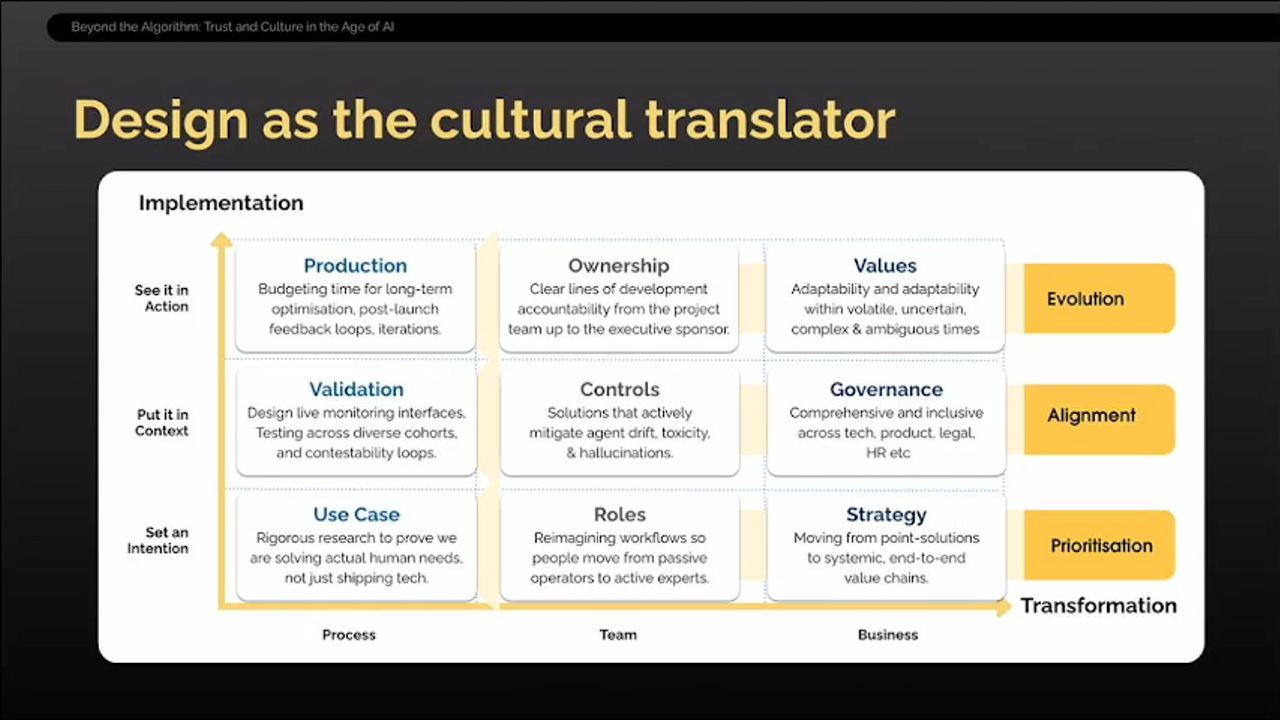
Hillary presents a framework developed 18 months ago mapping typical digital transformation conversations across transformation and implementation pathways, covering use cases, team roles, and business strategy/governance/values. She highlights that the 'people pathway' has become the critical connective tissue between business outcomes and technology, especially as new agentic roles (like agent owners) emerge.
Connecting Silos: Strategy, Governance, and Validation
Hillary describes how transformation pathways typically operate in silos, causing scaling efforts to stall due to lagging governance, unclear data controls, and undefined ownership of AI agents. She emphasizes the need for connected approaches linking strategy to use cases, governance alignment, and validation, and previews a detailed map of where design can intervene in each area.
Audience Discussion: Strategy and Point Solutions
Hillary opens the floor for audience input on moving from isolated point solutions (like an email summary agent) to systemic, end-to-end value chains such as a full AI-supported sales journey. She invites attendees to share experiences with point solution risks and multi-agent decision-making challenges, prompting audience responses.
Audience Discussion: Reimagining Roles and Automation Bias
Hillary discusses the risk of automation bias, describing how shifting workload downstream (e.g., a person forced to review hundreds of documents at once) turns people into passive 'rubber stamps' rather than active experts. She invites audience comments on workforce reimagining and how use cases are validated against real human needs before implementation.
Audience Discussion: Alignment, Governance Controls, and Contestability
Hillary explores inclusive governance spanning tech, legal, product, and HR, and the designer's role in explaining policy and building controls against drift, toxicity, and hallucinations. She emphasizes designing contestability loops so users challenge AI outputs rather than blindly trust them, and invites audience examples, including a contribution from Stephanie about collaborative problem-solving.
Values, Adaptive Ethics, and Organizational Ownership
Hillary discusses the need for adaptive organizational values in VUCA conditions, recommending the book on adaptive ethics referencing Frankenstein and the Gingerbread Man. She highlights a mismatch between board-level AI mandates and actual board risk appetite, stressing the importance of shared accountability and sustained investment in production and iteration, with further audience discussion on ownership.
Design's Role as Sociotechnical Leadership and Closing Questions
Hillary wraps up by mapping where design can show up across strategy, governance, and ownership as sociotechnical leadership in AI, framing designers' adaptability as a key superpower. She leaves the audience with three reflective questions about investing in resilient AI futures, designing systems to fail safely and loudly, and supporting human expertise without cognitive erosion.
Q&A: Designers' Evolving Influence in an Agentic World
During Q&A, an audience member questions whether Hillary's complex framework risks designers merely 'clinging to the table' rather than gaining real influence in agentic AI systems. Hillary responds by describing her strategy of framing human-centered design in terms of business risk and impact metrics to maintain influence, while admitting fatigue and renewed motivation in continually advocating for human centricity against organizations seeking shortcuts.
Got my clicker. Got my mic. You can all hear me. Hi, everybody. I'm Hillary. Yes. I am a sociotechnical something or other. So I have been a career designer my whole life. I built my first website in 1994 with my son on my lap. Yeah. You can do the math on all that. And I've worked in a whole range of organizations.
So I was freelance. I've worked in media companies. I worked at Yahoo. I worked at the ABC. I've worked at in enterprise and in startups as well. I worked at CSIRO for Spell, well, Data sixty one, which was Nikta absorbed into CSIRO. So a whole lot of deep tech incubation going on there. At the moment, I am at Salesforce, as a business transformation director, so please don't hold that against me.
But I'm subverting from within. So we still bring our human centered design practices to all of our customer engagements through that work. And yet, we're trying to keep the engineers and the salespeople honest at Salesforce. So I will not be talking about any Salesforce stuff today. I'm here to talk about culture. Just gonna check my notes.
Culture is this huge topic. There's society. There's kind of tribes. There's family culture, all different kinds. I'm just gonna talk about organizational culture just to make that simple for everybody. And even that is massive. Probably like everyone who's presented today, I lent heavily on the tools, the AI tools to help collect my notes and do my own research, felt overwhelmed, write something, threw it away, wake up in the middle of the night freaking out, did it again, got up at 05:30 this morning, did it again.
So we're all super nervous because we know that you are our comrades and our peers, and we're all in this together. So thank you for bearing with us all. How do I make this work? Sorry. Here we go. Been hearing have I got the wrong clicker? Is it this one? No? No. There's no clicker.
I have to stand here and use my finger. So old school. I also heard a lot of really amazing things today, actually, which was all of this nontechnical stuff, which is basically what I'm talking about. It's like the nontechnical factors of AI success. And again, know there's a of a balance between consultants and product designers as well, so I'm trying to cover a lot of bases.
But we're hearing I heard a lot of really cool things today around, humanizing tech, around context, around, curation, like really uniquely human characteristics, adaptability, new paradigms that we're working within, reframing. We also saw of a examples of you probably didn't realize it, but there was top down and bottom up governance being talked about a lot as well.
I spent a lot of my time in governments in in governance as well and around risk mitigation. And so that's the kind of work that I'm doing too. So I saw we saw some really cool things being talked about today. And I really do hope that this conference gets a Redux or a replay or another version to a whole bunch of nondesign audiences because I think what what you were sharing today was really important for for a lot of nondesign designers to hear.
So the World Economic Forum had this lovely quote around the bottleneck of intelligence is no longer compute. I mean, compute's important, as we heard. It's very resource intensive, but also credibility. And we've been hearing a lot of that today as well in different versions too. And so the things inside credibility are cultural, there's care, there's trust, and there's ethics.
Now I started my ethics journey about ten years ago when I was at Data sixty one, and there's Mina at the back there who was my colleague, comrade in arms, fighting that battle too. And so it's been an interesting journey. And also, like Riley, we've had to learn on the on the job, on the tools, absorbing where we can, and ethics in itself is a massive topic.
So I'm not going to unpack too much of that today. But there's a relationship between ethics and responsible AI and governance as well. So ethics is values and principles. Responsible AI is the application of that in kind of practical terms. And then governance is a whole bunch of stuff around the rules around that. So AI is not entering into an organization in a neutral state.
It is entering an existing cultural ecosystem. And that culture acts as a nervous system that will either safely integrate it or reject it. So it's a new thing being brought into organizations, and we know already that people are having visceral responses to it. Those responses, drift between, it's gonna be amazing, and we're gonna make millions of dollars, and we'll be the first CEO of a multi agent company, and there'll be no employees, and that's all really great apparently, which just sounds horrific.
And then there's these dystopian things, what's gonna be the end of the world. I heard someone listed, a thought leader and an author was saying, of all the big existential threats to humanity, AI is, like one in 10 as opposed to an asteroid hitting the planet, is like one in a thousand or something like that. It was pretty grim, what she was saying.
So there are these extreme views that was going on, and I think these tensions are freaking everybody out, And this is embedding itself into the cultural narrative as well. This is inevitability that it's coming. You've all got to get on board with it. If you don't have a job and you don't know how to use it, you're going to be unemployed.
It's just somewhere in the middle. We're hoping it'll just kind of settle. We want it to be boring. We want it to be every day. It's just another tool to do our work. And we're in this weird state of flux at the moment, and that's kind of like really energizing in negative and positive ways the cultural narrative that's going on as well.
And I'm sure you've all got friends and family who are going, oh, are you doing something with AI? And do you bother helping them understand it? Do you double down on it and help them as well? So I think we're surrounded by a lot of questions. And as practitioners close to it, I feel we often we want to advocate for its wise use.
And so we've heard a lot today about adoptability as well or adoption. So, you know, people will walk away when they have concerns, and they'll walk away in small ways or they'll just stop using a product completely. They won't pay for things anymore, pay for licenses, or they might just try another tool. The other danger is, ShadowAI.
So, you know, if you've got, like, a governed tool set that's not working for people, they'll just quietly go off and start using, you know, other tools that may have be less secure as well. So ShadowAI is a real threat to, especially to enterprise architecture and enterprise businesses around data privacy as well. So there's a really important behavioral and cultural lens to this around having stuff in place, which is the governance. Right? So that's the mechanism.
It's all about adherence to responsible standards and ethical standards, regulatory assurance frameworks, policies, and procedures. Like, that's all very important. Everyone has a role to play in governance as well. It's not just the lawyers. I mean, all of a sudden, lawyers have got a lot to say about AI. Right? Like, it's no longer just a tech conversation.
All these law firms are kind of producing guidance around, governance as well. So it's a really interesting time of flux that we're in. Trustworthiness is the property of this. So, you know, the objective evidence about that reliability, about that safety and all that accountability, and the kind of ongoing activities around observation and monitoring and tuning for accuracy, when to retire it, when to kind of continue building.
And then the outcome is trust. Is that system trusted? And then that's the question that the users are having. Like, do can I rely on this thing to do the thing that I need it to do? And so, of course, we're relevant. We've heard many examples of this today. So AI solutions really need to earn that social license to operate.
Strategy is really validated when it hits that front end operational user line. And the the exclusion of operational users is dire. And, you know, it's it's a really important thing to get those folks, as we all know, as as experienced designers, involved. I saw a huge, I can't really talk about the, company this was, but it was one of our customers.
It was a poster child AI rollout, a 100 agents for this for this company, this telecommunications company, big success. The back of house story was it had been wholesale rejected internally. The marketing team rejected the whole thing because no one in the marketing team had been consulted. They had just this rollout placed upon them.
And so they were freaked out about it. They didn't know how to use the tools, and it was completely misaligned to what they were doing. So it was, you know, it was implemented accurately. It worked well, but it was rejected because those folks were not having the tool designed to help them do their job, which that we've heard a lot about today as well.
So these are real, and these are huge issues for businesses like mine, which is a vendor, like yourselves, when you're trying to like, in your organizations trying to implement and support and work with these tools as well. And so including these folks, including the people whose hands are on the tools to do this work into the full life cycle, it's about bridging that hazardous gap between what's expected culturally and then the lost trust.
So I feel like we have covered a lot of those two earlier concepts a lot today, but, I just thought I'd include them. As you do, you sit there tinkering with your talk as you go through the day. I wonder if it's still important. But I wanted to introduce another framework. There's been a framework. There's so many frameworks today.
This is the conversation framework that we use routinely in our work. We came up with this about eighteen months ago as part of our big pivot in the work that we're doing as business consultants. And these conversations that we are finding in organizations, they look familiar. Any digital transformation conversation will touch on these things. There's a transformation pathway.
There's an implementation pathway to that. And in here, we've got use cases and validation of those use cases moving up into production, so how to scale something. We've got some team stuff going on around roles, what kind of actions are in place, who's earning what, and then the kind of pathway of business, which is how does the strategy what's the strategy in place, What's the governance around that strategy?
And what kinds of values are guiding decisions in the organization? So these are kind of familiar. But we're noticing, as we have noticed today as well, that these conversations are slow are changing shape completely. The paradigms are different now. So we have the technology pathway. We have, like, a business pathway. But in between, and especially really, really amplified at the moment, is the people pathway, which is the glue between the business outcomes and the technology in transformation work.
So this is kind of the typical pathways. They tend to operate in silos. Some use cases get produced. They're piloted. Some kind of evaluation, yes, it's performing as as designed. Let's scale it. But it comes to a grinding halt, probably because governance hasn't kept up with with what's required with production.
What kinds of data controls are in place to make sure that the AI isn't kinda like amplifying erroneous out Who's owning the new thing? Oh, you know, you have a bunch of AI owners, agentic owners. They're gonna be part of your team now. You're gonna monitor agents as well as people. That's a whole new skill set. And we're already hearing that one agent, keeping an eye on one agentic solution, is actually a huge amount of work.
And now folks are just being piled up because it's just a bit of technology. You can kind of do that. It's like, there's a lot going on there. And they're completely new ways of working as well and new ways of thinking. So these pathways really have to have a more connected approach. So what we're seeing and how we talk about this is, is the strategy informing the use case, and are we understanding who those use cases are for?
Which is a very, very simple human centered question. Is there alignment around the governance and all of the different parts of the government the governance departments that are now influencing what the controls are in place to then understand how we're going to validate what's being built. And then are the, is there there's this evolution conversation around the values of the organization, who owns those different parts of those values, the accountability roles, and then that can help to facilitate a more successful production.
There's a lot of words on this slide. I do apologize. But what I wanted to do was map where design can play a role in each of these. And, you know, all of this is quite familiar to us. I think it's really just a way of breaking it down to sort of diagnose what may be missing in a conversation that you're having, if you're having some trouble.
As designers, we were, like, completely on influence. Right? We don't have an awful amount of authority. We need to kind of have collaborators. We need to prove that what we're doing has value. And so the ability to diagnose a conversation where it might be coming unstuck is really important to us. So let's work through this. I kind of want to make this interactive as well.
So I'm going to pause after an explanation and ask you guys if you've had any experiences with with these things. Like, what are you saying on the ground? What's a problem for you, and what's working for you? I'd love to hear some examples, especially from those who haven't had a chance to speak today. So let's have a look at strategy.
I'm living in point solution land at the moment. Probably everybody else is as well. So how do we like, what's going on here around moving from point solutions to systemic end to end value chains? So rather than just doing an email summary agent, what does a complete sales journey look like with AgenTix support?
Does anybody does anybody have any comments about that? What are you seeing in your organizations about strategy, about the focus on discrete point solutions, and are there concerns about the ability for those point solutions to endure, to be connected up to other experiences? What happens if you've got two agents making decisions instead of one?
Any thoughts on that? I can't believe nobody has anything in their head. Come on. Don't be shy. Oh, yes. Thank you. Yep. Thank you. Sorry.
I did actually didn't warn the organizers that I'd be opening this up. You're gonna have to rely on yelling. Thank you. And I know we met at lunch, I can't remember your name, so I'm Okay. So moving on to roles. So reimagining workflows. So this is really important. So how to get people away from being just passive operators to active experts? So automation bias is a real risk.
Somebody said something about someone having to validate 300 no, 300 oh my god. Can't remember what it was. Anyway, it felt like there was like a checkpoint. Workload had been shifted downstream. So some poor mug had to kind of, like, review a huge number of documents as opposed to just having them kind of drip through throughout the week or through the month.
So that turned someone into a rubber stamp. Right? I haven't got the time to do this. It looks like, hey, I'm just gonna, like, sign off. Off it goes. So that's happening too. So this notion that we can become more efficient, but really we're just potentially moving workflow and that cognitive load downstream somewhere else instead. So how can we help people?
How can we reimagine the workflows so folks have the room to use that curiosity and their curation efforts? And this is what happens when strategically you move from point solutions into connected experiences. There is an upstream and downstream effect of that. So kind of looking at that completely new way of that service or that journey is really important.
And then that that then influences use cases. So conducting that research to prove actual human needs are being met and not just shipping a tech because there was like a token target or there's an implementation target. So has anybody got any comments about this sort of prioritization pathway? What are you seeing around roles and workforce reimagining?
And how are use cases being kind of validated or stress tested before commitment? What's your role in helping with that, if you've got any opportunity to do it? Do you want to be involved? No? All right. Yes, please.
Yeah. Thanks for that, Boris. For sure. Alright. We'll keep going. Alignment. So comprehensive and inclusive governance across tech, legal, product as well, and HR. So, yes, we've we've seen quite a few examples today of bottom up governance, looking at a use case, understanding who's impacted by it, at what point does it get handed off to a human to review it. Someone talked about policy, you know, into, you know, having you know, asking for a policy through their home loan application and then kind of ingesting that themselves, trying to understand that.
So, you know, we have a role to play in that. Like, what does good policy explanation look like? How does a policy get explained to you naturally without kind of, like, putting the organization into some kind of risk as well? Which then kind of moves down into the controls around that. So solutions that actively, mitigate drift, toxicity, and hallucinations.
So how can those controls be built into place? And then what's our role as designers in helping with that? Is it just an interface prompt here and there? Is it actually putting in those deliberate friction points to make sure that stuff's being checked? And again, of course, there's gonna be those pressures around efficiency and those trade offs that we have to make with that.
And then that helps to go through to the validation process, so designing, live monitoring interfaces to make sure they know, are agents behaving as planned? But also what's being measured in that? Is it just, yes, it's performing within microseconds? Or is there still a customer satisfaction output at the other end? Is there still an acceptable level of quality being delivered at the other end? And that does require testing across diverse cohorts and introducing contestability loops. We really want to have folks who use AI challenge it when they get an answer.
Like we all talked about that before as well. We're having these little, parameters that we're putting into Gen AI around our prompts. Don't be sycophantic. I routinely ask mine to challenge what I've said. I was like, you're agreeing with everything I'm saying. Give me the opposite version now. Yeah. Remember Hitchhiker's Guide to the Galaxy?
You remember the doorways? Was it Eddie the door? He was like, oh, I love I love to be of service, and I hope you enjoy going through my doorway. It's just what that feels like right now. Genuine people personality robots. Yep. So contestability. We would love people to challenge what's in front of them, build in this, validation mindset, like constantly, know, be skeptical.
We want everyone to be skeptical of what they're looking at. Even if they haven't got the time, we want them to kind of contest it. And then some have some way of bringing feedback into that. So validation is not just usability testing. It's not just UAT, but it's kind of like live feedback loops to, to to help to train the model better.
Any comments around that alignment, around validation of what you're seeing around or controls? Yes. Thanks, Stephanie. That's great.
And you're absolutely right. It is one of our superpowers is to collaborate, stay in the problem space way longer than anyone else is comfortable and work together on resolving it. I think that's a really great example. Thank you. And then the evolution, stream. So this is about continuous evolution over time. So having values set and agreed, it can kind of sound like lightweight, but it's really about coming together at the executive level, at the business unit level, at the team level, and understanding what you will and won't tolerate.
Just the oh, adaptability and adaptability. Good on your hill. I knew there's a typo in here somewhere. So the ability also to have, adaptive values because we are living in the VUCA times, aren't we? So it's volatile. There's a lot of uncertainty. Things are really complex, and there's a lot of ambiguity. I mean, I feel like VUCA is just like an understatement at the moment of the kind of conditions that we're we're trying to work under. But a really great book recommendation is adaptive ethics.
Author, I can't remember his name, just blanked on it, so sorry. But the subtitle is The Story of Frankenstein and the Gingerbread Man. So he uses a of fairy tale references. Really interesting story around, ethics and society and how social norms can shift over time. So we are seeing that very much, I think, accelerate at the moment too.
So understanding where to be adaptable and how to kind of exist in this, and that's an evolutionary trait that we're going through organizationally. That then leads into ownership. So the clear lines of development, accountability from the project team right up to the executive sponsor. Everyone needs to be accountable. It's it's not good enough to have I'm gonna say this.
In my role, I talk to board members, I talk to executive leaders, and I talk to folks who are kind of building stuff. And this is kind of with habit or this weird pattern. The board is mandating there must be AI in everything. I'm talking to the board members, they're like, not necessarily the same ones. I'm not going back and validating them.
What I'm hearing from boards is like, we have this risk appetite. We want to be really careful where we're bringing AI in. We want to see good examples. We're feeling a little bit overwhelmed by it all. There's a huge mismatch there. And then the teams, everyone's feeling overwhelmed. Everyone's feeling freaked out. So, you know, it kind of feels like everyone's kind of pushing the accountability somewhere else.
And we're all in it together. And I think you're right, Steffy. It's about coming together, and we have this great superpower to collaborate and to coordinate and to facilitate and to listen. And so, this alignment thing is really, really important. And in my work, I do that a lot too. We get them all in a room. They believe that they're aligned.
And I'm sure that I'm not the only person who ever had this experience. But it's like, oh, we never really had the time to sit and listen to each other, and our alignment is really off. But they're so busy with what they're doing. So clear lines of development and accountability, and it's just shared accountability from the project team all the way up to the executive and what that looks like in those roles.
And then production. So, you know, making sure there's budget and air cover for long term optimization, making the hard decisions about what's not working anymore and retiring it, and then those post launch feedback loops and the ability to iterate. And so it's not a set and forget thing like software has always been. This is a whole new paradigm that we've been talking about, about things being dynamic in in itself is a dynamic system.
So any comments about values in organizations that you're seeing, how that's being played out around accountability and ownership or the opposite of that? And then the issues around production and the ability to kind of scale these pilots. Sorry. Was that a hand up? Yes. Yeah. Yeah, great. Thank you.
Did you have you said no yet? Yes. And how how did that go? Those pesky designers making us, you know, hard questions again.
Yep. So before I close-up, any other thoughts about this? Is there anything else jump out here? I know there's a lot going on. I can go back a slide to kind of make it a little less angry. But look, we can show we show up everywhere. We show up in strategy. We show up in governance. We show up in, you know, ownership.
We can there's a role for design here. And I know I don't really need to convince you of this, but I think, it's it's encouraging and and heartening to know that, you know, we can reinvent ourselves. We're really good at adapting. We design our way out of our our own problems as well as everybody else's as well.
And so it's a really great superpower that we have. Yeah. And so this was just a stab that I had at where design can show up as sociotechnical leaders in AI. And you can all look forward to seeing everyone change their title. So kind of wrapping this up, AI that earns the social license to operate really relies on cultural awareness and building trust.
So it's a mindful thing. It's, and then this is kind of like collective ownership as well. So I'm going to leave you with three questions that you can potentially take away. So where might you need to invest in a more resilient AI enabled future? So that's the point solutions to production, to end to end chains.
That's the skills investment that's required. That's the ability to fail safely. Integrity mechanisms. Have you designed your AI to fail safely and loudly, or is it engineered to fail quietly behind a confidence surface? And then the human architecture.
Where are we intentionally supporting expertise without adding to cognitive erosion? Okay. So I don't know if I'm ahead of time or on time. A bit ahead of time? Okay. I know I've kind of asked you guys to jump in, but have you got any questions?
Why don't we start by thanking Hilary? Thank you. So do we have any questions for Hilary? At the back there, Greg, Behind you, Dana.
Thanks, Hillary. I was trying to comprehend the matrix you put in front of us, and I feel like you've seen a bit of the future before we've got into it, so it's great to have it mapped out. But from a design point of view, I'm wondering, design years ago tried to be at the table, more at the table, and we're at the table.
And it's almost like that's a matrix to try and get us clinging on to the table. So I'm just trying to understand how as a designer you really promote the values that we offer in this kind of agentic world because that's many options on that on that diagram.
Yeah. Fair enough.
We'd just like to know your thoughts about, in your different roles, how designers has shifted and mutated over the years.
You I know, don't even wanna look at it anymore. It's it's quite a lot, isn't it? It's a lot. I'll answer that question around how it's shifted. There's this phrase of always moving left. So I've always been, frustrated that having to justify our existence all the time. Like and so, you know, there's small d design, there's big d design. Right?
So there's designers, and then there's the active just designing stuff, is a verb, and everyone does a version of that. Right? So and there are some really great front end devs who are really great at design. There are product people who are really great at design, and there are designers who are really bad at design. So it's not necessarily that that comes with the title.
So I've tried to move left, or your left, this way, to get up to kind of have more influence. So but that whole time, I've tried to keep the dream alive about human centricity and that people are important and the work that we're doing has to include the people who it's being designed for. And so I know I'm preaching to the choir here, but, you know, I don't always try and find a way in with that, whether it's to do it's like it's it's unethical to do it that way. Or these days in my role, it's all around business risk. So I have to try and find an angle which is like, if you don't include the operational users, your adoption won't be successful, and you're just losing money on that, or you won't reach those efficiency outcomes that you're seeking.
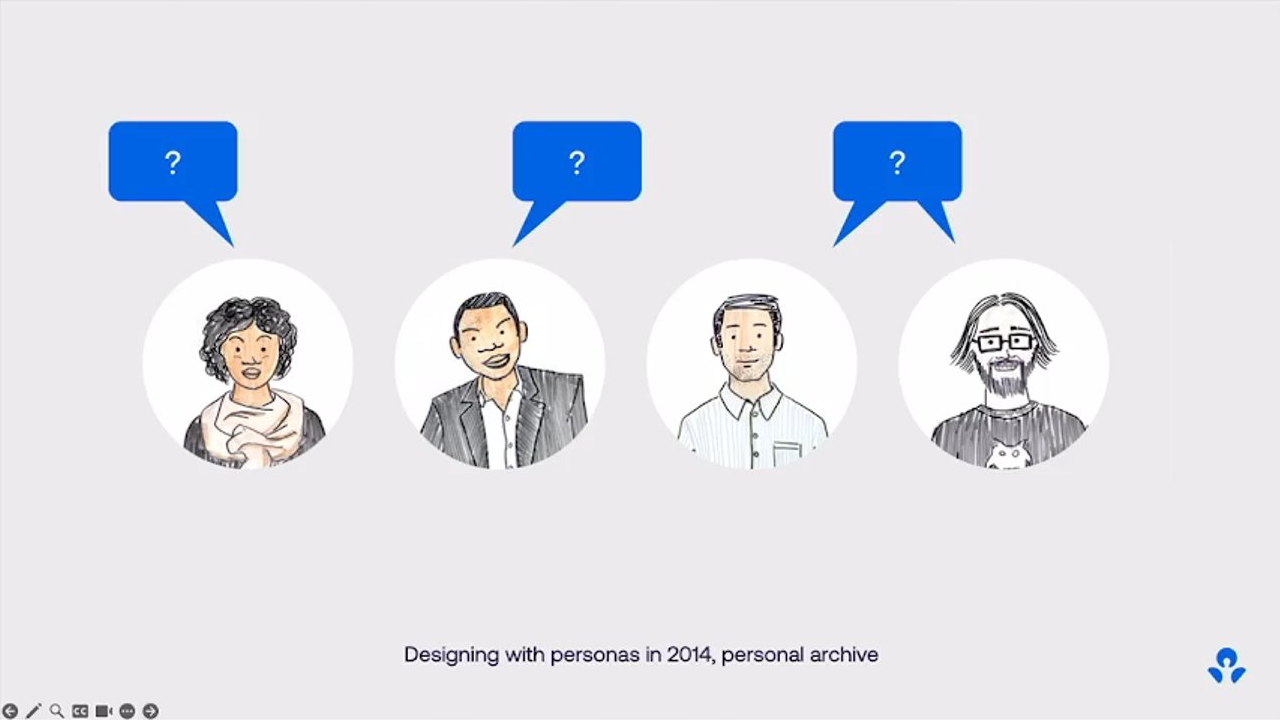
So I I tie business impact metrics very closely to the work that I'm doing as well. But we try to make sure that the right things are being measured in the change and always making the case, yeah, that human centricity is key. And yet organizations are looking for shortcuts all the time. They have prepackaged personas.
Then I go and talk to anyone. There's how I've got a persona. It's like, you know, you didn't make a persona properly. So I feel like you're conflating UI with UX all the time. So there's, you know, there's a lot of, like, just constantly thumping the drum, and there are times I get tired of doing it, and then I get invigorated again.
And so yeah. I don't know if I've answered the question, but I've just tried to hold on to human centricity in really in in the really in those really real sorry. In those very real terms. And that's usually because the people for whom these solutions are being rolled out have the least amount of power over what's going on, and the people who've got all the power are just making decisions on their behalf. And as a closet bolshie, I find that really appalling. So I just wanna try and do the right thing.
Beyond the Algorithm
Trust and Culture in the Age of AI
Hilary Cinis
Sociotechnical Strategy Director
(ai x design)
June 2026
Beyond the Algorithm
Trust and Culture in the Age of AI
Hilary Cinis
Sociotechnical Strategy Director
(ai x design)
June 2026
Beyond the Algorithm
Trust and Culture in the Age of AI
Hilary Cinis
Sociotechnical Strategy Director
(ai x design)
June 2026
Beyond the Algorithm
Trust and Culture
in the Age of AI
Hilary Cinis
Sociotechnical Strategy Director
(ai x design)
June 2026
Beyond the Algorithm
Trust and Culture in the Age of AI
Hilary Cinis
Sociotechnical Strategy Director
(ai x design)
June 2026
Beyond the Algorithm
Trust and Culture in the Age of AI
Hilary Cinis
Sociotechnical Strategy Director
(ai x design)
June 2026
Beyond the Algorithm
Trust and Culture in the Age of AI
Hilary Cinis
Sociotechnical Strategy Director
(ai x design)
June 2026
Beyond the Algorithm
Trust and Culture in the Age of AI
Hilary Cinis
Sociotechnical Strategy Director
(ai x design)
June 2026
Beyond the Algorithm
Trust and Culture
in the Age of AI
Hilary Cinis
Sociotechnical Strategy Director
(ai x design)
June 2026
A graphic depicts a modern, angular building with glowing blue wireframe lines extending from it, forming a grid, against a dark background.
Beyond the Algorithm
Trust and Culture in the Age of AI
Hilary Cinis
Sociotechnical Strategy Director
(ai x design)
June 2026
Beyond the Algorithm
Trust and Culture in the Age of AI
Hilary Cinis
Sociotechnical Strategy Director
ai x design
June 2026
An architectural rendering of a modern concrete and glass building, with glowing blue wireframe lines and grid patterns overlaid and emanating from it, suggesting a digital blueprint or data flow.
Beyond the Algorithm
Trust and Culture in the Age of AI
Hilary Cinis
Sociotechnical Strategy Director
(ai × design)
June 2026
Beyond the Algorithm
Trust and Culture in the Age of AI
Hilary Cinis
Sociotechnical Strategy Director
(ai x design)
June 2026
Beyond the Algorithm
Trust and Culture
in the Age of AI
Hilary Cinis
Sociotechnical Strategy Director
(ai x design)
June 2026
Beyond the Algorithm
Trust and Culture in the Age of AI
Hilary Cinis
Sociotechnical Strategy Director
ai x design
June 2026
An architectural rendering of a modern building with glowing blue grid lines and light beams representing its digital construction.
Beyond the Algorithm
Trust and Culture in the Age of AI
Hilary Cinis
Sociotechnical Strategy Director
(ai x design)
June 2026
Beyond the Algorithm
Trust and Culture in the Age of AI
Hilary Cinis
Sociotechnical Strategy Director
(ai x design)
June 2026
Beyond the Algorithm
Trust and Culture
in the Age of AI
Hilary Cinis
Sociotechnical Strategy Director
(ai x design)
June 2026
Beyond the Algorithm
Trust and Culture in the Age of AI
Hilary Cinis
Sociotechnical Strategy Director
(ai x design)
June 2026
Beyond the Algorithm
Trust and Culture in the Age of AI
Hilary Cinis
Sociotechnical Strategy Director
ai x design
June 2026
Beyond the Algorithm
Trust and Culture in the Age of AI
Hilary Cinis
Sociotechnical Strategy Director
ai x design
June 2026
Beyond the Algorithm
Trust and Culture in the Age of AI
Hilary Cinis
Sociotechnical Strategy Director
(ai x design)
June 2026
Beyond the Algorithm
Trust and Culture in the Age of AI
Hilary Cinis
Sociotechnical Strategy Director
(ai x design)
June 2026
Beyond the Algorithm
Trust and Culture in the Age of AI
Hilary Cinis
Sociotechnical Strategy Director
(ai x design)
June 2026
An abstract illustration of a modern architectural structure with glowing blue wireframe lines overlaid, suggesting digital or algorithmic elements.
Beyond the Algorithm: Trust and Culture in the Age of AI
The bottleneck of the Intelligent Age is no longer just compute, it's also credibility.
World Economic Forum
Beyond the Algorithm. Trust and Culture in the Age of AI
The bottleneck of the Intelligent Age is no longer just compute, it's also credibility.
World Economic Forum
Beyond the Algorithm: Trust and Culture in the Age of AI
The bottleneck of the Intelligent Age is no longer just compute, it's also credibility.
World Economic Forum
Beyond the Algorithm: Trust and Culture in the Age of AI
The bottleneck of the Intelligent Age is no longer just compute, it's also credibility.
World Economic Forum
- culture
- care
- trust
- ethics
Beyond the Algorithm: Trust and Culture in the Age of AI
The bottleneck of the Intelligent Age is no longer just compute, it's also credibility.
World Economic Forum
- culture
- care
- trust
- ethics
Beyond the Algorithm: Trust and Culture in the Age of AI
The bottleneck of the Intelligent Age is no longer just compute, it's also credibility.
World Economic Forum
- culture
- care
- trust
- ethics
Beyond the Algorithm: Trust and Culture in the Age of AI
The bottleneck of the Intelligent Age is no longer just compute, it's also credibility.
World Economic Forum
- culture
- care
- trust
- ethics
Beyond the Algorithm: Trust and Culture in the Age of AI
The bottleneck of the Intelligent Age is no longer just compute, it's also credibility.
World Economic Forum
- culture
- care
- trust
- ethics
Beyond the Algorithm: Trust and Culture in the Age of AI
The bottleneck of the Intelligent Age is no longer just compute, it's also credibility.
- culture
- care
- trust
- ethics
An arrow points from the word "credibility" to a list of terms: culture, care, trust, ethics.
Beyond the Algorithm: Trust and Culture in the Age of AI
The bottleneck of the Intelligent Age is no longer just compute, it's also credibility.
- culture
- care
- trust
- ethics
The bottleneck of the Intelligent Age is no longer just compute, it's also credibility.
World Economic Forum
- culture
- care
- trust
- ethics
Beyond the Algorithm: Trust and Culture in the Age of AI
The bottleneck of the Intelligent Age is no longer just compute, it's also credibility.
World Economic Forum
- culture
- care
- trust
- ethics
Beyond the Algorithm: Trust and Culture in the Age of AI
The bottleneck of the Intelligent Age is no longer just compute, it's also credibility.
World Economic Forum
- culture
- care
- trust
- ethics
An arrow points from the word "credibility" in the quote to a list of related terms.
Beyond the Algorithm: Trust and Culture in the Age of AI
The bottleneck of the Intelligent Age is no longer just compute, it's also credibility.
World Economic Forum
- culture
- care
- trust
- ethics
Beyond the Algorithm: Trust and Culture in the Age of AI
AI does not enter an organisation in a neutral state.
AI enters an existing cultural ecosystem, and that culture acts as a nervous system that will either safely integrate or reject it.
Beyond the Algorithm: Trust and Culture in the Age of AI
Extreme views are shaping culture
Dystopian → Pessimistic
- The Urgent Risks of Runaway AI
By Gary Marcus - Why Technology Favors Tyranny
By Yuval Noah Harari - Why AI Will Kill Us
By Eliezer Yudkowsky
Zone of uncertainty
This is also the zone of agency
Optimistic → Utopian
- Why AI Will Save the World
By Marc Andreessen - The Age of AI Has Begun
By Bill Gates
Beyond the Algorithm: Trust and Culture in the Age of AI
Extreme views are shaping culture
Pessimistic views include:
- The Urgent Risks of Runaway AI by Gary Marcus
- Why Technology Favors Tyranny by Yuval Noah Harari
- Why AI Will Kill Us by Eliezer Yudkowsky
Zone of uncertainty (This is also the zone of agency)
Optimistic views include:
- Why AI Will Save the World by Marc Andreessen
- The Age of AI Has Begun by Bill Gates
A diagram illustrating a spectrum of views on AI. On the far left, a dark, stormy image is labeled "Dystopian." An arrow from this side is labeled "Pessimistic." On the far right, a serene, lush image is labeled "Utopian." An arrow from this side is labeled "Optimistic." Both arrows point towards a central "Zone of uncertainty," which is noted as also being "the zone of agency." Below the pessimistic side, there are three cards with headshots of Gary Marcus, Yuval Noah Harari, and Eliezer Yudkowsky next to their article titles expressing cautious or negative views on AI. Below the optimistic side, there are two cards with headshots of Marc Andreessen and Bill Gates next to their article titles expressing positive views on AI.
Beyond the Algorithm: Trust and Culture in the Age of AI
Extreme views are shaping culture
Dystopian Pessimistic
- The Urgent Risks of Runaway AI
By Gary Marcus - Why Technology Favors Tyranny
By Yuval Noah Harari - Why AI Will Kill Us
By Eliezer Yudkowsky
Zone of uncertainty
This is also the zone of agency
Optimistic Utopian
- Why AI Will Save the World
By Marc Andreessen - The Age of AI Has Begun
By Bill Gates
Beyond the Algorithm: Trust and Culture in the Age of AI
Extreme views are shaping culture
Dystopian / Pessimistic:
- The Urgent Risks of Runaway AI
By Gary Marcus - Why Technology Favors Tyranny
By Yuval Noah Harari - Why AI Will Kill Us
By Eliezer Yudkowsky
Zone of uncertainty
This is also the zone of agency
Optimistic / Utopian:
- Why AI Will Save the World
By Marc Andreessen - The Age of AI Has Begun
By Bill Gates
A diagram illustrating a spectrum of views on AI, ranging from "Dystopian" and "Pessimistic" on the left to "Optimistic" and "Utopian" on the right, with a "Zone of uncertainty" and an arrow pointing to "This is also the zone of agency" in the middle.
The left side features a dark, desolate background imagery and lists three article titles with corresponding author portraits: Gary Marcus, Yuval Noah Harari, and Eliezer Yudkowsky.
The right side features a bright, lush forest background imagery and lists two article titles with corresponding author portraits: Marc Andreessen and Bill Gates.
Beyond the Algorithm: Trust and Culture in the Age of AI
Extreme views are shaping culture
- Pessimistic/Dystopian views:
- The Urgent Risks of Runaway AI by Gary Marcus
- Why Technology Favors Tyranny by Yuval Noah Harari
- Why AI Will Kill Us by Eliezer Yudkowsky
- Optimistic/Utopian views:
- Why AI Will Save the World by Marc Andreessen
- The Age of AI Has Begun by Bill Gates
Zone of uncertainty. This is also the zone of agency.
People walk away when they have concerns about AI.
Trust is an Outcome
Users believe a system will act in their best interest.
Trustworthiness is the Property
Objective evidence about reliability, safety & accountability via assurance frameworks, observation, monitoring and testing.
Governance is the Mechanism
Adherence to internal ethical and responsible AI standards, accountability; and external regulations via assurance frameworks, policies, procedures & compliance measures.
Beyond the Algorithm: Trust and Culture in the Age of AI
People walk away when they have concerns about AI.
Trust is an Outcome
Users believe a system will act in their best interest.
Trustworthiness is the Property
Objective evidence about reliability, safety & accountability via assurance frameworks, observation, monitoring and testing.
Governance is the Mechanism
Adherence to internal ethical and responsible AI standards, accountability; and external regulations via assurance frameworks, policies, procedures & compliance measures.
A concentric circle diagram shows the relationship between users, trust, trustworthiness, and governance. An outer circle labeled "Trust" is connected by a line to "Users". Inside "Trust" is a circle labeled "Trustworthy", and at the very center is a circle labeled "Governed".
Beyond the Algorithm: Trust and Culture in the Age of AI
People walk away when they have concerns about AI.
Trust is an Outcome
Users believe a system will act in their best interest.
Trustworthiness is the Property
Objective evidence about reliability, safety & accountability via assurance frameworks, observation, monitoring and testing.
Governance is the Mechanism
Adherence to internal ethical and responsible AI standards, accountability; and external regulations via assurance frameworks, policies, procedures & compliance measures.
Beyond the Algorithm: Trust and Culture in the Age of AI
People walk away when they have concerns about AI.
- Trust is an Outcome
Users believe a system will act in their best interest. - Trustworthiness is the Property
Objective evidence about reliability, safety & accountability via assurance frameworks, observation, monitoring and testing. - Governance is the Mechanism
Adherence to internal ethical and responsible AI standards, accountability; and external regulations via assurance frameworks, policies, procedures & compliance measures.
Beyond the Algorithm: Trust and Culture in the Age of AI
People walk away when they have concerns about AI.
Trust is an Outcome
Users believe a system will act in their best interest.
Trustworthiness is the Property
Objective evidence about reliability, safety & accountability via assurance frameworks, observation, monitoring and testing.
Governance is the Mechanism
Adherence to internal ethical and responsible AI standards, accountability; and external regulations via assurance frameworks, policies, procedures & compliance measures.
A diagram illustrating the relationship between Users, Trust, Trustworthiness, and Governance. It features concentric circles with the innermost labeled "Governed", surrounded by a circle labeled "Trustworthy", which is then surrounded by the outermost circle labeled "Trust". Above the circles, a separate circle labeled "Users" connects with a dotted line to the "Trust" circle, indicating that users relate to trust.
Beyond the Algorithm: Trust and Culture in the Age of AI
People walk away when they have concerns about AI.
Trust is an Outcome
Users believe a system will act in their best interest.
Trustworthiness is the Property
Objective evidence about reliability, safety & accountability via assurance frameworks, observation, monitoring and testing.
Governance is the Mechanism
Adherence to internal ethical and responsible AI standards, accountability; and external regulations via assurance frameworks, policies, procedures & compliance measures.
A diagram illustrates a hierarchy of concepts. At the top, a circle labeled "Users" connects via a dashed line to the outermost circle of a concentric diagram. The concentric circles are labeled from outside to inside: "Trust", "Trustworthy", and "Governed".
Beyond the Algorithm: Trust and Culture in the Age of AI
People walk away when they have concerns about AI.
Trust is an Outcome
Users believe a system will act in their best interest.
Trustworthiness is the Property
Objective evidence about reliability, safety & accountability via assurance frameworks, observation, monitoring and testing.
Governance is the Mechanism
Adherence to internal ethical and responsible AI standards, accountability; and external regulations via assurance frameworks, policies, procedures & compliance measures.
A concentric circle diagram illustrating the relationship between Users, Trust, Trustworthiness, and Governance in AI. The innermost circle is labeled 'Governed', the middle 'Trustworthy', and the outermost 'Trust'. An arrow points from a 'Users' label above the circles to the 'Trust' circle.
Beyond the Algorithm: Trust and Culture in the Age of AI
People walk away when they have concerns about AI.
Trust is an Outcome
Users believe a system will act in their best interest.
Trustworthiness is the Property
Objective evidence about reliability, safety & accountability via assurance frameworks, observation, monitoring and testing.
Governance is the Mechanism
Adherence to internal ethical and responsible AI standards, accountability; and external regulations via assurance frameworks, policies, procedures & compliance measures.
A diagram depicts three concentric circles. The outermost circle is labeled 'Trust', the middle 'Trustworthy', and the innermost 'Governed'. A line extends from the 'Trust' circle upwards to a smaller circle labeled 'Users'.
Beyond the Algorithm: Trust and Culture in the Age of AI
People walk away when they have concerns about AI.
Trust is an Outcome
Users believe a system will act in their best interest.
Trustworthiness is the Property
Objective evidence about reliability, safety & accountability via assurance frameworks, observation, monitoring and testing.
Governance is the Mechanism
Adherence to internal ethical and responsible AI standards, accountability; and external regulations via assurance frameworks, policies, procedures & compliance measures.
A diagram showing a hierarchy of concepts. At the top, a circle labeled "Users" points downwards to a large outer circle labeled "Trust". Inside "Trust" is a smaller circle labeled "Trustworthy". At the very center, inside "Trustworthy", is the smallest circle labeled "Governed".
People walk away when they have concerns about AI.
Trust is an Outcome
Users believe a system will act in their best interest.
Trustworthiness is the Property
Objective evidence about reliability, safety & accountability via assurance frameworks, observation, monitoring and testing.
Governance is the Mechanism
Adherence to internal ethical and responsible AI standards, accountability; and external regulations via assurance frameworks, policies, procedures & compliance measures.
Beyond the Algorithm: Trust and Culture in the Age of AI
People walk away when they have concerns about AI.
Trust is an Outcome
Users believe a system will act in their best interest.
Trustworthiness is the Property
Objective evidence about reliability, safety & accountability via assurance frameworks, observation, monitoring and testing.
Governance is the Mechanism
Adherence to internal ethical and responsible AI standards, accountability; and external regulations via assurance frameworks, policies, procedures & compliance measures.
AI solutions need to earn the social license to operate.
AI strategy is validated on the frontline, where top-down policy meets bottom-up operations.
By including operational users directly into the design & development lifecycle, we bridge the hazardous gap between cultural expectation and lost trust.
START HERE
Strategy
- Business ambitions
- Data transformation goals
- Executive champions
Desirable
Why would I use this?
Viability
How does it support the business
Feasibility
How best to build/buy this?
Beyond the Algorithm: Trust and Culture in the Age of AI
AI solutions need to earn the social license to operate.
AI strategy is validated on the frontline, where top-down policy meets bottom-up operations.
By including operational users directly into the design & development lifecycle, we bridge the hazardous gap between cultural expectation and lost trust.
AI solutions need to earn the social license to operate.
AI strategy is validated on the frontline, where top-down policy meets bottom-up operations.
By including operational users directly into the design & development lifecycle, we bridge the hazardous gap between cultural expectation and lost trust.
START HERE
Strategy
- Business ambitions
- Data transformation goals
- Executive champions
Desirable
Why would I use this?
Viability
How does it support the business
Feasibility
How best to build/buy this?
AI solutions need to earn the social license to operate.
AI strategy is validated on the frontline, where top-down policy meets bottom-up operations.
By including operational users directly into the design & development lifecycle, we bridge the hazardous gap between cultural expectation and lost trust.
START HERE
Strategy
- Business ambitions
- Data transformation goals
- Executive champions
Diagram Concepts:
- Desirable: Why would I use this?
- Viability: How does it support the business?
- Feasibility: How best to build/buy this?
AI solutions need to earn the social license to operate.
AI strategy is validated on the frontline, where top-down policy meets bottom-up operations.
By including operational users directly into the design & development lifecycle, we bridge the hazardous gap between cultural expectation and lost trust.
Beyond the Algorithm: Trust and Culture in the Age of AI
AI solutions need to earn the social license to operate.
AI strategy is validated on the frontline, where top-down policy meets bottom-up operations.
By including operational users directly into the design & development lifecycle, we bridge the hazardous gap between cultural expectation and lost trust.
Framework Components:
- START HERE
- Strategy
- Business ambitions
- Data transformation goals
- Executive champions
- Desirable: Why would I use this?
- Viability: How does it support the business
- Feasibility: How best to build/buy this?
A diagram illustrating a framework for AI solution development. An arrow points from "START HERE" to a Venn diagram. The Venn diagram consists of three overlapping circles labeled "Desirable," "Viability," and "Feasibility." Above the circles, a box outlines "Strategy," which includes a list of supporting elements.
AI solutions need to earn the social license to operate.
Beyond the Algorithm: Trust and Culture in the Age of AI
AI strategy is validated on the frontline, where top-down policy meets bottom-up operations.
By including operational users directly into the design & development lifecycle, we bridge the hazardous gap between cultural expectation and lost trust.
Strategy
- Business ambitions
- Data transformation goals
- Executive champions
Desirable
Why would I use this?
Viability
How does it support the business
Feasibility
How best to build/buy this?
Beyond the Algorithm: Trust and Culture in the Age of AI
AI solutions need to earn the social license to operate.
AI strategy is validated on the frontline, where top-down policy meets bottom-up operations.
By including operational users directly into the design & development lifecycle, we bridge the hazardous gap between cultural expectation and lost trust.
START HERE
- Strategy
- Business ambitions
- Data transformation goals
- Executive champions
- Desirable
- Why would I use this?
- Viability
- How does it support the business
- Feasibility
- How best to build/buy this?
Beyond the Algorithm: Trust and Culture in the Age of AI
AI solutions need to earn the social license to operate.
AI strategy is validated on the frontline, where top-down policy meets bottom-up operations.
By including operational users directly into the design & development lifecycle, we bridge the hazardous gap between cultural expectation and lost trust.
Framework for AI Solution Development
Start Here (points to Desirable)
Strategy
- Business ambitions
- Data transformation goals
- Executive champions
Desirable: Why would I use this?
Viability: How does it support the business?
Feasibility: How best to build/buy this?
A Venn diagram illustrates a framework for AI solution development. A large outer circle, labeled "Strategy," lists "Business ambitions," "Data transformation goals," and "Executive champions." Inside, three overlapping circles represent key considerations: "Desirable" (asking "Why would I use this?"), "Viability" (asking "How does it support the business?"), and "Feasibility" (asking "How best to build/buy this?"). An arrow originating from "START HERE" points to the "Desirable" circle.
Beyond the Algorithm: Trust and Culture in the Age of AI
AI solutions need to earn the social license to operate.
AI strategy is validated on the frontline, where top-down policy meets bottom-up operations.
By including operational users directly into the design & development lifecycle, we bridge the hazardous gap between cultural expectation and lost trust.
START HERE
- Strategy
- Business ambitions
- Data transformation goals
- Executive champions
- Desirable
- Why would I use this?
- Viability
- How does it support the business
- Feasibility
- How best to build/buy this?
Beyond the Algorithm: Trust and Culture in the Age of AI
AI solutions need to earn the social license to operate.
AI strategy is validated on the frontline, where top-down policy meets bottom-up operations.
By including operational users directly into the design & development lifecycle, we bridge the hazardous gap between cultural expectation and lost trust.
Starting with Strategy:
- Business ambitions
- Data transformation goals
- Executive champions
Key Considerations:
- Desirable: Why would I use this?
- Viability: How does it support the business?
- Feasibility: How best to build/buy this?
AI solutions need to earn the social license to operate.
AI strategy is validated on the frontline, where top-down policy meets bottom-up operations.
By including operational users directly into the design & development lifecycle, we bridge the hazardous gap between cultural expectation and lost trust.
Strategy
- Business ambitions
- Data transformation goals
- Executive champions
Desirable
Why would I use this?
Viability
How does it support the business?
Feasibility
How best to build/buy this?
AI solutions need to earn the social license to operate.
AI strategy is validated on the frontline, where top-down policy meets bottom-up operations.
By including operational users directly into the design & development lifecycle, we bridge the hazardous gap between cultural expectation and lost trust.
START HERE
- Strategy
- Business ambitions
- Data transformation goals
- Executive champions
- Desirable
- Why would I use this?
- Viability
- How does it support the business
- Feasibility
- How best to build/buy this?
Beyond the Algorithm: Trust and Culture in the Age of AI
AI solutions need to earn the social license to operate.
AI strategy is validated on the frontline, where top-down policy meets bottom-up operations.
By including operational users directly into the design & development lifecycle, we bridge the hazardous gap between cultural expectation and lost trust.
Strategy
- Business ambitions
- Data transformation goals
- Executive champions
Desirable
- Why would I use this?
Viability
- How does it support the business
Feasibility
- How best to build/buy this?
A diagram illustrates a strategic approach for AI solutions. A large dashed outer circle frames the entire diagram, encompassing a central Venn diagram. The Venn diagram consists of three overlapping circles: "Desirable" (Why would I use this?), "Viability" (How does it support the business), and "Feasibility" (How best to build/buy this?). Above these, within the outer circle, is a section labeled "Strategy," which includes "Business ambitions," "Data transformation goals," and "Executive champions." An arrow from a "START HERE" label points towards the "Desirable" circle, indicating the starting point of the process.
Beyond the Algorithm: Trust and Culture in the Age of AI
AI solutions need to earn the social license to operate.
AI strategy is validated on the frontline, where top-down policy meets bottom-up operations.
By including operational users directly into the design & development lifecycle, we bridge the hazardous gap between cultural expectation and lost trust.
START HERE
Strategy
- Business ambitions
- Data transformation goals
- Executive champions
Desirable
Why would I use this?
Viability
How does it support the business
Feasibility
How best to build/buy this?
Beyond the Algorithm: Trust and Culture in the Age of AI
AI solutions need to earn the social license to operate.
AI strategy is validated on the frontline, where top-down policy meets bottom-up operations.
By including operational users directly into the design & development lifecycle, we bridge the hazardous gap between cultural expectation and lost trust.
START HERE
- Strategy: Business ambitions, Data transformation goals, Executive champions
- Desirable: Why would I use this?
- Viability: How does it support the business?
- Feasibility: How best to build/buy this?
A diagram illustrating an AI strategy framework. A large dashed circle encompasses three overlapping circles, all within the context of "Strategy." The "Strategy" element includes points like Business ambitions, Data transformation goals, and Executive champions. The three overlapping circles are labeled "Desirable" (Why would I use this?), "Viability" (How does it support the business?), and "Feasibility" (How best to build/buy this?). An arrow labeled "START HERE" points towards the "Desirable" circle.
Beyond the Algorithm: Trust and Culture in the Age of AI
Conversations Framework
| Process | Team | Business | |
|---|---|---|---|
| See it in Action | Production | Ownership | Values |
| Put it in Context | Validation | Controls | Governance |
| Set an Intention | Use Case | Roles | Strategy |
A diagram displaying a 3x3 matrix titled "Conversations Framework". The vertical axis, moving upwards, is labeled with "Set an Intention", "Put it in Context", and "See it in Action", with an arrow indicating overall progression towards "Implementation". The horizontal axis, moving to the right, is labeled with "Process", "Team", and "Business", with an arrow indicating overall progression towards "Transformation". Each of the nine cells in the grid contains a single word.
Conversations Framework
Beyond the Algorithm: Trust and Culture in the Age of AI
- Implementation (vertical axis, ascending):
- See it in Action
- Put it in Context
- Set an Intention
- Transformation (horizontal axis, ascending):
- Process
- Team
- Business
Framework Matrix
- Process / See it in Action: Production
- Team / See it in Action: Ownership
- Business / See it in Action: Values
- Process / Put it in Context: Validation
- Team / Put it in Context: Controls
- Business / Put it in Context: Governance
- Process / Set an Intention: Use Case
- Team / Set it in Intention: Roles
- Business / Set it in Intention: Strategy
Beyond the Algorithm: Trust and Culture in the Age of AI
Conversations Framework
This framework is presented as a 3x3 matrix, with axes labeled "Implementation" (vertical, increasing upwards) and "Transformation" (horizontal, increasing to the right).
- The vertical axis has three levels: "See it in Action" (top), "Put it in Context" (middle), and "Set an Intention" (bottom).
- The horizontal axis has three categories: "Process" (left), "Team" (middle), and "Business" (right).
The cells within the matrix are:
- See it in Action row: Production (Process), Ownership (Team), Values (Business)
- Put it in Context row: Validation (Process), Controls (Team), Governance (Business)
- Set an Intention row: Use Case (Process), Roles (Team), Strategy (Business)
Beyond the Algorithm: Trust and Culture in the Age of AI
Conversations Framework
The framework is presented as a 3x3 matrix, illustrating pathways for Implementation and Transformation.
| Process | Team | Business | |
|---|---|---|---|
| See it in Action | Production | Ownership | Values |
| Put it in Context | Validation | Controls | Governance |
| Set an Intention | Use Case | Roles | Strategy |
Beyond the Algorithm: Trust and Culture in the Age of AI
Conversations Framework
This framework is organized around two primary axes: "Implementation" (vertical, progressing from setting an intention to seeing it in action) and "Transformation" (horizontal, spanning from process-oriented discussions to broader business strategy). It defines nine key areas for conversations.
| Process | Team | Business | |
|---|---|---|---|
| See it in Action | Production | Ownership | Values |
| Put it in Context | Validation | Controls | Governance |
| Set an Intention | Use Case | Roles | Strategy |
A 3x3 matrix diagram titled "Conversations Framework". The vertical axis, labeled "Implementation", progresses upwards with categories: "Set an Intention" (bottom), "Put it in Context" (middle), and "See it in Action" (top). The horizontal axis, labeled "Transformation", progresses rightwards with categories: "Process" (left), "Team" (middle), and "Business" (right). The nine cells of the matrix contain the following terms, from bottom-left to top-right: Use Case, Roles, Strategy; Validation, Controls, Governance; and Production, Ownership, Values.
Beyond the Algorithm: Trust and Culture in the Age of AI
Conversations Framework
| Process | Team | Business | |
|---|---|---|---|
| See it in Action | Production | Ownership | Values |
| Put it in Context | Validation | Controls | Governance |
| Set an Intention | Use Case | Roles | Strategy |
The framework also highlights overall paths: "Implementation" (vertical axis, ascending) and "Transformation" (horizontal axis, rightward).
Conversations Framework
Beyond the Algorithm: Trust and Culture in the Age of AI
The framework maps out key conversations across a grid, with a vertical axis representing stages of implementation (from setting an intention to seeing it in action) and a horizontal axis representing areas of focus (Process, Team, Business).
| Process | Team | Business | |
|---|---|---|---|
| See it in Action | Production | Ownership | Values |
| Put it in Context | Validation | Controls | Governance |
| Set an Intention | Use Case | Roles | Strategy |
The vertical progression from "Set an Intention" to "See it in Action" indicates "Implementation". The horizontal progression from "Process" to "Business" indicates "Transformation".
Beyond the Algorithm: Trust and Culture in the Age of AI
Conversations Framework
| Process | Team | Business | |
|---|---|---|---|
| See it in Action | Production | Ownership | Values |
| Put it in Context | Validation | Controls | Governance |
| Set an Intention | Use Case | Roles | Strategy |
The framework also indicates an 'Implementation' progression along the vertical axis (from Set an Intention to See it in Action) and a 'Transformation' progression along the horizontal axis (from Process to Business).
Typical pathways
Beyond the Algorithm: Trust and Culture in the Age of AI
Implementation
- See it in Action
- TECHNOLOGY: Production
- PEOPLE: Ownership
- EXECUTIVE: Values
- Put it in Context
- TECHNOLOGY: Validation
- PEOPLE: Controls
- EXECUTIVE: Governance
- Set an Intention
- TECHNOLOGY: Use Case
- PEOPLE: Roles
- EXECUTIVE: Strategy
Process → Team → Business → Transformation
Beyond the Algorithm: Trust and Culture in the Age of AI
Typical pathways
Implementation
| TECHNOLOGY | PEOPLE | EXECUTIVE | |
|---|---|---|---|
| See it in Action | Production | Ownership | Values |
| Put it in Context | Validation | Controls | Governance |
| Set an Intention | Use Case | Roles | Strategy |
Below the columns, horizontal labels indicate: Process (under Technology), Team (under People), and Business (under Executive). An arrow points from Business towards Transformation.
A diagram titled "Typical pathways" illustrating a framework for implementation. It features a 3x3 grid with three vertical columns labeled "TECHNOLOGY", "PEOPLE", and "EXECUTIVE", and three horizontal rows labeled "Set an Intention", "Put it in Context", and "See it in Action". An upward arrow indicates progression in each column.
The cells are filled as follows: for TECHNOLOGY, from bottom to top, "Use Case", "Validation", "Production"; for PEOPLE, "Roles", "Controls", "Ownership"; and for EXECUTIVE, "Strategy", "Governance", "Values".
Below the grid, there are labels "Process" corresponding to TECHNOLOGY, "Team" to PEOPLE, and "Business" to EXECUTIVE. A horizontal arrow labeled "Transformation" extends from the "Business" label to the right.
Beyond the Algorithm: Trust and Culture in the Age of AI
Typical pathways
Implementation
| TECHNOLOGY | PEOPLE | EXECUTIVE | |
|---|---|---|---|
| See it in Action | Production | Ownership | Values |
| Put it in Context | Validation | Controls | Governance |
| Set an Intention | Use Case | Roles | Strategy |
The pathways lead to Transformation across Process, Team, and Business.
Beyond the Algorithm: Trust and Culture in the Age of AI
Typical pathways
Implementation
| TECHNOLOGY | PEOPLE | EXECUTIVE | |
|---|---|---|---|
| See it in Action | Production | Ownership | Values |
| Put it in Context | Validation | Controls | Governance |
| Set an Intention | Use Case | Roles | Strategy |
| Process | Team | Business |
Transformation
Beyond the Algorithm: Trust and Culture in the Age of AI
Typical pathways
| Implementation | TECHNOLOGY | PEOPLE | EXECUTIVE |
|---|---|---|---|
| See it in Action | Production | Ownership | Values |
| Put it in Context | Validation | Controls | Governance |
| Set an Intention | Use Case | Roles | Strategy |
| Process | Team | Business |
This diagram illustrates typical pathways for transformation, moving from setting intention to seeing action, across Technology, People, and Executive domains, leading to overall Transformation.
Transformation →
Beyond the Algorithm: Trust and Culture in the Age of AI
Typical pathways
This diagram illustrates three pathways for implementation and transformation, organized by Technology, People, and Executive focus. Each pathway outlines progression through three stages: Set an Intention, Put it in Context, and See it in Action.
Technology Pathway (Process)
- Set an Intention: Use Case
- Put it in Context: Validation
- See it in Action: Production
People Pathway (Team)
- Set an Intention: Roles
- Put it in Context: Controls
- See it in Action: Ownership
Executive Pathway (Business)
- Set an Intention: Strategy
- Put it in Context: Governance
- See it in Action: Values
These integrated pathways collectively lead to organizational Transformation.
A conceptual diagram titled "Typical pathways" illustrating a 3x3 grid. The vertical axis on the left is labeled "Implementation" and shows stages: Set an Intention, Put it in Context, and See it in Action, with an upward arrow indicating progression. The top horizontal axis shows three columns: TECHNOLOGY, PEOPLE, and EXECUTIVE. Underneath these columns, at the bottom of the grid, are labels: Process, Team, and Business. Within the grid, each column has three entries: for TECHNOLOGY (Use Case, Validation, Production), for PEOPLE (Roles, Controls, Ownership), and for EXECUTIVE (Strategy, Governance, Values). Upward arrows within each column indicate progression. A horizontal arrow labeled "Transformation" extends to the right from the bottom of the grid.
Beyond the Algorithm: Trust and Culture in the Age of AI
Typical pathways
Implementation:
- Technology pathway:
- Set an Intention: Use Case
- Put it in Context: Validation
- See it in Action: Production
Underlying focus: Process
- People pathway:
- Set an Intention: Roles
- Put it in Context: Controls
- See it in Action: Ownership
Underlying focus: Team
- Executive pathway:
- Set an Intention: Strategy
- Put it in Context: Governance
- See it in Action: Values
Underlying focus: Business
The overall flow is towards Transformation.
A diagram illustrating three parallel pathways for implementation, leading to transformation. The vertical axis represents stages of implementation: "Set an Intention", "Put it in Context", and "See it in Action".
The three pathways are:
- Technology: Progresses from Use Case, to Validation, to Production, focusing on Process.
- People: Progresses from Roles, to Controls, to Ownership, focusing on Team.
- Executive: Progresses from Strategy, to Governance, to Values, focusing on Business.
All pathways, when followed, contribute to an overall Transformation, indicated by a horizontal arrow.
Beyond the Algorithm: Trust and Culture in the Age of AI
Cross-cutting concerns
This matrix outlines implementation concerns, progressing from 'Set an Intention' to 'See it in Action' along the vertical axis, and from 'Process' through 'Team' and 'Business' to 'Transformation' along the horizontal axis.
| Process | Team | Business | Transformation | |
|---|---|---|---|---|
| See it in Action | Production | Ownership | Values | Evolution |
| Put it in Context | Validation | Controls | Governance | Alignment |
| Set an Intention | Use Case | Roles | Strategy | Prioritisation |
Beyond the Algorithm: Trust and Culture in the Age of AI
Cross-cutting concerns
| Process | Team | Business | Transformation | |
|---|---|---|---|---|
| See it in Action | Production | Ownership | Values | Evolution |
| Put it in Context | Validation | Controls | Governance | Alignment |
| Set an Intention | Use Case | Roles | Strategy | Prioritisation |
Beyond the Algorithm: Trust and Culture in the Age of AI
Cross-cutting concerns
The slide presents a matrix diagram illustrating cross-cutting concerns for AI implementation and transformation, organized by stages of implementation and areas of focus.
- Implementation (vertical progression from intention to action):
- Set an Intention:
- Process: Use Case
- Team: Roles
- Business: Strategy
- Result: Prioritisation
- Put it in Context:
- Process: Validation
- Team: Controls
- Business: Governance
- Result: Alignment
- See it in Action:
- Process: Production
- Team: Ownership
- Business: Values
- Result: Evolution
- Set an Intention:
The horizontal progression across Process, Team, and Business areas culminates in Transformation.
Beyond the Algorithm: Trust and Culture in the Age of AI
Cross-cutting concerns
| Implementation Stage | Process | Team | Business | Transformation Outcome |
|---|---|---|---|---|
| See it in Action | Production | Ownership | Values | Evolution |
| Put it in Context | Validation | Controls | Governance | Alignment |
| Set an Intention | Use Case | Roles | Strategy | Prioritisation |
A conceptual matrix diagram titled 'Cross-cutting concerns'. It shows a vertical arrow labeled 'Implementation' progressing from 'Set an Intention' to 'Put it in Context' to 'See it in Action'. A horizontal arrow labeled 'Transformation' moves across 'Process', 'Team', and 'Business' columns. The matrix cells detail specific concerns: for 'Set an Intention', they are 'Use Case', 'Roles', 'Strategy', and 'Prioritisation'; for 'Put it in Context', they are 'Validation', 'Controls', 'Governance', and 'Alignment'; and for 'See it in Action', they are 'Production', 'Ownership', 'Values', and 'Evolution'. The final column (Prioritisation, Alignment, Evolution) is highlighted in yellow, indicating transformation outcomes.
Beyond the Algorithm: Trust and Culture in the Age of AI
Cross-cutting concerns
The slide presents a matrix for implementation, with concerns categorized by intention and functional areas.
Implementation Stages:
- See it in Action:
- Process: Production
- Team: Ownership
- Business: Values
- Overall Goal: Evolution
- Put it in Context:
- Process: Validation
- Team: Controls
- Business: Governance
- Overall Goal: Alignment
- Set an Intention:
- Process: Use Case
- Team: Roles
- Business: Strategy
- Overall Goal: Prioritisation
The horizontal axis categorizes concerns as relating to Process, Team, and Business, leading towards overall Transformation.
A matrix diagram illustrates "Cross-cutting concerns" for "Implementation." The vertical axis outlines three stages: "Set an Intention," "Put it in Context," and "See it in Action." The horizontal axis progresses from "Process" to "Team" to "Business," culminating in "Transformation." Each cell within the grid contains a specific term representing a concern at that intersection (e.g., "Use Case" for "Set an Intention" and "Process," "Governance" for "Put it in Context" and "Business").
Cross-cutting concerns
- Beyond the Algorithm: Trust and Culture in the Age of AI
| Implementation | ||||
| Process | Team | Business | Transformation | |
| See it in Action | Production | Ownership | Values | Evolution |
| Put it in Context | Validation | Controls | Governance | Alignment |
| Set an Intention | Use Case | Roles | Strategy | Prioritisation |
Cross-cutting concerns
Beyond the Algorithm: Trust and Culture in the Age of AI
Implementation
- See it in Action: Production, Ownership, Values, Evolution
- Put it in Context: Validation, Controls, Governance, Alignment
- Set an Intention: Use Case, Roles, Strategy, Prioritisation
Categories (left to right, indicating progression): Process, Team, Business, Transformation
Beyond the Algorithm: Trust and Culture in the Age of AI
Design as the cultural translator
Implementation
| Process | Team | Business | Transformation | |
|---|---|---|---|---|
| See it in Action |
Production
Budgeting time for long-term optimisation, post-launch feedback loops, iterations. |
Ownership
Clear lines of development accountability from the project team up to the executive sponsor. |
Values
Adaptability and adaptability within volatile, uncertain, complex & ambiguous times |
Evolution |
| Put it in Context |
Validation
Design live monitoring interfaces. Testing across diverse cohorts. and contestability loops. |
Controls
Solutions that actively mitigate agent drift. toxicity. & hallucinations. |
Governance
Comprehensive and inclusive across tech, product, legal, HR etc. |
Alignment |
| Set an Intention |
Use Case
Rigorous research to prove we are solving actual human needs. not just shipping tech. |
Roles
Reimagining workflows so people move from passive operators to active experts. |
Strategy
Moving from point-solutions to systemic, end-to-end value chains. |
Prioritisation |
Beyond the Algorithm: Trust and Culture in the Age of AI
Design as the cultural translator
Implementation
The implementation framework is structured across Process, Team, and Business dimensions, categorized by the level of action: See it in Action, Put it in Context, and Set an Intention.
- Process
- Team
- Business
See it in Action
- Production: Budgeting time for long-term optimisation, post-launch feedback loops, iterations.
- Ownership: Clear lines of development accountability from the project team up to the executive sponsor.
- Values: Adaptability and adaptability within volatile, uncertain, complex & ambiguous times.
Put it in Context
- Validation: Design live monitoring interfaces. Testing across diverse cohorts and contestability loops.
- Controls: Solutions that actively mitigate agent drift, toxicity, & hallucinations.
- Governance: Comprehensive and inclusive across tech, product, legal, HR etc.
Set an Intention
- Use Case: Rigorous research to prove we are solving actual human needs. not just shipping tech.
- Roles: Reimagining workflows so people move from passive operators to active experts.
- Strategy: Moving from point-solutions to systemic, end-to-end value chains.
Overall Transformation goals:
- Evolution
- Alignment
- Prioritisation
Beyond the Algorithm: Trust and Culture in the Age of AI
Design as the cultural translator
Implementation
| Process | Team | Business | ||
|---|---|---|---|---|
| See it in Action |
Production
Budgeting time for long-term optimisation, post-launch feedback loops, iterations. |
Ownership
Clear lines of development accountability from the project team up to the executive sponsor. |
Values
Adaptability and adaptability within volatile, uncertain, complex & ambiguous times |
Evolution |
| Put it in Context |
Validation
Design live monitoring interfaces. Testing across diverse cohorts, and contestability loops. |
Controls
Solutions that actively mitigate agent drift, toxicity, & hallucinations. |
Governance
Comprehensive and inclusive across tech, product, legal, HR etc. |
Alignment |
| Set an Intention |
Use Case
Rigorous research to prove we are solving actual human needs, not just shipping tech. |
Roles
Reimagining workflows so people move from passive operators to active experts. |
Strategy
Moving from point-solutions to systemic, end-to-end value chains. |
Prioritisation |
| Transformation | ||||
Beyond the Algorithm: Trust and Culture in the Age of AI
Design as the cultural translator
Implementation
The implementation framework is structured by action type (See it in Action, Put it in Context, Set an Intention) and domain (Process, Team, Business).
See it in Action
-
Process - Production: Budgeting time for long-term optimisation, post-launch feedback loops, iterations.
-
Team - Ownership: Clear lines of development accountability from the project team up to the executive sponsor.
-
Business - Values: Adaptability and adaptability within volatile, uncertain, complex & ambiguous times.
Put it in Context
-
Process - Validation: Design live monitoring interfaces. Testing across diverse cohorts, and contestability loops.
-
Team - Controls: Solutions that actively mitigate agent drift, toxicity, & hallucinations.
-
Business - Governance: Comprehensive and inclusive across tech, product, legal, HR etc.
Set an Intention
-
Process - Use Case: Rigorous research to prove we are solving actual human needs, not just shipping tech.
-
Team - Roles: Reimagining workflows so people move from passive operators to active experts.
-
Business - Strategy: Moving from point-solutions to systemic, end-to-end value chains.
These actions drive:
- Evolution
- Alignment
- Prioritisation
Ultimately leading to Transformation.
A diagram illustrating an "Implementation" framework, structured as a 3x3 grid. The rows are "See it in Action", "Put it in Context", and "Set an Intention". The columns are "Process", "Team", and "Business". Each cell contains a title and description related to its row and column. Arrows point from this grid to a vertical stack of boxes on the right labeled "Evolution", "Alignment", and "Prioritisation", which in turn points to a final box labeled "Transformation".
Beyond the Algorithm: Trust and Culture in the Age of AI
Design as the cultural translator
Implementation
| Process | Team | Business | ||
|---|---|---|---|---|
| See it in Action | Production Budgeting time for long-term optimisation, post-launch feedback loops, iterations. | Ownership Clear lines of development accountability from the project team up to the executive sponsor. | Values Adaptability and adaptability within volatile, uncertain, complex & ambiguous times | Evolution |
| Put it in Context | Validation Design live monitoring interfaces. Testing across diverse cohorts. and contestability loops. | Controls Solutions that actively mitigate agent drift, toxicity. & hallucinations. | Governance Comprehensive and inclusive across tech, product. legal, HR etc. | Alignment |
| Set an Intention | Use Case Rigorous research to prove we are solving actual human needs. not just shipping tech. | Roles Reimagining workflows so people move from passive operators to active experts. | Strategy Moving from point-solutions to systemic. end-to-end value chains. | Prioritisation |
Transformation
Beyond the Algorithm: Trust and Culture in the Age of AI
Design as the cultural translator
Implementation
This framework outlines implementation across three stages (See it in Action, Put it in Context, Set an Intention) and three organizational dimensions (Process, Team, Business), driving towards an overall transformation.
- See it in Action
- Process: Production
Budgeting time for long-term optimisation, post-launch feedback loops, iterations. - Team: Ownership
Clear lines of development accountability from the project team up to the executive sponsor. - Business: Values
Adaptability and adaptability within volatile, uncertain, complex & ambiguous times.
- Process: Production
- Put it in Context
- Process: Validation
Design live monitoring interfaces. Testing across diverse cohorts, and contestability loops. - Team: Controls
Solutions that actively mitigate agent drift, toxicity, & hallucinations. - Business: Governance
Comprehensive and inclusive across tech, product, legal, HR etc.
- Process: Validation
- Set an Intention
- Process: Use Case
Rigorous research to prove we are solving actual human needs, not just shipping tech. - Team: Roles
Reimagining workflows so people move from passive operators to active experts. - Business: Strategy
Moving from point-solutions to systemic, end-to-end value chains.
- Process: Use Case
The journey involves:
- Evolution
- Alignment
- Prioritisation
- Transformation (indicated by an arrow from left to right at the bottom)
Beyond the Algorithm: Trust and Culture in the Age of AI
Design as the cultural translator
The slide presents an "Implementation" framework, categorized by process, team, and business, across three stages: "See it in Action", "Put it in Context", and "Set an Intention".
- See it in Action
-
- Process: Production: Budgeting time for long-term optimisation, post-launch feedback loops, iterations.
- Team: Ownership: Clear lines of development accountability from the project team up to the executive sponsor.
- Business: Values: Adaptability and adaptability within volatile, uncertain, complex & ambiguous times.
- Put it in Context
-
- Process: Validation: Design live monitoring interfaces. Testing across diverse cohorts, and contestability loops.
- Team: Controls: Solutions that actively mitigate agent drift, toxicity, & hallucinations.
- Business: Governance: Comprehensive and inclusive across tech, product, legal, HR etc.
- Set an Intention
-
- Process: Use Case: Rigorous research to prove we are solving actual human needs, not just shipping tech.
- Team: Roles: Reimagining workflows so people move from passive operators to active experts.
- Business: Strategy: Moving from point-solutions to systemic, end-to-end value chains.
Accompanying this framework is a vertical progression of transformation aspects, from bottom to top:
- Transformation
- Prioritisation
- Alignment
- Evolution
A diagram titled "Design as the cultural translator." It features a central 3x3 grid outlining "Implementation" across "Process," "Team," and "Business" dimensions for stages "See it in Action," "Put it in Context," and "Set an Intention." Each cell in the grid contains a concept and its description. To the right of the grid, a vertical column of four yellow boxes with an upward arrow indicates a progression from "Transformation" to "Evolution."
Beyond the Algorithm: Trust and Culture in the Age of AI
Design as the cultural translator
Implementation Framework
See it in Action
Process: Production
Budgeting time for long-term optimisation, post-launch feedback loops, iterations.
Team: Ownership
Clear lines of development accountability from the project team up to the executive sponsor.
Business: Values
Adaptability and adaptability within volatile, uncertain, complex & ambiguous times
Evolution
Put it in Context
Process: Validation
Design live monitoring interfaces. Testing across diverse cohorts, and contestability loops.
Team: Controls
Solutions that actively mitigate agent drift, toxicity, & hallucinations.
Business: Governance
Comprehensive and inclusive across tech, product, legal, HR etc.
Alignment
Set an Intention
Process: Use Case
Rigorous research to prove we are solving actual human needs, not just shipping tech.
Team: Roles
Reimagining workflows so people move from passive operators to active experts.
Business: Strategy
Moving from point-solutions to systemic, end-to-end value chains.
Prioritisation
Transformation
A diagram illustrating a framework for implementation, structured as a 3x3 grid. The vertical axis is labeled "Implementation" and has three sub-sections: "See it in Action", "Put it in Context", and "Set an Intention". The horizontal axis is labeled with "Process", "Team", and "Business". Each cell in the grid describes a concept. To the right of the grid, a vertical column lists "Evolution", "Alignment", and "Prioritisation", with a large vertical arrow labeled "Transformation" extending down alongside these.
Beyond the Algorithm: Trust and Culture in the Age of AI
Design as the cultural translator
Implementation
See it in Action
- Production (Process): Budgeting time for long-term optimisation, post-launch feedback loops, iterations.
- Ownership (Team): Clear lines of development accountability from the project team up to the executive sponsor.
- Values (Business): Adaptability and adaptability within volatile, uncertain, complex & ambiguous times.
Put it in Context
- Validation (Process): Design live monitoring interfaces. Testing across diverse cohorts. and contestability loops.
- Controls (Team): Solutions that actively mitigate agent drift, toxicity. & hallucinations.
- Governance (Business): Comprehensive and inclusive across tech, product, legal, HR etc.
Set an Intention
- Use Case (Process): Rigorous research to prove we are solving actual human needs. not just shipping tech.
- Roles (Team): Reimagining workflows so people move from passive operators to active experts.
- Strategy (Business): Moving from point-solutions to systemic, end-to-end value chains.
Transformation Focus
- Evolution
- Alignment
- Prioritisation
- Transformation
Beyond the Algorithm: Trust and Culture in the Age of AI
Design as the cultural translator
Implementation
The implementation framework is structured by action levels (See it in Action, Put it in Context, Set an Intention) and operational areas (Process, Team, Business).
See it in Action
- Process - Production: Budgeting time for long-term optimisation, post-launch feedback loops, iterations.
- Team - Ownership: Clear lines of development accountability from the project team up to the executive sponsor.
- Business - Values: Adaptability and adaptability within volatile, uncertain, complex & ambiguous times.
- Transformation Goal: Evolution
Put it in Context
- Process - Validation: Design live monitoring interfaces. Testing across diverse cohorts, and contestability loops.
- Team - Controls: Solutions that actively mitigate agent drift, toxicity, & hallucinations.
- Business - Governance: Comprehensive and inclusive across tech, product, legal, HR etc.
- Transformation Goal: Alignment
Set an Intention
- Process - Use Case: Rigorous research to prove we are solving actual human needs, not just shipping tech.
- Team - Roles: Reimagining workflows so people move from passive operators to active experts.
- Business - Strategy: Moving from point-solutions to systemic, end-to-end value chains.
- Transformation Goal: Prioritisation
Overall Objective: Transformation
Design as the cultural translator
Beyond the Algorithm: Trust and Culture in the Age of AI
Implementation
See it in Action
-
Production
Budgeting time for long-term optimisation, post-launch feedback loops, iterations.
-
Ownership
Clear lines of development accountability from the project team up to the executive sponsor.
-
Values
Adaptability and adaptability within volatile, uncertain, complex & ambiguous times
Put it in Context
-
Validation
Design live monitoring interfaces. Testing across diverse cohorts, and contestability loops.
-
Controls
Solutions that actively mitigate agent drift, toxicity, & hallucinations.
-
Governance
Comprehensive and inclusive across tech, product, legal, HR etc.
Set an Intention
-
Use Case
Rigorous research to prove we are solving actual human needs. not just shipping tech.
-
Roles
Reimagining workflows so people move from passive operators to active experts.
-
Strategy
Moving from point-solutions to systemic, end-to-end value chains.
Transformation Process
- Evolution
- Alignment
- Prioritisation
- Transformation
A conceptual diagram titled "Implementation" presents a 3x3 grid of detailed considerations, organized by vertical stages "See it in Action", "Put it in Context", and "Set an Intention". The horizontal categories for these considerations are implicitly "Process", "Team", and "Business". Each cell within the grid contains a heading (e.g., Production, Ownership, Values) and a short descriptive paragraph. To the right of this grid, a separate vertical column lists four related concepts: "Evolution", "Alignment", "Prioritisation", and "Transformation".
Beyond the Algorithm: Trust and Culture in the Age of AI
Design as the cultural translator
Implementation
| Process | Team | Business | Transformation Goals | |
|---|---|---|---|---|
| See it in Action |
ProductionBudgeting time for long-term optimisation, post-launch feedback loops, iterations. |
OwnershipClear lines of development accountability from the project team up to the executive sponsor. |
ValuesAdaptability and adaptability within volatile, uncertain, complex & ambiguous times |
Evolution |
| Put it in Context |
ValidationDesign live monitoring interfaces. Testing across diverse cohorts. and contestability loops. |
ControlsSolutions that actively mitigate agent drift, toxicity. & hallucinations. |
GovernanceComprehensive and inclusive across tech, product, legal, HR etc |
Alignment |
| Set an Intention |
Use CaseRigorous research to prove we are solving actual human needs. not just shipping tech. |
RolesReimagining workflows so people move from passive operators to active experts. |
StrategyMoving from point-solutions to systemic, end-to-end value chains. |
Prioritisation |
The overall framework aims towards Transformation.
Design as the cultural translator
Implementation
Under "See it in Action":
- Process: Production
Budgeting time for long-term optimisation, post-launch feedback loops, iterations.
- Team: Ownership
Clear lines of development accountability from the project team up to the executive sponsor.
- Business: Values
Adaptability and adaptability within volatile, uncertain, complex & ambiguous times
Associated transformation outcome: Evolution
Under "Put it in Context":
- Process: Validation
Design live monitoring interfaces. Testing across diverse cohorts, and contestability loops.
- Team: Controls
Solutions that actively mitigate agent drift, toxicity, & hallucinations.
- Business: Governance
Comprehensive and inclusive across tech, product, legal, HR etc.
Associated transformation outcome: Alignment
Under "Set an Intention":
- Process: Use Case
Rigorous research to prove we are solving actual human needs, not just shipping tech.
- Team: Roles
Reimagining workflows so people move from passive operators to active experts.
- Business: Strategy
Moving from point-solutions to systemic, end-to-end value chains.
Associated transformation outcome: Prioritisation
The entire grid represents a process leading to Transformation.
Beyond the Algorithm: Trust and Culture in the Age of AI
Design as the cultural translator
Implementation
| Process | Team | Business | Transformation | |
|---|---|---|---|---|
| See it in Action |
Production: Budgeting time for long-term optimisation, post-launch feedback loops, iterations. |
Ownership: Clear lines of development accountability from the project team up to the executive sponsor. |
Values: Adaptability and adaptability within volatile, uncertain, complex & ambiguous times. |
Evolution |
| Put it in Context |
Validation: Design live monitoring interfaces. Testing across diverse cohorts, and contestability loops. |
Controls: Solutions that actively mitigate agent drift, toxicity, & hallucinations. |
Governance: Comprehensive and inclusive across tech, product, legal, HR etc. |
Alignment |
| Set an Intention |
Use Case: Rigorous research to prove we are solving actual human needs, not just shipping tech. |
Roles: Reimagining workflows so people move from passive operators to active experts. |
Strategy: Moving from point-solutions to systemic, end-to-end value chains. |
Prioritisation |
Design as the cultural translator
Implementation
See it in Action:
- Production: Budgeting time for long-term optimisation, post-launch feedback loops, iterations.
- Ownership: Clear lines of development accountability from the project team up to the executive sponsor.
- Values: Adaptability and adaptability within volatile, uncertain, complex & ambiguous times
Put it in Context:
- Validation: Design live monitoring interfaces. Testing across diverse cohorts, and contestability loops.
- Controls: Solutions that actively mitigate agent drift, toxicity, & hallucinations.
- Governance: Comprehensive and inclusive across tech, product, legal, HR etc.
Set an Intention:
- Use Case: Rigorous research to prove we are solving actual human needs, not just shipping tech.
- Roles: Reimagining workflows so people move from passive operators to active experts.
- Strategy: Moving from point-solutions to systemic, end-to-end value chains.
Column Categories: Process, Team, Business
Transformation Journey:
- Evolution
- Alignment
- Prioritisation
- Transformation
A diagram illustrating "Design as the cultural translator" through an "Implementation" framework. It features a 3x3 grid. The vertical axis on the left is labeled "See it in Action", "Put it in Context", and "Set an Intention". The horizontal axis at the bottom is labeled "Process", "Team", and "Business". Each cell within the grid contains a concept with a bold title and a descriptive paragraph. To the right of the grid, there is a vertical list of terms: Evolution, Alignment, Prioritisation, and Transformation, connected by an upward-pointing arrow indicating a progression.
Beyond the Algorithm: Trust and Culture in the Age of AI
Design as the cultural translator
Implementation
| Process | Team | Business | |
|---|---|---|---|
| See it in Action | Production: Budgeting time for long-term optimisation, post-launch feedback loops, iterations. | Ownership: Clear lines of development accountability from the project team up to the executive sponsor. | Values: Adaptability and adaptability within volatile, uncertain, complex & ambiguous times. |
| Put it in Context | Validation: Design live monitoring interfaces. Testing across diverse cohorts. and contestability loops. | Controls: Solutions that actively mitigate agent drift, toxicity. & hallucinations. | Governance: Comprehensive and inclusive across tech, product, legal, HR etc. |
| Set an Intention | Use Case: Rigorous research to prove we are solving actual human needs. not just shipping tech. | Roles: Reimagining workflows so people move from passive operators to active experts. | Strategy: Moving from point-solutions to systemic, end-to-end value chains. |
Transformation:
- Evolution
- Alignment
- Prioritisation
Beyond the Algorithm: Trust and Culture in the Age of AI
Design as the cultural translator
Implementation
| Process | Team | Business | |
|---|---|---|---|
| See it in Action |
ProductionBudgeting time for long-term optimisation, post-launch feedback loops, iterations. |
OwnershipClear lines of development accountability from the project team up to the executive sponsor. |
ValuesAdaptability and adaptability within volatile, uncertain, complex & ambiguous times |
| Put it in Context |
ValidationDesign live monitoring interfaces. Testing across diverse cohorts, and contestability loops. |
ControlsSolutions that actively mitigate agent drift, toxicity, & hallucinations. |
GovernanceComprehensive and inclusive across tech, product, legal, HR etc |
| Set an Intention |
Use CaseRigorous research to prove we are solving actual human needs. not just shipping tech |
RolesReimagining workflows so people move from passive operators to active experts. |
StrategyMoving from point-solutions to systemic, end-to-end value chains. |
- Evolution
- Alignment
- Prioritisation
Transformation
Beyond the Algorithm: Trust and Culture in the Age of AI
Design as the cultural translator
Implementation
The framework is structured across three phases of action (See it in Action, Put it in Context, Set an Intention) and three organizational dimensions (Process, Team, Business).
See it in Action
- Production (Process)
- Budgeting time for long-term optimisation, post-launch feedback loops, iterations.
- Ownership (Team)
- Clear lines of development accountability from the project team up to the executive sponsor.
- Values (Business)
- Adaptability and adaptability within volatile, uncertain, complex & ambiguous times
Put it in Context
- Validation (Process)
- Design live monitoring interfaces. Testing across diverse cohorts. and contestability loops.
- Controls (Team)
- Solutions that actively mitigate agent drift, toxicity. & hallucinations.
- Governance (Business)
- Comprehensive and inclusive across tech, product, legal, HR etc.
Set an Intention
- Use Case (Process)
- Rigorous research to prove we are solving actual human needs. not just shipping tech.
- Roles (Team)
- Reimagining workflows so people move from passive operators to active experts.
- Strategy (Business)
- Moving from point-solutions to systemic, end-to-end value chains.
Overall Transformation Steps:
- Evolution
- Alignment
- Prioritisation
- Transformation
Design as the cultural translator
Beyond the Algorithm: Trust and Culture in the Age of AI
Implementation
| Process | Team | Business | ||
|---|---|---|---|---|
| See it in Action | Production: Budgeting time for long-term optimisation, post-launch feedback loops, iterations. | Ownership: Clear lines of development accountability from the project team up to the executive sponsor. | Values: Adaptability and adaptability within volatile, uncertain, complex & ambiguous times. | Evolution |
| Put it in Context | Validation: Design live monitoring interfaces. Testing across diverse cohorts. and contestability loops. | Controls: Solutions that actively mitigate agent drift, toxicity. & hallucinations. | Governance: Comprehensive and inclusive across tech, product, legal, HR etc. | Alignment |
| Set an Intention | Use Case: Rigorous research to prove we are solving actual human needs. not just shipping tech. | Roles: Reimagining workflows so people move from passive operators to active experts. | Strategy: Moving from point-solutions to systemic, end-to-end value chains. | Prioritisation |
Transformation
Beyond the Algorithm: Trust and Culture in the Age of AI
Design as the cultural translator
Implementation
- Budgeting time for long-term optimisation, post-launch feedback loops, iterations.
- Clear lines of development accountability from the project team up to the executive sponsor.
- Adaptability and adaptability within volatile, uncertain, complex & ambiguous times
- Design live monitoring interfaces.
- Testing across diverse cohorts, and contestability loops.
- Solutions that actively mitigate agent drift, toxicity, & hallucinations.
- Comprehensive and inclusive across tech, product, legal, HR etc.
- Rigorous research to prove we are solving actual human needs, not just shipping tech.
- Reimagining workflows so people move from passive operators to active experts.
- Moving from point-solutions to systemic, end-to-end value chains.
Beyond the Algorithm: Trust and Culture in the Age of AI
Design as the cultural translator
Implementation
| Process | Team | Business | Transformation | |
|---|---|---|---|---|
| See it in Action |
ProductionBudgeting time for long-term optimisation, post-launch feedback loops, iterations. |
OwnershipClear lines of development accountability from the project team up to the executive sponsor. |
ValuesAdaptability and adaptability within volatile, uncertain, complex & ambiguous times |
Evolution |
| Put it in Context |
ValidationDesign live monitoring interfaces. Testing across diverse cohorts, and contestability loops. |
ControlsSolutions that actively mitigate agent drift, toxicity, & hallucinations. |
GovernanceComprehensive and inclusive across tech, product, legal, HR etc. |
Alignment |
| Set an Intention |
Use CaseRigorous research to prove we are solving actual human needs, not just shipping tech. |
RolesReimagining workflows so people move from passive operators to active experts. |
StrategyMoving from point-solutions to systemic, end-to-end value chains. |
Prioritisation |
A matrix diagram titled "Design as the cultural translator" illustrating different aspects of implementation. The matrix has three rows labeled "See it in Action", "Put it in Context", and "Set an Intention" on the vertical axis, and three columns labeled "Process", "Team", and "Business" on the horizontal axis. Each of the nine cells within the matrix contains a title and a brief description related to its row and column. A fifth column on the far right is titled "Transformation" and contains labels "Evolution", "Alignment", and "Prioritisation" corresponding to each row, respectively.
Beyond the Algorithm: Trust and Culture in the Age of AI
Design as the cultural translator
Implementation
See it in Action: Evolution
- Production (Process): Budgeting time for long-term optimisation, post-launch feedback loops, iterations.
- Ownership (Team): Clear lines of development accountability from the project team up to the executive sponsor.
- Values (Business): Adaptability and adaptability within volatile, uncertain, complex & ambiguous times.
Put it in Context: Alignment
- Validation (Process): Design live monitoring interfaces. Testing across diverse cohorts, and contestability loops.
- Controls (Team): Solutions that actively mitigate agent drift, toxicity, & hallucinations.
- Governance (Business): Comprehensive and inclusive across tech, product, legal, HR etc.
Set an Intention: Prioritisation
- Use Case (Process): Rigorous research to prove we are solving actual human needs, not just shipping tech.
- Roles (Team): Reimagining workflows so people move from passive operators to active experts.
- Strategy (Business): Moving from point-solutions to systemic, end-to-end value chains.
Overall objective: Transformation.
A structured diagram titled 'Implementation' illustrates 'Design as the cultural translator'. It features a grid organized into three rows and three columns. The rows are labeled 'See it in Action', 'Put it in Context', and 'Set an Intention' along a vertical axis, and are associated with overarching themes of 'Evolution', 'Alignment', and 'Prioritisation' respectively. The columns are labeled 'Process', 'Team', and 'Business' along a horizontal axis. Each cell in the grid contains a key concept with a descriptive bullet point. A diagonal arrow at the bottom right indicates a movement towards 'Transformation', representing the overall progression.
Design as the cultural translator
Implementation
| Process | Team | Business | ||
|---|---|---|---|---|
| See it in Action |
ProductionBudgeting time for long-term optimisation, post-launch feedback loops, iterations. |
OwnershipClear lines of development accountability from the project team up to the executive sponsor. |
ValuesAdaptability and adaptability within volatile, uncertain, complex & ambiguous times |
Evolution |
| Put it in Context |
ValidationDesign live monitoring interfaces. Testing across diverse cohorts, and contestability loops. |
ControlsSolutions that actively mitigate agent drift, toxicity & hallucinations. |
GovernanceComprehensive and inclusive across tech, product, legal, HR etc. |
Alignment |
| Set an Intention |
Use CaseRigorous research to prove we are solving actual human needs, not just shipping tech. |
RolesReimagining workflows so people move from passive operators to active experts. |
StrategyMoving from point-solutions to systemic, end-to-end value chains. |
Prioritisation |
| Transformation | ||||
Beyond the Algorithm: Trust and Culture in the Age of AI
Design as the cultural translator
Implementation
| Process | Team | Business | |
|---|---|---|---|
| See it in Action |
ProductionBudgeting time for long-term optimisation, post-launch feedback loops, iterations. |
OwnershipClear lines of development accountability from the project team up to the executive sponsor. |
ValuesAdaptability and adaptability within volatile, uncertain, complex & ambiguous times |
| Put it in Context |
ValidationDesign live monitoring interfaces. Testing across diverse cohorts. and contestability loops. |
ControlsSolutions that actively mitigate agent drift. toxicity. & hallucinations. |
GovernanceComprehensive and inclusive across tech, product, legal, HR etc |
| Set an Intention |
Use CaseRigorous research to prove we are solving actual human needs. not just shipping tech. |
RolesReimagining workflows so people move from passive operators to active experts. |
StrategyMoving from point-solutions to systemic. end-to-end value chains. |
- Evolution
- Alignment
- Prioritisation
- Transformation
A slide titled "Design as the cultural translator" features a 3x3 matrix under the heading "Implementation". The matrix columns are "Process", "Team", and "Business". The rows are "See it in Action", "Put it in Context", and "Set an Intention". Each cell contains a specific aspect of implementation. To the right of the matrix, a vertical flow indicates a progression through "Evolution", "Alignment", "Prioritisation", and "Transformation".
Beyond the Algorithm: Trust and Culture in the Age of AI
Design as the cultural translator
| Process | Team | Business | ||
|---|---|---|---|---|
| See it in Action |
ProductionBudgeting time for long-term optimisation, post-launch feedback loops, iterations. |
OwnershipClear lines of development accountability from the project team up to the executive sponsor. |
ValuesAdaptability and adaptability within volatile, uncertain, complex & ambiguous times |
Evolution |
| Put it in Context |
ValidationDesign live monitoring interfaces. Testing across diverse cohorts. and contestability loops. |
ControlsSolutions that actively mitigate agent drift, toxicity. & hallucinations. |
GovernanceComprehensive and inclusive across tech, product, legal, HR etc. |
Alignment |
| Set an Intention |
Use CaseRigorous research to prove we are solving actual human needs. not just shipping tech. |
RolesReimagining workflows so people move from passive operators to active experts. |
StrategyMoving from point-solutions to systemic, end-to-end value chains. |
Prioritisation |
Transformation
Beyond the Algorithm: Trust and Culture in the Age of AI
Design as the cultural translator
Implementation
- See it in Action (leading to Evolution):
- Process - Production: Budgeting time for long-term optimisation, post-launch feedback loops, iterations.
- Team - Ownership: Clear lines of development accountability from the project team up to the executive sponsor.
- Business - Values: Adaptability and adaptability within volatile, uncertain, complex & ambiguous times.
- Put it in Context (leading to Alignment):
- Process - Validation: Design live monitoring interfaces. Testing across diverse cohorts, and contestability loops.
- Team - Controls: Solutions that actively mitigate agent drift, toxicity, & hallucinations.
- Business - Governance: Comprehensive and inclusive across tech, product, legal, HR etc.
- Set an Intention (leading to Prioritisation):
- Process - Use Case: Rigorous research to prove we are solving actual human needs, not just shipping tech.
- Team - Roles: Reimagining workflows so people move from passive operators to active experts.
- Business - Strategy: Moving from point-solutions to systemic, end-to-end value chains.
The overall journey depicted is one of Transformation.
A matrix diagram titled "Design as the cultural translator" outlines implementation strategies. The matrix is structured with three vertical categories on the left: "See it in Action," "Put it in Context," and "Set an Intention." Across the bottom, there are three horizontal categories: "Process," "Team," and "Business." Each of the nine cells at their intersection contains a bolded sub-category title and a descriptive phrase. Along the right side of the matrix, an arrow points upwards, labeled with "Transformation" at its base, and has three milestones: "Evolution" (corresponding to "See it in Action"), "Alignment" (corresponding to "Put it in Context"), and "Prioritisation" (corresponding to "Set an Intention").
Design as the cultural translator
Beyond the Algorithm: Trust and Culture in the Age of AI
Implementation
| Process | Team | Business | Transformation Phase | |
|---|---|---|---|---|
| See it in Action | Production Budgeting time for long-term optimisation, post-launch feedback loops, iterations. | Ownership Clear lines of development accountability from the project team up to the executive sponsor. | Values Adaptability and adaptability within volatile, uncertain, complex & ambiguous times | Evolution |
| Put it in Context | Validation Design live monitoring interfaces. Testing across diverse cohorts, and contestability loops. | Controls Solutions that actively mitigate agent drift, toxicity, & hallucinations. | Governance Comprehensive and inclusive across tech, product, legal, HR etc. | Alignment |
| Set an Intention | Use Case Rigorous research to prove we are solving actual human needs, not just shipping tech. | Roles Reimagining workflows so people move from passive operators to active experts. | Strategy Moving from point-solutions to systemic, end-to-end value chains. | Prioritisation |
| Transformation | ||||
Beyond the Algorithm: Trust and Culture in the Age of AI
Design as the cultural translator
| Process | Team | Business | |
|---|---|---|---|
| See it in Action |
Production
Budgeting time for long-term optimisation, post-launch feedback loops, iterations. |
Ownership
Clear lines of development accountability from the project team up to the executive sponsor. |
Values
Adaptability and adaptability within volatile, uncertain, complex & ambiguous times |
| Put it in Context |
Validation
Design live monitoring interfaces. Testing across diverse cohorts, and contestability loops. |
Controls
Solutions that actively mitigate agent drift, toxicity, & hallucinations. |
Governance
Comprehensive and inclusive across tech, product, legal, HR etc. |
| Set an Intention |
Use Case
Rigorous research to prove we are solving actual human needs, not just shipping tech. |
Roles
Reimagining workflows so people move from passive operators to active experts. |
Strategy
Moving from point-solutions to systemic, end-to-end value chains. |
- Evolution
- Alignment
- Prioritisation
Transformation
Beyond the Algorithm: Trust and Culture in the Age of AI
Design as the cultural translator
Beyond the Algorithm: Trust and Culture in the Age of AI
Design as the cultural translator
Implementation:
| Process | Team | Business | Transformation | |
|---|---|---|---|---|
| See it in Action |
ProductionBudgeting time for long-term optimisation, post-launch feedback loops, iterations. |
OwnershipClear lines of development accountability from the project team up to the executive sponsor. |
ValuesAdaptability and adaptability within volatile, uncertain, complex & ambiguous times |
Evolution |
| Put it in Context |
ValidationDesign live monitoring interfaces. Testing across diverse cohorts, and contestability loops. |
ControlsSolutions that actively mitigate agent drift, toxicity, & hallucinations. |
GovernanceComprehensive and inclusive across tech, product, legal, HR etc. |
Alignment |
| Set an Intention |
Use CaseRigorous research to prove we are solving actual human needs, not just shipping tech. |
RolesReimagining workflows so people move from passive operators to active experts. |
StrategyMoving from point-solutions to systemic, end-to-end value chains. |
Prioritisation |
A grid diagram illustrates how 'Design as the cultural translator' impacts 'Implementation'. The diagram has three main column categories: 'Process', 'Team', and 'Business'. Three row categories are 'See it in Action', 'Put it in Context', and 'Set an Intention'. Each intersection of a row and column contains a concept with a short description. An additional column on the right shows 'Transformation' outcomes: 'Evolution' for 'See it in Action', 'Alignment' for 'Put it in Context', and 'Prioritisation' for 'Set an Intention'.
Beyond the Algorithm: Trust and Culture in the Age of AI
Design as the cultural translator
Implementation:
See it in Action
-
- Production (Process)
- Budgeting time for long-term optimisation, post-launch feedback loops, iterations.
-
- Ownership (Team)
- Clear lines of development accountability from the project team up to the executive sponsor.
-
- Values (Business)
- Adaptability and adaptability within volatile, uncertain, complex & ambiguous times
Put it in Context
-
- Validation (Process)
- Design live monitoring interfaces. Testing across diverse cohorts. and contestability loops.
-
- Controls (Team)
- Solutions that actively mitigate agent drift, toxicity. & hallucinations.
-
- Governance (Business)
- Comprehensive and inclusive across tech, product, legal, HR etc.
Set an Intention
-
- Use Case (Process)
- Rigorous research to prove we are solving actual human needs. not just shipping tech.
-
- Roles (Team)
- Reimagining workflows so people move from passive operators to active experts.
-
- Strategy (Business)
- Moving from point-solutions to systemic, end-to-end value chains.
Transformation Aspects
- Evolution
- Alignment
- Prioritisation
- Transformation (overall)
The slide presents a framework titled "Design as the cultural translator." It features a 3x3 grid under the heading "Implementation." The rows of the grid are labeled "See it in Action," "Put it in Context," and "Set an Intention." The columns are labeled "Process," "Team," and "Business." Each cell within the grid contains a title and a descriptive text. To the right of the grid, a vertical column shows transformation phases: "Evolution," "Alignment," and "Prioritisation," corresponding to the three rows, with an overall "Transformation" label at the bottom right.
Beyond the Algorithm: Trust and Culture in the Age of AI
Design as the cultural translator
Implementation
Transformation
Budgeting time for long-term optimisation, post-launch feedback loops, iterations.
Clear lines of development accountability from the project team up to the executive sponsor.
Adaptability and adaptability within volatile, uncertain, complex & ambiguous times
Design live monitoring interfaces. Testing across diverse cohorts, and contestability loops.
Solutions that actively mitigate agent drift, toxicity, & hallucinations.
Comprehensive and inclusive across tech, product, legal, HR etc.
Rigorous research to prove we are solving actual human needs. not just shipping tech.
Reimagining workflows so people move from passive operators to active experts.
Moving from point-solutions to systemic, end-to-end value chains.
Design as the cultural translator
Beyond the Algorithm: Trust and Culture in the Age of AI
Implementation
| Process | Team | Business | |
|---|---|---|---|
| See it in Action | Production: Budgeting time for long-term optimisation, post-launch feedback loops, iterations. | Ownership: Clear lines of development accountability from the project team up to the executive sponsor. | Values: Adaptability and adaptability within volatile, uncertain, complex & ambiguous times. |
| Put it in Context | Validation: Design live monitoring interfaces. Testing across diverse cohorts, and contestability loops. | Controls: Solutions that actively mitigate agent drift, toxicity, & hallucinations. | Governance: Comprehensive and inclusive across tech, product, legal, HR etc. |
| Set an Intention | Use Case: Rigorous research to prove we are solving actual human needs. not just shipping tech. | Roles: Reimagining workflows so people move from passive operators to active experts. | Strategy: Moving from point-solutions to systemic, end-to-end value chains. |
- Evolution
- Alignment
- Prioritisation
- Transformation
Beyond the Algorithm: Trust and Culture in the Age of AI
Design as the cultural translator
Implementation
A framework for implementation is presented as a grid, with vertical categories 'See it in Action', 'Put it in Context', and 'Set an Intention', and horizontal categories 'Process', 'Team', and 'Business'. Additionally, there are overarching concepts of 'Evolution', 'Alignment', 'Prioritisation', and 'Transformation'.
See it in Action:
- Production (Process): Budgeting time for long-term optimisation, post-launch feedback loops, iterations.
- Ownership (Team): Clear lines of development accountability from the project team up to the executive sponsor.
- Values (Business): Adaptability and adaptability within volatile, uncertain, complex & ambiguous times.
This level corresponds to Evolution.
Put it in Context:
- Validation (Process): Design live monitoring interfaces. Testing across diverse cohorts, and contestability loops.
- Controls (Team): Solutions that actively mitigate agent drift, toxicity, & hallucinations.
- Governance (Business): Comprehensive and inclusive across tech, product, legal, HR etc.
This level corresponds to Alignment.
Set an Intention:
- Use Case (Process): Rigorous research to prove we are solving actual human needs, not just shipping tech.
- Roles (Team): Reimagining workflows so people move from passive operators to active experts.
- Strategy (Business): Moving from point-solutions to systemic, end-to-end value chains.
This level corresponds to Prioritisation.
The overall framework aims for Transformation.
Beyond the Algorithm: Trust and Culture in the Age of AI
Design as the cultural translator
Implementation
| Process | Team | Business | ||
|---|---|---|---|---|
| See it in Action |
ProductionBudgeting time for long-term optimisation, post-launch feedback loops, iterations. |
OwnershipClear lines of development accountability from the project team up to the executive sponsor. |
ValuesAdaptability and adaptability within volatile, uncertain, complex & ambiguous times |
Evolution |
| Put it in Context |
ValidationDesign live monitoring interfaces. Testing across diverse cohorts, and contestability loops. |
ControlsSolutions that actively mitigate agent drift, toxicity, & hallucinations. |
GovernanceComprehensive and inclusive across tech, product, legal, HR etc |
Alignment |
| Set an Intention |
Use CaseRigorous research to prove we are solving actual human needs. not just shipping tech. |
RolesReimagining workflows so people move from passive operators to active experts. |
StrategyMoving from point-solutions to systemic, end-to-end value chains. |
Prioritisation |
Transformation |
||||
Design as the cultural translator
Implementation
| Process | Team | Business | Transformation | |
|---|---|---|---|---|
| See it in Action |
ProductionBudgeting time for long-term optimisation, post-launch feedback loops, iterations. |
OwnershipClear lines of development accountability from the project team up to the executive sponsor. |
ValuesAdaptability and adaptability within volatile, uncertain, complex & ambiguous times |
Evolution |
| Put it in Context |
ValidationDesign live monitoring interfaces. Testing across diverse cohorts, and contestability loops. |
ControlsSolutions that actively mitigate agent drift, toxicity, & hallucinations. |
GovernanceComprehensive and inclusive across tech, product, legal, HR etc |
Alignment |
| Set an Intention |
Use CaseRigorous research to prove we are solving actual human needs, not just shipping tech. |
RolesReimagining workflows so people move from passive operators to active experts. |
StrategyMoving from point-solutions to systemic, end-to-end value chains. |
Prioritisation |
Design as the cultural translator
Implementation
- See it in Action
- Production
Budgeting time for long-term optimisation, post-launch feedback loops, iterations. - Ownership
Clear lines of development accountability from the project team up to the executive sponsor. - Values
Adaptability and adaptability within volatile, uncertain, complex & ambiguous times
- Production
- Put it in Context
- Validation
Design live monitoring interfaces. Testing across diverse cohorts, and contestability loops. - Controls
Solutions that actively mitigate agent drift, toxicity, & hallucinations. - Governance
Comprehensive and inclusive across tech, product, legal, HR etc.
- Validation
- Set an Intention
- Use Case
Rigorous research to prove we are solving actual human needs, not just shipping tech. - Roles
Reimagining workflows so people move from passive operators to active experts. - Strategy
Moving from point-solutions to systemic, end-to-end value chains.
- Use Case
- Process
- Team
- Business
- Evolution
- Alignment
- Prioritisation
- Transformation
Design as the cultural translator
Implementation
The slide presents a framework structured as a grid for implementation, with columns for Process, Team, and Business, and rows for See it in Action, Put it in Context, and Set an Intention. An additional column on the far right indicates outcomes related to each row.
See it in Action:
- Process: Production - Budgeting time for long-term optimisation, post-launch feedback loops, iterations.
- Team: Ownership - Clear lines of development accountability from the project team up to the executive sponsor.
- Business: Values - Adaptability and adaptability within volatile, uncertain, complex & ambiguous times.
This row corresponds to Evolution.
Put it in Context:
- Process: Validation - Design live monitoring interfaces. Testing across diverse cohorts, and contestability loops.
- Team: Controls - Solutions that actively mitigate agent drift, toxicity, & hallucinations.
- Business: Governance - Comprehensive and inclusive across tech, product, legal, HR etc.
This row corresponds to Alignment.
Set an Intention:
- Process: Use Case - Rigorous research to prove we are solving actual human needs, not just shipping tech.
- Team: Roles - Reimagining workflows so people move from passive operators to active experts.
- Business: Strategy - Moving from point-solutions to systemic, end-to-end value chains.
This row corresponds to Prioritisation.
The overall framework aims for Transformation.
A diagram illustrating the "Design as the cultural translator" framework, presented as a grid outlining implementation concepts across process, team, and business dimensions, with corresponding outcomes.
Beyond the Algorithm: Trust and Culture in the Age of AI
Design as the cultural translator
Implementation
A framework demonstrating implementation through Process, Team, and Business lenses, across stages of action, context, and intention, leading to Evolution, Alignment, Prioritisation, and Transformation.
See it in Action:
-
Process: Production
Budgeting time for long-term optimisation, post-launch feedback loops, iterations.
-
Team: Ownership
Clear lines of development accountability from the project team up to the executive sponsor.
-
Business: Values
Adaptability and adaptability within volatile, uncertain, complex & ambiguous times.
Put it in Context:
-
Process: Validation
Design live monitoring interfaces. Testing across diverse cohorts, and contestability loops.
-
Team: Controls
Solutions that actively mitigate agent drift, toxicity, & hallucinations.
-
Business: Governance
Comprehensive and inclusive across tech, product, legal, HR etc.
Set an Intention:
-
Process: Use Case
Rigorous research to prove we are solving actual human needs, not just shipping tech.
-
Team: Roles
Reimagining workflows so people move from passive operators to active experts.
-
Business: Strategy
Moving from point-solutions to systemic, end-to-end value chains.
These implementation efforts drive:
- Evolution
- Alignment
- Prioritisation
- Transformation
Beyond the Algorithm: Trust and Culture in the Age of AI
Design as the cultural translator
Implementation
This framework, titled 'Implementation', maps concepts across three dimensions: Process, Team, and Business, and three levels of engagement: See it in Action, Put it in Context, and Set an Intention. The overall goals are Evolution, Alignment, Prioritisation, and Transformation.
See it in Action
- Production
- Budgeting time for long-term optimisation, post-launch feedback loops, iterations.
- Ownership
- Clear lines of development accountability from the project team up to the executive sponsor.
- Values
- Adaptability and adaptability within volatile, uncertain, complex & ambiguous times
Put it in Context
- Validation
- Design live monitoring interfaces. Testing across diverse cohorts, and contestability loops.
- Controls
- Solutions that actively mitigate agent drift, toxicity, & hallucinations.
- Governance
- Comprehensive and inclusive across tech, product, legal, HR etc.
Set an Intention
- Use Case
- Rigorous research to prove we are solving actual human needs, not just shipping tech.
- Roles
- Reimagining workflows so people move from passive operators to active experts.
- Strategy
- Moving from point-solutions to systemic, end-to-end value chains.
Overall Outcomes
- Evolution
- Alignment
- Prioritisation
- Transformation
Beyond the Algorithm: Trust and Culture in the Age of AI
Design as the cultural translator
Implementation
| Process | Team | Business | |
|---|---|---|---|
| See it in Action |
ProductionBudgeting time for long-term optimisation, post-launch feedback loops, iterations. |
OwnershipClear lines of development accountability from the project team up to the executive sponsor. |
ValuesAdaptability and adaptability within volatile, uncertain, complex & ambiguous times |
| Put it in Context |
ValidationDesign live monitoring interfaces. Testing across diverse cohorts, and contestability loops. |
ControlsSolutions that actively mitigate agent drift, toxicity, & hallucinations. |
GovernanceComprehensive and inclusive across tech, product, legal, HR etc. |
| Set an Intention |
Use CaseRigorous research to prove we are solving actual human needs, not just shipping tech. |
RolesReimagining workflows so people move from passive operators to active experts. |
StrategyMoving from point-solutions to systemic, end-to-end value chains. |
- Evolution
- Alignment
- Prioritisation
- Transformation
A diagram illustrating an "Implementation" framework as a 3x3 grid. The rows are "See it in Action", "Put it in Context", and "Set an Intention". The columns are "Process", "Team", and "Business". Each cell contains a title and a description. To the right of the grid, a vertical flow shows four stages: Evolution, Alignment, Prioritisation, and Transformation, connected by arrows indicating progression.
Beyond the Algorithm: Trust and Culture in the Age of AI
Design as the cultural translator
Implementation
Process
Team
Business
See it in Action
Production
Budgeting time for long-term optimisation, post-launch feedback loops, iterations.
Ownership
Clear lines of development accountability from the project team up to the executive sponsor.
Values
Adaptability and adaptability within volatile, uncertain, complex & ambiguous times
Put it in Context
Validation
Design live monitoring interfaces. Testing across diverse cohorts. and contestability loops.
Controls
Solutions that actively mitigate agent drift, toxicity. & hallucinations.
Governance
Comprehensive and inclusive across tech, product, legal, HR etc.
Set an Intention
Use Case
Rigorous research to prove we are solving actual human needs. not just shipping tech.
Roles
Reimagining workflows so people move from passive operators to active experts.
Strategy
Moving from point-solutions to systemic, end-to-end value chains.
Evolution
Alignment
Prioritisation
Transformation
A conceptual matrix diagram titled "Design as the cultural translator" for "Implementation". The matrix has three rows labeled "See it in Action", "Put it in Context", and "Set an Intention", and three columns labeled "Process", "Team", and "Business". Each cell within the 3x3 grid contains a specific principle or action. On the right side, an upward arrow indicates a progression through "Evolution", "Alignment", and "Prioritisation", culminating in "Transformation".
Beyond the Algorithm: Trust and Culture in the Age of AI
Design as the cultural translator
Implementation
| Process | Team | Business | |
|---|---|---|---|
| See it in Action |
Production
Budgeting time for long-term optimisation, post-launch feedback loops, iterations. |
Ownership
Clear lines of development accountability from the project team up to the executive sponsor. |
Values
Adaptability and adaptability within volatile, uncertain, complex & ambiguous times |
| Put it in Context |
Validation
Design live monitoring interfaces. Testing across diverse cohorts. and contestability loops. |
Controls
Solutions that actively mitigate agent drift, toxicity. & hallucinations. |
Governance
Comprehensive and inclusive across tech, product, legal, HR etc. |
| Set an Intention |
Use Case
Rigorous research to prove we are solving actual human needs. not just shipping tech. |
Roles
Reimagining workflows so people move from passive operators to active experts. |
Strategy
Moving from point-solutions to systemic, end-to-end value chains. |
Transformation Categories
- Evolution
- Alignment
- Prioritisation
Beyond the Algorithm: Trust and Culture in the Age of AI
Design as the cultural translator
Implementation
The implementation framework is structured across three phases (See it in Action, Put it in Context, Set an Intention) and three domains (Process, Team, Business), driving towards Transformation, Prioritisation, Alignment, and Evolution.
- See it in Action (Process): Production Budgeting time for long-term optimisation, post-launch feedback loops, iterations.
- See it in Action (Team): Ownership Clear lines of development accountability from the project team up to the executive sponsor.
- See it in Action (Business): Values Adaptability and adaptability within volatile, uncertain, complex & ambiguous times
- Put it in Context (Process): Validation Design live monitoring interfaces. Testing across diverse cohorts, and contestability loops.
- Put it in Context (Team): Controls Solutions that actively mitigate agent drift, toxicity, & hallucinations.
- Put it in Context (Business): Governance Comprehensive and inclusive across tech, product, legal, HR etc
- Set an Intention (Process): Use Case Rigorous research to prove we are solving actual human needs. not just shipping tech.
- Set an Intention (Team): Roles Reimagining workflows so people move from passive operators to active experts.
- Set an Intention (Business): Strategy Moving from point-solutions to systemic, end-to-end value chains.
The progression on the right side, from bottom to top, includes:
- Transformation
- Prioritisation
- Alignment
- Evolution
A diagram illustrating Design as a cultural translator, featuring an implementation framework. It is structured as a 3x3 grid with rows labeled "See it in Action", "Put it in Context", and "Set an Intention" (from top to bottom), and columns labeled "Process", "Team", and "Business" (from left to right). Each cell contains a specific aspect of implementation. To the right of the grid, a vertical column shows a progressive flow, indicated by an upward arrow, starting with "Transformation" at the bottom, moving up through "Prioritisation" and "Alignment", and culminating in "Evolution" at the top.
Beyond the Algorithm: Trust and Culture in the Age of AI
Design as the cultural translator
Implementation
This matrix outlines aspects across Process, Team, and Business for different stages of implementation.
See it in Action (Evolution)
- Production
- Budgeting time for long-term optimisation, post-launch feedback loops, iterations.
- Ownership
- Clear lines of development accountability from the project team up to the executive sponsor.
- Values
- Adaptability and adaptability within volatile, uncertain, complex & ambiguous times
A diagram showing a 3x3 matrix titled "Implementation". The rows are labeled "See it in Action", "Put it in Context", and "Set an Intention". The columns are implicitly labeled "Process", "Team", and "Business" at the bottom of the matrix. Each cell contains a heading and a short description. On the right side, corresponding to the rows, are the labels "Evolution", "Alignment", and "Prioritisation". Below the matrix, an arrow indicates a progression towards "Transformation".
Beyond the Algorithm: Trust and Culture in the Age of AI
Design as the cultural translator
Production
Budgeting time for long-term optimisation, post-launch feedback loops, iterations.
Ownership
Clear lines of development accountability from the project team up to the executive sponsor.
Values
Adaptability and adaptability within volatile, uncertain, complex & ambiguous times
Evolution
Validation
Design live monitoring interfaces. Testing across diverse cohorts, and contestability loops.
Controls
Solutions that actively mitigate agent drift, toxicity, & hallucinations.
Governance
Comprehensive and inclusive across tech, product, legal, HR etc
Alignment
Use Case
Rigorous research to prove we are solving actual human needs, not just shipping tech.
Roles
Reimagining workflows so people move from passive operators to active experts.
Strategy
Moving from point-solutions to systemic, end-to-end value chains.
Prioritisation
A structured diagram with a 3x3 grid, titled "Design as the cultural translator". The vertical axis represents "Implementation" with sub-categories "See it in Action", "Put it in Context", and "Set an Intention". The horizontal axis categorizes "Process", "Team", and "Business". Each cell in the grid contains a bold title and a description related to the intersection of these axes. On the far right, spanning across the rows, are additional labels: "Evolution", "Alignment", and "Prioritisation", all culminating under an overarching label "Transformation".
Design as the cultural translator
Beyond the Algorithm: Trust and Culture in the Age of AI
Implementation
| Process | Team | Business | ||
|---|---|---|---|---|
| See it in Action | Production Budgeting time for long-term optimisation, post-launch feedback loops, iterations. | Ownership Clear lines of development accountability from the project team up to the executive sponsor. | Values Adaptability and adaptability within volatile, uncertain, complex & ambiguous times | Evolution |
| Put it in Context | Validation Design live monitoring interfaces. Testing across diverse cohorts, and contestability loops. | Controls Solutions that actively mitigate agent drift, toxicity, & hallucinations. | Governance Comprehensive and inclusive across tech, product, legal, HR etc | Alignment |
| Set an Intention | Use Case Rigorous research to prove we are solving actual human needs, not just shipping tech. | Roles Reimagining workflows so people move from passive operators to active experts. | Strategy Moving from point-solutions to systemic, end-to-end value chains. | Prioritisation |
Transformation
Beyond the Algorithm: Trust and Culture in the Age of AI
Design as the cultural translator
Implementation
| Process | Team | Business | |
|---|---|---|---|
| See it in Action |
ProductionBudgeting time for long-term optimisation, post-launch feedback loops, iterations. |
OwnershipClear lines of development accountability from the project team up to the executive sponsor. |
ValuesAdaptability and adaptability within volatile, uncertain, complex & ambiguous times |
| Put it in Context |
ValidationDesign live monitoring interfaces. Testing across diverse cohorts, and contestability loops. |
ControlsSolutions that actively mitigate agent drift, toxicity, & hallucinations. |
GovernanceComprehensive and inclusive across tech, product, legal, HR etc |
| Set an Intention |
Use CaseRigorous research to prove we are solving actual human needs, not just shipping tech. |
RolesReimagining workflows so people move from passive operators to active experts. |
StrategyMoving from point-solutions to systemic, end-to-end value chains. |
- Evolution
- Alignment
- Prioritisation
- Transformation
A diagram illustrating a framework for design implementation, structured as a 3x3 grid. The vertical axis is labeled with stages: "See it in Action", "Put it in Context", and "Set an Intention". The horizontal axis is labeled with categories: "Process", "Team", and "Business". Each cell within the grid contains a specific concept and its description. To the right of the grid, a vertical stack of yellow boxes lists "Evolution", "Alignment", "Prioritisation", and "Transformation", indicating phases or outcomes related to the respective rows and the overall process. An arrow indicates an overall flow from "Set an Intention" up to "See it in Action" and from "Process" across to "Business", culminating in "Transformation".
Beyond the Algorithm: Trust and Culture in the Age of AI
Design as the cultural translator
Implementation
- See it in Action
- Production: Budgeting time for long-term optimisation, post-launch feedback loops, iterations.
- Ownership: Clear lines of development accountability from the project team up to the executive sponsor.
- Values: Adaptability and adaptability within volatile, uncertain, complex & ambiguous times
- Put it in Context
- Validation: Design live monitoring interfaces. Testing across diverse cohorts. and contestability loops.
- Controls: Solutions that actively mitigate agent drift. toxicity. & hallucinations.
- Governance: Comprehensive and inclusive across tech, product, legal, HR etc
- Set an Intention
- Use Case: Rigorous research to prove we are solving actual human needs. not just shipping tech.
- Roles: Reimagining workflows so people move from passive operators to active experts.
- Strategy: Moving from point-solutions to systemic, end-to-end value chains.
Process, Team, Business
Evolution, Alignment, Prioritisation, Transformation
A matrix diagram titled "Design as the cultural translator" illustrating the stages of "Implementation". The left vertical axis is labeled "See it in Action", "Put it in Context", and "Set an Intention". The bottom horizontal axis is labeled "Process", "Team", and "Business". The grid contains nine boxes, each with a bold title and a short description. These boxes are grouped into three rows and three columns. The right vertical column outside the main grid lists "Evolution", "Alignment", "Prioritisation", and "Transformation".
Beyond the Algorithm: Trust and Culture in the Age of AI
Design as the cultural translator
Implementation
Production
Budgeting time for long-term optimisation, post-launch feedback loops, iterations.
Ownership
Clear lines of development accountability from the project team up to the executive sponsor.
Values
Adaptability and adaptability within volatile, uncertain, complex & ambiguous times
Validation
Design live monitoring interfaces. Testing across diverse cohorts, and contestability loops.
Controls
Solutions that actively mitigate agent drift, toxicity, & hallucinations.
Governance
Comprehensive and inclusive across tech, product, legal, HR etc
Use Case
Rigorous research to prove we are solving actual human needs. not just shipping tech.
Roles
Reimagining workflows so people move from passive operators to active experts.
Strategy
Moving from point-solutions to systemic, end-to-end value chains.
- Evolution
- Alignment
- Prioritisation
- Transformation
A diagram illustrating an implementation framework, presented as a 3x3 grid. The vertical axis labels are 'See it in Action', 'Put it in Context', and 'Set an Intention'. The horizontal axis labels are 'Process', 'Team', and 'Business'. Each cell in the grid contains a title and a short description related to these axes. To the right of the grid, a vertical list of four terms is displayed: Evolution, Alignment, Prioritisation, and Transformation.
Beyond the Algorithm: Trust and Culture in the Age of AI
Design as the cultural translator
Implementation
This matrix outlines key considerations for implementation, categorized by their focus and outcome.
| Process | Team | Business | Outcome | |
|---|---|---|---|---|
| See it in Action |
Production
Budgeting time for long-term optimisation, post-launch feedback loops, iterations. |
Ownership
Clear lines of development accountability from the project team up to the executive sponsor. |
Values
Adaptability and adaptability within volatile, uncertain, complex & ambiguous times |
Evolution |
| Put it in Context |
Validation
Design live monitoring interfaces. Testing across diverse cohorts, and contestability loops. |
Controls
Solutions that actively mitigate agent drift, toxicity, & hallucinations. |
Governance
Comprehensive and inclusive across tech, product, legal, HR etc. |
Alignment |
| Set an Intention |
Use Case
Rigorous research to prove we are solving actual human needs, not just shipping tech. |
Roles
Reimagining workflows so people move from passive operators to active experts. |
Strategy
Moving from point-solutions to systemic, end-to-end value chains. |
Prioritisation |
An overarching goal indicated by an arrow at the bottom is: Transformation.
A matrix diagram titled 'Implementation' with three main columns: Process, Team, and Business, and three main rows: See it in Action, Put it in Context, and Set an Intention. Each cell within the 3x3 grid contains a key term and a description. To the right of the grid, three labels are aligned with the rows: Evolution, Alignment, and Prioritisation. An arrow at the bottom spans across the columns, pointing towards a final outcome labeled Transformation.
Beyond the Algorithm: Trust and Culture in the Age of AI
Design as the cultural translator
Implementation
See it in Action
- Production: Budgeting time for long-term optimisation, post-launch feedback loops, iterations. (Process)
- Ownership: Clear lines of development accountability from the project team up to the executive sponsor. (Team)
- Values: Adaptability and adaptability within volatile, uncertain, complex & ambiguous times (Business)
Put it in Context
- Validation: Design live monitoring interfaces. Testing across diverse cohorts, and contestability loops. (Process)
- Controls: Solutions that actively mitigate agent drift, toxicity, & hallucinations. (Team)
- Governance: Comprehensive and inclusive across tech, product, legal, HR etc. (Business)
Set an Intention
- Use Case: Rigorous research to prove we are solving actual human needs, not just shipping tech. (Process)
- Roles: Reimagining workflows so people move from passive operators to active experts. (Team)
- Strategy: Moving from point-solutions to systemic, end-to-end value chains. (Business)
Evolution
Alignment
Prioritisation
Transformation
Beyond the Algorithm: Trust and Culture in the Age of AI
Design as the cultural translator
Implementation
See it in Action
- Production (Process): Budgeting time for long-term optimisation, post-launch feedback loops, iterations.
- Ownership (Team): Clear lines of development accountability from the project team up to the executive sponsor.
- Values (Business): Adaptability and adaptability within volatile, uncertain, complex & ambiguous times.
Put it in Context
- Validation (Process): Design live monitoring interfaces. Testing across diverse cohorts. and contestability loops.
- Controls (Team): Solutions that actively mitigate agent drift, toxicity, & hallucinations.
- Governance (Business): Comprehensive and inclusive across tech, product, legal, HR etc.
Set an Intention
- Use Case (Process): Rigorous research to prove we are solving actual human needs, not just shipping tech.
- Roles (Team): Reimagining workflows so people move from passive operators to active experts.
- Strategy (Business): Moving from point-solutions to systemic, end-to-end value chains.
This implementation framework drives Transformation, which includes Evolution, Alignment, and Prioritisation.
Design as the cultural translator
Beyond the Algorithm: Trust and Culture in the Age of AI
Implementation
See it in Action
- Production: Budgeting time for long-term optimisation, post-launch feedback loops, iterations.
- Ownership: Clear lines of development accountability from the project team up to the executive sponsor.
- Values: Adaptability and adaptability within volatile, uncertain, complex & ambiguous times.
Put it in Context
- Validation: Design live monitoring interfaces. Testing across diverse cohorts, and contestability loops.
- Controls: Solutions that actively mitigate agent drift, toxicity, & hallucinations.
- Governance: Comprehensive and inclusive across tech, product, legal, HR etc.
Set an Intention
- Use Case: Rigorous research to prove we are solving actual human needs, not just shipping tech.
- Roles: Reimagining workflows so people move from passive operators to active experts.
- Strategy: Moving from point-solutions to systemic, end-to-end value chains.
Transformation Outcomes
- Evolution
- Alignment
- Prioritisation
- Transformation
Design as the cultural translator
Implementation
The slide presents an implementation framework structured as a matrix with vertical progression from "Set an Intention" to "See it in Action", and horizontal progression across "Process", "Team", and "Business". An additional "Transformation" column is aligned with the vertical progression.
-
Set an Intention
- Process - Use Case: Rigorous research to prove we are solving actual human needs, not just shipping tech.
- Team - Roles: Reimagining workflows so people move from passive operators to active experts.
- Business - Strategy: Moving from point-solutions to systemic, end-to-end value chains.
Transformation: Prioritisation
-
Put it in Context
- Process - Validation: Design live monitoring interfaces. Testing across diverse cohorts, and contestability loops.
- Team - Controls: Solutions that actively mitigate agent drift, toxicity, & hallucinations.
- Business - Governance: Comprehensive and inclusive across tech, product, legal, HR etc.
Transformation: Alignment
-
See it in Action
- Process - Production: Budgeting time for long-term optimisation, post-launch feedback loops, iterations.
- Team - Ownership: Clear lines of development accountability from the project team up to the executive sponsor.
- Business - Values: Adaptability and adaptability within volatile, uncertain, complex & ambiguous times.
Transformation: Evolution
A diagram illustrating an "Implementation" framework for "Design as the cultural translator". It features a 3x3 grid organized by rows (Set an Intention, Put it in Context, See it in Action) and columns (Process, Team, Business), with detailed descriptions in each cell. An additional column on the right, labeled "Transformation", lists corresponding outcomes for each row: Prioritisation, Alignment, and Evolution.
Beyond the Algorithm: Trust and Culture in the Age of AI
Design as the cultural translator
Implementation
The slide presents a framework structured around implementation stages and areas of focus.
See it in Action
-
Process: Production
Budgeting time for long-term optimisation, post-launch feedback loops, iterations. -
Team: Ownership
Clear lines of development accountability from the project team up to the executive sponsor. -
Business: Values
Adaptability and adaptability within volatile, uncertain, complex & ambiguous times.
Put it in Context
-
Process: Validation
Design live monitoring interfaces. Testing across diverse cohorts, and contestability loops. -
Team: Controls
Solutions that actively mitigate agent drift, toxicity, & hallucinations. -
Business: Governance
Comprehensive and inclusive across tech, product, legal, HR etc.
Set an Intention
-
Process: Use Case
Rigorous research to prove we are solving actual human needs, not just shipping tech. -
Team: Roles
Reimagining workflows so people move from passive operators to active experts. -
Business: Strategy
Moving from point-solutions to systemic, end-to-end value chains.
Transformation
Overarching goals or outcomes of the framework:
- Evolution
- Alignment
- Prioritisation
Beyond the Algorithm: Trust and Culture in the Age of AI
Design as the cultural translator
Implementation
| Process | Team | Business | |
|---|---|---|---|
| See it in Action |
ProductionBudgeting time for long-term optimisation, post-launch feedback loops, iterations. |
OwnershipClear lines of development accountability from the project team up to the executive sponsor. |
ValuesAdaptability and adaptability within volatile, uncertain, complex & ambiguous times |
| Put it in Context |
ValidationDesign live monitoring interfaces. Testing across diverse cohorts, and contestability loops. |
ControlsSolutions that actively mitigate agent drift, toxicity, & hallucinations. |
GovernanceComprehensive and inclusive across tech, product, legal, HR etc |
| Set an Intention |
Use CaseRigorous research to prove we are solving actual human needs. not just shipping tech. |
RolesReimagining workflows so people move from passive operators to active experts. |
StrategyMoving from point-solutions to systemic, end-to-end value chains. |
Evolution
Alignment
Prioritisation
Transformation
A diagram titled "Implementation" presents a 3x3 matrix with column headers "Process", "Team", "Business" and row headers "See it in Action", "Put it in Context", "Set an Intention". Each cell contains a concept and a brief description. Concepts include Production, Ownership, Values, Validation, Controls, Governance, Use Case, Roles, and Strategy. To the right of the matrix, there is a vertical list of terms: Evolution, Alignment, Prioritisation, and Transformation, with an arrow pointing from the "Business" column of the matrix towards "Transformation".
Beyond the Algorithm: Trust and Culture in the Age of AI
Design as the cultural translator
Implementation
This framework illustrates design implementation across Process, Team, and Business, categorized by action stages and leading to transformation outcomes:
- See it in Action:
- Process: Production Budgeting time for long-term optimisation, post-launch feedback loops, iterations.
- Team: Ownership Clear lines of development accountability from the project team up to the executive sponsor.
- Business: Values Adaptability and adaptability within volatile, uncertain, complex & ambiguous times.
- Put it in Context:
- Process: Validation Design live monitoring interfaces. Testing across diverse cohorts and contestability loops.
- Team: Controls Solutions that actively mitigate agent drift, toxicity, & hallucinations.
- Business: Governance Comprehensive and inclusive across tech, product, legal, HR etc.
- Set an Intention:
- Process: Use Case Rigorous research to prove we are solving actual human needs, not just shipping tech.
- Team: Roles Reimagining workflows so people move from passive operators to active experts.
- Business: Strategy Moving from point-solutions to systemic, end-to-end value chains.
The outcomes of this framework include:
- Evolution
- Alignment
- Prioritisation
- Transformation
Beyond the Algorithm: Trust and Culture in the Age of AI
Design as the cultural translator
Implementation Stages:
- See it in Action:
- Process - Production: Budgeting time for long-term optimisation, post-launch feedback loops, iterations.
- Team - Ownership: Clear lines of development accountability from the project team up to the executive sponsor.
- Business - Values: Adaptability and adaptability within volatile, uncertain, complex & ambiguous times
- Put it in Context:
- Process - Validation: Design live monitoring interfaces. Testing across diverse cohorts, and contestability loops.
- Team - Controls: Solutions that actively mitigate agent drift, toxicity, & hallucinations.
- Business - Governance: Comprehensive and inclusive across tech, product, legal, HR etc.
- Set an Intention:
- Process - Use Case: Rigorous research to prove we are solving actual human needs, not just shipping tech.
- Team - Roles: Reimagining workflows so people move from passive operators to active experts.
- Business - Strategy: Moving from point-solutions to systemic, end-to-end value chains.
Transformation Outcomes:
- Evolution
- Alignment
- Prioritisation
- Transformation
Beyond the Algorithm: Trust and Culture in the Age of AI
Design as the cultural translator
Implementation
| Process | Team | Business | ||
|---|---|---|---|---|
| See it in Action |
ProductionBudgeting time for long-term optimisation, post-launch feedback loops, iterations. |
OwnershipClear lines of development accountability from the project team up to the executive sponsor. |
ValuesAdaptability and adaptability within volatile, uncertain, complex & ambiguous times |
Evolution |
| Put it in Context |
ValidationDesign live monitoring interfaces. Testing across diverse cohorts. and contestability loops. |
ControlsSolutions that actively mitigate agent drift, toxicity. & hallucinations. |
GovernanceComprehensive and inclusive across tech, product, legal, HR etc. |
Alignment |
| Set an Intention |
Use CaseRigorous research to prove we are solving actual human needs. not just shipping tech. |
RolesReimagining workflows so people move from passive operators to active experts. |
StrategyMoving from point-solutions to systemic, end-to-end value chains. |
Prioritisation |
Transformation
Beyond the Algorithm: Trust and Culture in the Age of AI
Design as the cultural translator
Implementation
| Process | Team | Business | ||
|---|---|---|---|---|
| See it in Action |
ProductionBudgeting time for long-term optimisation, post-launch feedback loops, iterations. |
OwnershipClear lines of development accountability from the project team up to the executive sponsor. |
ValuesAdaptability and adaptability within volatile, uncertain, complex & ambiguous times |
Evolution |
| Put it in Context |
ValidationDesign live monitoring interfaces. Testing across diverse cohorts. and contestability loops. |
ControlsSolutions that actively mitigate agent drift, toxicity. & hallucinations. |
GovernanceComprehensive and inclusive across tech, product, legal, HR etc. |
Alignment |
| Set an Intention |
Use CaseRigorous research to prove we are solving actual human needs. not just shipping tech. |
RolesReimagining workflows so people move from passive operators to active experts. |
StrategyMoving from point-solutions to systemic, end-to-end value chains. |
Prioritisation |
Transformation
Beyond the Algorithm: Trust and Culture in the Age of AI
Design as the cultural translator
Implementation
| Process | Team | Business | |
|---|---|---|---|
| See it in Action |
Production
Budgeting time for long-term optimisation, post-launch feedback loops, iterations. |
Ownership
Clear lines of development accountability from the project team up to the executive sponsor. |
Values
Adaptability and adaptability within volatile, uncertain, complex & ambiguous times |
| Put it in Context |
Validation
Design live monitoring interfaces. Testing across diverse cohorts. and contestability loops. |
Controls
Solutions that actively mitigate agent drift, toxicity. & hallucinations. |
Governance
Comprehensive and inclusive across tech, product, legal, HR etc. |
| Set an Intention |
Use Case
Rigorous research to prove we are solving actual human needs. not just shipping tech. |
Roles
Reimagining workflows so people move from passive operators to active experts. |
Strategy
Moving from point-solutions to systemic, end-to-end value chains. |
Transformation
- Evolution
- Alignment
- Prioritisation
Design as the cultural translator
Implementation
-
See it in Action:
- Process - Production: Budgeting time for long-term optimisation, post-launch feedback loops, iterations.
- Team - Ownership: Clear lines of development accountability from the project team up to the executive sponsor.
- Business - Values: Adaptability and adaptability within volatile, uncertain, complex & ambiguous times.
-
Put it in Context:
- Process - Validation: Design live monitoring interfaces. Testing across diverse cohorts. and contestability loops.
- Team - Controls: Solutions that actively mitigate agent drift, toxicity. & hallucinations.
- Business - Governance: Comprehensive and inclusive across tech, product, legal, HR etc.
-
Set an Intention:
- Process - Use Case: Rigorous research to prove we are solving actual human needs. not just shipping tech.
- Team - Roles: Reimagining workflows so people move from passive operators to active experts.
- Business - Strategy: Moving from point-solutions to systemic, end-to-end value chains.
Overall Transformation Elements:
- Evolution
- Alignment
- Prioritisation
- Transformation
A diagram titled "Design as the cultural translator" outlines implementation processes. It features a 3x3 grid with rows labeled "See it in Action", "Put it in Context", and "Set an Intention", and columns labeled "Process", "Team", and "Business". Each cell contains a keyword and a description. To the right of the grid, there are three vertically stacked yellow boxes labeled "Evolution", "Alignment", and "Prioritisation", which all lead to a final yellow box labeled "Transformation".
Beyond the Algorithm: Trust and Culture in the Age of AI
Design as the cultural translator
Implementation
| Process | Team | Business | |
|---|---|---|---|
| See it in Action | Production Budgeting time for long-term optimisation, post-launch feedback loops, iterations. | Ownership Clear lines of development accountability from the project team up to the executive sponsor. | Values Adaptability and adaptability within volatile, uncertain, complex & ambiguous times |
| Put it in Context | Validation Design live monitoring interfaces. Testing across diverse cohorts, and contestability loops. | Controls Solutions that actively mitigate agent drift, toxicity, & hallucinations. | Governance Comprehensive and inclusive across tech, product, legal, HR etc. |
| Set an Intention | Use Case Rigorous research to prove we are solving actual human needs. not just shipping tech. | Roles Reimagining workflows so people move from passive operators to active experts. | Strategy Moving from point-solutions to systemic, end-to-end value chains. |
- Evolution
- Alignment
- Prioritisation
Transformation
Beyond the Algorithm: Trust and Culture in the Age of AI
Design as the cultural translator
Implementation
Process
See it in Action: Production
Budgeting time for long-term optimisation, post-launch feedback loops, iterations.
Put it in Context: Validation
Design live monitoring interfaces. Testing across diverse cohorts, and contestability loops.
Set an Intention: Use Case
Rigorous research to prove we are solving actual human needs. not just shipping tech.
Team
See it in Action: Ownership
Clear lines of development accountability from the project team up to the executive sponsor.
Put it in Context: Controls
Solutions that actively mitigate agent drift, toxicity, & hallucinations.
Set an Intention: Roles
Reimagining workflows so people move from passive operators to active experts.
Business
See it in Action: Values
Adaptability and adaptability within volatile, uncertain, complex & ambiguous times
Put it in Context: Governance
Comprehensive and inclusive across tech, product, legal, HR etc.
Set an Intention: Strategy
Moving from point-solutions to systemic, and-to-end value chains.
- Evolution
- Alignment
- Prioritisation
- Transformation
Beyond the Algorithm: Trust and Culture in the Age of AI
Design as the cultural translator
Implementation
| Process | Team | Business | ||
|---|---|---|---|---|
| See it in Action |
ProductionBudgeting time for long-term optimisation, post-launch feedback loops, iterations. |
OwnershipClear lines of development accountability from the project team up to the executive sponsor. |
ValuesAdaptability and adaptability within volatile, uncertain, complex & ambiguous times |
Evolution |
| Put it in Context |
ValidationDesign live monitoring interfaces. Testing across diverse cohorts, and contestability loops. |
ControlsSolutions that actively mitigate agent drift, toxicity, & hallucinations. |
GovernanceComprehensive and inclusive across tech, product, legal, HR etc |
Alignment |
| Set an Intention |
Use CaseRigorous research to prove we are solving actual human needs, not just shipping tech. |
RolesReimagining workflows so people move from passive operators to active experts. |
StrategyMoving from point-solutions to systemic, end-to-end value chains. |
Prioritisation |
| Transformation | ||||
A conceptual diagram illustrating 'Design as the cultural translator' for 'Implementation', structured as a grid. The grid has three rows: 'See it in Action', 'Put it in Context', and 'Set an Intention', and three columns: 'Process', 'Team', and 'Business'. Each cell at the intersection of a row and column describes a concept and its details related to design implementation. To the right of the grid, a vertical column of labels indicates outcomes: 'Evolution' (aligned with 'See it in Action'), 'Alignment' (aligned with 'Put it in Context'), and 'Prioritisation' (aligned with 'Set an Intention'). Arrows indicate progression: one pointing upwards alongside the 'Implementation' axis, and another pointing rightward from the grid area towards 'Transformation' as an overall outcome, located below the right-side labels.
Beyond the Algorithm: Trust and Culture in the Age of AI
Design as the cultural translator
Implementation
This section outlines implementation stages and related concepts:
See it in Action
Process: Production
Budgeting time for long-term optimisation, post-launch feedback loops, iterations.Team: Ownership
Clear lines of development accountability from the project team up to the executive sponsor.Business: Values
Adaptability and resilience within volatile, uncertain, complex & ambiguous times.Evolution
Put it in Context
Process: Validation
Design live monitoring interfaces. Testing across diverse cohorts. and contestability loops.Team: Controls
Solutions that actively mitigate agent drift, toxicity. & hallucinations.Business: Governance
Comprehensive and inclusive across tech, product, legal, HR etc.Alignment
Set an Intention
Process: Use Case
Rigorous research to prove we are solving actual human needs. not just shipping tech.Team: Roles
Reimagining workflows so people move from passive operators to active experts.Business: Strategy
Moving from point-solutions to systemic, end-to-end value chains.Prioritisation
Transformation
This label encompasses Evolution, Alignment, and Prioritisation.Beyond the Algorithm: Trust and Culture in the Age of AI
Design as the cultural translator
Implementation
- See it in Action
- Production: Budgeting time for long-term optimisation, post-launch feedback loops, iterations.
- Ownership: Clear lines of development accountability from the project team up to the executive sponsor.
- Values: Adaptability and adaptability within volatile, uncertain, complex & ambiguous times.
- Evolution
- Put it in Context
- Validation: Design live monitoring interfaces. Testing across diverse cohorts, and contestability loops.
- Controls: Solutions that actively mitigate agent drift, toxicity, & hallucinations.
- Governance: Comprehensive and inclusive across tech, product, legal, HR etc.
- Alignment
- Set an Intention
- Use Case: Rigorous research to prove we are solving actual human needs, not just shipping tech.
- Roles: Reimagining workflows so people move from passive operators to active experts.
- Strategy: Moving from point-solutions to systemic, end-to-end value chains.
- Prioritisation
- Transformation
Design as the cultural translator
Beyond the Algorithm: Trust and Culture in the Age of AI
Implementation
| Process | Team | Business | |
|---|---|---|---|
| See it in Action |
ProductionBudgeting time for long-term optimisation, post-launch feedback loops, iterations. |
OwnershipClear lines of development accountability from the project team up to the executive sponsor. |
ValuesAdaptability and adaptability within volatile, uncertain, complex & ambiguous times |
| Put it in Context |
ValidationDesign live monitoring interfaces. Testing across diverse cohorts, and contestability loops. |
ControlsSolutions that actively mitigate agent drift, toxicity, & hallucinations. |
GovernanceComprehensive and inclusive across tech, product, legal, HR etc. |
| Set an Intention |
Use CaseRigorous research to prove we are solving actual human needs. not just shipping tech. |
RolesReimagining workflows so people move from passive operators to active experts. |
StrategyMoving from point-solutions to systemic, end-to-end value chains. |
Transformation
- Evolution
- Alignment
- Prioritisation
Beyond the Algorithm: Trust and Culture in the Age of AI
Design as the cultural translator
Implementation
| Process | Team | Business | Transformation | |
|---|---|---|---|---|
| See it in Action |
Production
Budgeting time for long-term optimisation, post-launch feedback loops, iterations. |
Ownership
Clear lines of development accountability from the project team up to the executive sponsor. |
Values
Adaptability and adaptability within volatile, uncertain, complex & ambiguous times |
Evolution |
| Put it in Context |
Validation
Design live monitoring interfaces. Testing across diverse cohorts, and contestability loops. |
Controls
Solutions that actively mitigate agent drift, toxicity, & hallucinations. |
Governance
Comprehensive and inclusive across tech, product, legal, HR etc. |
Alignment |
| Set an Intention |
Use Case
Rigorous research to prove we are solving actual human needs, not just shipping tech. |
Roles
Reimagining workflows so people move from passive operators to active experts. |
Strategy
Moving from point-solutions to systemic, end-to-end value chains. |
Prioritisation |
Beyond the Algorithm: Trust and Culture in the Age of AI
Design as the cultural translator
Implementation
| Process | Team | Business | ||
|---|---|---|---|---|
| See it in Action |
ProductionBudgeting time for long-term optimisation, post-launch feedback loops, iterations. |
OwnershipClear lines of development accountability from the project team up to the executive sponsor. |
ValuesAdaptability and adaptability within volatile, uncertain, complex & ambiguous times. |
Evolution |
| Put it in Context |
ValidationDesign live monitoring interfaces. Testing across diverse cohorts, and contestability loops. |
ControlsSolutions that actively mitigate agent drift, toxicity, & hallucinations. |
GovernanceComprehensive and inclusive across tech, product, legal, HR etc. |
Alignment |
| Set an Intention |
Use CaseRigorous research to prove we are solving actual human needs, not just shipping tech. |
RolesReimagining workflows so people move from passive operators to active experts. |
StrategyMoving from point-solutions to systemic, end-to-end value chains. |
Prioritisation |
Transformation (overall direction indicated by an arrow at the bottom)
Design as the cultural translator
Implementation
| Process | Team | Business | |
|---|---|---|---|
| See it in Action |
ProductionBudgeting time for long-term optimisation, post-launch feedback loops, iterations. |
OwnershipClear lines of development accountability from the project team up to the executive sponsor. |
ValuesAdaptability and adaptability within volatile, uncertain, complex & ambiguous times |
| Put it in Context |
ValidationDesign live monitoring interfaces. Testing across diverse cohorts. and contestability loops. |
ControlsSolutions that actively mitigate agent drift, toxicity. & hallucinations. |
GovernanceComprehensive and inclusive across tech, product, legal, HR etc |
| Set an Intention |
Use CaseRigorous research to prove we are solving actual human needs. not just shipping tech. |
RolesReimagining workflows so people move from passive operators to active experts. |
StrategyMoving from point-solutions to systemic, end-to-end value chains. |
Connected to these are: Evolution, Alignment, Prioritisation, leading to Transformation.
A diagram showing "Design as the cultural translator" with an "Implementation" matrix. The matrix has three rows labeled "See it in Action", "Put it in Context", and "Set an Intention", and three columns labeled "Process", "Team", and "Business". Each cell contains a title and a description. To the right of the matrix are three boxes labeled "Evolution", "Alignment", and "Prioritisation", arranged vertically with a downward arrow indicating "Transformation".
Design as the cultural translator
Implementation
- **See it in Action**
- **Production**
Budgeting time for long-term optimisation, post-launch feedback loops, iterations.
- **Ownership**
Clear lines of development accountability from the project team up to the executive sponsor.
- **Values**
Adaptability and adaptability within volatile, uncertain, complex & ambiguous times
- **Production**
- **Put it in Context**
- **Validation**
Design live monitoring interfaces. Testing across diverse cohorts, and contestability loops.
- **Controls**
Solutions that actively mitigate agent drift, toxicity, & hallucinations.
- **Governance**
Comprehensive and inclusive across tech, product, legal, HR etc
- **Validation**
- **Set an Intention**
- **Use Case**
Rigorous research to prove we are solving actual human needs, not just shipping tech.
- **Roles**
Reimagining workflows so people move from passive operators to active experts.
- **Strategy**
Moving from point-solutions to systemic, end-to-end value chains.
- **Use Case**
Transformation
- Evolution
- Alignment
- Prioritisation
Process Team Business
Beyond the Algorithm: Trust and Culture in the Age of AI
Design as the cultural translator
Implementation
This section describes an implementation framework across three columns: Process, Team, and Business, and three rows: See it in Action, Put it in Context, and Set an Intention.
Process
-
See it in Action: Production
Budgeting time for long-term optimisation, post-launch feedback loops, iterations.
-
Put it in Context: Validation
Design live monitoring interfaces. Testing across diverse cohorts. and contestability loops.
-
Set an Intention: Use Case
Rigorous research to prove we are solving actual human needs. not just shipping tech.
Team
-
See it in Action: Ownership
Clear lines of development accountability from the project team up to the executive sponsor.
-
Put it in Context: Controls
Solutions that actively mitigate agent drift, toxicity, & hallucinations.
-
Set an Intention: Roles
Reimagining workflows so people move from passive operators to active experts.
Business
-
See it in Action: Values
Adaptability and adaptiveness within volatile, uncertain, complex & ambiguous times.
-
Put it in Context: Governance
Comprehensive and inclusive across tech, product, legal, HR etc.
-
Set an Intention: Strategy
Moving from point-solutions to systemic, end-to-end value chains.
Transformation involves:
- Evolution
- Alignment
- Prioritisation
A diagram illustrating an implementation framework, structured as a 3x3 grid. The columns are labeled "Process", "Team", and "Business". The rows are labeled "See it in Action", "Put it in Context", and "Set an Intention". A vertical arrow on the left side of the grid is labeled "Implementation". A horizontal arrow below the grid is labeled "Transformation". To the right of the grid are three vertically stacked boxes labeled "Evolution", "Alignment", and "Prioritisation".
Design as the cultural translator
Implementation
| Process | Team | Business | |
|---|---|---|---|
| See it in Action | ProductionBudgeting time for long-term optimisation, post-launch feedback loops, iterations. | OwnershipClear lines of development accountability from the project team up to the executive sponsor. | ValuesAdaptability and adaptability within volatile, uncertain, complex & ambiguous times |
| Put it in Context | ValidationDesign live monitoring interfaces. Testing across diverse cohorts and contestability loops. | ControlsSolutions that actively mitigate agent drift, toxicity & hallucinations. | GovernanceComprehensive and inclusive across tech, product, legal, HR etc. |
| Set an Intention | Use CaseRigorous research to prove we are solving actual human needs, not just shipping tech. | RolesReimagining workflows so people move from passive operators to active experts. | StrategyMoving from point-solutions to systemic, end-to-end value chains. |
Transformation:
- Prioritisation
- Alignment
- Evolution
Beyond the Algorithm: Trust and Culture in the Age of AI
Design as the cultural translator
Implementation: A framework detailing responsibilities and outcomes, progressing from 'Set an Intention' to 'See it in Action' across 'Process', 'Team', and 'Business' dimensions.
| Process | Team | Business | Outcome | |
|---|---|---|---|---|
| See it in Action |
ProductionBudgeting time for long-term optimisation, post-launch feedback loops, iterations. |
OwnershipClear lines of development accountability from the project team up to the executive sponsor. |
ValuesAdaptability and adaptability within volatile, uncertain, complex & ambiguous times |
Evolution |
| Put it in Context |
ValidationDesign live monitoring interfaces. Testing across diverse cohorts, and contestability loops. |
ControlsSolutions that actively mitigate agent drift, toxicity, & hallucinations. |
GovernanceComprehensive and inclusive across tech, product, legal, HR etc. |
Alignment |
| Set an Intention |
Use CaseRigorous research to prove we are solving actual human needs, not just shipping tech. |
RolesReimagining workflows so people move from passive operators to active experts. |
StrategyMoving from point-solutions to systemic, end-to-end value chains. |
Prioritisation |
The framework aims towards Transformation.
A diagram illustrating a conceptual framework. It is structured as a 3x3 grid with vertical labels 'See it in Action', 'Put it in Context', and 'Set an Intention' on the left, and horizontal labels 'Process', 'Team', and 'Business' at the bottom. A vertical arrow on the left points upwards, labeled 'Implementation'. To the right of each row are boxes labeled 'Evolution', 'Alignment', and 'Prioritisation'. A horizontal arrow at the bottom right points towards 'Transformation'. Each cell in the grid contains a title and a descriptive paragraph.
Beyond the Algorithm: Trust and Culture in the Age of AI
Design as the cultural translator
Implementation
See it in Action
- Process: Production
Budgeting time for long-term optimisation, post-launch feedback loops, iterations.
- Team: Ownership
Clear lines of development accountability from the project team up to the executive sponsor.
- Business: Values
Adaptability and adaptability within volatile, uncertain, complex & ambiguous times
Put it in Context
- Process: Validation
Design live monitoring interfaces. Testing across diverse cohorts, and contestability loops.
- Team: Controls
Solutions that actively mitigate agent drift, toxicity, & hallucinations.
- Business: Governance
Comprehensive and inclusive across tech, product, legal, HR etc.
Set an Intention
- Process: Use Case
Rigorous research to prove we are solving actual human needs. not just shipping tech.
- Team: Roles
Reimagining workflows so people move from passive operators to active experts.
- Business: Strategy
Moving from point-solutions to systemic, end-to-end value chains.
Transformation Flow
- Evolution
- Alignment
- Prioritisation
- Transformation
Design as the cultural translator
Beyond the Algorithm: Trust and Culture in the Age of AI
Implementation
This framework is structured by stages of action (See it in Action, Put it in Context, Set an Intention) and areas of focus (Process, Team, Business).
See it in Action
- Process - Production: Budgeting time for long-term optimisation, post-launch feedback loops, iterations.
- Team - Ownership: Clear lines of development accountability from the project team up to the executive sponsor.
- Business - Values: Adaptability and adaptability within volatile, uncertain, complex & ambiguous times.
Put it in Context
- Process - Validation: Design live monitoring interfaces. Testing across diverse cohorts, and contestability loops.
- Team - Controls: Solutions that actively mitigate agent drift, toxicity, & hallucinations.
- Business - Governance: Comprehensive and inclusive across tech, product, legal, HR etc.
Set an Intention
- Process - Use Case: Rigorous research to prove we are solving actual human needs. not just shipping tech.
- Team - Roles: Reimagining workflows so people move from passive operators to active experts.
- Business - Strategy: Moving from point-solutions to systemic, end-to-end value chains.
Overall outcomes of this framework include:
- Evolution
- Alignment
- Prioritisation
- Transformation
Design as the cultural translator
Beyond the Algorithm: Trust and Culture in the Age of AI
Implementation Framework
This framework is structured around three levels of action (See it in Action, Put it in Context, Set an Intention) across three organizational dimensions (Process, Team, Business).
See it in Action
- Process: Production
- Budgeting time for long-term optimisation, post-launch feedback loops, iterations.
- Team: Ownership
- Clear lines of development accountability from the project team up to the executive sponsor.
- Business: Values
- Adaptability and adaptability within volatile, uncertain, complex & ambiguous times
Put it in Context
- Process: Validation
- Design live monitoring interfaces. Testing across diverse cohorts. and contestability loops.
- Team: Controls
- Solutions that actively mitigate agent drift, toxicity, & hallucinations.
- Business: Governance
- Comprehensive and inclusive across tech, product, legal, HR etc
Set an Intention
- Process: Use Case
- Rigorous research to prove we are solving actual human needs. not just shipping tech.
- Team: Roles
- Reimagining workflows so people move from passive operators to active experts.
- Business: Strategy
- Moving from point-solutions to systemic. end-to-end value chains.
Transformation Stages
- Evolution
- Alignment
- Prioritisation
- Overall goal: Transformation
Beyond the Algorithm: Trust and Culture in the Age of AI
Design as the cultural translator
Implementation
- See it in Action
-
- Production: Budgeting time for long-term optimisation, post-launch feedback loops, iterations.
- Ownership: Clear lines of development accountability from the project team up to the executive sponsor.
- Values: Adaptability and adaptability within volatile, uncertain, complex & ambiguous times.
- Put it in Context
-
- Validation: Design live monitoring interfaces. Testing across diverse cohorts, and contestability loops.
- Controls: Solutions that actively mitigate agent drift, toxicity, & hallucinations.
- Governance: Comprehensive and inclusive across tech, product, legal, HR etc.
- Set an Intention
-
- Use Case: Rigorous research to prove we are solving actual human needs, not just shipping tech.
- Roles: Reimagining workflows so people move from passive operators to active experts.
- Strategy: Moving from point-solutions to systemic, end-to-end value chains.
This framework drives:
- Evolution
- Alignment
- Prioritisation
- Transformation
A diagram presenting a 3x3 grid framework for implementation. The rows are labeled "See it in Action", "Put it in Context", and "Set an Intention". The columns are labeled "Process", "Team", and "Business". Each cell within the grid contains a concept and a brief description. To the right of the grid, a vertical list of four terms in yellow boxes indicates outcomes: Evolution, Alignment, Prioritisation, and Transformation.
Design as the cultural translator
Implementation
See it in Action
- Production (Process): Budgeting time for long-term optimisation, post-launch feedback loops, iterations.
- Ownership (Team): Clear lines of development accountability from the project team up to the executive sponsor.
- Values (Business): Adaptability and adaptability within volatile, uncertain, complex & ambiguous times.
Put it in Context
- Validation (Process): Design live monitoring interfaces. Testing across diverse cohorts, and contestability loops.
- Controls (Team): Solutions that actively mitigate agent drift, toxicity, & hallucinations.
- Governance (Business): Comprehensive and inclusive across tech, product, legal, HR, etc.
Set an Intention
- Use Case (Process): Rigorous research to prove we are solving actual human needs, not just shipping tech.
- Roles (Team): Reimagining workflows so people move from passive operators to active experts.
- Strategy (Business): Moving from point-solutions to systemic, end-to-end value chains.
Transformation Path
- Evolution
- Alignment
- Prioritisation
- Transformation
Beyond the Algorithm: Trust and Culture in the Age of AI
Design as the cultural translator
Implementation
| Process | Team | Business | ||
|---|---|---|---|---|
| See it in Action |
Production
|
Ownership
|
Values
|
Evolution |
| Put it in Context |
Validation
|
Controls
|
Governance
|
Alignment |
| Set an Intention |
Use Case
|
Roles
|
Strategy
|
Prioritisation |
Transformation
A diagram illustrating a framework for design as a cultural translator, organized into a 3x3 matrix under the heading "Implementation". The matrix is categorized by "Process", "Team", and "Business" horizontally, and "See it in Action", "Put it in Context", and "Set an Intention" vertically. Each cell contains a bolded topic and a short descriptive text. To the right of the matrix, three separate boxes label "Evolution", "Alignment", and "Prioritisation" vertically, with a long vertical arrow labeled "Transformation" running alongside them, pointing downwards.
Beyond the Algorithm: Trust and Culture in the Age of AI
Design as the cultural translator
Implementation
| Process | Team | Business | |
|---|---|---|---|
| See it in Action |
ProductionBudgeting time for long-term optimisation, post-launch feedback loops, iterations. |
OwnershipClear lines of development accountability from the project team up to the executive sponsor. |
ValuesAdaptability and adaptability within volatile, uncertain, complex & ambiguous times |
| Put it in Context |
ValidationDesign live monitoring interfaces. Testing across diverse cohorts. and contestability loops. |
ControlsSolutions that actively mitigate agent drift, toxicity. & hallucinations. |
GovernanceComprehensive and inclusive across tech, product, legal, HR etc. |
| Set an Intention |
Use CaseRigorous research to prove we are solving actual human needs. not just shipping tech. |
RolesReimagining workflows so people move from passive operators to active experts. |
StrategyMoving from point-solutions to systemic, end-to-end value chains. |
Transformation concepts, flowing upwards:
- Transformation
- Prioritisation
- Alignment
- Evolution
A diagram illustrating "Design as the cultural translator" through a 3x3 matrix. The matrix has row labels "See it in Action", "Put it in Context", and "Set an Intention" on the left, and column labels "Process", "Team", and "Business" at the top. Each cell in the grid contains a heading and a short descriptive paragraph. To the right of the matrix, there is a vertical flow indicated by an arrow moving upwards, listing the concepts: Transformation, Prioritisation, Alignment, and Evolution.
Design as the cultural translator
Beyond the Algorithm: Trust and Culture in the Age of AI
Implementation
Production
Budgeting time for long-term optimisation, post-launch feedback loops, iterations.
Ownership
Clear lines of development accountability from the project team up to the executive sponsor.
Values
Adaptability and adaptability within volatile, uncertain, complex & ambiguous times.
Validation
Design live monitoring interfaces. Testing across diverse cohorts, and contestability loops.
Controls
Solutions that actively mitigate agent drift, toxicity, & hallucinations.
Governance
Comprehensive and inclusive across tech, product, legal, HR etc.
Use Case
Rigorous research to prove we are solving actual human needs, not just shipping tech.
Roles
Reimagining workflows so people move from passive operators to active experts.
Strategy
Moving from point-solutions to systemic, end-to-end value chains.
Design as the cultural translator
Implementation
| Process | Team | Business | |
|---|---|---|---|
| See it in Action | Production: Budgeting time for long-term optimisation, post-launch feedback loops, iterations. | Ownership: Clear lines of development accountability from the project team up to the executive sponsor. | Values: Adaptability and adaptability within volatile, uncertain, complex & ambiguous times. |
| Put it in Context | Validation: Design live monitoring interfaces. Testing across diverse cohorts, and contestability loops. | Controls: Solutions that actively mitigate agent drift, toxicity, & hallucinations. | Governance: Comprehensive and inclusive across tech, product, legal, HR etc. |
| Set an Intention | Use Case: Rigorous research to prove we are solving actual human needs, not just shipping tech. | Roles: Reimagining workflows so people move from passive operators to active experts. | Strategy: Moving from point-solutions to systemic, end-to-end value chains. |
- Evolution
- Alignment
- Prioritisation
- Transformation
Beyond the Algorithm: Trust and Culture in the Age of AI
Design as the cultural translator
Implementation
See it in Action (Process, Team, Business)
- Production: Budgeting time for long-term optimisation, post-launch feedback loops, iterations.
- Ownership: Clear lines of development accountability from the project team up to the executive sponsor.
- Values: Adaptability and adaptability within volatile, uncertain, complex & ambiguous times
Put it in Context (Process, Team, Business)
- Validation: Design live monitoring interfaces. Testing across diverse cohorts, and contestability loops.
- Controls: Solutions that actively mitigate agent drift, toxicity, & hallucinations.
- Governance: Comprehensive and inclusive across tech, product, legal, HR etc
Set an Intention (Process, Team, Business)
- Use Case: Rigorous research to prove we are solving actual human needs, not just shipping tech.
- Roles: Reimagining workflows so people move from passive operators to active experts.
- Strategy: Moving from point-solutions to systemic, end-to-end value chains.
Evolution
Alignment
Prioritisation
Transformation
Beyond the Algorithm: Trust and Culture in the Age of AI
Cross-cutting concerns
| Implementation | Process | Team | Business | Transformation |
|---|---|---|---|---|
| See it in Action | Production | Ownership | Values | Evolution |
| Put it in Context | Validation | Controls | Governance | Alignment |
| Set an Intention | Use Case | Roles | Strategy | Prioritisation |
Beyond the Algorithm: Trust and Culture in the Age of AI
Design as the cultural translator
Implementation
Implementation considerations are categorized by 'Process', 'Team', and 'Business' across three stages:
See it in Action
- Process: Production - Budgeting time for long-term optimisation, post-launch feedback loops, iterations.
- Team: Ownership - Clear lines of development accountability from the project team up to the executive sponsor.
- Business: Values - Adaptability and adaptability within volatile, uncertain, complex & ambiguous times.
Put it in Context
- Process: Validation - Design live monitoring interfaces. Testing across diverse cohorts, and contestability loops.
- Team: Controls - Solutions that actively mitigate agent drift, toxicity, & hallucinations.
- Business: Governance - Comprehensive and inclusive across tech, product, legal, HR etc.
Set an Intention
- Process: Use Case - Rigorous research to prove we are solving actual human needs, not just shipping tech.
- Team: Roles - Reimagining workflows so people move from passive operators to active experts.
- Business: Strategy - Moving from point-solutions to systemic, end-to-end value chains.
These elements contribute to a larger transformation, leading to:
- Evolution
- Alignment
- Prioritisation
- Transformation
A diagram illustrates 'Implementation' as a 3x3 grid. The rows are labeled vertically: 'See it in Action', 'Put it in Context', and 'Set an Intention'. The columns are labeled horizontally at the bottom: 'Process', 'Team', and 'Business'. Each cell in the grid contains a key concept and its description. To the right of the grid, a vertical arrow indicates 'Transformation', alongside which are four concepts listed in yellow boxes: 'Evolution', 'Alignment', 'Prioritisation', and 'Transformation'.
Design as the cultural translator
Implementation
The implementation framework is structured as a matrix with three horizontal stages and three vertical domains.
- Horizontal Stages (from bottom to top, with corresponding outcomes on the right):
- Set an Intention (Prioritisation):
- Use Case (Process): Rigorous research to prove we are solving actual human needs, not just shipping tech.
- Roles (Team): Reimagining workflows so people move from passive operators to active experts.
- Strategy (Business): Moving from point-solutions to systemic, end-to-end value chains.
- Put it in Context (Alignment):
- Validation (Process): Design live monitoring interfaces. Testing across diverse cohorts, and contestability loops.
- Controls (Team): Solutions that actively mitigate agent drift, toxicity, & hallucinations.
- Governance (Business): Comprehensive and inclusive across tech, product, legal, HR etc.
- See it in Action (Evolution):
- Production (Process): Budgeting time for long-term optimisation, post-launch feedback loops, iterations.
- Ownership (Team): Clear lines of development accountability from the project team up to the executive sponsor.
- Values (Business): Adaptability and adaptability within volatile, uncertain, complex & ambiguous times.
- Set an Intention (Prioritisation):
The horizontal progression across the domains is labelled as Transformation.
Beyond the Algorithm: Trust and Culture in the Age of AI
AI that earns the social license to operate relies on cultural awareness & building trust.
Beyond the Algorithm: Trust and Culture in the Age of AI
AI that earns the social license to operate relies on cultural awareness & building trust.
Strategic Anchor
Where might we need to invest in more resilient AI enabled futures?
Beyond the Algorithm: Trust and Culture in the Age of AI
AI that earns the social license to operate relies on cultural awareness & building trust.
Strategic Anchor
Where might we need to invest in more resilient AI enabled futures?
Integrity Mechanisms
Have we designed our AI to fail safely and loudly, or are they engineered to fail quietly behind a confident surface?
Human Architecture
Where are we intentionally supporting expertise without adding to cognitive erosion?
Beyond the Algorithm: Trust and Culture in the Age of AI
AI that earns the social license to operate relies on cultural awareness & building trust.
Strategic Anchor
Where might we need to invest in more resilient AI enabled futures?
Integrity Mechanisms
Have we designed our AI to fail safely and loudly, or are they engineered to fail quietly behind a confident surface?
Human Architecture
Where are we intentionally supporting expertise without adding to cognitive erosion?
Beyond the Algorithm: Trust and Culture in the Age of AI
AI that earns the social license to operate relies on cultural awareness & building trust.
- Strategic Anchor
Where might we need to invest in more resilient AI enabled futures?
- Integrity Mechanisms
Have we designed our AI to fail safely and loudly, or are they engineered to fail quietly behind a confident surface?
- Human Architecture
Where are we intentionally supporting expertise without adding to cognitive erosion?
Beyond the Algorithm: Trust and Culture in the Age of AI
AI that earns the social license to operate relies on cultural awareness & building trust.
Strategic Anchor
Where might we need to invest in more resilient AI enabled futures?
Integrity Mechanisms
Have we designed our AI to fail safely and loudly, or are they engineered to fail quietly behind a confident surface?
Human Architecture
Where are we intentionally supporting expertise without adding to cognitive erosion?
AI that earns the social license to operate relies on cultural awareness & building trust.
- Strategic Anchor
Where might we need to invest in more real-enabled future? - Integrity Mechanisms
How have we designed our AI to fail safely and be thoroughly engineered to fail quietly behind a confident...? - Human Architecture
Where are we intentionally supporting expertise leading to cognitive erosion?
AI that earns the social license to operate relies on cultural awareness & building trust.
- Strategic Anchor
Where might we need to invest to meet in more reali enabled futures?
- Integrity Mechanisms
How have we designed our AI to fail safely and be they engineered to fall quietly behind a conflict?
- Human Architecture
Where are we intentionally supporting expert adding to cognitive erosion?
AI that earns the social license to operate relies on cultural awareness & building trust.
Strategic Anchor
- Where might we need to invest in more realms enabled future?
Integrity Mechanisms
- How we designed our AI to fail safely and be they engineered to fail quietly behind a conf
Human Architecture
- Where are we intentionally supporting expert adding to cognitive erosion?
AI that earns the social license to operate relies on cultural awareness & building trust.
Strategic Anchor
- Where might we need to invest in more AI-enabled futures?
Integrity Mechanisms
- How we designed our AI to fall safely and be they engineered to fall quietly behind a config...
Human Architecture
- Where are we intentionally supporting expert adding to cognitive erosion?
AI that earns the social license to operate relies on cultural awareness & building trust.
- Strategic Anchor
Where might we need to invest in more real-enabled futures?
- Integrity Mechanisms
How we designed our AI to fail safely and be they engineered to fail quietly behind a conf...
- Human Architecture
Where are we intentionally supporting expert adding to cognitive erosion?
AI that earns the social license to operate relies on cultural awareness & building trust.
Strategic Anchor
Where might we need to invest in more real-enabled future?
Integrity Mechanisms
How have we designed our AI to fall safely and gracefully? Are they engineered to fail quietly behind a confident user experience?
Human Architecture
Where are we intentionally supporting expertise rather than adding to cognitive erosion?
AI that earns the social license to operate relies on cultural awareness & building trust.
Strategic Anchor
Where might we need to invest in more real-enabled future?
Integrity Mechanisms
How have we designed our AI to fail safely and be they engineered to fail quietly behind a curtain?
Human Architecture
Where are we intentionally supporting expert, adding to cognitive erosion?
AI that earns the social license to operate relies on cultural awareness & building trust.
Strategic Anchor
- Where might we need to invest in more AI-enabled futures?
Integrity Mechanisms
- How have we designed our AI to fail safely and so they engineered to fail quietly behind a confi...
Human Architecture
- Where are we intentionally supporting expert adding to cognitive erosion?
AI that earns the social license to operate relies on cultural awareness & building trust.
Strategic Anchor
Where might we need to invest in more risk-enabled futures?
Integrity Mechanisms
How have we designed our AI to fail safely and fairly, or are they engineered to fail quietly behind a confident surface?
Human Architecture
Where are we intentionally supporting expert adding to cognitive-erosion?
AI that earns the social license to operate relies on cultural awareness & building trust.
Strategic Anchor
- Where might we need to invest in more real enabled future?
Integrity Mechanisms
- Have we designed our AI to fail safely and is it engineered to fail quietly behind a confi
Human Architecture
- Where are we intentionally supporting expert adding to cognitive erosion?
AI that earns the social license to operate relies on cultural awareness & building trust.
Strategic Anchor
- Where might we need to invest in more real enabled futures?
Integrity Mechanisms
- Have we designed our AI to fail safely and to be engineered to fail quietly behind a confident and reassuring user experience?
- Where are we intentionally supporting expertise without adding to cognitive erosion?
Human Architecture
- Where are we intentionally supporting expertise without adding to cognitive erosion?
AI that earns the social license to operate relies on cultural awareness & building trust.
Strategic Anchor
- Where might we need to invest in more real enabled futures?
Integrity Mechanisms
- How have we designed our AI to fail safely and to they engineered to fail quietly behind a conf?
Human Architecture
- Where are we intentionally supporting expert aiding to cognitive erosion?
AI that earns the social license to operate relies on cultural awareness & building trust.
Strategic Anchor
- Where might we need to invest in more real enabled futures?
Integrity Mechanisms
- Have we designed our AI to fail safely and to be engineered to fail quietly behind a 'confidence halo'?
Human Architecture
- Where are we intentionally supporting expert adding to cognitive erosion?
AI that earns the social license to operate relies on cultural awareness & building trust.
Strategic Anchor
- Where might we need to invest in more real enabled futures?
Integrity Mechanisms
- How have we designed our AI to fail safely and is it engineered to fail quietly behind a confident human?
Human Architecture
- Where are we intentionally supporting expert adding to cognitive erosion?
AI that earns the social license to operate relies on cultural awareness & building trust.
Strategic Anchor
- Where might we need to invest in more real enabled futures?
Integrity Mechanisms
- How have we designed our AI to fail safely and to be engineered to fail quietly behind a confident outlook?
Human Architecture
- Where are we intentionally supporting expert adding to cognitive erosion?
AI that earns the social license to operate relies on cultural awareness & building trust.
Strategic Anchor
- Where might we need to invest in more real enabled futures?
Integrity Mechanisms
- How have we designed our AI to fail safely and have they engineered to fail quietly behind a confident and accountable human operator?
Human Architecture
- Where are we intentionally supporting expert judgment, adding to cognitive erosion?
AI that earns the social license to operate relies on cultural awareness & building trust.
Strategic Anchor
Where might we need to invest in more AI-enabled futures?
Integrity Mechanisms
Have we designed our AI to fail safely and to be engineered to fall quietly behind a consistent standard of trust?
Human Architecture
Where are we intentionally supporting expert input without adding to cognitive erosion?
AI that earns the social license to operate relies on cultural awareness & building trust.
- Strategic Anchor
Where might we need to invest in more real enabled futures? - Integrity Mechanisms
Have we designed our AI to fail safely and to they engineered to fail quietly behind a conf - Human Architecture
Where are we intentionally supporting expert adding to cognitive erosion?
Supporting Adoption, Trust and Culture in the Age of AI
AI that earns the social license to operate relies on cultural awareness & building trust.
Strategic Anchor
- Where might we need to invest in more real enabled futures?
Integrity Mechanisms
- How we designed our AI to fail safely and to be engineered to fail quietly behind a confident and robust architecture.
Human Architecture
- Where are we intentionally supporting expert adding to cognitive erosion?
AI that earns the social license to operate relies on cultural awareness & building trust.
Strategic Anchor
Where might we need to invest in more real enabled futures?
Integrity Mechanisms
Have we designed our AI to fail safely and to they engineered to fail quietly behind a conf?
Human Architecture
Navigating Regulation, Trust and Culture in the Age of AI
AI that earns the social license to operate relies on cultural awareness & building trust.
Design as the cultural translator
AI that earns the social license to operate relies on cultural awareness & building trust.
- Strategic Anchor
Where might we need to invest in more resilient AI enabled futures? - Integrity Mechanisms
How have we designed our AI to fail safely and lucidly, or are they engineered to fail quietly behind a confident surface? - Human Architecture
Where are we intentionally supporting expertise without adding to cognitive-erosion?
AI that earns the social license to operate relies on cultural awareness & building trust.
Strategic Anchor
- Where might we need to invest in more resilient AI enabled futures?
Integrity Mechanisms
- Have we designed our AI to fail safely and loudly or are they engineered to fail quietly behind a confident surface?
Human Architecture
- Where are we intentionally supporting expertise without adding to cognitive erosion?
AI that earns the social license to operate relies on cultural awareness & building trust.
Strategic Anchor
- Where might we need to invest in more resilient AI enabled futures?
Integrity Mechanisms
- Have we designed our AI to fail safely and laudably or are they engineered to fall quietly behind a confident surface?
Human Architecture
- Where are we intentionally supporting expertise without adding to cognitive erosion?
AI that earns the social license to operate relies on cultural awareness & building trust.
Strategic Anchor
- Where might we need to invest to be more resilient AI enabled future?
Integrity Mechanisms
- Have we designed our AI to fail safely and lucidly, or are they engineered to fail quietly behind a confident surface?
Human Architecture
- Where are we intentionally supporting expertise without adding to cognitive erosion?
AI that earns the social license to operate relies on cultural awareness & building trust.
- Strategic Anchor
Where might we need to invest in more resilient AI enabled futures? - Integrity Mechanisms
Have we designed our AI to fail safely and loudly or are we they engineered to fail quietly behind a confident surface? - Human Architecture
Where are we intentionally supporting expertise without adding to cognitive erosion?
AI that earns the social license to operate relies on cultural awareness & building trust.
- Strategic Anchor
Where might we need to invest in more resilient AI enabled futures?
- Integrity Mechanisms
Have we designed our AI to fail safely and loudly or are they engineered to fail quietly behind a confident surface?
- Human Architecture
Where are we intentionally supporting expertise without adding to cognitive erosion?
AI that earns the social license to operate relies on cultural awareness & building trust.
Strategic Anchor
- Where might we need to invest to be more resilient AI enabled future?
Integrity Mechanisms
- Have we designed our AI to fall safely and lucidly or are they engineered to fail quietly behind a confident surface?
Human Architecture
- Where are we intentionally supporting expertise without adding to cognitive erosion?
AI that earns the social license to operate relies on cultural awareness & building trust.
- Strategic Anchor
Where might we need to invest in more resilient AI enabled futures? - Integrity Mechanisms
Have we designed our AI to fail safely and loudly or are they engineered to fail quietly behind a confident surface? - Human Architecture
Where can we be intentionally supporting expertise without adding to cognitive erosion?
AI that earns the social license to operate relies on cultural awareness & building trust.
Strategic Anchor
- Where might we need to invest in more resilient AI enabled future?
Integrity Mechanisms
- How have we designed our AI to fail safely and lucidly or are they engineered to fail quietly behind a confident surface?
Human Architecture
- When are we intentionally supporting expertise without adding to cognitive erosion?
AI that earns the social license to operate relies on cultural awareness & building trust.
Strategic Anchor
- Where might we need to invest in more resilient, AI-enabled futures?
Integrity Mechanisms
- How have we designed our AI to fail safely and lucidly, or are they engineered to fail quietly behind a confident surface?
Human Architecture
- When are we intentionally supporting expertise without adding to cognitive erosion?
AI that earns the social license to operate relies on cultural awareness & building trust.
Strategic Anchor
- Where might we need to invest to be more resilient, AI enabled future?
Integrity Mechanisms
- Have we designed our AI to fail safely and luxuriously or are they engineered to fail quietly behind a confident surface?
Human Architecture
- Where are we intentionally supporting expertise without adding to cognitive erosion?
AI that earns the social license to operate relies on cultural awareness & building trust.
Strategic Anchor
- Where might we need to invest to be more resilient? An enabled future?
Integrity Mechanisms
- How have we designed our AI to fail safely and laudably or are they engineered to fail quietly behind a confident surface? Do they report to us?
Human Architecture
- Where are we intentionally supporting expertise without adding to cognitive erosion?
AI that earns the social license to operate relies on cultural awareness & building trust.
Strategic Anchor
- Where might we need to invest to be more resilient. AI enabled futures?
Integrity Mechanisms
- Have we designed our AI to fail safely and laudably, or are they engineered to fail quietly behind a confident surface?
Human Architecture
- Where are we intentionally supporting expertise without adding to cognitive erosion?
AI that earns the social license to operate relies on cultural awareness & building trust.
- Strategic Anchor
Where might we need to invest in more resilient AI enabled future? - Integrity Mechanisms
Have we designed our AI to fail safely and loudly or are they engineered to fall quietly behind a confident surface? - Human Architecture
Where are we intentionally supporting expertise without adding to cognitive clutter?
AI that earns the social license to operate relies on cultural awareness & building trust.
Strategic Anchor
Where might we need to invest in to make resilient AI enabled futures?
Integrity Mechanisms
How have we designed our AI to fall safely and lucidly or are they engineered to fail quietly behind a confident surface?
Human Architecture
Where are we intentionally supporting expertise without adding to cognitive erosion?
AI that earns the social license to operate relies on cultural awareness & building trust.
Strategic Anchor
- Where might we need to invest to make resilient AI enabled future?
Integrity Mechanisms
- Have we designed our AI to fail safely and laudably or are they engineered to fail quietly behind a confident surface?
Human Architecture
- Where are we intentionally supporting expertise without adding to cognitive erosion?
AI that earns the social license to operate relies on cultural awareness & building trust.
Strategic Anchor
- Where might we need to invest to be more resilient AI enabled future?
Integrity Mechanisms
- How are we designed our AI to fail safely and lawfully or are they engineered to fail quietly behind a confident surface?
Human Architecture
- Where are we intentionally supporting expertise without adding to cognitive erosion?
AI that earns the social license to operate relies on cultural awareness & building trust.
Strategic Anchor
- Where might we need to invest in more resilient AI enabled futures?
Integrity Mechanisms
- How have we designed our AI to fail safely and lucidly or are they engineered to fall quietly behind a confident surface?
Human Architecture
- Where are we intentionally supporting expertise without adding to cognitive burden?
AI that earns the social license to operate relies on cultural awareness & building trust.
Strategic Anchor
- Where might we need to invest in more resilient AI-enabled futures?
Integrity Mechanisms
- Have we designed our AI to fail safely and laudably or are they engineered to fall quietly behind a confident surface?
Human Architecture
- Where are we intentionally supporting expertise without adding to cognitive erosion?
AI that earns the social license to operate relies on cultural awareness & building trust.
Strategic Anchor
- Where might we need to invest in more resilient AI enabled futures?
Integrity Mechanisms
- Have we designed our AI to fall safely and lucidly or are they engineered to fail quietly behind a confident surface?
Human Architecture
- When are we so intentionally supporting expertise without adding to cognitive erosion?
AI that earns the social license to operate relies on cultural awareness & building trust.
Strategic Anchor
- Where might we need to invest to be more resilient AI enabled future?
Integrity Mechanisms
- How we designed our AI to fail safely and locally or are we engineered to fail quietly behind a confident surface?
Human Architecture
- When do we intentionally supporting expertise without adding to cognitive burden?
AI that earns the social license to operate relies on cultural awareness & building trust.
Strategic Anchor
- Where might we need to invest to make resilient AI-enabled futures?
Integrity Mechanisms
- How have we designed our AI to fail safely and lucidly or are they engineered to fail quietly behind a confident surface?
Human Architecture
- When are we intentionally supporting expertise without adding to cognitive erosion?
AI that earns the social license to operate relies on cultural awareness & building trust.
Strategic Anchor
- Where might we need to invest to make it more resilient?
Integrity Mechanisms
- Have we designed our AI to fail safely and ethically or are they engineered to fail quickly behind a confident surface?
Human Architecture
- Where are we intentionally supporting expertise without adding to cognitive erosion?
AI that earns the social license to operate relies on cultural awareness & building trust.
Strategic Anchor
- Where might we need to invest in more resilient AI enabled futures?
Integrity Mechanisms
- How have we designed our AI to fail safely and lucidly or are we engineered to fail quietly behind a confident surface?
Human Architecture
- Where are we intentionally supporting expertise without adding to cognitive erosion?
AI that earns the social license to operate relies on cultural awareness & building trust.
Strategic Anchor
- Where might we need to invest in more resilient, AI-enabled futures?
Integrity Mechanisms
- How have we designed our AI to fail safely and laudably, or are they engineered to fall quietly behind a confident surface?
Human Architecture
- Where are we so intentionally supporting expertise without adding to cognitive erosion?
AI that earns the social license to operate relies on cultural awareness & building trust.
Strategic Anchor
- Where might we need to invest in more resilient AI enabled futures?
Integrity Mechanisms
- Have we designed our AI to fail safely and laudably or are they engineered to fail quietly behind a confident surface?
- How can we ensure due process & contestability in AI enabled decision making?
Human Architecture
- Where are we intentionally supporting expertise without adding to cognitive erosion?
AI that earns the social license to operate relies on cultural awareness & building trust.
Strategic Anchor
Where might we need to invest in more resilient AI enabled futures?
Integrity Mechanisms
How have we designed our AI to fail safely and laudably or are they engineered to fall quietly behind a confident surface?
Human Architecture
Where are we intentionally supporting expertise without adding to cognitive erosion?
Concepts & Methods
- Agentic AI
- AI Governance
- Automation Bias
- Contestability
- Human-Centered Design
- Point Solutions
- Responsible AI
- ShadowAI
- Social License to Operate
- Sociotechnical Design
- VUCA
Organisations & Products
- ABC
- CSIRO
- Data61
- Salesforce
- World Economic Forum
- Yahoo
Works
- Adaptive Ethics
- Hitchhiker's Guide to the Galaxy