How to lead in a time of seismic change
Why AI makes design judgment more valuable
MC Monsalve compares AI disruption with the arrival of mobile phones and responsive design. She challenges the idea that AI makes professional disciplines interchangeable and argues that designers become more valuable when teams must decide what to make and why.
Responding to team anxiety with space to explore
Questions about expertise, craft and job security reveal the team's deeper uncertainty about its future. Drawing on lessons from leading through COVID, Monsalve chooses to create time and space for exploration instead of mandating AI adoption.
Building a shared discovery process
Surveys, private campfire conversations and individual discussions help the design leadership team establish three working groups. ABC AI principles, a common discovery process and regular playbacks give the groups direction while keeping the wider team connected.
Three experiments in strengthening design practice
Monsalve explains how the research, design systems, and strategic and conceptual design groups are exploring AI. Their experiments address research administration, connected system documentation and richer concept development while preserving human interpretation and judgment.
Testing personalised experiences with realistic prototypes
Engineers and designers use Figma Make and Claude Code to build prototypes of ABC products that respond to audience preferences with real content. Monsalve shows how these experiences bring questions about recommendations, news personalisation and trust into audience testing before major engineering investment.
Extending journalism and preparing designers for change
ABC Assist helps turn verified radio journalism into digital briefings, with journalists reviewing and approving every story. Monsalve reflects on how shared experiments have shifted her team from anxiety to curiosity and ownership. She closes by affirming designers' responsibility to understand people, interpret evidence and help organisations make better decisions as tools evolve.
I'm gonna make a bold statement and say that design is in its main character era. So Steve has already explained who I am, and so I guess I'll just jump to the paragraph which says, I'm here today to talk to you about how I've been leading my wonderful, exceptional team at the ABC through the seismic change that we are all witnessing across our field because of the latest expressions of AI.
My talk today is specifically about my team and what we are up to, and it's not more broadly about the ABC or AI. Just in case there's any journalists in the room. So I'd like everyone to cast their minds back to when playing Snake on your phone was the most exciting thing that it could do.
So when it was when it was the most exciting thing you could do, I remember having a Nokia, I remember playing Snake, and I really love it. I actually really do think that it is the one game that we should all still have, but it was the only thing that we could do on our phone other than making phone calls.
The point of this is I don't think our profession has had as huge amount of disruption since the introduction of mobiles, mobile phones and responsive design. It was a hugely disruptive period. We had conferences about it. I'm pretty sure we had lots of UX Australia conferences about it. We had workshops about it.
It was something that we all had to upskill, particularly in things like accessibility. At the time, it felt revolutionary, it felt exciting, and it also felt kind of bonkers that we would ever use our mobile phones for anything other than playing snake and making phone calls. I was working in finance at the time, and a good friend of mine said to me, 'One day, you're going to do all your mobile banking on your phone,' and I thought he was wild.
But just like mobiles, the impact of having that power in our pocket has changed the way we design and has changed the way we live, it is what it is. It isn't something that we challenge. We've adapted, we've reinvented, and our lives have moved on. The difference between that time and this time is that there is a notion that AI is kind of democratizing product development.
Coders can be designers, designers can be coders, coders, and product management, well, they can do it all. But that is not true. It's a terrible simplification of where we're up to specifically at the ABC, and it's very reductive to the practice what the practices bring. I personally think that this time is elevating the need for designers more than ever before.
As my daughter would say, design now a main character. Because when almost anything can be made, the real question becomes what should we make and why? So today, I'm here to talk to you about the introduction of this new tech and how it feels like something we've been through before, and how we're facing it within my team, front on and practically. I'm not sure what types of questions you've all been faced with over the last two years from your staff or the questions that you've asked yourself, but these are some of the things that I've been asked.
What are we supposed to be experts at? What happens if we get it wrong? Will AI make us better designers? What should I protect? What will it make us faster? What parts of our craft are gonna be eroded? What parts of our craft are gonna be enhanced? What happens if design as we know it dies? What my team was really asking me is, m c, what is gonna happen to us?
There started to be discussions around how, instead of having teams of people, that product development would look like this. You just put some things in a chat box, it would turn it into code, and suddenly we would have the live product. I don't know how you all felt when you first started to see VO, but this stuff started to really, really kind of come at the core of people.
And, again, it reminded me of another time when Google sprints came about. I don't know how you all felt about Google sprints, but the idea that anyone could make anything within three days, that metric went around where I worked for a really long time. Again, it was that whole disruption of what design brings. So no matter what the questions were, and no matter how quickly I tried to address the concerns, more would come because the questions were a symptom of a much larger question: what is going to happen?
The last time I was faced with that question and the need to answer it but with no idea how to answer it was when COVID arrived. My staff, all of us, everyone in this room, were all sent to work from home and sometimes not with the tools we needed. I remember how we initially addressed it we just kept working. And for those who have got kids, we just kept working, and we also taught our kids syllabus.
My daughter's maths has never, ever, ever improved. And then something changed. We realised that this was a huge event, and we actually needed to stop and we needed to talk about how we were feeling. So we changed our weeks to suit the environment we were in. At that at the time, that looked like daily check ins in the morning. At the peak of COVID, that was daily check ins in the morning and afternoon, and then we had things like online quizzes, and we introduced things like Friday night drinks and all of that. We did it all online.
Things have changed since then. We have evolved. I'm really lucky that we've kept some of those things at the ABC. I get to work from where I love to work. I get to work from home, and and some things we're let we have let go of, which I'm also pleased about because I hated online quizzes. But it was a really safe space to explore new ways of working, And so connecting that mobiles, COVID AI, I like a good analogy, we're in a time of change where no one knows the answer, but whatever it is, it's changing our tooling, it's changing the ways of working, it's happening in real time, and I believe we need to solve it with humanity.
What I was actually more worried about was my team. I was worried about the change curve of learning new tech whilst people were already under the pump. AI didn't come and then road maps stopped. AI came and our road maps are still there. That people in the team were adopting AI at various levels and speed. That resistance was coming from a place of fear, and that there was a potential of going back to the era of the unicorn. There was a real big fear that all of our jobs were coming to an end in real time.
So a was once spiraling now sorry. One a team team that was once aligned now felt like it was spiraling. And there was a real moment where at, December last year, I was like, well, maybe I just get everybody to just use AI and make them do it and get them to put it into their job plans that they're using AI.
And I had to stop myself, and it was like, okay. That's not gonna work. That's not gonna solve anything. So instead of mandating the tools and creating rules and actually forcing people to do it, I had a moment where I was like, no. We're gonna actually I'm gonna just the things that I can control is I can create space.
I can create focus time, and I can let the team decide how they're gonna use it. So in January this year, we looked at that change. And instead of resisting what might happen, it was time to take the bull by the horns and understand what AI was gonna give us and how we could leverage that and be clear about what we bring and what we wanna continue to bring to the table in a space and time where we're getting to actually, control these new ways of working.
The first step was to stop and regroup first as a design LT and then as a design team. We needed to shift the needle from fear and fearless to something that was more galvanized, less the hero's journey and a lot more like Band of Brothers. So we created many spaces for the team to give us feedback about how they were feeling.
The team is a team of 30, so it's not just a small team. It's quite a large team, and everybody's kind of dispersed. So firstly, we did that in surveys, then we had an in person session, which we called a campfire session. And this was really important because this session wasn't recorded, it wasn't transcribed, and it wasn't shared.
And then we also then had lots of one on one conversations. From there, as a designer LT, we used this information to create these working group focus areas, a research focus area, a designer systems components working area, and a strategic and conceptual design working area. The first part of this journey was very stock standard discovery process.
From there, the design LT created direction and then we have the wonderful Mina who is shepherding us to follow a process. To make life simpler in this journey, we've agreed to inherit the ABC AI principles as our building blocks. Just for reference, if people would like to know what they are, here they are. To help guide the work, as I mentioned, Mina gave us a shared discovery process for all the three working groups to use.
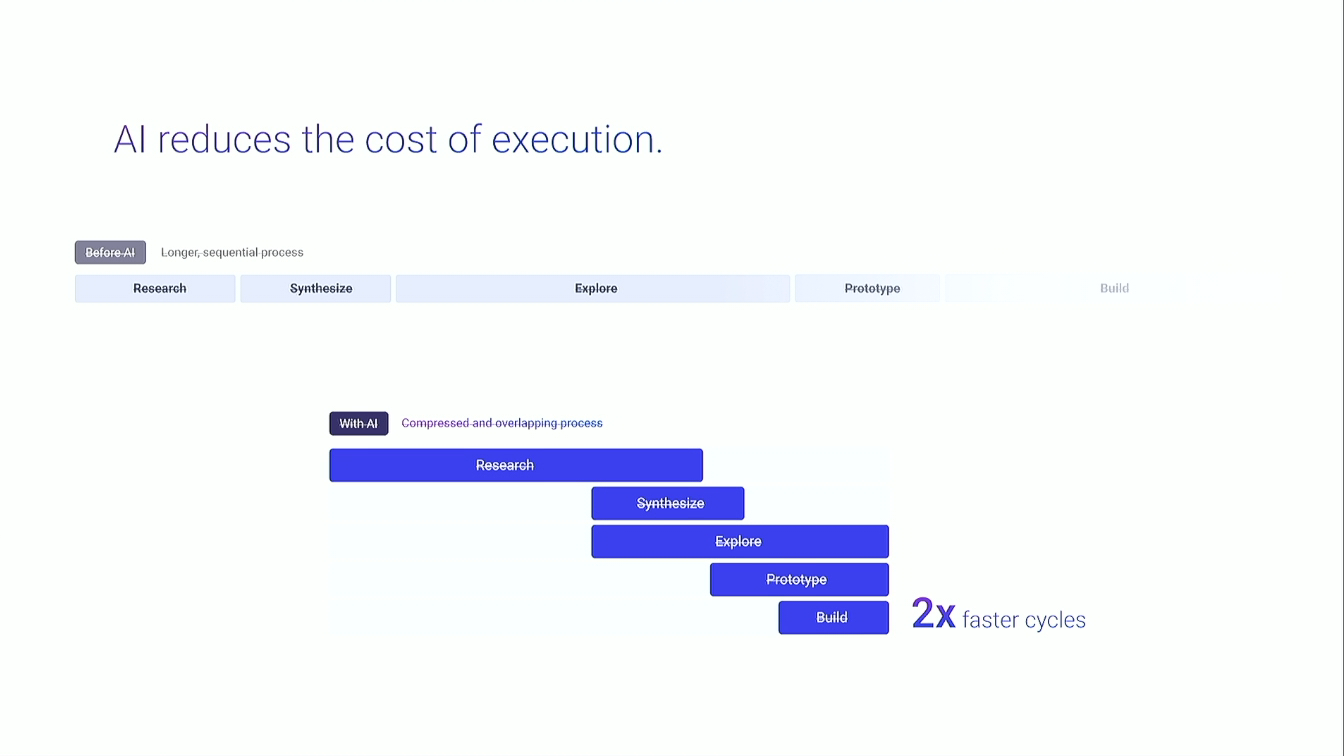
This is the process. The process moves us from foundations to applied experiments to integrating successful practices into our design practice and finally into a sustainable operating model. Right now we're at the applied experiments phase and I'll walk you through what that looks like for each group in a moment. But the process itself isn't the most important thing.
What is the most important thing is that the team is staying connected. We have a shared cadence of fortnightly working group sessions. We use the common discovery process and everybody follows that and we also have monthly playback so that the broader team is informed of what we're working on. That means that we're learning together. We're sharing what's working, we're sharing what's not working, and no one team goes too far and no one gets left behind.
For me, the most important thing is that I'm starting to see people going from this individual uncertainty and nervousness into being in a space that they've got collective exploration. Taking you through each of the working groups, the first working group is the research working group. Their goal is to improve how research is safely captured, synthesised, stored, reused and applied to decisions with clear principles that follow and workflows and clear principles, workflows and human oversight.
The research working group is exploring how AI can reduce the administrative overhead of research without diminishing the intellectual rigor behind it. One area they're exploring is AI assisted synthesis. The most important thing here is they're looking at ways to make sure that we're not offloading synthesis to AI and, again, that's critical because you just see it happening so often and it's terrible.
The goal is to use AI to help with some of the more manual tasks, like organising notes, structuring evidence and connecting themes so researchers can spend more time doing the things they're uniquely skilled at: interpretation, sense making and exercising judgement. They're also exploring what a research repository could look like.
We face the challenge that everybody in this room faces. We have research everywhere and we really want to create a space and be able to use AI to help make those repositories actually stay alive and for us to be able to find that research more easily. And finally, they're exploring how research insights can become become a context layer for AI enabled design systems, helping ensure that future design decisions are grounded in real audience evidence rather than just assumptions.
The next working group is the design systems working group, and their goal is really around how to improve design system consistency, scalability, component quality, developer handoff and AI readiness across platforms. The design systems working group is tackling the challenge that I suspect many of you have in the room. Our design system knowledge is everywhere.
It's in Figma, it's in Confluence, it's in Storybook, it's in GitLab, it it is in a whole bunch of other places. In people's minds, it's everywhere. The result is duplication, inconsistency, and a lot of effort spent keeping everything in sync. What the team is exploring is whether AI can help us create a single knowledge layer across all of those systems.
Instead of people manually updating documentation in multiple places and hunting for differences, could AI help us identify those changes and propose updates and then just have a human review and approve those changes? The vision is a living ecosystem, one where design systems stay connected, current, and much easier to maintain.
The second area that they're looking at is exploring what an AI fluid design system might look like. Not just a design system for humans, but a design system that AI can understand as well. So how do we structure our documentation and components so that AI can generate work that's aligned to our standards, patterns, and ways of working from the start?
This is something that we're still exploring, and it's really fascinating, and I I look forward to presenting at another talk. Well, actually, it'll be Simon and his team. And then the third working group is the strategic and conceptual design working group. Their goal is to use AI to strengthen concept generation and prototyping narrative, framing and stakeholder alignment while ensuring concepts are grounded in real evidence and critical design thinking.
They're looking at three areas. The first is the maker, how AI can help us create richer, more tangible concepts and prototypes that allow us to test ideas earlier with greater realism. The second is the aspiring partner, exploring how AI can help support synthesis, challenge our thinking and help us connect ideas without replacing human judgment.
And the third is the challenger, where AI deliberately takes on the role of contrarian, devil's advocate, helping us to surface blind spots, risks and opportunities to see what we have missed. All of the teams are working with very common themes. Human judgement remains essential, guardrails and principles are needed, tooling needs to be evaluated intentionally and cross functional collaboration is critical.
So, after setting up those working groups the question becomes what happens when we actually put this way of working into practice? This is where the approach starts to become tangible. At the ABC, our product is our content. One of the challenges with testing new content experiences with our audience is if people don't connect with the content they're looking at, they can only suspend disbelief for so long.
Eventually, the feedback becomes about the content and not the experience you're trying to test. So we asked how can we make prototypes feel more like the products we're actually trying to evaluate? At the same the same time, we're also exploring the more broader question, which is does a personalized what does a personalized experience actually mean? What should be personalized and when?
Through an AI prototype hackathon with engineers and designers, we built digital twins of our three flagship products in days rather than months. Using FigmaMake and ClaudeCode, we connected these prototypes to make real content collections and created personalized homepage experiences that responded to audience preferences and behaviours in real time. That meant we could test dynamic personalisation concepts before making major engineering investments. If you'd told me we could do this two years ago, again, I'd say there's no way.
We also tested this approach on iView. What you're seeing is a homepage that adapts to the individual. As people move through the onboarding, we're able to explore different recommendation models, understand how genre preferences might influence navigation, change the order of content selections, highlight live and local content that is most relevant to them, and surface different content based off their interests and behaviors, all in a prototype. What surprised the team through this process was how AI didn't diminish the role of design, it actually expanded it.
Decisions and conversations that usually take place at the technical discussions much closer to implementation were unpacked early earlier with feedback from the audience who could see and feel the implications. Conversations such as which degree of personalisation is too far in news, when refreshing collections, what is the sweet spot between flooding the feed and being too cautious.
In the context of the ABC, where trust is paramount, being able to test these concepts with low stakes and high fidelity means we can navigate these complex spaces with humanity and care. Again, the breakthrough here isn't just the prototype. It was the ability to test genuine personalised experiences with audiences before committing to significant engineering effort.
Instead of people asking us instead of saying to people 'please imagine what this feels like', we can now put it in front of them and observe their reactions in real time. All of this was made possible through a combination of FigmaMake and Cloud Code not really. It only happened because the team, specifically Manon and Danny, saw the opportunity to lean in and because we'd created the space for it to happen. Saying all of that, it's with these informed perspectives we've started to incorporate AI in both our conceptual design work as well as our audience facing features.
I'm now gonna show you how we use AI to help us create something to leverage content in new ways. But before I do, I do really wanna stress that trust is paramount at the ABC, especially in news, but across every single division. We want to do the right thing. We take our role and obligations to Australians seriously.
So with that in mind. Another team has tackled something very different. It's a long standing problem that we have. Regional reporters produce trusted journalism every day for radio audiences. But what about the people who don't listen to the radio? What about the people who just read their news? The question wasn't how to create more journalism it was how to help existing journalism reach more people without asking already stretched teams to do everything twice. The result is ABC Assist, an AI assisted workflow that brings that helps to convert verified local radio journalism into digital briefings. Journalists still review, edit and approve every story.
The AI isn't replacing the journalism. It simply helps to extend its reach. No new roles, no replacements, just a practical application of AI that helps us to get more journalism to find its audience. So what have we learnt? When we look back on what the biggest difference, it hasn't been the prototypes, it hasn't been the tools.
It was creating the conditions for the team to explore together. We started with people, not technology. We created safe spaces for discussion, agreed on principles early, gave ownership to the team and focused on practical experiments. Most importantly, we share what we are learning as we go, and we also have Mina keeping us on track. The goal remain the goal still remains.
We're not looking for one answer. The goal continues to be to build confidence through exploration, leverage where AI where we want to. Six months ago, people were asking whether AI would replace them. Today, they're bringing experiments, ideas, opportunities back to the team. We've moved from a place where there was a lot of fear to a place where there's lots of curiosity, where people had individual anxiety to this collective exploration, where people were looking to me for answers, now they're running their own experiments, where AI was happening to us and it was quite a negative thing to shaping what happens and how we are going to embrace AI.
So what does the future hold for design? I believe it is bright for us. In a world where everything is going to be made more possible, easier to implement and roadmaps are going to be formulated with the click of a button or a chat prompt, being able to make sense make sense make and story tell has never been more important.
Being able to hold a perspective grounded in real insight, to have designs that are being formulated, tweaked, and iterated based off real research, and having the ability to tell a room why this versus something that lacks genuine insight is the right choice is something that we have been doing our entire careers. Some steps are gonna get easier for sure.
Upskilling just like when the mobile came out is a nonnegotiable. Being clear about where AI fits into our world and being open and not denying it is key. Whilst the UI Utopian product pipeline may still come, I'm less scared of this future. Twenty years ago, we learnt how to design for mobile. A few years ago, we learnt how to lead through a global pandemic. I mean, I words I'd never thought I would say.
And today, we're learning how to work alongside AI. And just like every major shift before it, the tools will continue to change. The workflows will continue to change. Parts of our craft will get faster. Some will feel uncomfortable, some already do feel uncomfortable. But the thing that won't change is our responsibility to understand people, make sense of complexity, and help organisations make better decisions.
We are still gonna be the advocates for humans. That is what designers have always done. And do I think I've solved it? Not a chance. But my team is more curious, they're more galvanised, and they're more prepared. And honestly, I really do think that's enough. Thanks, y'all.
Technologies & Tools
- Artificial intelligence
- Figma
- Confluence
- Storybook
- GitLab
- Figma Make
- Claude Code
Standards & Specs
- ABC AI principles
Concepts & Methods
- Responsive design
- Accessibility
- Google Design Sprint
- Change curve
- Campfire session
- Discovery process
- AI-assisted synthesis
- Research repository
- Design systems
- Design thinking
- Digital twins
Organisations & Products
- ABC
- Nokia
- ABC iview
- ABC Assist
Works
- Snake