Beyond Designers: Building a Culture of UX Through a Playbook
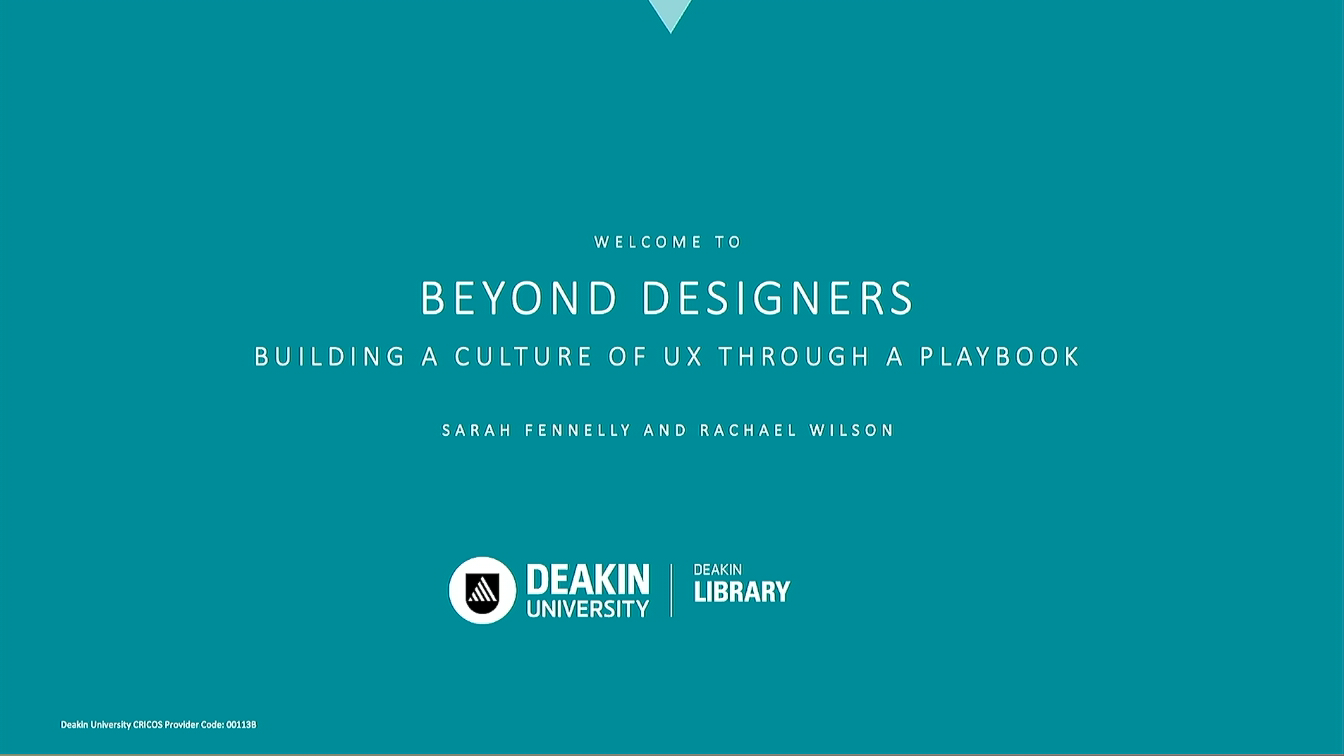
Meeting UX Demand Beyond the Design Team
Sarah Fennelly introduces the breadth of Deakin Library’s services and the challenge of meeting growing demand for UX with limited specialist capacity. She explains why the library formed a cross-disciplinary team to develop a playbook that would help colleagues embed UX in their everyday work.
Discovering What a Playbook Could Solve
Teams working in isolation had created duplicated effort, inconsistent experiences and uncertainty about where to find design guidance. Sarah describes how the team investigated playbooks and drew practical lessons from government resources, Google’s Design Sprint methodology and existing Deakin materials.
Replacing Assumptions with Staff Research
The team maps existing resources, platform requirements and intended users, then recognizes that its plans rest on untested assumptions. Interviews with 16 library staff reveal fragmented guidance, varied workflows and substantial design work by people who do not identify as designers. Sarah explains how these findings become requirements and user stories for a practical, centralized resource.
Designing Plays People Can Navigate and Use
Rachael Wilson explains how the team uses prototypes, consistent page structures and contextual guidance to make the playbook approachable. The team adapts Queensland Government material under a Creative Commons license and organizes content around the Double Diamond. Roles, plays and game plans let staff follow a complete process or select an activity for an immediate need.
Turning Priority Workflows into Reviewed Content
The team prioritizes three game plans: creating study guides, preparing presentations and improving web content. Subject experts draft activities, peers check assumptions and communications specialists align language and tone. SharePoint experiments and Figma prototypes establish feasibility, while governance discussions clarify how experience design connects with project management.
Launching the Playbook and Supporting Adoption
Prepared templates and content help the team build the SharePoint site, refine it with returning research participants and launch in March 2025. Rachael describes onboarding sessions, walkthroughs and case studies that support practical use, alongside workshop fatigue that prompts a shift toward requested sessions. Content management practices and recurring operational reviews support ongoing maintenance.
What It Takes to Build a Lasting UX Culture
Sarah Fennelly and Rachael Wilson reflect on stronger team capability, missed stakeholders and leadership gaps that affected advocacy. Staff feedback shows that high awareness does not automatically produce adoption, making tailored support and further content development priorities. They conclude that the playbook makes specialist knowledge accessible, while lasting cultural change requires a broader organizational strategy.
Rachel and I are really excited to share this opportunity to share with you all a project that we think is valuable in growing UX maturity and capability within any organization. So whether you have a huge team of dedicated UX experts or if you're a lone UX wolf. So let's start with a quick show of hands. How many of you here today actually know what we do in academic libraries? Can I get an idea?
Like, couple of four or five. Okay. So to make sure we're all starting from the same place, I'll begin with a bit of an overview about what academics libraries do and the role that they play. So we're not just about books on shelves nor shushing people. That is Those days are long gone. Deakin Library has around 140 staff dealing with everything from answering day to day questions from students through to liaising with the world's biggest publishers on multimillion dollar subscriptions.
Some of the examples of services the library provide are open publishing, including open educational resources such as e textbooks research support for grants, PhDs and scientific research we do teaching and learning support for students, academics and professional staff We do have extensive public programs and designing complex exhibitions that showcase Deakin research and student work, and the list goes on. In the library, we're fortunate to have a dedicated experience design team which incorporates expertise in UX research, visual design, content strategy and management, and front and back end development, us to offer an end to end design support for the library.
We also have learning design, service design, and communications capabilities sitting within other teams within the library. So we have this great expertise in the library, but we can't do everything. And one of our biggest challenges was UX appetite outweighing our resource capacity. So which when you think about it is actually a really good problem to have. Leadership identified that UX should form a core driver for library experiences, but due to resourcing, we needed a way to uplift and enable our colleagues who have little or no formal UX training to enable them to embed UX practice in their work.
Within with limited time and resources, how do we enable teams or individuals to consistently deliver those great user experiences? Well, our strategic UX leader at the time recommended a playbook could help solve this issue along with a handful of other recommendations in her late twenty twenty three strategic UX plan proposal. So to address this challenge, we formed a cross disciplinary project team made up of expert designers from across the library.
So we framed our presentation today using the same process we follow in our projects, which is the double diamond approach. So let's start with discover. But before we delve in, I have a question for the audience here today, to test your academic library knowledge. So which one of us up here is the librarian? Can I get a show of hands if you hands up if you think it's me and hands down if you think it's Rach?
I don't think you're tricking Facebook.
No. I don't think we are. If you said Rach, you would be correct.
It's me. And many people probably don't realize that, in Australia, professional librarians, require generally an accredited university, degree to become a librarian. It doesn't have to be a graduate though oh, sorry, a bachelor's. It can be a postgrad or a master's.
So as a project group, we began by examining the problem statement, which was across the library, different teams were designing content, services, and learning experiences, but there was no shared approach. So for each, each team, was working in isolation. So some had developed their own methods whilst others were starting from scratch every time. This led to a duplicated effort, inconsistent user experiences and really a lack of cohesion across our offerings.
We also heard clearly from staff that they wanted better tools and guidance to support their design work with something practical, accessible, and that aligned with how they actually work. So what is a playbook? We had no idea. According to the Oxford Dictionary, the term playbook has three meanings. Firstly, a book containing the text of play or plays.
Secondly, a book of games and activities for children. And finally, originally from North American football, a manual containing different plays and strategies. So players study it to understand their roles and execute coordinated strategies. So for our situation, obviously, the latter meeting was what we went with. We also came across a really great, definition from Mark Delgano's Medium article, which we adopted, which describes a playbook simply as a manual for how some things get done in those bits of an organization. And this definition resonated with us.
It's quite practical and it was flexible and it really focused on enabling teams and individuals to work with clarity and consistency. So after receiving the discovery brief, we began with the preliminary environmental scan and research to explore playbooks, explore playbooks developed by institutions similar to ours. So we found some fantastic government initiatives like the Queensland Government's Digital Services Design Playbook and the Victorian Government Human Centered Design Playbook, as well as the industry kind of experts like Google's Design Sprint methodology and also other internal Deakin departments, resources, toolkits.
And we found both government resources had really clear and actionable instructions, a well structured information architecture. The digital services design playbook really impressed us with its methodology first approach, and it clearly explained the design framework and listed relevant design plans and options whilst placing key information upfront on each page. And this really gave us some fantastic ideas on how we might be able to structure some of that information that we provided.
So now in onto the define stage, but before I continue, let's do another quick myth or truth. So, the question is, for you in the audience, academic libraries can only be accessed by university staff or students. Hands up if you think that's the truth, and hands down if you think that's false. Well, if you said false, you'd be correct.
So most academic libraries are open to the public. So next time you are visiting or going past a university, pop in and go and see the library. So how did we, start to define this work? Well, at the start of the workshop, we brought together everything that we'd learned so far. So we had, we shared the environmental scan that we conducted, and we also took time to look at the library design resources that were already in circulation.
So things like our library design system, our good practice for library study guide design, our communications handbook, and our data and insights hub, to understand how that playbook would connect and intersect with them. As we worked through this, a couple of really important dependencies became clear. The library intranet project that we had at the time and a number of concurrent service reviews that were underway already.
And these kind of really shaped our thinking, particularly around the timing and how the playbook would integrate into the broader digital ecosystem. We also defined what we needed from the platform. So it really needs to be easy to access, simple to maintain, it needs to be enterprise and need to be scalable over time and with an ability to support multiple contributors and also expand access beyond the library.
When we then identified our core users. So our primary audience was the library staff who were designing experiences across research, learning, teaching, digital search and physical spaces, as well as ourselves, the expert designers. And our secondary users included team leads and others who would help embed the playbook into workflows. But one of our most important outcomes from the workshop was actually realizing that we were working with a hell of a lot of assumptions. We had really strong ideas about what people needed but we didn't yet have enough evidence or shared clarity to confidently move forward.
So to validate those assumptions, we mapped out exactly what we wanted to learn from library staff and the questions that we needed answered. So we were particularly interested in understanding the experiences people were creating, the outputs they were designing, the tools and resources they used, and the challenges that they encountered along the way. We recruited 16 library staff members who were actively designing experiences across those six identified experience areas.
And because there was a lot of nuance in what we were exploring, we decided interviews would be the most appropriate research method. We wanted people to be able to provide context and explain their workflows and to talk through the challenges they faced in their own words. So interviews gave us that flexibility to dig deeper and explore the areas that we hadn't anticipated.
Given the size of the project team, we took a really divide and conquer approach, and this also created a really great opportunity for some team members who were really interested in UX research, and it helped them to build their interviewing skills. We created a series of those mirror mirror templates around our interview themes, we gave interviewers the flexibility to either take notes during the session or work from a transcript afterwards.
And having all that data in one place really meant that we could easily code responses and identify patterns and run affinity mapping sessions across the team. And as we synthesized the interviews, we also mapped the different types of experiences staff were creating along with the output that they were producing to support those experiences. So what was quickly affirmed was the breadth of design work happening across the library by people who didn't actually see themselves as formally designing an experience. So several common challenges emerged.
Staff told us they were spending a lot of time hunting for information across multiple resources. Processes varied depending on the team or individual, creating inconsistency and uncertainty, and many people weren't always sure whether the work that they were doing counted as design and where to go for help. And like most organizations, high workloads meant that there was little time to explore new approaches.
But we also had very clearly we also heard a very clear vision of what staff wanted. They wanted a single place to access design resources and guidance beyond a repository of documents. They wanted a resource that supported different ways of working, whether that was searching or browsing or learning from examples or following step by step instructions. And they really wanted examples of activities that they could do at each stage of the double diamond design process.
They also wanted support that felt relevant to their context with access to design expertise when more specialized guidance was required. One particular participant described it as wanting it to contain everything a staff member would need to create an experience. So together, these insights gave us a clear set of requirements and user stories that form the foundation of the playbook to help guide us in the next stage of design.
So I'm gonna hand over to Rach who's gonna talk you through the design and deliver phases.
Thanks. But first, another quick question. What do all of these people have in common? Former first lady Laura Bush, the author of Alice's Adventures in Wonderland, Lewis Carroll, chairman Malte Dong, and the first FBI director, J Edgar Hoover. Shout out the answer. There's probably a theme. You know? Maybe. They all either worked in libraries or studied library management.
Yeah. But they probably do have
a library run after them as well.
I agree with that.
I should have explored that one before I went into the design. Our guiding principles were using clean and simple design to reduce cognitive load, having intuitive navigation, offering easy access points to frequently access resources and grounding concepts of the playbook in universal and library specific context really helped shape the UI and content design.
We used the low fidelity prototypes to figure out the information structure on the page, of all the different pages, what supporting content would be required, how the information would be presented, and the relationships between pages, and how we anticipated people would actually interact with the playbook. All whilst keeping in mind the constraints of our chosen platform, SharePoint, and other resources that we had already developed to support staff such as our library design system, our data and insights hub, and digital content management framework. And we really took inspiration from the fantastic work that the Queensland government did on their digital service design playbook and found that the structure of their play page provided us with a really, amazing design that we could adapt and build upon using the Creative Commons BY four point o license.
This really helped us save time so that we were able to dedicate right time to writing our content. And it's important to note that like any UX process, we was really critical for us to contextualize the experience from that base that we had found to our own unique organizational perspective and what our exact user needs were. An example of that contextualization that we made was adding in difficulty levels, objectives, and values to the overview of our page designs so, that we could support time poor users to scan and decide if content fitted their needs, or the content that we wrote.
We obviously wrote from scratch. Building on our user research, we spent a lot of time thinking about how also the content should be framed and supported. One of the challenges was that many of our users had never encountered a playbook before, so we couldn't assume that they would immediately understand how to use it. So to address this, we also included a dedicated getting started, section to help users understand both the purpose of the resource and how to navigate it confidently.
And we also wanted the playbook to reinforce good design practice without forcing people through rigid processes. So we organized the content around the stages of the double diamond design process, allowing users to either follow the end to end approach or to simply dip in and use the plays most relevant to their immediate needs. This was really similar to how most of the products that we discovered during the initial environmental scanning, phase had also structured their playbooks. And we also included the purpose of each stage and, what it that was triggered by.
For example, the purpose of the discover phase is to understand the problem or the need and it's usually triggered by an initial brief for us whether it be an email from the owner, a Jira ticket, a strategic project plan document. We ended up retaining the original sporting language to ensure consistency with other industry examples and the language is that we used is roles, which describe the people involved in an activity.
Plays are the individual design activities, and we include instructions on how to run those. And game plans are the collection of plays that can be combined, to achieve a particular outcome or to create a specific type of experience. Every play, again, followed the same structure. We included key information such as the value, who should be involved, the time required upfront, plus those step by step instructions, and we used consistent formatting throughout the entire site.
Again, that consistency was really important because it helped to reduce cognitive load and made the playbook hopefully easier to use and learn over time. Once we had our structure in place, the next challenge was creating the content itself. And very quickly we realized that we had way more topics and activities that we could include than realistically we had time to develop. So rather than trying to create everything at once, we prioritized the areas that our research told us would deliver the greatest value for our library users.
So we initially focused on three of the most common experiences being created across the library and they are creating a library study guide, creating a presentation and undertaking a web content uplift. So these became our first three game plans and the individual activities that we would do as part of those processes became the first sets of plays. And the game plans essentially become cheat sheets for how to achieve a particular outcome.
Our users really wanted best practice guide guidelines too on what to do during the different stages tailored to the experience that they were creating. So we added in explainers of what outcomes they might expect at the end of each design stage such as touch points with any expert design staff or processes that they may need to follow, such as submitting a content draft to the platform owner for approval before proceeding to the next stage.
The content development process was also very much a divide and conquer effort much like our user interviews. Members of the project team wrote plays based on their individual areas of expertise. Then once drafted, the content went through peer review. This was important for us because it helped to identify places where instructions relied on specialist knowledge or assumptions that might not make sense to our intended audience.
And then finally, a language and tone of voice review was completed with support from our communication specialists to ensure that the content felt cohesive regardless of who had written it. And the result was a strong foundation of content that could launch with the Playbook while also creating a framework that allows us to continue to add content to the, Playbook over time.
Then happening concurrently to the content development and the low fidelity prototyping, our developers were busy creating a Sandpit SharePoint site to ensure that the platform could meet our design and content needs in practice. And, thankfully, we've been able to learn from, from that practice in, subsequent projects as well. Sarah did this. Figma to build high fidelity prototypes using the Microsoft SharePoint design system, and this prototype was presented to both the project owner and sponsor at the time, and we received approval to proceed to build. And at this point, we also engaged with our library governance and strategic initiatives staff to make sure that we were aligning with endorsed library project management practices.
And we actually had a few changes that came out of this discussion including simplifying or removing some plays that we had originally drafted in the discovery phase. Those convos helped us understand more clearly the difference and crossover between project management and experience design, and how they support each other in getting projects done within our unique library context.
And once the prototypes were finalized, we moved on to the delivery phase of the project. But first, a question. We have all hopefully, just completed our census a couple of weeks ago. In the last census, 2021, how many people do you think noted themselves as a librarian? So hands up for less than 5,000, hands down for more than 5,000.
There were 6,400 people identified as librarian with almost 64% being female with a median age of 51 years old. So I've still got some time left. Into the build, we had thankfully set ourselves up for a really streamlined process. The web content and the page templates had already been verified and prepared which enabled the project team members to populate the site content which freed up the developers to focus on structure, navigation, and any customizations required.
And this resulted in a really smooth transition from prototype to prod. We had minimal overheads and we actually had confidence that the platform could deliver what we needed to do both in, like, currently and in the future. Seeing the SharePoint site come to life did highlight some room for improvement in our IA design and just some inconsistent language that we missed which were easily rectified.
Once it was mostly complete and built, we ran another informal check-in with five of the members from our original test group and again, their feedback overall was positive with just a couple of minor iterations required. Once the playbook was complete, we launched it to our senior leadership team and, received endorsement. And finally, we're able to launch it in March 2025, introducing it at an all staff meeting and supporting the rollout through our internal communications and library news channels.
But we knew that simply, launching the playbook wouldn't be enough in our attempts to uplift staff understanding and adoption of UX practices into their ways of working. Our research had already highlighted that some staff would need onboarding and support to understand how the playbook could fit into their processes. So to achieve this, we, ran ad hoc onboarding sessions and enablement activities, including presentations, guided walkthroughs, and practical case studies, that demonstrated how the playbook could be applied to real library projects.
We also developed targeted agnostic onboarding sessions for our strategic project leads. These were scheduled for the beginning of the year to coincide with our yearly, project kickoff cycle. However, they were canceled this year due to workshop fatigue. The new approach recommended by the current product owner is to allow interested people to request this session instead.
So we've seen encouraging signs of uptake across the organization, particularly in several directorates that have that had already adopted using the double diamond framework into their ways of working, and they have found using the playbook a practical tool, to support planning, decision making, and, experience design activities. And MyJam, like any digital asset, the playbook will require consistent check ins, reviews, and content management to ensure that it remains a highly usable and relevant resource.
So we developed a a content management plan and put into place some basic content management practices. SharePoint isn't the greatest when it comes to, offering automated content management tools, but we did manage to create some workarounds. And we also have ongoing bimonthly check ins with the operational team to discuss updates and any plans, review our usage, and, think about any engagement and enablement activities that we need to think about.
There we go. Lessons learned and next steps. Like all good projects, we had quite a few things that worked well and some things that we could have done better. We really, were thankful in having a project team that had the right people in it, which meant that we could draw on the expertise spread across the library and we really walked the talk in taking a user centered approach to developing this tool and one of the byproducts being that we actually enhanced our own UX expertise along the way. And rather than creating a theoretical resource, we're really proud of the accessible and practical nature of the playbook and the guidance it provides. In terms of what we could have done better, we definitely missed, identifying a couple of key stakeholders early in the piece that would have helped us better understand where that playbook sits alongside other library processes and documentation such as, project management.
And while we ran the project to the best of our ability, we experienced both strategic and project ownership and leadership gaps throughout the project thanks to organizational restructures, which ultimately impacted the circulation and advocacy of the products to the wider library. And like most of us, we were all juggling concurrent projects which made finding time to write content difficult, especially, without an enterprise AI tool which could have helped streamline that content review process in particular.
And finally, the project team could have benefited from having specialized UX training in the early in the project to ensure that we were all working on a, like, a standard and uniform baseline understanding of end to end UX. So how's it tracking now? Since launching, we've surveyed our staff again and have discovered that awareness is generally high. Most respondents had heard of the playbook and those that had used it described it as being valuable, useful, and comprehensive.
But what we learned also was that awareness doesn't automatically translate into adoption. And while staff could see the value of the resource, some found it a little overwhelming at first and wanted more guidance on how to use it in practice. The other interesting finding was around the name itself, library design playbook. Show of hands, who thinks maybe the word design was the issue here? Or maybe the word playbook?
Playbook. Yeah. While the term design was broadly understood and well received, playbook generated more mixed reactions, and some staff connected with it immediately while others found it a little too corporate or strongly associated with sport. But ultimately, though, there was no clear consensus on an alternative name. And what this has reinforced for us is that it's not the name that's the problem, it's the socialization and adoption.
So our biggest opportunity now is to continue to build capability, confidence and familiarity so that the playbook becomes a natural part of how people work rather than simply a resource that they know exists.
Alright. So what's next? We're currently surveying staff to get a better understanding of their adoption of the playbook and what if there any barriers exist. We also need to review the approach to socialization and plan to advocate for more tailor a more approach, to meet our user needs. We're also seeking allocated time to develop more playbook content, to that support staff developing more experiences.
So some of those, game plans we'd like to have a look at are things like creating simple things like creating a video, developing a visual identity, and developing a communications plan. Overall, this project, has not only created a really valuable resource for the library, but it's also reinforced our own understanding and competency in UX and design methodology.
Through this project, the project team was able to enhance their skills and build a greater understanding of how we work together and then how we each contribute to ensuring the library staff develop and deliver great user centered library experiences. Pleasingly, we've also seen other areas of the university recognizing the value of the playbook, specifically our enterprise UX team and the School of Communications and Creative Arts who are now exploring the potential of teaching for the playbook with their undergraduate cohorts studying design thinking.
So our presentation today was called Building a Culture of UX Through a Playbook. So did we build a culture of UX? Sort of. What the Playbook has done is to help build a culture of UX is by taking the expert design knowledge that we as specialists have, and has made it accessible for library staff in a library shaped context, taking it from being something a few designers do to something that a whole library can understand, adopt, and apply consistently.
Library staff now have a place to go for guidance and practical information, and for some staff, it's definitely helped them refine this, thinking to be, more user first. But the playbook itself was never going to be the sole answer to building a culture of UX. When creating a culture, it's about changing the way people think and giving them knowledge in a really accessible way and bringing them along on the journey as an entire organization.
So it can't be just done in isolation. It really needs to be a part of a much bigger strategy encompassing, the ways in which we work and we think as a whole. The playbook was never gonna be the entire solution, but it is one really important piece of the puzzle. So thanks again for, so much for having us and for this opportunity. We'll leave you with our amazing project team at Teakin Library as this project could not have happened without their expertise and enthusiasm for experience design and UX.
Thank you for having us today.
Technologies & Tools
- Library design system
- Microsoft SharePoint
- Jira
- Figma
- SharePoint design system
Standards & Specs
- CC BY 4.0
Concepts & Methods
- UX maturity
- Open educational resources
- UX research
- Content strategy
- Service design
- Double Diamond
- Environmental scanning
- Design Sprint
- Information architecture
- User interviews
- Affinity mapping
- User stories
- Cognitive load
- Content design
- Low-fidelity prototyping
- Peer review
- High-fidelity prototyping
- Content management plan
- User-centered design
Organisations & Products
- Deakin Library
Works
- Library Design Playbook
- Digital Services Design Playbook
- Human-Centred Design Playbook