Enjoyment as a Design Principle and Metric
Why memorable experiences resist efficiency
Sakib Jalil contrasts organisations’ focus on efficiency with the unhurried dinners, holidays and conversations people remember. He invites the audience to reflect on meaningful experiences and asks why product teams rarely apply those lessons to design.
When measurable outcomes crowd out human value
Jalil examines how dashboards, recruitment and organisational decisions privilege outcomes that teams can easily quantify. He argues that this emphasis sidelines connection, enjoyment and valuable qualitative research. As AI makes efficiency easier to achieve, he proposes enjoyment as a source of product differentiation.
Trains, banking and the human cost of convenience
Three research examples challenge the assumption that faster service always improves an experience. Train connectivity changes passengers’ perception of travel time, while deliberate banking delays increase customers’ sense of safety. A cancer-care app reveals a deeper trade-off when convenient remote care removes valued contact with clinicians and family.
Give discovery enough time for surprises
Jalil questions pressure to compress or replace user research with AI-generated discovery. He draws on pharmaceutical research and unexpected discoveries to argue that innovation needs time and openness. He then asks the audience to recall something inefficient they enjoyed.
Design around motivation, ability and the moment
Jalil introduces an adapted model that connects motivation, ability and the context in which an interaction occurs. He uses Amazon purchasing, Apple unboxing and Spotify’s annual listening recap to explore how ease, anticipation and surprise can support enjoyment. Research helps designers understand when people value speed and when they welcome a slower experience.
Match the pace to the person’s purpose
Jalil contrasts exploratory holiday planning with booking a time-sensitive business trip to show how context changes the value of efficiency. He criticises booking countdowns that interrupt enjoyable exploration. He encourages the audience to introduce enjoyment into meetings, planning and client interactions as well as interfaces.
Measure the moments people remember
Jalil shares how students’ qualitative feedback revealed the value of conversations, shared exploration and personal attention beyond teaching throughput metrics. He describes applying enjoyment through the time he spends helping students think. He closes by urging teams to make enjoyment a distinguishing quality as AI expands access to optimisation.
So when it comes to products and services, you'll notice that most organizations and teams, they're talking about some form of measurements, some form of metrics. In other words, efficiency. This could be in the forms of faster services, leaner workflows, tighter workflows, even faster systems.
And businesses and people who are doing this, whether we are designers and nondesigners, we are doing it with a lot of well meaning intentions. At some point, behind the scenes, it's intended towards the user's experience, customer's experience, or employee experience. But talking about experience, if we get out of this domain of products and services and think about the human moments, our lives from our lives, In other domains, can see that some of the most important moments that people actually remember are the moments they enjoy, and these are deliberately inefficient.
Okay? So efficiency wasn't part of them or was never the star. It was part of the story, but it was about enjoyment. So I want you to think about a long family dinner. In this case, this is from my twenty twenty four Christmas with when my mother-in-law was still alive, so this was our last Christmas when it took us six hours, three hours to set the table and talk and drink in between, and another three hours at least to finish and putting things in the dishes.
A family long family lunch like that sorry. It was lunch that went to dinner. It's in Barcelona, so lunch and dinner has no blurred lines. I mean, so no clear lines. It was unplanned. Similarly, think of the last holiday that you took, a holiday that's not rushed, unplanned, but these are things people remember.
Or a conversation that didn't have a tight agenda with your boss or meeting notes, but it can go in so many places that you build a connection. You may even think of the next business idea through that conversation. So why aren't we using the very same research we learned from our human life stories into our products and services?
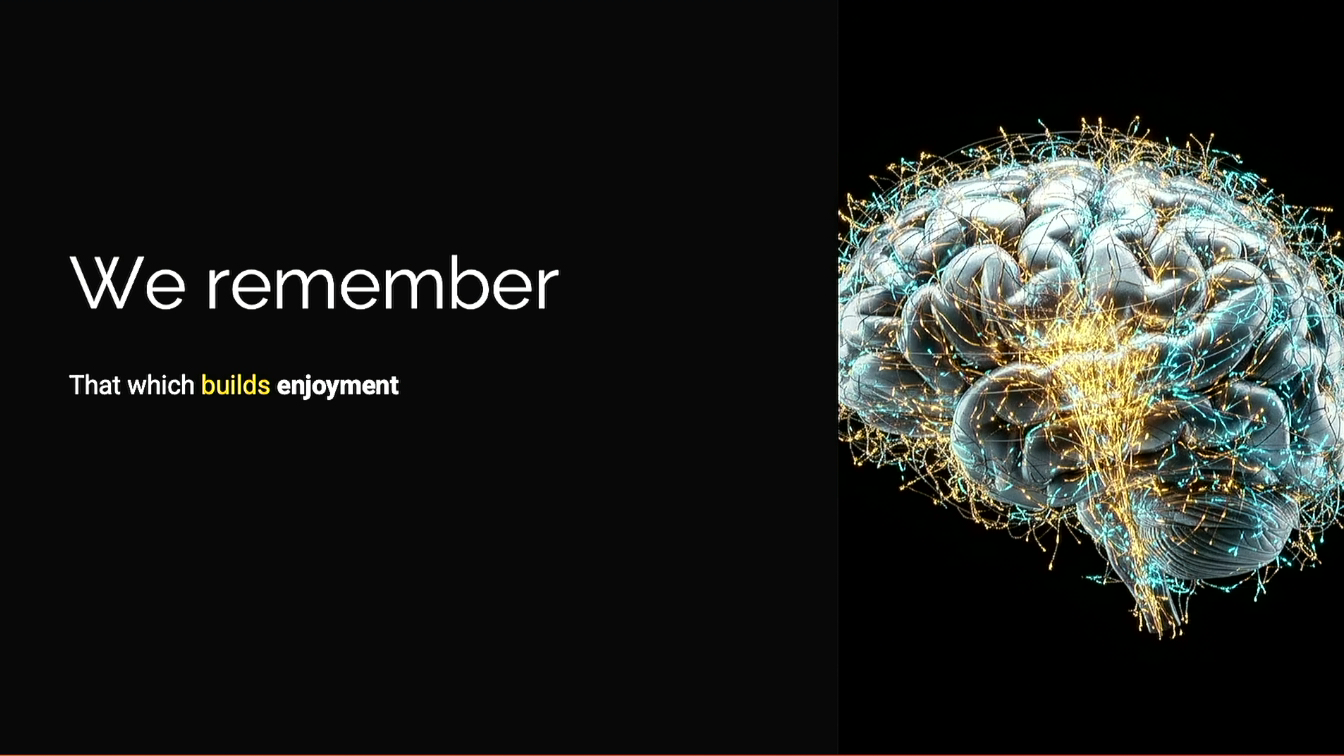
That's what I'm wondering about, and I want you to think along with me. So when we think of cognitive science and research, well, I'm not a cognitive scientist, but I had to use their results in IT. Cognitive science shows that exactly how memory forms is not how fast it forms, it's how the memory what the memory actually became when it became enjoyment or a pleasure or a pain as well.
And how fast it happens is the path. So the neural networks work to create that path. But what we remember in our end of life, and it varies in different demographics or, you know, we don't know how long we live, But what we remember are those moments that we enjoyed somehow. It was never the moments that were efficient.
So I want you to close your eyes just for a few seconds and think about the last time you made a new friend or the last time you fell in love with an idea, with another being, another human being, and think of how much of that was planned, how efficient was that.
Alright. You can open your eyes now. So these moments don't really follow efficiency rules. Efficiency is somewhere there in the background for sure, but it's never the star. So in this talk, I'm going to go through three parts. First I think the timer isn't working.
So for yeah, okay. So the first, we are going to talk about that our obsession with efficiency. Then I'm going to give you some examples of efficiency or not, Alright? And then I'm going to talk to you about approaches to build enjoyment. So let's talk about the first part.
You walk into any organizations and you'll see dashboards everywhere. Now, of course, on screens, you'll see colored bars, KPIs, OKRs, right, green ticks saying, yes, we are on track. Okay? And they feel good, they are measurable, They feel manageable.
And they are great because, you know, it's problematic if we don't look at them. But it's also problematic if we only look at them. Let's talk about our kind of area, user research. Even user research has changed over time from the last thirty years.
We used to do so much ethnographic studies, rapid ethnography, co design diary studies, and we are trending towards more usability tests or somehow adding in numbers. Alright? So now we are more focused on faster response rates, task completion rates. And even I heard from my students and my ex colleagues that recruiters are asking, your resume doesn't look that you have anything actionable. Add something, add a metric, you want to add this and that. And one of my friends, Sophie, and she allowed me to use her name, she said then she had to ask from the organization, which is very famous, she had to ask her business and product managers to see why did we make that decision because it's not in her domain, she was studying the people.
She didn't know why we made that feature. I mean, knew what it would achieve, so she had to put these things. And their resumes are now looking like product managers, and we are skipping the real work that we are actually known for. And this behavior is going from classrooms that I teach now, and I also have seen this in the boardrooms where we look at the metrics, the numbers, and that's how we make decisions.
So I want to say that we have normalized these things now, like tickets closed. These are just examples. I mean, of course, there there could be flaws if you look at them, but these are some examples. They are easy to measure, so we have normalized them. But they are not the norm. Many people think they are the norm, but we are also allowing them to be normalized.
But the things on the right, enjoyment, feeling understood, a sense of control, a moment that gave you some joy, or connection with someone or something. These are not easy to prove, also because the environments we work in these days, nobody pays attention, so sometimes we just give up. Right? We just don't know that we can actually prove them. There's research out there.
So these are not becoming norm and these are not being used. K? So we have normalized things that are easy to measure, and implementation science calls this the tyranny of what's visible. Behavior scientists use that too, but that's not really my field, so I won't talk about it.
So this is what's happening. And, of course, I generated these images with prompting AI. Right? But I've worked through this. So by doing all these things, we are forgetting what's valuable. Right? Meaning, connections. And many things that are invisible, they are not making it to the boardroom, but they're cracking the whole product, even Teams. Accidentally, when we are doing redundancies, sometimes we may be even getting rid of some people who are at the core of your Teams, or some features or some services that doesn't really make profit, but that's the reason you actually had the customer base in the very first place. So if we are just measuring what's visible, we are missing out what's valuable.
And as we are missing these out, these conversations and decisions in the boardrooms are no longer happening around what's valuable. Okay? I also heard from people, even during promotions, they're very, very talented colleagues. They do great work and they have such great consulting and social skills. But during promotions, they have to prove with numbers.
Right, because their leaders don't have time to see what impact they actually have in the organization. Right? And they feel frustrated. How do I prove this? How do I prove that? So what I want us to remember is that in the last twenty six years, here's what technology, technological developments have happened.
We moved from worldwide web to mobile computing to cloud computing to automation, and we are living in the midst of AI, agentic AI. In terms of digital experience, what we have done with these technologies are mostly around moving people from a to b faster, smoother, and also increasing their user experience aesthetically, which is great, making things beautiful, making things more emotionally connectable, and also from product perspective, adding the next feature. So even though those technological things changed, at core, in the digital experience, we are doing these kind of experience improvements.
But I believe the next big breakthrough will be enjoyment because efficiency is no longer something we need to do anymore because we have AI to do that. And products that will that will be head and shoulders heads and shoulders above other products, they will focus on the enjoyment because that's where they will make the difference because you won't be competing in efficiency in a year or two.
Alright. So I look at now some of the examples of efficiency or not, starting with an old example of this was one of my first research only to learn how to analyze perception. So I was a PhD student, but the project was from MS, I can't even pronounce properly, Netherlands is the Dutch train.
They're really, really fast. I was just a simple researcher trying to analyze the thematic codes and stuff. Right? So what their problem at that point was that they would move really fast and people still complained. Right? Because they're on time, they have business meetings.
Even if it was thirty seconds or one minute delayed, the rating was really really bad. Right? So there was a lot of frustration on the delay and when they arrived at their destination, people felt, oh, it's such a relief. Just get out and you will even if you're on the train, you would also feel like, how fast can I get out?
Because everybody's racing to get out. So NS did a collaboration with T Mobile in 2009 because they cannot change train speed anymore because it's so expensive and they have to change the infrastructure. So could they do research with changing perception of being in the train? So what they did was having at that point I'm sorry, at that moment, having good Internet was really important.
Right? So you could do your work, and T Mobile provided that uninterrupted, very good quality Internet so people could actually work in the train. And when they arrived at their destination, they actually felt interrupted. So the distance or the speed didn't change.
What changed was their perception. Right? So it's not only that efficiency can change everything, we can play with other dimensions because we are still humans. The second example is my last consulting work before I went back to academia. This was for a local small bank in New South Wales. Of course, I'm not I just I'm showing a mock up prototype that is not related to it.
But what we did is we were really understanding what does safety and trust mean to the customers, existing customers, because this bank is very loyal to their customers. So we tried at least 12 different types of prototype with 12 different versions of delays until we concluded that two to three seconds of delay when you're logging into your bank was the ideal for this customer base, for this bank because they felt they were safer.
They were safely logging in their banks. Right? Because if you just log in and the answer is right there sorry. The bank transaction is right there, sometimes you don't feel it's as safe. So in this case, what happened was we didn't make it efficient. Even though it could have logged in faster, we slowed it down.
But it's not a deception. It's to give them a perception of safety because the bank really was following a very secured protocol. The third one is also from a long time old research that I was part of. At that point this was called OnPoint app in California. It would trace a cancer patient's skin symptoms after they are doing chemotherapy, so they could upload their photos in the app and they would get a feedback immediately or later from their doctor or nurses.
They could also have medication reminders reminding them of what to do, how much water to drink, what else they could or could not do. So when we did the research, we used multiple methods. Usability wise, it was super good, super efficient. We also did a super quick sessions of perception with them.
So we couldn't do a full ethnographic study but we gave them diaries to write down sentiments and share with us. So what happened was the app to them functionally was great, but a lot of participants, and I'm just quoting one person's pseudonym here, her name was Pam, she was 68, she said the app took away her desire to live longer and fight with cancer.
Because when she had cancer and she was going through chemotherapy, she was also looking forward to see her doctors, the nurses, because that would be her way to get out. And she would look forward and say, oh, I have to be better, I have to dress up because on that day I have an appointment. And her son used to drive her from Davis to Sacramento. And she had this one on one time with her son, it was thirty minutes drive.
So she told us that you took away the time with my son, all right, with this. So the app made the process very efficient for the doctors and maybe for certain parts of some patients, but it also took away the moments that gave her strength. And it was not just one person, it was many of them.
Now talking about efficiency, excuse me, We also see so much research being cut in the digital industry right now. Or if you're doing research, you're given a deadline. Oh, you do use the research, six weeks, five weeks, three weeks. Sadly, I was recently talking to a very good friend of mine, and she was a product owner.
She sold her products. But she was saying, you know the discovery you did in your last organization for six weeks? AI can do it in six hours. And she she is a startup founder. So I spoke to some other startup founders in the Sydney startup hub and then UTS startup hub, and they don't even value discovery anymore or user research because they said, what are you going to find out that AI cannot find out?
Right? We need to build. But the other industry, like the pharmaceutical industry, has always been doing really good in spending money and time in R and D. Right? They give five years of funding at once because they know you cannot put KPIs and goals for innovation.
Right? So they do research. And an example or two will be, we know about penicillin's discovery in 1928. It didn't happen overnight. Alexander Flemming went on a holiday. Right? And on his petri dish, he found the bacteria was not growing anymore like he predicted, and he found penicillin.
Right? And it saves lives today. In the 1990s, we know of the organization called Pfizer. They also did trial with Sildenafil as a heart attack drug to help reduce symptoms of cardio irregularities of heartbeat, right?
But after the trial, they found people weren't returning the pills because they had other benefits. Right? So innovation cannot have a deadline or efficiency or KPIs. We need time if we want real innovation. And I think pharmaceutical industry is doing that really well, but sadly, digital industry isn't.
So I want to pause for a moment again with you. Timer And isn't working for me. So I just want you to think again, when is the last time you did something inefficient, but enjoyed it? K. And hold that thought with you. Alright. So let's move on to the last part, approaches to build enjoyment. So we have been talking about why enjoyment will be, I believe, the next great breakthrough when we will be competing with super efficient apps everywhere. And I have used this as a modified model.
You have seen different versions of it from Persuasive Tech Lab, but this has a different interpretation. So let's think of these and walk with me slowly. The vertical axis is motivation. So when we use something or do something, we can have low motivation or high motivation.
How do we know it? We have to do user research. We have to talk to our people because it's not always the same. And AI can do that as well. Okay. Then in the horizontal axis, have the ability. Okay? Ability to do something faster or ability to do something slower.
The last twenty years are all those. No matter what technological innovations we have, we are always playing along that because we can introduce a new feature. And now every other app, even Miro, has an AI feature that comes there because we just want to add the ability to do something better for the user, right?
And the third dimension is the moment that both of those happen. So for example, the low, low area is where we don't want to play because if we know there's low motivation, sometimes we can make the ability high, like Amazon's one click. Right? Sorry. Is it called one click? Just buy one click and you can buy something.
So sometimes we can balance that out even though the user has low motivation. But this dimension is the moment. So the moment here is the context, and it will depend on people to people. Right? It could be a trigger, like a phone is ringing because it's a situation where it's an alarm. Right? And in the moment, people decide.
It could be for some people ritual, but we don't know. We cannot force a ritual on people. They will make meaning out of it if we have that trigger there. Some people will make it a ritual, some won't. It could be an unplanned event, a cue, or some sort of thing. Let me show you something. Can I just check?
Ten. Okay. Sorry. So the screen timer has gone off, so I'm checking with them. So think of Apple's unboxing experience. A user who had bought Apple and they know it's coming, your Apple product is coming that day, and this is not about the ones who are going to the shop.
Many of them actually go to the shop and go home and do it as a ritual, the unwrapping part. But anyway, you have the high motivation and Apple did do the research to make the ability to get your product a bit slower. You have to unpack, then unpack and unpack, open the warranty guide, slowly take out one piece at a time.
And research shows that people love it, right? There's also some research showing that people have taken a leave from work or taken a couple of two hours off to enjoy that moment of unwrapping. And it matters. Spotify Spotify gives you an option of seeing, here's what you have been listening to this year, and you can get it in one click. And you will be surprised too that even though it's you are not motivated so much to know, or you are, you'll feel, oh, why not? Let's have a look.
Just one click. And it tells you this is what you have been listening to, and it adds color, it adds animation. And the best thing is that enjoyment, is that surprise reveal that the user has. Right? And it means something to that person. So I want you to we'll compare two examples.
I want you to think of you booking your next holiday. Alright? And in that next holiday, you have one destination planned, but you're just wondering if you could surprise if you're your friend or a loved one by adding something else to that holiday or if you can make better value for the money you pay.
K? Because you're too believe already. And how would you feel if a window suddenly pops up that you got twenty minutes to finish booking your ticket? This is not the right time to press people to force to buy their ticket, and Singapore Airlines still does it. I hope no one's here from Singapore. They still do it.
It's they put the timer and you just get stressed when you're planning a holiday. But if you change a scenario, like you're going for a business meeting or UX Australia conference, which you'll enjoy, but you want to be home before the weekend. At this moment, you want to do your bookings a bit faster. Right? Because you want to go back and spend the weekend with your family. So at this context, the ticket price and all the things that we play with users may work.
Right? Because you want the efficiency. So if we, I'm not saying that efficiency is useless, it's like we need to think beyond that to make our products compete against the new age that is coming. Alright. So now I want you to think super quickly that if you could bring even one person enjoyment, whether for your business or your team, how could you do that?
For your team, by that I mean, maybe it could be your next meeting, your next design sprint, your next catch up. When you do sprint planning, you're going to a new client. Even some of those things, it doesn't need to be an interface design. It could be just something you change in the process.
Alright? I can share something. So just from last July when I started doing casual teaching, I just checked and I took help of Excel and Gen AI to count the number of different students I taught was 1,407, right, from July 2025. And I checked four assignments for each of them.
That means I checked about 4,000 assignments. Right? And I got lots of feedback from the university systems. Yeah. Response times, how quickly I completed their assignments, you know, all these kind of things. But what mattered to me was I got 16 qualitative feedback and this is where the students told me that, oh, at this point I explored an idea with them.
Okay? Because I spent some time with them. It didn't mean that I I didn't really solve it with them, but I spent some time with them and they remember that. Okay? Then sometimes they had a challenge and we had to think together because first, I didn't know how to solve it, and also, we are not supposed to help them.
To do their thinking, we can only provoke them. So I see it and spend the time when they book it with me and have the conversation. So even though we didn't solve, they have given me super high ratings. And there were also things that I don't even remember, but they remember conversations that helped them to feel just a little bit better. And these really worked for them and for me other than those numbers, which I actually generated with ChatGipedia, really, just putting that how many different students did I teach.
Right? So that's how I've been trying to apply it. Okay. So we are at the end, and I just want to remind you again that I believe that our next biggest breakthrough will be if we focus on enjoyment because if every product, if you want some sort of efficiency or some sort of optimization, you can do it super easily with AI and agentic AI.
And what will set some products apart from others will be enjoyment, so not efficiency alone. So thank you so much. There are some references that I used.
People
- Alexander Fleming
Technologies & Tools
- Generative AI
- Agentic AI
- Microsoft Excel
Concepts & Methods
- Cognitive science
- KPIs
- OKRs
- User research
- Ethnography
- Rapid ethnography
- Co-design
- Diary studies
- Usability testing
- Task completion rate
- Implementation science
- Prototyping
Organisations & Products
- NS
- T-Mobile
- OnPoint
- Pfizer
- Persuasive Tech Lab
- Miro
- Amazon 1-Click
- Apple
- Spotify Wrapped
- Singapore Airlines