Leadership that lasts
What should good leaders leave behind?
Amir Ansari defines leadership as helping others grow, regardless of job title or formal authority. He polls the audience about what leaders should leave behind, surfacing capability, confidence, culture, empathy and support.
The invitation that started a leadership journey
Ansari recalls a manager who entrusted him with a team before he felt ready to lead. He traces the achievements that subsequently shaped his understanding of leadership, from stronger design practices to systems, operating models and awards.
Three organisations, three disappearing legacies
Ansari recounts building consultancy capability, rebranding a mobile development business and reshaping design at a financial technology company. Acquisitions and executive changes later dismantled or obscured much of that work, prompting him to question which achievements endure.
Organisations change; people carry the investment
Ansari distinguishes important work from permanent legacy and asks the audience to recognise how routinely organisations restructure. He proposes investing in people through three practices: building better thinkers, better humans and better leaders.
Build better thinkers through difficult trade-offs
Ansari encourages leaders to develop independent judgment by helping teams examine trade-offs, question assumptions and navigate ambiguity. He describes withdrawing a team from a toxic client despite the resulting redundancies, then explains why leaders must make trade-offs visible and revisit decisions as circumstances change.
Build better humans by protecting trust
Ansari connects caring leadership with generosity, humility and a safe environment for honesty. He tells how a previously resentful manager trusted him enough to request an individual contributor role, then invites the audience to practise a small act of care through a consensual hug.
Build better leaders who stay calm under pressure
Ansari urges leaders to delegate meaningful decisions, help others influence beyond their immediate teams and teach calm responses to pressure. He uses Bear Grylls's account of military training and a difficult client kickoff to illustrate how experience and repetition build composure.
Your leadership shadow travels with others
Ansari explains how a leader's words, priorities and behaviour send signals that others carry into future workplaces. He reflects on his mistakes and describes how unexpected messages from former colleagues renew his sense of purpose.
The people who keep your leadership alive
Ansari shares how leaders across his personal and professional life have supported him through illness, grief and family hardship. Returning to his first manager, he reveals the small act of initiative that inspired that manager's investment and asks listeners to measure leadership by what people continue building after they leave.
So, I'm going to talk to you about leadership. Specifically, leadership that lasts. But I'm going to preface my talk with two things. One, when I talk about leadership, I'm not just talk... Talking about people in a position of power, people who are managing others. I'm also talking about anybody who aspires to be a leader, help others improve and grow, or just generally anybody who's interested to make their lives better and be a better version of themselves.
So that's the first preface. And second one is, this is the only time in this talk I will mention the word AI. You've heard it, you're not going hear it again. So if you want to hear more, you might be a bit disappointed. So, I would like to also acknowledge the traditional owners of the land in which we meet, the Gadigal people of the Euro Nation. I would like to pay my respects to the elders past and present. And I would like to acknowledge the enduring knowledge, care and leadership whose connection to country, culture and community continues across generations.
Now, I'm gonna do a quick poll. So, a second, I'm gonna get you to take your phones out, you're gonna scan a QR code, We'll go to slido.com. That includes you guys who are sitting around virtually or doing maybe jumping jacks that I can't see. And I'm going to ask you two questions. So get ready, pull out your phones.
Now, you've all had leaders, right? You've had good leaders, you've had average leaders, you've probably had some shit leaders. So go to slido.com and enter that number, or enter the QR code, and we're going have a bit of a horse race. I would like to know: What should good leaders leave behind? Product leaders, design leaders, technology leaders.
And you can choose multiple. And if you choose 'other', that's okay, because that's what the second question is going to be about. Okay. Looks like a bit of a strong winner. Capability, growth and maturity.
We've got 48 people responding. Great. Maybe I'll let the people online enter some as well. Where's other? Okay. 28%. Interesting. Keen to know what people say there. Maybe these results are surprising, maybe they're not.
It's good to see what the audience is thinking. Okay. So, if you said other... Now, I'm gonna move to the next question, and I'm gonna get you to just put some words in of what you think other is. Ideally, you enter phrases or words per entry, but you can enter multiple times. All right, we ready? Okay. It's the same QR code, so you can be on the same website. You don't need to scan it again.
But just throw some words out. Now, I'm not moderating this, so please keep the language clean. Actually, don't. I don't really care. Tim Tams, 100%. Leaders need to leave Tim Tams behind. That's a given. Confidence. Okay, so if our confidence is winning, team culture, culture, support, cynicism, distrust, empathy, great, work life balance, time bombs, don't know what that means, Happy teams, inspiration, ego. I feel they'll leave their ego at the door, or leave it behind, if that makes sense.
Are we surprised at these results? Confidence has shrunk, culture is increasing. Okay. I'll keep going. What was that, Ollie?
I'm mom on TV. I'm mom on TV. That wasn't me, by the way, obviously. Okay. Now we're gonna travel back in time. So hopefully, old the older people in the audience gets the reference for the 2,001 movie.
But maybe most of you are a bit too young. So, are two people. The person on the left works for a software company. He's shaping product experience. He's doing user experience before it was mainstream. He's doing agile, ways of working, product strategy, to name a few.
He was well ahead of his game. We'll call him Mark. Person on the right, an up and coming young designer. This is his second job, and he's about a few months into his job. Let's call him Amir. So Mark and Amir are having a conversation.
Now, I just need to preface this as well. Mark is from Northern Ireland, with an extremely strong accent. I've done my best to try and replicate that here. But it probably doesn't do him justice. Hey, Amir. I think you should manage the department and the team. To which, Amir responds, Who, me? I'm just a kid.
Nah, you'll be right. I'll be here to support you. But I've never managed or led anything besides my school volleyball team. That is true. There's a first time for everything. Famous last words. To which I reply, Fuck it. Why not? Let's do it. In my mind, I had some doubts, but at the same time, I thought: You know what?
He's taking a risk. If I screw up, it's going to be his neck on the line. Now, I'll explain what that story is about later on. Suffice to say, I couldn't see what Mark saw in me, but I gave him full trust. And that conversation was the seed that has led me here twenty five years later.
So, as leaders, we invest in teams, systems, methods, rituals, crafts and culture. And the reason we do that, as leaders, is to accelerate delivery, increase quality, help organizations thrive, and invest into the future and see ahead. There's a quote by Warren Buffett that says, Someone is sitting in the shade today because someone planted a tree a long time ago.
But, like trees, not everything that we build lasts or continues to grow. Sometimes things fade, some are replaced, and some only last a season. So, my name is Amir, and I've been around for twenty five years in the digital and design space.
I've worked for start ups, agencies, enterprises, and government, for brands such as ATO, the Australian Taxation Office, for clients like Virgin Airlines, ANZ, Telstra, some of the big names you can think of. And on paper, I've done what I thought a good leader does: accelerate delivery, increase quality, and help my organization scale.
As a design leader, I've helped organizations increase their design maturity. I've helped build award worthy design systems. I've built visions and playbooks. I've restructured teams for a better operating model. I've grown the actual practice of design, and my teams have won actual awards.
The sort of stuff that you're proud of, and you think is what leadership is all about. Right? But, for quite some time, I was under an illusion. The things I thought I was leaving behind. So I'm going share three stories with you, or three experiences, talk about my achievements, which I thought would be my legacy.
So, we're going to do some time travel again. Back in 2005, I joined a very small design consultancy called Stanford Interactive. I was employee number four. I helped them build capability, I helped them build revenue growth, managed to get them some big clients, I scaled the practice and frameworks, I created conditions for long term commercial success, and I even managed the Melbourne office for some time.
I was quite proud of my achievements and my team's achievements. And the eight years I spent there, I like to think it had something to do with them getting acquired by a small consultancy called PwC. You Google Stanford Interactive now, you'd be lucky to even find that logo. People left, the brand was dissolved, and many of their projects actually were pulled off the shelf.
For me, I saw growth as a visible marker for my achievements, but I questioned if it was a durable one. Okay. Move forward in time. It's 2017. I was approached by a consultancy called B2Cloud. They were Australia's probably top mobile design and dev consultancy.
And they wanted me to actually increase their design capability within the organization. One of the first things I did, with the help of the leadership team, I rebranded them to Transpire. And I got to work. I helped build new services, new ways of working, new offerings, new capability. I helped them win clients such as Soncorp and Virgin and some of the bigger brands that you can think of.
I helped increase design maturity across all practices, from engineering to product, even to the C level. I created some amazing standards and ways of working, and that again helped us win some awards. I was quite proud of the work that I've done. And then, just after I left, they got acquired by another company called CINT, a Brazilian consultancy.
Don't try and say CINT too quickly. Again, the investment that I had made over those years is not visible And maybe question my worth and the effort that I put in. Now this talk isn't about talk of acquisitions.
So Iris does still exist. They're a global B2B2C platform and fintech. So, if you've ever used Comsec to trade or NAB Trade, or you've seen a financial adviser in Australia, or depending on who your superannuation is with, you've probably interacted with a white label of an Iris product that my team and I had a hand in designing and building. So, in 2021, the chief product officer reached out to me and said: Hey, listen, we've got a design capability, but we need to grow it.
It's not sufficient. It's not working well. I had about three months of interviews, quartered everybody within the organization in the product and engineering, CEO, CTO, CPO, head of design, head of head of engineering, head of delivery, and so forth. And after three months, I got made an offer, and I took it.
A week before, about to start, my boss reaches out and says, Mia, before you start, just a word of warning. One of the design managers in your team actually applied for your job. We didn't give it to him. He's not very happy. Good luck! Throw a minute to the deep end.
Fun and games. But, during that time, I helped reshape the practice to operating models, multiple time zones, create a shared language in engineering, product, change, helped be a sponsor for the award worthy design system, in my opinion, and created some huge efficiency gains.
Again, very proud of the work that I've done over the two years. Now, I would have probably been there for another five if it wasn't for a change of guards. The next CEO is pushed out, new CEO is coming in. The CEO brought in McKinsey. Anybody from McKinsey here? Okay, hopefully there's nobody online.
You know what happens when McKinsey comes to town? Okay. If you don't know, read the book McKinsey Comes to Town. Let's just say, a lot of mess. And the work that I had done over the two years disappeared overnight. Literally. Product, design, engineering. And the list goes on.
You get the hint, right? When I look back at every employer, not much has endured except one thing. And I'll talk about that in just a second. Important doesn't mean permanent. Back to that illusion, the work that I've done is really important.
And I'm proud of that work. However, they were not my legacy, which I thought there would be. Why is that? Companies restructure. People made redundant. There's mergers and acquisitions. There's a change of guards from a leadership perspective. Strategy reset. Budget cuts and so forth.
In fact, put your hand up if you've gone through a company restructure. Keep your hand up if you've been made redundant. No, keep your hand up. Keep your hand up if you've gone through a merger and acquisition, executive changes, budget cuts. Right. Pretty much most of people in this room.
Actually, put your hand down. Put your hand up if you didn't put your hand up when I asked all those questions. One. Go and work for Steve. You're going to be a lucky man. There you go. That's probably the answer. Right? Organisations are mere temporary containers of our work.
So, if that is the case, if that is true, what should leaders leave behind? If our efforts and investments are not permanent, what things endure after and become the legacy of our workers' leaders? It's not things that disappear, but ones that endure and compound.
And you're probably guessing where I'm going with this. It's the humans. It's the people. People sitting next to you. The people online. They're the things that endure and compound after a leader leaves. So, I'm going to share with you three practices that will help with this endurance.
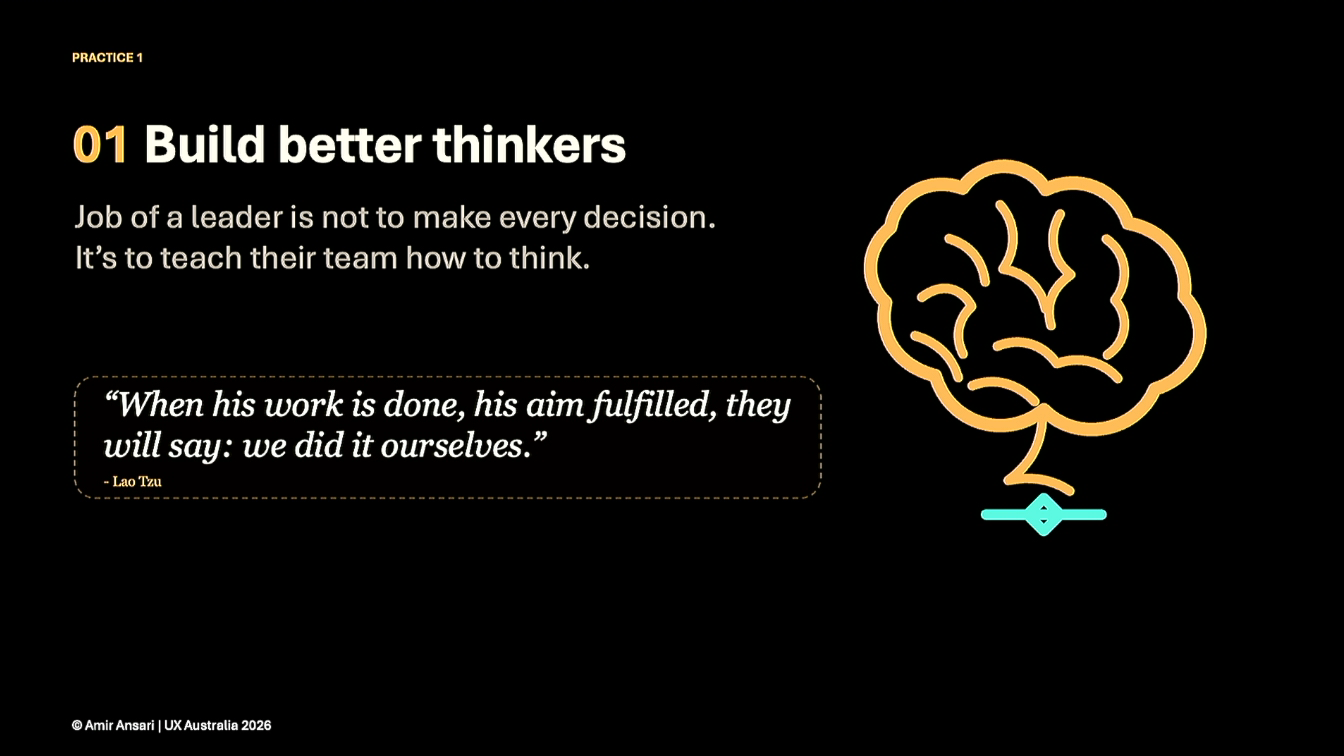
Our goal as leaders is to help people be better thinkers, better humans, and better leaders. I'm gonna spend the next little while unpacking these three and give you some principles. Let's start with the first one: building better thinkers. So the job of a leader is not to make every decision.
It's to help their teams build judgment to make better decisions without them. A Chinese philosopher once said, when his work is done, his aim is fulfilled, they will say, we did it ourselves.' So, I'm about to share three principles.
Now, this is not a definitive list. These are the three go tos that I go to when I'm trying to practice this leadership practice. The first one: We need to navigate trade offs. We need to help our teams navigate trade offs. Questions such as: What are you choosing not to optimize for? Which of your choices or decisions is the least worst?
Unpack ambiguity through curiosity. As designers, we are naturally curious, right? So get your teams to ask: What do they know? What do they assume or need to learn? What might you be missing? What don't you know? And finally, practice judgment.
What is your most responsible choice from here, especially in the current climate? So, I thought I'd pick one of these and share a personal story: navigating trade offs. As a young leader, I remember spending the majority of my cognitive energy trying to make the decision between two very poor choices.
I had to pick one. So, probably about fifteen years ago, probably a bit longer, I was asked to step up for being a principal consultant to run the operations of the Melbourne studio. So I was already client facing, I was on projects, I was billable, but now I was responsible for the operational and financial health of their practice, as well as the 15 consultants.
Now, there are a few consultants in this room. You know what a good consultant does? Prioritizes clients every single time. Because we know referrals come from good clients that are happy. And conversely, if we do a poor job do a poor job of servicing our clients, not only will that one come back, we'll have a commercial, financial, and reputational risk.
So, single day, I used to wake up with these two choices of: Okay, do I give some love to the clients, or do I give some love to the Melbourne studio and the consultants? And every single time, I chose the client. And I didn't feel good about it. And fast forward ten years, I met another organization, and we won an amazingly lucrative client that would feed us for about six months.
And within the first couple of months, we realized this is an extremely toxic client. Poor behaviors, gaslighting, just to name a few. So bad that our teams were actually having mental breakdowns and using our EAP service. Now, I had to make a choice: do I keep the teams of that client and help feed them for the next six months?
Or tell the client, no, thanks,' pull the team out, but because of the revenue impact, potentially have to make a few of them redundant? I'm not sure what choice you would make. I made the choice to get the team to be pulled out, because I felt I had a duty of care, as their leaders, for their mental health.
But unfortunately, that led to some redundancies. Not a big amount, but a few. What I did learn during that process was, while navigating trade offs, we need to make the trade offs visible, choose deliberately, communicate clearly, and revisit the decision when the context changes.
And it's a hard task. Practice number two: Building Better Humans. As leaders, need to foster the conditions for people to be brave, kind, honest, useful, and to lead from where they are. Good old Simon Sinek, He says, leadership is not about people being in charge. Leadership is about taking care of those in your charge.
So, three practices, or three principles that I tend to follow to be a better human. First one: protect the space. High trust cannot survive constant panic. I'll just repeat that. High trust cannot survive constant panic. So as leaders, we need to let our team's ideas and concerns and mistakes surface in a safe environment.
As leaders, we need to be generous. We need to be generous with our eyes, ears, time, energy, shoulders, wallet. Let them know that we're there for them, and show up. And the third one: Demonstrate that humility and vulnerability are key traits of a good leader.
So, thought again, I'd take one of these principles: protecting the space, creating a warm environment for people to be themselves. Now, mentioned to you at one of the gigs that I was told that the design manager in my team went for my job and didn't get it. So I knew when I started that job that I would have to spend the first two months really building trust and showing why I deserve to be in that role.
Three months in, we're having a one on one, which we do on a weekly basis, and this person opened up and said, Amir, look, I have to be honest with you. I went for your job, and I didn't get it. I've been pissed off ever since. And I've been watching you like an eagle, waiting for you to trip up. I went, wow.
Good to have a friend around? But he went on. He said, but in these three months, you've shown me why I wasn't cut out for the job. I couldn't do what you're doing right now, and I thank you for it. And I got goosebumps. It was fully unsolicited.
But he didn't stop there. He said, I trust you. I feel like this is a safe space. I don't want to be a leader. I never have. I'm only in this position because of my tenure and of my age. I would love to be an individual contributor, and I want to work with you to see if we can make this work.
Now, that takes a lot of courage and there's a lot of bravery, right, to come and tell your manager that you don't want to lead people. And in effect, what they were saying is, I want to dump my people onto you to sort out. And obviously, I'm not going say no, so I supported him. We created a new role to go over his team in a short period until I backfilled.
But I was really proud to go, wow, okay, I've managed to create such a safe space that this person is willing to be fully open and honest about where he's at. A lovely friend of mine, Veeda, who used to be the head of design at Medibank, wrote a beautiful book, I highly recommend it, The Soft Power Manual.
And in it, there's a quote that I've pulled out here: Create the space where your teams can cry, laugh, breathe, swear, collapse, recover, and celebrate. So I'm going ask you to do one thing for me now. When when I count to three, I'll talk about the people online in a second, turn to the person next to you and give them a hug.
Don't make it awkward if they say no. Inform consent. If you're by hang on, I haven't counted to three yet. And if you're by yourself or if you're online, just give yourself a hug. Are we ready? One, two, three. Just keep making it.
They say twenty seconds is what a good hug should blast. Online, I can't see you, I can't hear you, but I'm hoping you've given yourself a hug. Thank you. And final, practice: build better leaders.
Don't create followers. Create people who multiply judgment, care, and craft. American political activist and lawyer says, The function of leadership is to produce more leaders, not more followers. So, the three principles that I tend to follow.
Again, it's not a definitive list. First one. Delegate judgment to your people. Right? Give them real decisions, just tasks. Create multipliers and let leadership travel. Teach people to influence rooms you are not in.
Help them coach people internally or externally. And the last one, build calmness on the chaos. Show and teach people how to manage their pressures and craziness and lead with calm clarity. So I'll now pick this last principle and unpack it.
Now, you might recognize this person. You might see this person as a TV celebrity who jumps into freezing Arctic waters butt naked, or eats scorpions for breakfast, lunch, dinner. Or you might see him as an SAS member, part of the British elite force named Bear Grylls.
So Bear Grylls goes on to share a story about what it was like as part of the induction process into the SAS. He said, they got him to do these things called sickeners. The word probably explains it, right? Two minutes of hardcore boxing, unlimited push ups and sit ups, Hill clients carrying another recruit until they vomited.
And that they got him to do it again, and again, and again. Now, initially, he thought, this is the recruitment process. They're choosing the best from the worst. And that was partly true. But later, he had an 'ah' moment. He said: You realize that the purpose was something entirely different.
They were building calmness into their bodies. It says, when you've been pushed to the point of vomiting a 100 times in training, the real crisis does not feel like the end of the world. Your hand functions, your brain functions, your lungs are still functioning. Not because you're fearless, but because you've been there before.
And he says that, you know, calmness under pressure is not a personality trait. It is a discipline, and it is built. And a quote that I've pulled out, when you see someone step up in a moment of chaos and lead with clarity, you are not seeing a spontaneous act of heroism. You are seeing the result of thousands of quiet, unseen repetition.
That's way too slow. And that reminds me of another personal story. I remember Tim and I were in a client kickoff, and within the five minutes, the client changed the scope, delivery timelines, budget.
After about sixty minutes, the client leaves, and then my team and I are having a debrief. And I remember one of my designers comes to me and goes, Amir, what the fuck? Were you not there? Were you with the fairies? Were you not listening to this? This is going be an absolute shit show. And I remember telling this person, it's okay.
I've got it, we've got it, we've been here before. We'll make it work. And I think about six or nine months later, at the end of the project, we're having a showcase and a bit of a debrief. And I remember, as this person was standing up, actually presenting to the client, he looked at me and gave me a nice smile and a wink, and I knew exactly what he was doing.
He managed to build some calmness on the chaos. So, it's the people that carry leadership forward. Right? Your influence moves into organizations, teams, products, and services that you may never see. So, by focusing on the people, teaching people to be better thinkers, better humans, and better leaders, you're setting up for a much more effective long term investment that compounds after you leave.
A buddy of mine, David Bacon, who's currently at Bupa, got me across this term called the leadership shadow. So the idea is, as leaders, we cast a shadow like we do as humans. Right? We cast them through what we say, what we do, what we prioritize, and what we measure.
And that shadow produces some signals. People notice those signals often more than the documentation, the ways of working, the frameworks. And those signals are things like mood, body language, facial expressions and behaviors. And like a shadow, it's hard to turn off. It's always there. So we need to be mindful of it.
So over the years, I've been constantly reflecting on what I've done, what I could have done better, and what should I continue doing. And whenever I think about what leadership means, I think leadership is like being a parent. It's not easy. And as much as you are proud, looking at yourself, going, how good am I?
You're bound to screw up more often than you think. And that's okay. I've made many mistakes over the years. I didn't give someone the space to think in their own speed. I made assumptions about certain individuals' values that end up being so toxic that had a huge impact on the rest of the organization.
I assumed people didn't need my help because they didn't ask for it. I led too much from in front and not from behind. And then I've had to make those tough calls, redundancy, performance improvements, and performance improvement plans, warnings, just to name a few. They never go smoothly, and the list goes on, and I'm sure I haven't been perfect throughout that journey.
So then whenever I talk to my team and try to bolster them and give them confidence to be a leader, goes, I don't want be a leader. Based on everything that you're telling me, why should I? What are the benefits? And then I pull out my phone, I pull out a text message from a staff member that I hadn't worked with for five or ten years, and I say, this is the reason that I do it. It's when you get some amazing people that you've worked with send you a text message out of the blue thanking you for being a great leader, helping supporting them, investing in them, investing in their growth.
And they don't come often, but they come often enough to remind me why I keep doing what I'm doing. They give me a great sense of purpose being a leader. Last time I checked, my design system didn't send me a text message saying, hey, thanks, Amir, you're awesome. Or your capability framework doesn't send you a Slack message, hey, thanks for inventing me. Right?
It's the humans that send those messages. And it's them who carry the investment that you've made in them forward years afterwards. So Maya Angelou says, people will forget what you said, people will forget what you did, but they will never forget how you made them feel.
I think now, more than ever, it's so important for us to focus on the people. In my opinion, we are more fragile and delicate in our generation. I've personally had some really hard roller coaster years over the last few years. Multiple visits to the emergency hospital and emergency visits, and transfusions and operations. I'm currently going through my wife's cancer journey with her, which is not very easy.
I've had death of friends, colleagues, and people that I've worked with, plus all the crap that's going around the world. Right? And I've survived those times, and I think I will continue to survive them because I've had great leaders in my life. And those leaders are not just people like Mark or people that I've reported to, but my daughter, my wife, my neighbor, my colleagues, my friends, some of those who are in this room.
I'm sure each and every one of you have experienced some of these, and probably a lot more. This list is not very long, but I'm sure it can be much longer. So the only investment that I've made that has endured is the people that I work with. Everything else mattered. It was important, but hasn't necessarily endured.
Now, let's go back to the market EMEA conversation. Now, I don't talk in third person, so I'm just going say me. So... I asked Mark, probably a few years afterwards, I said, what did I do, or what did I say, or what did I demonstrate that made you think, Hey, I'm going to invest in me and become a leader?
And he said, It was the first day of your interview. Oh, jeez, I must have nailed that one. And he went to say, we're sitting there, having an interview Thank you. And I could see from your face that you couldn't understand a word that I said. And that's okay, you're not alone.
My accent's very strong. So I said, I'm going to go and get the design manager that you report to, and she can continue the conversation. Great. He leaves, goes to find this person, he walks in, and apparently, and I don't remember this, he sees my shoes on the floor, sees me standing on top of a filing cabinet with a wall clock in my hand as if I'm about to steal it.
And apparently, he said, Amir, what the heck are you doing? Apparently, to which I replied... Daylight saving was about two and a half months ago. No one took the time or the effort just to jump on and set the clock back. So I thought I'd do it. And apparently, there and then, he saw that I had the courage, the initiative, And he felt that instead of just investing in the frameworks and products and experiences, he was going to spend his time investing in me.
And that was back in 2001. And his impact was on me, not just the product or the organization he worked for. That company no longer exists, ironically. So he and many leaders after him have helped me be a better thinker, better human, and better leader.
And you'll be surprised how long your friendships can endure, twenty five years later. As I continue to help people that I'm trying to coach and lead, compound my investment, right now, I am compounding his investment twenty five years on.
So, as I conclude this talk, I invite you to consider that maybe the real measure of leadership is not what you build while you are there. Maybe it's what people continue to build after you have left. Thank you.
People
- Mark
- Warren Buffett
- Simon Sinek
- Bear Grylls
- David Bacon
- Maya Angelou
Technologies & Tools
- Slido
Concepts & Methods
- Design maturity
- Design systems
- Building better thinkers
- Navigating trade-offs
- Building better humans
- Protecting the space
- Building better leaders
- Leadership shadow
Organisations & Products
- Australian Taxation Office
- ANZ
- Telstra
- PwC
- B2Cloud
- Transpire
- Suncorp
- CI&T
- Iress
- CommSec
- nabtrade
- McKinsey & Company
- Special Air Service
Works
- The Soft Power Manual