Applying Anthropology in Design Research: Why Culture Is the Conversion Strategy

Why the Research Brief Already Contains an Answer
William Anthony Yanko, PhD introduces his anthropology background and strategic research role across travel brands. He argues that research briefs routinely prescribe interface changes before anyone investigates the problem. He connects anthropology and design research through the gap between what people say and what they do, framing cultural understanding as essential to choosing worthwhile questions.
Read the Brief as Evidence of Organisational Culture
Yanko examines how questions about adoption, simplification and missing features embed assumptions about users and solutions. Drawing on Clifford Geertz, he treats organisational common sense as something researchers must investigate. He explains how quantitative and qualitative research complement each other and argues that returning a better question can be a project's most valuable result.
Investigate Status, Trust and Everyday Practice
Francis Fukuyama's work helps Yanko distinguish price objections from concerns about recognition, status and inherited trust. He proposes trust mapping and ranking audits to expose how services classify customers. John Postill's attention to practice then shifts research toward routines, surrounding tools and expert users who push products to their limits.
Study Embodied Experience and the Pressure to Be Delighted
Yanko uses Sarah Pink's work to show why bodily experience, surroundings and interruptions belong in research evidence. He recommends doing tasks yourself, recording the setting and examining actual past experiences. Sara Ahmed's account of circulating emotions and happy objects reveals how product histories and expectations can pressure participants to perform satisfaction.
Read Refusal as Identity and Workarounds as Design
Ariel Heryanto's work helps explain why people reject functional products when accepting them threatens their desired identity. Yanko recommends investigating imagined users, social audiences and what agreement would mean to participants. Drawing on Tricia Rose's Black Noise, he then treats spreadsheets, sticky notes and other workarounds as evidence of creative responses to system limitations.
Preserve Local Differences, Uncertainty and Researcher Position
Yanko describes culture as something people perform, contest and translate locally, recommending that researchers analyse groups separately before comparing them. He defines ethnography as a commitment to understanding why apparently irrational behaviour makes sense within an unfamiliar context. Drawing on Sarah Pink, Yoko Akama and Shanti Sumartojo, he argues that confusion and participants' perceptions of the researcher form valuable evidence.
What Researchers Should Bring to Monday—and the AI Era
Yanko consolidates the talk into practices: observe behaviour, collect workarounds, investigate status, preserve contradictions and record confusion before explaining it away. He argues that AI makes plausible answers readily available while leaving the work of identifying worthwhile questions unresolved. Researchers retain their advantage through theoretical knowledge, field experience and an understanding of why people's actions make sense to them.
Two disclaimer. The first one, I did use AI to help me frame and make my presentation a little bit better. I'm not a designer by training, and I'm absolutely terrible at design. You don't really want to see my presentation without the help of AI. The second one. I am somebody who was sorry.
Somebody who was diagnosed with autism roughly ten years ago. So you might see me kind of looking elsewhere or kind of like speeding up or slowing down. Yeah. So yes, sir. Awesome. Now that we are over that, good afternoon. Really nice to meet all of you. All the talk has been incredible, and I'm loving it. I'm Doctor. William Bianco.
I am an anthropologist, and I am a full time cat dad, as you can see from all of you. I I love cats. And these two are my daughters, Haru and Adeline. I even got tattoos of them. Oops. Sorry. I was a bit distracted. I wanna start with something that took me almost a decade now to actually notice, Roy.
Almost every single research brief that I have ever been handed, it always arrived with an answer or answers that are already written into it. Right? People are asking for wording changes. People are asking for the interface. You can see from the brief that they were asking for you to move a button. They were asking for you to cut the steps, to add a feature. And let me tell you, in nearly twelve years now of working in this field, it has almost never been the interface.
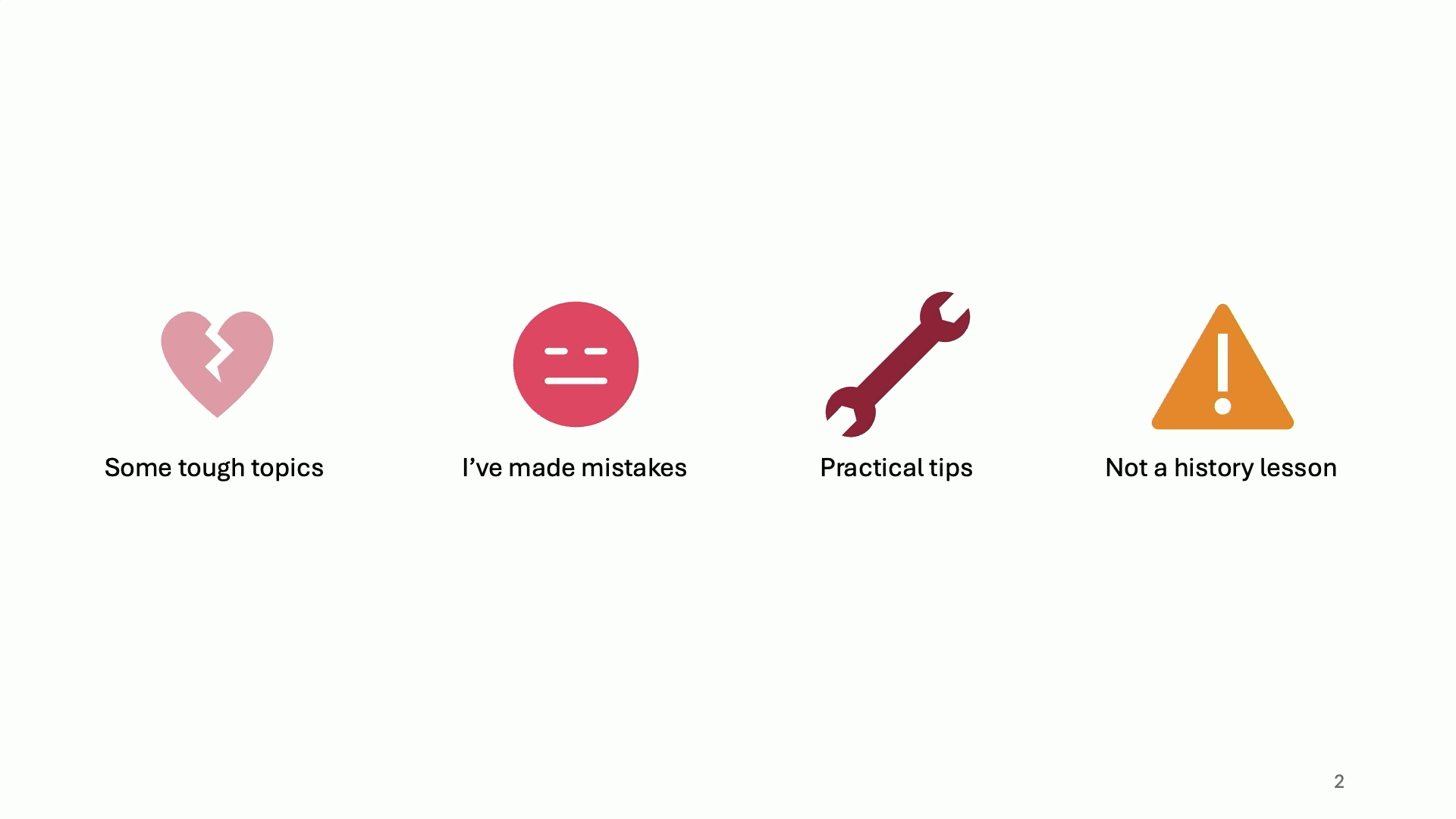
I'm not going to talk to you about any sort of findings tonight. One is because it's a bit too much. And second, I got declined by privacy and security at the flight center, and they said that, no, you shouldn't be talking about any of those things. So sorry for that. Instead, I wanna talk to you about my ways of working that I've been using to to spot that, to spot those sort of things in those research briefs, where it came from, and what I hope I could change when it comes to your Monday morning.
Also, just a bit of context to add here. You might see my title as a research leader at FCTG Leisure. It's a bit of a weird sort of title, right? At FCTG, I structure research to focus primarily on strategic research. So what we do is we work with senior executives. We sit on those executive meetings and collaborate with the board of directors, with the C suits and other senior execs across all the different brands that we have under the umbrella on the annual planning, working on OKRs, and more.
The technical day to day research pieces are now democratized across Flatlander Travel Group, handled by my researchers. We have UX designers, product managers, tech leads, PA engineers. On average, I will say we have roughly 100 to 500 quote unquote researchers that do study analyzing results every single month.
Now, a bit of a word about where I am standing, because the whole talk argues about where you stand this data, right? My doctorate, my PhD, was on the politics of Indonesian hip hop, where I researched into who was allowed to speak, in what language, and what caused freedom in Indonesia. Pretty exciting stuff. Just Google my name and mapping the politics of Indonesian hip hop. You'll find it in Google.
Now, I now lead research across 15 travel brands all across the world for Flight Centre Travel Group. People will assume that there is a career change, Troy, but I will argue otherwise. I'm still studying exactly the same thing. I'm still studying people. In both cases, I'm looking at the gap between a story that people tell you about what they do versus what they actually do.
Exactly the same thing. And in both cases, that gap between those understandings is where everything interesting lives. Now, five words. And this is something that we have always been doing for the past so many years. Why did they do that? It is sort of the most ordinary question in our discipline, being researchers. And it is honestly one of the most difficult things for you to explain to people.
What someone does only makes sense against everything that they already take for granted. And people are almost never aware of that well enough to talk to you about it. Just think about yourself. Have you ever think about the things that you usually do on a day to day basis? And then somebody come to ask you, hey, can you tell me more about that? But you actually forgot that part because it's on autopilot, right? You're so used to doing those things that you don't even realize that anymore.
Nobody can actually really talk to you through their own habits because their habit, in its own term, is exactly the thing that you have stopped noticing, which is a bit of a difficult thing to study. So this is what I want to talk to you today. The first one is on understanding research brief as a product of culture that brought it.
So reading a research brief is actually the real piece of analysis that you would do as a researcher. It's not just textbook work. The second part is seven thinkers and theories, each of them naming a theory and a suggestion for how you could incorporate them into your own work. And number three is what all of this looks when the business wants the answer in forty eight hours, which is typical, including when you actually need to tell them, hey, no, this research actually sounds terrible.
We already know the answer. Why are we even doing this? Hopefully, that will help you by the end of this presentation. Now, the claim at the bottom here is the one that I really want to enforce. Right? Breathing culture is not something that you just add on top of the research. It is how you work out whether the question was actually worth asking at all.
Also, you'll see a lot of memes scattered on these theory heavy slides. I was an academic lecturer for quite a number of years all across Melbourne, And I know memes are the only thing keeping people up when we discuss this kind of heavy theory. So look into that. Part one. Before we get anywhere near old methodology, I want to look at the one thing our field rarely study, which is those resource requests, the resource brief itself.
Now, I want you to read these three questions with me, right? Will, why won't they adopt it? Pretty typical. Somebody will ask you, why are they not using that sort of feature? It's incredible. That research brief has already assumed that the tool that you design and the tool that you have works, and the deficit is on the user. Number two, how do we simplify this?
Typical. There is an assumption that the problem is user effort, which means that every remedy that's available to you is abstraction. That means that you need to reduce something to make it simple. And number three what features are we actually missing? What's there is that, oh, that means that we're actually missing something.
That it means that we need to add something into the backlog, which is not always the answer after I did ten to fifteen years of research. What I found really interesting here is this dude right there, Clifford Gertz. Anybody knows who he is? Yes. Amazing. Awesome. He's super useful here because he treats common sense as a culture of its own.
It's not the absence of a theory, but a theory that's so subtle that nobody can see it as one anymore. A research brief is common sense written down. It tells you what your organization has stopped arguing about. Now, let me be extremely careful here, because I I don't I don't wanna step on, you know, other people's foot, right?
Because this is where people might be like, oh, hey, numbers, quant data, they are bad. Qualitative data, the best. Not exactly the case here. I run surveys constantly. Would not be able to do any of my work without surveys. They really are great at a subluxury scale. They give you a lot of pictures about distribution.
They give you boundaries of a claim that you are entitled to make via your research. But what they cannot tell you is why what someone did made sense to them at that specific moment in time. For example, you have seen a Slack message that say, oh, hey, we actually noticed a drop of red records that 1,000 people have left this page overnight.
What is going on here? What that message say is that it cannot record that page that said something about who they were and why the users left that specific page. And this is why we do qualitative research. This is the part that you can actually act on. And this is the part that actually needs a lot more investigation.
Now, this is a change that I think a lot of us need to make. When you're given a research brief, you answer a question that you were given properly on time because it's corporate work. But what you need to do then is to hand them back questions that the research tells you to investigate. In academic research, this is something that's completely normal, right?
You go out, you study one thing, you find out that the question that you were trying to ask was kind of dumb, and then the field tells you that the study is actually about something else. And reporting that finding that the question that you are asking is the wrong question is the most important thing to do there.
Right? It is not a scoping failure. The project was actually a success. Unfortunately, in our industry, I found that it's still being treated as going off brief. I will argue here that that is exactly the most useful thing that you can do as a researcher, which is, you know, go off brief.
Part two. Seven ideas. Each one of these is a life's work. I tried to squeeze them into two slides, which is honestly a crime against all seven of them. They they will hate it so much. However, you know, being an anthropologist and a rule breaker that I am, I'm gonna do it anyway. Now I wanna I want you to take them as tools.
These are not summaries. I'm not trying to be Claude. I'm not trying to be Chad GPT or I'm not trying to be jabinized here. Keep an open mind and see what you could incorporate into your mundane. First one, Francis Fukuyama. His thesis that I really love is this. What are people actually pursuing? Digging up this old Greek word, timos, which refers to the part of us that needs to be recognized as worth something, that matters because a lot of behaviors that look like it's about money, it's all about status. It's different.
His other work, this book right here, trust, hits a little bit harder. The willingness to trust a stranger is something a society inherits. It varies enormously between places, and no company can simply decide to have this trust. You can't just come in and say, hey, user, you need to trust me now because we are great.
That has never worked, right? This is why trust badges do not produce trust. And a friendly tone of voice that you hear companies try to do via prints, via ads, or even using Salesforce, Agent Force, it's terrible. It does not produce trust because it sounds like human, but it's not human. There's no connection there.
There's nothing being built between those two. Both of these things are interaction. Either someone gives or someone does not give the trust. Now, there are three learnings here. The first is what I will call probing past price. When someone gives you a course or a time as a reason, do not accept it as the answer. Ask them to describe, when was the last time you actually feel like the wrong sort of customer?
Because nobody can actually really volunteers. They don't like telling people when they were being made to feel small. But people can tell you a story about that. The second one is a trust map. Before you ask, what do you think of our brand? Ask them, who do you actually trust within this space of category and where that came from?
Because you are not trying to create and manufacture trust. You are trying to borrow this sense of trust from something else or somewhere else. And the third one is the ranking audit. Walk your own process end to end and write down every single point where you sort people by tier, by eligibility, and by how much people spend on your product or the audio services.
That list is kind of short. It is usually extremely uncomfortable for you to actually interrogate yourself there. But that's exactly where you need to study it. Second one is Doctor. John Possel from RMIT University. He is a personal course friend of mine. He was my research mentor. He was my PhD examiner as well.
And he's somebody who's just excellent. His recent research talks about how we should stop studying the thing itself and stop studying the audience, which is interesting. It's different from what we have heard so far. But you need to study the practice, the routine, the unremarkable, those things that people barely notice that your object of study sit inside.
So study where they sit. Study where they are. Study those environment. A field of study is a matter of relationships. It's not just places. Online, offline are not two separate sites. And this sort of platform is not a community, which means that the interesting question here is really what people think about your product, but it is what your product has become a part of.
Three learnings here, shadow the routine rather than booking a session. I notice a lot here. An hour will be somebody doing the actual job from before. Your product was being open or your service is being open. And after it closes, we'll tell you more than the seven interviews conducted outside of the context. The second one is collect the parts that you do not own.
Ask them to screen share things. Ask them to open things. Look at their browser tab. What are they actually looking at? Because I don't know. Love it. It's a little bit privacy related stuff, but that's where the fun is. That's where the knowledge is. Your product does not sit by itself. Nobody is using just your product.
People open other tabs. And that's the part that you actually need to study. And the third one is recruit deliberately for the power users. So these are the people who have promised their life that they would destroy your product. They would push your product to its limits. But these are people that you need to talk to.
These are people that are so expert at their product that they are better at their product and services than you yourself. Talk to them. Professor Sarapeng, she has been mentioned quite a few times here. She's the third one on the list. There are two insights from her work that I really lean on. The first one is that experience always happens somewhere and with the whole body. So you need to embody that feeling, that experience in a particular room, here, at the temperature, at the temperature, in front of somebody else. If you strip all the setting away for the for the sake of control, like what we are doing a lot of when it comes to a moderated research online, you have removed that fairy thing that you were trying to study.
See, not that if you that you learn by taking part yourself rather than pulling answers out of somebody that sit across the table of you. Do that thing yourself. Experience it. See what it feels like. See what it looks like. And the second one from her book, Principles and Practice, is that the online life is not a separate world needing separate methods.
So aligning with John earlier, she wants us to follow the practice ceremonies around the product and not just the product itself. Three things. First one costs absolutely nothing. Have you ever tried to do that task yourself, like those tests that you're launching? Unfortunately, in the company where I work for, that is a rare thing to do.
So people will just launch something, and then they're like, oh, wait, why do people not take it to do it this way? Because they didn't even test it among themselves. So do that. The second, lock the setting wow, that's a good timing. Second one, lock the setting the way you lock your sample, where they were, who else was there, what was interrupting, whether they were standing up between other jobs.
And a remote unmoderated session is a setting, too. So make sure that you record all of those different things. I think we were talking about AI and how AI captures those sort of words that people are talking about. But the context, even if it's an unmoderated session, pay attention to the background. What do people actually do? Are they kids screaming at the background?
That means that your product needs to do something else or something else. And number three, chase the instruction. Not tell me how you plan a trip, but show me how you did the last trip. Because whenever you ask people, hey, this is the future thing. This could happen. What will you do? It's not great. And don't correct people when they do the wrong thing. Ask them what they experienced instead of what they wish it could have happened.
Professor Sara Ahmed, if you have read her work, she's just incredible. Her works have really changed how I write discussion guides the most. Her argument is that emotions are not private things sitting inside of us that we then let out. Emotions move between people. And as they move, they stick to objects, which then build up feelings over time, over these years and years of continuous contact.
Insurance policy, for example all of us here well, most of us, hopefully, have insurance policy is not a neutral thing. It is carrying every claim that anyone in the room has ever had refused. Her second idea is about happy objects, where there are things that are promised to make us happy.
Holiday, for example. You are expected to be happy when you think about holiday, and whoever refuses being happy when thinking about holiday becomes the killjoy. In our context, moderated study in a corpora setting, it means that the delight that sometimes you record in a session may actually be required of your participants.
Those things are being enforced of them. When they're using your product, they need to lie. They need to tell you that your product is incredible. But that is something that we shouldn't be doing. That is something that we need to fail rather than enforce. Those things are not being built naturally. Now, three things from Sara Ahmed's.
The first one is to stop asking how they feel about the product and ask them to describe the last time they dealt with one in order from the beginning. You want an episode, not just an attitude. The second, trace what has sparked to it. Ask what they have heard about this product from other people, because the reverse claim when it comes to insurance, the late refund when it comes to travel, the argument at the counter when it comes to travel, all arrive with your product, whether or not they happen to your participant. They have heard about it from somewhere else.
And number three, recruit people who will not perform the like. Find people who actually hate your product because these people are people who will actually tell you clearly and honestly what your product is all about. Stop talking to people who like your product. Ariel Herrianto is number fifth on the list, the closest one to my own training. He is an expert in popular culture in Indonesia.
He writes a lot about military dictatorship and how purchasing something is a form of identity. Now, this is what's interesting. When you think about version of products, think about every product a company has ever labeled budget, basic, or essential. Think about Kmart versus Target, right? Encore versus big brand items.
The product usually works. The shirt that you buy off Kmart will perform exactly the same as the shirt that you buy off Uniqlo or something else that's a bit more expensive. But there are people who refuse to buy them, and they refuse it the hardest when other people can see that they are making those choices, when people notice that, oh, wait, why are you buying those cheaper stuff? Because accepting those things means that they are being found some way that they do not wish to be classified as.
The same with health, right? If you offer assistance to somebody who believes that they shouldn't need assistance, and the offer itself is an insult, in either case, people are not just refusing the offer. It is about what saying yes to those over made them feel and look in the eyes of their peers.
Four things here. The first one is the one that I always use every single time. Who do you picture when you actually use this product? Then how is that person different from you? Because people can rarely describe how a product say about them. But people, they can describe the imagined user and the distance between that figure that they were talking about and the person that you are talking to. It's the learning for you.
Second one, again, find the correct audience, because people choose with somebody in mind, even when they are alone at a laptop. Who will know about this choice and what they will think about that choice. Number three, ask what saying yes will have meant to them, not what it will cost them.
And number four, I know this is super cute, all the cats. But when you are doing qualitative research, please retire the rating scale. Don't ask those questions around that, because that scale is built for arithmetic, right? It doesn't record a statement about who someone is. Every single time you ask those, you actually start to classify people based on that sort of selection.
And referring back to what I had discussed earlier, that is not something that you want to do. Professor Trishiros from Brown University is number six. Her book, Black Noise read it. It's incredible. She explains hip hop's core techniques, flow, layering, rupture, as a style that's built directly out of having very, very little. Thus, broken equipment, the limits of the equipment, it turned into a craft that billions of people all across the world laugh and enjoy to this day. I mean, I wrote a thesis on its interpretation and localization in Indonesia.
And what we could get from Tricia is applying the concept that she had in her book, where organizations have something that they're using that's not being classified as tools that are approved by the organization. Think about the spreadsheet that you're looking at. Think about all the sticky notes that people are sticking all over your office. If I walk into Flight Centre, I will see people having spreadsheet and print out Excel spreadsheet just on the wall, because our tools are sometimes a bit terrible.
But they had to use that. So look at that. Look at those laminated card. These shadow processes are the most honest, the signed documents in the building. Somebody made those under real conditions with no budget, no permission, and they are still being used. So a workaround is worth reading as something somebody made rather than a filer to comply.
Four learnings here. First, collect the artifact. Number two, interview the person that made it, not just the people who just use it. Thank you. Number three, name what was being withheld. Understand why do people do certain things.
And number four, write the finding very important as a property of the system that you're studying rather than the property of the person that you are studying. Because the moment you say if you put not following the process, it describes human being, right? Not given what they needed describes a systemic problem.
It's a problem with the system. And that is something that you can decide and prove on, and you don't actually make the blame. You don't shift the blame onto the person, onto your users. Hello? What are voices? Associate Professor Brigitte Brosele, the last one, from University of Copenhagen.
She's incredible. For her, culture is not a fixed backdrop. It is something that's being claimed. It is something that's being performed and something that's being argued over and a value that only really holds somewhere once somebody has put it in a local term. Learnings from her, segment before you synthesize, Analyze each group on its own term, and only then compare across demographics.
Because the moment you put everybody into just one pool, it will produce a middle that no group recognizes and nobody will actually act on. So segment first. And number two, trace the local version. Take any standard that you have set centrally, a service promise, a design pattern, a policy, and go and find out what it has become in three different places.
Local variation is not people getting it wrong. Is not being the standard that's being used by these people. And number three, follow where the story gets retold. Ask who told them this and who they have told since, because as the accounts morph, they travel. And by the time you hear the version has already been shared by its own route, think about it as the Chinese Whisper version of your own products.
And number three, I think I'm going to skip this because I'm running out of time. But Oh, I'm fine? Yeah. Awesome. This one is quite interesting, right? When we as an ethnographer, as an anthropologist, I rely on ethnography to do everything. But I feel like ethnography has quietly come to me in an interview that's being conducted in somebody's kitchen.
Ethnography is not just a technique or a longer session or a question of where the researcher happens to be sitting. The way I think about ethnography is this. Ethnography, when you say that you're doing an ethnographic study, it is a promise that you make as a researcher. That behavior, which looks irrational to you at the time, makes perfect science inside a context that you have not learned yet.
And the learning of it is your job rather than a participant's job. That promise travels. Right? Understanding that it will survive that three week timeline study. And that's something that we need to keep track of. The moment you do not understand.
So Professor Sara Ping from Monash University, Kamzakiya, with associate professor Yoko Akama from Aramaide University, and Professor Santi Sumatojo from Monash as well. All three of them, they all work in design research rather than pure anthropology. Their argument is that uncertainty is not a problem to be clear up before the real work starts. It is the condition the work happens in, and the moment you cannot make sense of what somebody had just said is the most informative moment that you get.
Because that is their way of making sense running into yours. It's two different ways of interpreting the same exact thing. It's quite interesting here, because most of us are trained to smooth those moments over. Most of us want to feel comfortable in understanding everything. Most of us want to feel comfortable with just knowing things, right? But that's the thing that we shouldn't be doing.
We should avoid that. We need to be comfortable in being uncomfortable. And this is the bit that I feel like our industry has dropped when it borrows the word anography from academia. In academia, you are required to say where you're standing. You work for a company whose product you're asking about. The participants, they know that.
And that conviction of them knowing already shares the answer to the research problem that you are trying to solve. And you shouldn't be trying to scrap that bias of your data. It is a part of the encounter. It is the evidence itself. Who they think you are tells you what they think the company is. So write about the conditions of the encounter into the study itself, in the same place and with the same care as you write up your sample.
Now, this is something that I'm going to skip. I've talked about that. Now, this is what I really mean by the title. Reading culture is what turns a number somebody can explain into a decision somebody can defend. And the one thing about that moment we are in, anybody in this room, you all can get a really comforting sounding answer to a stated question in about four seconds.
All of us have access to AI. Working on which question was worth asking takes knowing the field, and that part has not really gotten any faster. So five things that I hope you'll take with you and practice them on Monday. Number one, Postal and Pink tell us that what people say is a story told afterwards.
What they do is the evidence. So build the study so you can watch their behavior and treat the gap between the two as your finding. Trisha Rose says that the things that people actually do might not be actually covered by your interviews. So collect the spreadsheet, the workaround, the sticky note. Fukuyama and Ahmed argue that people act to be seen as worth something, and feelings stick to things rather than sitting inside people.
So treat those price objection, people complaining about how expensive your things are, as a claim but standing until you have ruled it out. Grossler Ariel Heranto asked us to never average away a contradiction. Embrace those things, and read the brief as evidence of what the business already believes. And five, the one that's most often being skipped, Yokal Kama, Sara Hping, and Santi Shumatajo, they want us to write the confusion the same day before you explain it away to yourself, before you try to justify what you're thinking about.
Because tidying those things up into themes are where those moments actually get lost. Now, one last thing, I swear. And it's the reason I gave this talk today, right, whether there's a set of case studies explaining what I did at Flood Center. Everybody in this room, you all can get competently sounding, confidently written answer to almost any question in about four seconds because of AI.
That speed from question to, you know, quote unquote, insight is leveling out super fast, and it's not where researchers like us will be valuable. What doesn't level out is knowing the theory well enough to see what approaches are missing, knowing the field well enough to know which question is worth asking, knowing the people well enough to understand why what they did made sense to them, and having actually done the work rather than reading a terrible AI summary of it.
That combination is our advantage as design researchers. Now, if any of this is useful to you or you think, oh, Will, you're just talking out of your yeah? The QR code on the right is where you'll find me. I'll genuinely welcome argument, criticism, anything. Thank you. Thank you.
People
- Clifford Geertz
- Francis Fukuyama
- John Postill
- Sarah Pink
- Sara Ahmed
- Ariel Heryanto
- Tricia Rose
- Yoko Akama
- Shanti Sumartojo
Technologies & Tools
- Artificial intelligence
- Microsoft Excel
Concepts & Methods
- Anthropology
- Strategic research
- OKRs
- Research democratisation
- Quantitative research
- Qualitative research
- Thymos
- Probing past price
- Trust mapping
- Ranking audit
- Shadowing
- Embodied experience
- Happy objects
- Ethnography
- Researcher positionality
Organisations & Products
- Flight Centre Travel Group
- Salesforce Agentforce
Works
- Trust
- Black Noise