Beyond the Method: Ethnography as a Mindset
Reading the Room
Bec Purser and Sophie Goodman position ethnography alongside strategy and design: strategy chooses the room, design shapes it, and ethnography reads it. They argue that organisations lose valuable context when they treat ethnography only as a supporting research method rather than a broader mindset.
What Ethnography Adds to Strategy and Design
Purser and Goodman connect established accounts of good strategy and design with ethnographic habits such as noticing absences, understanding context, and tolerating discomfort. Mary Douglas’s institutional theory and Gillian Tett’s “anthro-vision” show how ethnography can challenge organisational tunnel vision.
A Profession in Need of a New Story
Future-of-work reports prize capabilities already cultivated through ethnographic training, yet the discipline faces problems of awareness, acclaim, and access. Drawing on Australian meetups and shrinking university programs, the speakers call for a story that presents ethnography as an organisational capability rather than a matter of professional luck.
Guidepost One: Start with People
Bec Purser introduces six guideposts for an ethnographic mindset, beginning with people rather than predefined problems or objectives. A Mumbai railway safety project demonstrates how studying perception and existing behaviour produced a low-cost intervention where warnings and barriers had failed.
Guidepost Two: Decentre Yourself
Purser frames decentring as an active examination of one’s assumptions, power, values, and position. She links cultural humility and decolonisation to co-creation, self-determination, and even more-than-human design through a Singapore building created for both people and urban ecology.
Guidepost Three: Models Serve Reality
An ethnographic mindset treats every model as provisional and useful only within context. Purser shows how ethnographic work at a Middle Eastern theme park revealed group bonding as the real driver of satisfaction—something an elaborate data platform and its existing metrics could not capture.
Guidepost Four: Stay with Discomfort
Purser describes discomfort as a productive signal that researchers should investigate instead of smoothing away. Contrasting anthropology’s colonial legacy with the Uluru Statement consultations, she shows how remaining open to tension and unexpected demands can reveal deeper truths and more consequential outcomes.
Guidepost Five: Integrate the Whole Practice
Ethnography becomes more than interviews, observations, or coding when practitioners combine them with curiosity, interpretation, participation, and sustained contextual engagement. Intel’s mobility research illustrates how integrating social observation, ecosystem mapping, business analysis, and hypothesis testing can reframe an entire strategic problem.
Guidepost Six: Build the Muscle
Purser presents ethnography as both an ethical profession and a capability learned through repeated fieldwork, reflection, adaptation, and unlearning. The long-running user-experience practice at Danfoss shows how organisations can develop this muscle from conventional testing toward contextual and participatory work.
Practices for Reading the Room
Sophie Goodman closes with practical ways to cultivate the mindset: seek unfamiliar ideas, question assumptions and power, pursue contradictions, make theoretical framing explicit, and treat interpretations as hypotheses. She and Bec Purser urge practitioners to embed ethnographic thinking throughout projects and commit to continual learning, unlearning, and relearning.
So firstly, don't let that fool you because we are actually quite friendly. But why are we here today? So we are social science groupies, basically. We're big believers in ethnography as both a method and also the value of it as a distinct mindset. So we talk about it a lot together. We've both worked as ethnographers with some excellent strategy and design teams and we think there should be more of it.
So, as you found out, Beck is a service designer in public transport with a degree in design anthropology. I'm a design and social researcher with an applied anthropology degree. So every now and again, we think that we should do something constructive by getting out of our rabbit holes and testing out our ideas with others. So here we are.
And we think you're gonna be good audience in this particular conference to see if it resonates and hopefully the ideas we share will be of value to you also. So if we start off with how we've been thinking about this, is thanks, Megan. I told her she needed to mind that.
A way of how these three things fit together. So firstly, using a metaphor of a room. So strategy is about choosing to be in that room and design is about shaping the experience of that room. Ethnography is about reading the room. So but not just in the familiar way of like a research method. So who's in it and what they're doing, but more in a broader way that considers what's normal, what's unsaid, what's expected and what histories are playing out beneath the surface.
So we already know that strategy with design and design with strategy are pretty established combinations. However, many organizations minimize the role of ethnography and yet the broader context, the history, the unsaid and everything else playing out below the surface will always influence the choices being made and the experiences being had, whether we acknowledge and plan for them or not.
So let's just look a little bit more closely at how these three things fit together. So there's an existing relationship between all three, but we'd argue that the ethnography as method currently sits in a supporting role to the other two. That's okay, but it's not the full story. Firstly, we think you we're gonna assume that you guys are familiar with ethnography, its relationship with anthropology, and are familiar and that we expect you've probably also even used it, but in its method, research method format. We think you're sitting on a potential gold mine if you can harness it as a mindset because it adds valuable dimension to both strategy and design and bring something unique on its own.
So let's look briefly at what good looks like for each of these. So according to business professors Michael Porter and Roger Martin, good business strategy is understanding internal capabilities and external opportunities and making choices about those. Martin emphasizes that strategy is as much about deciding what not to do as what to do.
Good strategists, he says, embrace discomfort and understand that strategy is about influencing external customer behavior as well as your internal stakeholders. This inside outside perspective, paying attention to what is and isn't present, giving consideration to multiple audiences, and sitting with discomfort is really familiar with ethnographers. This to us starts to sound a lot like a reading the room mindset.
Now to design. According to Don Norman, good design is harder to notice than poor design because it fits so well that with with our needs that the design often goes unnoticed. Dita Rams, the creator of the 10 commandments of design, said you cannot under you cannot understand good design if you don't understand people. Design is made for people.
And in architecture, there's a saying about the importance of designing a thing by considering it in its context. So a chair in a room, a room in a house, a house in an environment, an environment in a city plan. In ethnography, we call this thick description. Once again, this sounds like a good fit with an ethnographic approach, such as noticing what's hidden in plain sight, identifying unmet needs, and understanding people and their experience.
But what does ethnography bring on its own? Ethnography is great at questioning default logic and viewing things from different angles. Anthropologist Mary Douglas in her book, How Institutions Think, described institutions as cognitive systems that determine what information is and isn't deemed important or relevant by what they allow in and what they don't, what events are remembered, and what are accepted narratives.
As a result, this institutional mindset can create a form of tunnel vision. The pitfalls for strategy and design are obvious with this institutional mindset. So for example, a company's ideas about customers, the market, its employees, what the future looks like can prevent them from identifying emerging trends, risks, or opportunities that don't fit their existing mental models.
And an ethnographic mindset can be an antidote to these pitfalls. Gillian Tett, another anthropologist and the editor at large of the Financial Times in The US, refers to the perspective that ethnography brings as anthro vision. So which is a type of lateral vision that helps broaden out from a company's tunnel vision and even see around corners.
So theoretically, ethnography can add depth and dimension to both strategy and design and bring its own value. But let's look at what's beyond theory and conceptually possible to the skills of the future. So this is analysis for of the core themes from the future of jobs reports by the World Economic Forum from the last nine years. So going back from 2016 to 2025, as well as the most recent jobs and skills Australia reports so we can get a bit of an Australian perspective.
The top five skills of the future match what training in ethnography provides. So it looks like an ethnographic mindset is perfectly placed for the skills of the future. This should be a good news story for ethnography. But we don't think ethnography story is working quite so well. It's currently limited to just being a method, and we think that the story of ethnography needs an upgrade.
So what's preventing us from having this upgraded story, updated story for ethnography. So there are three a's we've come up with. The first is awareness. So this is from an Instagram reel of an Uber driver talking with a uni student about her studies in the social sciences and her career plans to be a social worker. She finds out during the Uber trip that she will be graduating with a degree in sociology, not the social work qualification she wanted.
It's a funny exchange and I'm glad that kinda worked without seeing the clip. However, we generally have an issue in the social sciences around awareness of what we are about and what we offer. Secondly, acclaim. We regularly feature in media reports such as this one. This shows anthropology as top of the list of unemployment rates of graduates by subject. It's US based but gets picked up by media, circulates around LinkedIn, and if anybody's got a social science degree, it was probably circulating for weeks in your LinkedIn.
It was mine. And forms part of the story about anthropology and ethnography. Then lastly, access. So universities are cutting funding to anthropology and other social science programs. This is professor of anthropology, John Friedman, in The Netherlands. He and his colleagues were fired from their positions in February of this year, and the whole sociocultural anthropology track was removed from course offerings as the university deemed it unnecessary and redundant.
This photo is taken from is is of a video taken on the day he was fired. All their usual buildings and classrooms had been locked, but the students were still there, still wanting to learn, so he gave his lecture outside to students. It was recorded and went viral. He actually now posts he did lose his job, but he now posts popular lectures and content on YouTube and TikTok.
Similar things are actually happening to course offerings here as well. And Beck and I have actually seen these play out firsthand. We started a group a couple of years ago of Australian ethnographers. So one of the things we did was run a series of meetups about the current state of the of the profession in companies in Australia. And across three events, we heard the same thing.
Ethnography story is currently about luck. Luck that we're aware that the discipline exists. Many of us shared stories that we just kinda stumbled and came across it. Luck in finding an employer who values it, although frequently those employers are amazing champions for us. And increasingly, luck in being able to get training in it. So our central point is basically this, and to be honest, this is what we're testing out with you.
Ethnography is a method for providing insight into strategy and design has been a good and successful relationship. Let's now build on it so that ethnography can play a broader role in organizations. We think that by embracing ethnography as a mindset, we can help steer the story of ethnography away from those issues of poor awareness, reduced access, quick jokey media grabs, and towards a profession that epitomizes the skills of the future workforce.
So what is an ethnographic mindset? If you can't tell, it's something that we think about a lot, and I'll hand hand over to Bec.
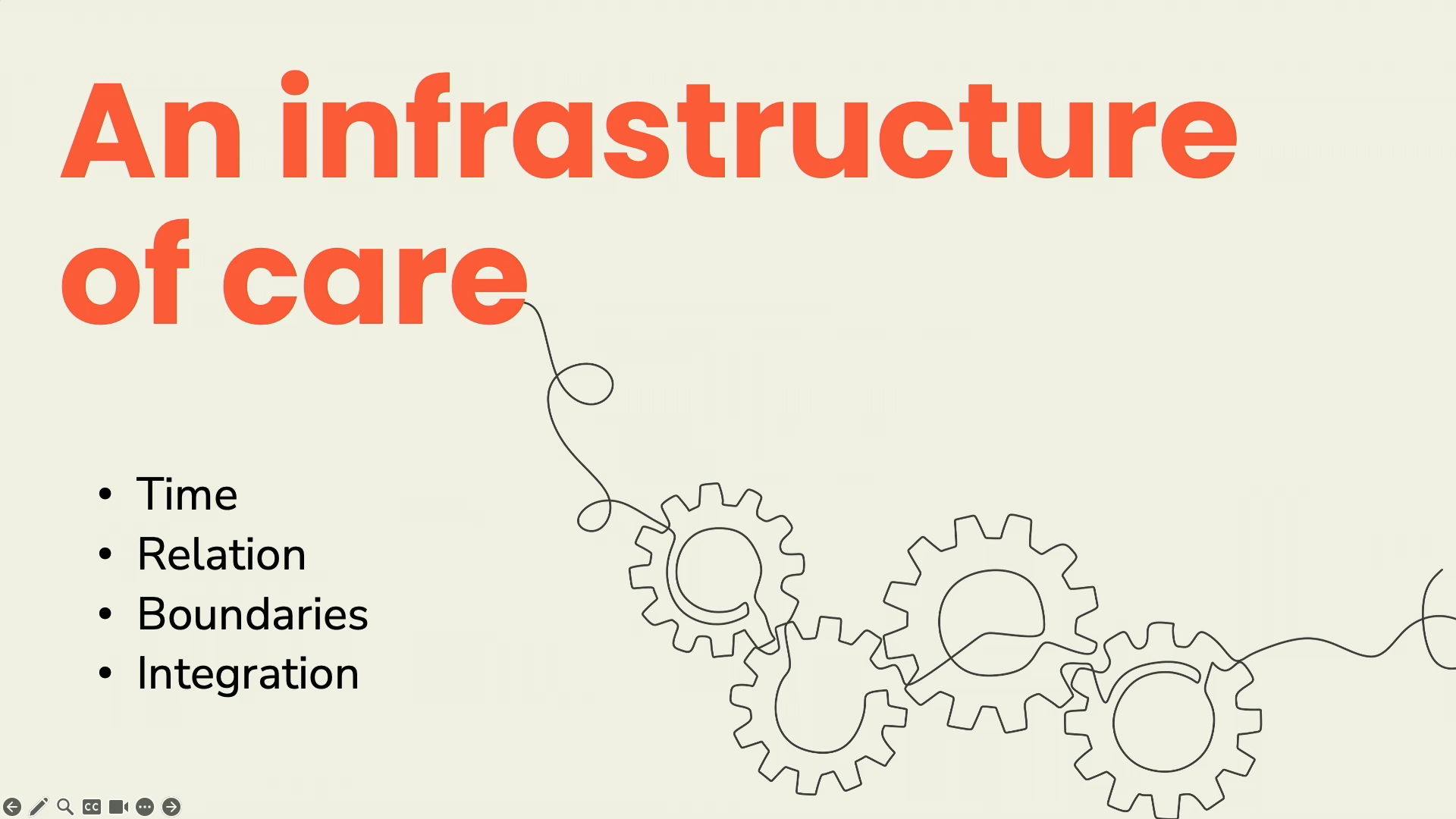
So Sophie and I have put together these six guideposts, we're calling them. They are they're not meant to be they're meant to be reference points over being rules or methods, like markers on a trail. These are supposed to help keep us and, hopefully, you guys as well orientated on the path to help remember what matters in ethnographic mindset, especially when there can be so much noise and distraction in our daily work lives in particular.
The first one is start with people, not problems. If you begin with problems, you risk framing them too narrowly or reflecting institutional priorities over human ones. If you start with objectives, you risk opposing distractions or direction that might miss the grounded truth of people's lives. Starting with people means understanding how they navigate, live, and make sense of the world around them.
From there, problems and objectives can be defined in ways that are meaningful, grounded, and offer long lasting solutions. For each of these, we're going to talk about the history of them. What is the root of these things? When we talk about each of these disciplines, starting with problems, objectives or people, it's not a stylistic choice.
It is one that is based in, deeply rooted in the history of each field. Design orientating from the mid twentieth century, from, engineering and industrial design. Herbert Simon, who wrote The Science of the Artificial in 1969, refers to design as design transforming conditions from preferred ones, sorry, transferring conditions to preferred ones.
This evolved into human centered design and design thinking with Stanford and IDEO, and then systems thinking reinforces this idea by showing that problems are interconnected. But design assumes that problems can be identified, framed, and solved through iterative processes. Strategy, which is rooted in military, business, and economic planning traditions, with Henry Mitzberg's five p's for anyone who's done marketing at university.
It focuses on long term positioning, competitive advantage, and decision making under uncertainty. But ethnography with the fieldwork, the immersive fieldwork of Melanisky, the Chicago School of Urban Studies, is influenced by symbolic interpretism with Mead, by interpretive anthropology with Goertz, and with critical ethnography under Foucault.
It centres context, history, relationship and lived experiences of people. And it assumes that you have to understand the system, you have to understand the people and how they live in it and how they interpret it and how they navigate within it. For each of these, we've also pulled an example to help show how it fits into a real world context, and this is one of my favorite examples to reference.
Obviously, I work in transport, so I love anything to do with trains. But this organisation, Final Mile, was working with the Mumbai rail, company about trains. So in Mumbai, in the in suburban Mumbai, there is a huge set of rail lines, mostly at ground level, hundreds of tracks moving 7,000,000 people every day, an enormous system.
It carries through dense neighbourhoods. Footbridges over the Mumbai rail system are rare and physically challenging to use when they are available, so many people cross the tracks directly. And this involves traversing potentially multiple lines where trains can be passing up to every minute and travelling over a 100 kilometers per hour, and therefore, fatalities are common.
At the time of this project, there was ten people were dying every single day crossing the tracks. So the problem was that safety measures, warnings, signs, media campaigns, and fencing of the past had done very little to change this behavior. But final mile started with people. So they looked at, well, why are people doing this, and what do we know about the people who are doing this?
And one of the things that they identified was that people are actually really bad at identifying whether a train is accelerating or decelerating, and the speed at which it's going on, particularly on straight tracks coming directly towards you. So this optical illusion, where they paint yellow lines on the tracks, actually enables people to very effectively identify whether the train is moving, slowing, getting faster, and what speed it's going, to support the people who are going to take this risk anyway, to make that risk better. It's low cost.
It led to a dramatic reduction in deaths, and the outcome was successful. It also changed the way the organisation considered safety campaigns and how they talk to people in the future Rather than taking this paternalistic approach of, no, you don't, they worked with people to do what they needed to do.
The next one is you need to decenter. It is not about you. This starts with a simple idea, stepping out of your own assumptions, what you prefer, your default logics, so that you can be part of the work. You're still there. Your worldview is important, but you need to examine it, consider your perspectives, your values, and consider your bias and your power in any situation that you're in.
It doesn't mean erasing you. It means recognizing where you stand in that process. Dori Tunstall, who has presented at this conference before, she calls it cultural humility. It's about the practice of self reflection, of understanding your position and how you can learn from others. And it actually goes a step further. It's about listening to learn and to co create with the people that we work with in research, and it's about supporting self determination.
Decentering is not a passive practice. It's an active choice, a choice to step back and to let others step forward. So decentering is rooted in anthropology and ethnography's history, with early researchers often causing harm by assuming that their worldview was neutral or superior. Through failure and critique, decentering has emerged as a corrective response, an approach to minimize misinterpretation and to shift away from extractive results and extractive approaches.
Over time, it's become a core part a core ethical part of this project, and design and strategy has embraced this with participatory methods and how we represent people. Decentering is critical if we want to engage in meaningful ways with decolonisation. It helps dismantle the structures and the assumptions that uphold dominant worldviews, especially those grounded in colonial powers.
And it stands it's a stance, and it's a method, one that enables cultural justice, supports self determination, and makes room for equitable forms of knowledge and collaboration. And in design, it can stretch beyond people. We often think about decentering as marginalized communities, and that is incredibly important. But this is an example from Singapore, where a hotel building was designed, 27 story tower with a living facade, 21 different plants and wildlife that changed over time, with a goal of serving not just people but of the urban life that lived around it, shifting perspective to move beyond humans and to comfort from human comfort to aesthetics. This is a great example of urban reciprocity, where architecture becomes part of the shared environment and not just for the human exclusive domain. All models are wrong, some are useful.
An ethnographic mindset recognises that all models are wrong, but some are useful. It draws from multiple frameworks, theories, but remains unbound to a single one. Context needs to dictate what is useful and what should be set aside. Theory isn't applied as a tool, not a truth. Hypotheses are developed, tested in the field, and refined based on evidence or discarded. In this way, ethnographers stay agile, applying and adapting theory as it fits realities they encounter rather than forcing realities to fit in with its theory.
The phrase all models are wrong, some are useful was coined by statistician George e p Box in the late nineteen seventies. Originally used for statistics, but it has emphasizing that models are always a simplification of reality and can never fully capture the complexity of the world around us. Box's view draws on early scientific philosophy, such as Karl Popper's principles of theory, that must mean that theories are always provisional and testable over time. This idea has spread beyond statistics and into lots of forms of research, including economics, culture, cultural studies, social research, and climate science, but it serves as a good reminder that there are no absolute truths in models.
Red Associates, a very famous ethnography led strategic consultancy, did a great piece of work which was for a Middle Eastern theme park who had heavily invested in a big data platform, and they were trying to measure what was a good customer experience. They used economic models that had been tested and tried from across the world and integrated over 250 data sources.
Everything from ride time to food purchases was all based on existing models and theories around retail and travel. But when researchers looked closer, they discovered something surprising. Through ethnographic work with only 12 visitor groups, they found that the biggest driver of a great visit, of what people determined to be a really good experience, that they would go back, was about group bonding. It was about the people that they were with.
Families and friends cared most about staying together and having a shared experience. Data scientists tried to build a bonding index using the data that they already had in the model, but they failed. The available metrics could not capture a group bonding index. Weak proxies were used, such as ticket scans or purchase patterns, but the problem wasn't the technology.
It was the starting point. The data model had been defined before understanding what actually mattered. Sitting with the discomfort is the deliberate practice of holding space for uncertainty, for complexity, for contradictions, and for emotional unease. Rather than rushing to resolution or control, it involves resisting the urge to impose neat categories, immediate answers or dominant assumptions when faced with situations or perspectives or truths.
In ethnography, design and strategy, it means staying with the tension, the ambiguities long enough for deep insights to develop and having a more respectful response when they emerge. It requires reflexivity and humility and recognizing that your own worldview and tools are not providing the solution, and that discomfort often signals that there is something interesting, that there is something useful, and that there is something valuable in this space.
Goertz described a related practice of thick descriptions, offering layered, context rich accounts of cultural phenomena that go beyond surface interpretations and attaching actions and understanding how these actions fit together. Sitting with the discomfort allows these nuances to emerge rather than avoiding sorry, meaning that we avoid flattening the reality of lived experiences into simplified interpretations. So the root of this was that early anthropology was rooted in colonial powers.
Researchers often avoided discomfort by simplifying complex ideas to fit Western frameworks, portraying themselves as neutral, objective observers. Malinowski often credited with shaping modern ethnography through his immersive fieldwork. His published work was clean.
It was ordered, and it had provided a view of culture. But his private diaries released decades later show a completely different picture. They reveal a personal story of frustration, prejudice, and a personal struggle to connect with the subjects of his work.
These reveal that ethnographic work is never emotion free and is never completely subjective. A well documented example of this is the Uluru Statement to the Heart consultations. Government appointed facilitators initially expected to gather straightforward input into constitutional recognition from Aboriginal and Torres Strait Islander peoples.
Instead, many participants voiced frustrations that symbolic changes without structural reform would not address systemic justice. Rather than steering the discussions back to the expected topics, facilitators allowed space for difficult conversations around sovereignty, treaty and truth telling. This meant sitting with political tensions, conflicting priorities and uncomfortable truths about Australia's history. The result was the Uluru Statement to the Heart, which articulated a clear and unexpected call for First Nations voices to parliament, treaty making and truth telling, outcomes that would not have emerged if the facilitators had rushed to simplify or to resolve discomfort.
When discomfort arises, resist the urge to smooth it over. Ethnography is more than the sum of its parts. Ethnography is a way of seeing and understanding the world, combining observation, reflection, deep engagement with people and context. It's about challenging assumptions from a single interaction, like a ninety minute interview or a checklist of activities.
It's about seeing the world differently, synthesizing stories, behaviors, contexts, and contradictions in new ways. Crucially, ethnography values knowing with people, not just knowing about them. Plotter and Hartmann describe ethnography as involving everything from observing, listening, coding, interpreting, visualising, but these activities alone do not make an ethnographic mindset. It is how they are pulled together with a willingness to be curious, open, and be surprised.
So this tradition of immersive anthropology comes from the fieldwork. We see it in early practitioners such as Maliniski and Boas, who spent extended periods of time with communities combining multiple techniques from inquiry, observation, participation, interviewing, and detailed experimentation.
They documented these, and that became the original ethnography. But over time, ethnography evolved from anthropology into sociology, education, public health, and applied fields such as design and business. As it changed context, it's adapted its toolkit, adding visual participatory approaches, interdisciplinary theory, but it retained the integrative nature.
Ken Anderson, the cofounder of EPIC, was among those who helped Intel bring ethnography into strategy, design, marketing and organisations. One example was from 2010, where Intel Labs set out to rethink the future of mobility. Instead of starting with devices, the team identified three major shifts.
Data was becoming more mobile. Personal data was driving billion dollar business, and models were shifting from monetization of data to enabled participatory value creation between the two. Using ethnographic research, they combined social observation, ecosystem mapping, public participation and engagement, business analysis, and rapid hypothesis testing.
The breakthrough didn't come from a single phase, a method, an interview, or a single phase of a project. It came from integrating multiple perspectives, reframing mobility around personal data and control, and creating space for individual developers to manage and share data on their own terms. Finally, it is a practice you have to practice.
Ethnography is both a professional practice with its own standards and active, meaning its own standards and ethics, and an active practice, constantly tested and refined in the field. Unlike medicine or law, it has no formal accreditation, but it requires the same ongoing commitment to learning. Fieldwork is central. It's about continuous learning and unlearning and reframing.
It has a you know it when you see it quality that has to be built on ethics, humility, and sustained engagement. Direct participation matters. Like strategy and design, it is not innate, it is learnt through practice. So ethnography didn't start the way that we know it today.
It started with early anthropologists who were largely armchair anthropologists, theories built on secondhand accounts sent back from the New World rather than direct engagement. The shift came towards the late nineteenth century, where direct participation and observation in the field became central to ethnography. Practice theories such as Bordeaux and Gideon's helped explain this, that practice is learning through constant action, shaped through context and constantly adapted.
Plotter and Harman describe this as pulsating curation of skills, adapting and discarding techniques based on as the situations shift. In a sense, ethnography is like a muscle. It must be stretched, exercised, and strengthened through continuous practice. The user experience group at Danfoss is a great example of this, of how an ethnographic function has been an ongoing professional practice and active practice. The Danish multinational makes things like refrigerator parts, heating and air conditioning, so it would be unsurprising if most people in this room had not heard of them.
But over the decades, the group moved from conventional user testing through in context design with users to participatory approaches. This is not a one off methodology. They have used it to grow and develop their capability and sustain them through challenging organisational change. Very quickly.
Is that mic on? Very quickly, in the thirty seconds. We just wanted to leave you with something practical as well. So if you're interested in developing an ethnographic mindset, consume, like, a good brain food diet. So seek out unfamiliar ideas, experiences, podcasts, books, and I encourage you to consume the treasure trove that is ethnographic theory.
Think think about your thinking. So Bex has spoken about reflexivity. So question what you're doing, where your power is coming from, your your assumptions and your biases. When you come across tension and contradictions, lean into them, delve deeper. What you say, your language and framing, obviously, this crowd knows this, but it's really important. So ask curious questions, invite stories, share interpretations as hypotheses, not conclusions so that you can invite counter arguments and refinement.
And say out loud the framing that you're using. So if you're using some theory, mention it out loud so that you're inviting others in so that they too can use it, but also learn. And do, obviously, practice. Beck has mentioned that you must practice. So act with humility and openness. Embed the ethnographic light thinking across the entire project, not just in individual research components. And and I suppose commit to continuous learning, unlearning, and relearning because we think that the jobs of the future will belong to those who can read the room.
Thank you.
People
- Michael Porter
- Roger Martin
- Don Norman
- Dieter Rams
- Mary Douglas
- Gillian Tett
- Herbert Simon
- Henry Mintzberg
- Bronisław Malinowski
- George Herbert Mead
- Clifford Geertz
- Michel Foucault
- George E. P. Box
- Karl Popper
- Franz Boas
- Ken Anderson
Concepts & Methods
- Ethnography
- Design anthropology
- Applied anthropology
- Thick description
- Anthro-Vision
- Cultural humility
- Human-centered design
- Design thinking
- Systems thinking
- Mintzberg’s 5 Ps
- Chicago School
- Symbolic interactionism
- Interpretive anthropology
- Critical ethnography
- Urban reciprocity
Organisations & Products
- World Economic Forum
- Jobs and Skills Australia
- IDEO
- Final Mile
- Red Associates
- EPIC
- Intel
- Danfoss
Works
- How Institutions Think
- Future of Jobs Report
- Sciences of the Artificial
- Uluru Statement