Soft Power: Designing the Infrastructure of Care
Care’s Invisible Power
Dr. Lena Belin frames care as both a way of being—expressed through decency and attentiveness—and the practical work embedded in systems. When these two dimensions align, care becomes an often-invisible source of strength and soft power.
When Efficiency Outsources the Work
Automated checkouts, phone menus, and digital forms transfer organizational work onto customers, creating small frictions that accumulate across already layered lives. Belin calls people managing simultaneous work, study, caregiving, disability, and health demands “stackers,” arguing that humane infrastructure must reduce rather than redistribute these burdens.
From Personal Experience to Care Infrastructure
Belin asks the audience to recall a moment when life exceeded their capacity and an efficient system failed to provide what they needed. Drawing on her experiences as a designer, parent, carer, researcher, and neurodivergent person, she presents care as the infrastructure that makes belonging possible and introduces four anchors: time, relationships, boundaries, and integration.
Time as a Signal of Value
The first anchor treats time as a designed expression of value rather than a neutral resource. Belin proposes rhythms, rest, recovery, and flexibility as practical design considerations, then shows how Schwartz Rounds and Zappos create better outcomes by protecting reflection and rewarding connection.
Designing for Relationships and Reciprocity
Relational care replaces transactional delivery with trust, reciprocity, presence, and mutual responsiveness. Belin connects care theory with self-managed nursing teams and Queensland’s Aboriginal and Torres Strait Islander Career Pathway Service, demonstrating how relationship-led structures improve outcomes and expand opportunity.
Boundaries Protect Care
Belin defines boundaries through clarity, safety, limits, and containment, emphasizing that individuals cannot absorb unlimited responsibility for making systems caring. She shows how contracts, laws, and organizational safeguards protect care, citing the Right to Disconnect and BetStop as concrete examples.
Integration Beyond the Touchpoint
The fourth anchor asks designers to align policies, practices, services, and lived experience across a wider system. Bogotá’s Care Blocks illustrate this principle by colocating childcare, elder care, training, and legal support so caregivers do not bear the burden of navigating fragmented institutions.
Extending Care Across the Service Journey
Belin recounts work with Kids Helpline to identify gaps before young people enter its counselling service, including limited awareness, referral pathways, distressing waits, and urgent risk. Outreach networks and a proposed distress button demonstrate how designers can extend care before and around a formal service interaction.
Care Is a Deliberate Choice
Belin concludes that care appears in choices about rhythm, trust, data collection, boundaries, accessibility, language, and systemic alignment. She invites designers to identify where care is eroding and commit to one action that could restore it.
What I'm talking to you about today isn't new or innovative. I'm sorry. In fact, it's as old as humankind, and it's everywhere. In fact, all of the amazing talks over the last two days, I feel, have a through line of care one way or another, whether it's there or not.
And, of course, they have pointed also to the points where we fail to think about or design for care. So my hope in this talk is that we can all see a little bit of ourselves in the topic of care. And you'll see that I don't have very many slides, but I have quite a few pauses.
And the reason for that is because, yes, care applies to organizations. That's my one of my main points. But also really think through how this applies to you in your own life as a designer, leader, etcetera. So here's the paradox. Care is everywhere, and yet it's almost always invisible.
You don't notice it until it's not there, until it's gone. So care, the word itself, in English at least, can be a little bit ambiguous, I find. So on the one hand, we think about it as doing something, looking after sick, frail, vulnerable, like receiving care in hospital or childcare, perhaps. So there's quite a practical element to it, caring for someone doing. And on the other hand, care also means something very, very basic. Decency, kindness, thoughtfulness.
Lots of words for that. So the way we treat a stranger, perhaps a situation where nothing is formally required of us, but it's just who we are. So the being and the doing. And I draw this out deliberately. Firstly, we rarely stop to kind of consider consider our words.
But it's the stance that we take and how we show up with attentiveness and respect. And it's also the work that we do. So the systems and the practices that we build. So when I talk about care, I'm actually talking about both.
You need to find for yourself where that intersection is between those two. But one of the key observations that I've made is when those things align, so when being and doing come together, it's very powerful. And hence soft power because it's invisible, but it's really at the core of incredible strength.
So why does it really matter? Well, as badly designed or perhaps not so badly designed systems and machines, they proliferate as we've, you know, we've discussed a lot in the last two days. And as they become more and more part of us, probably, you know, part of our bodies as well, they will continue hope I'm not being too pessimistic.
More realistic, they will continue to exclude certain parts of humanity, as we've also seen in the last two days. But they're not just excluding, but they're also outsourcing extra work. And that causes strains for humans.
And I'll go into this a little bit later on why. I mean, you've seen we're seeing this everywhere already. Think about the self checkouts in the supermarket. So it saves on labor cost. Great. But effectively pushes the scanning and bagging and troubleshooting onto onto us as customers.
Automated phone menus. Supposed to streamline? Yeah. They do to an extent for the organization. But I don't know if you've ever been in that situation before. They force you to repeat yourselves, yourself endlessly. And digital forms, of course, they save admin hours, but often they cut into my time in the evening.
So individually, these frictions are small, but collectively, they stack. And people carry this growing burden of inefficiency or of efficiency from the point of the organization into their daily lives. So what do I mean by stacking?
Not an official term. That's what I call it. I think we live in an age of stackers. People aren't living one role, at any point in time, but they're stacking them and trying to perform all of them at once. Many of our participant groups that we as designers often work with, they stack. Most of them, in fact.
Students are stacking study with paid work. Parents are stacking their day to day jobs with caregiving. Professionals are stacking career, parenting, and sometimes also elder care. And many, as we know from perhaps our own experience and and also from the talks, many are stacking neurodiverse or mental health challenges on top of all of this.
So in other words, everyday life is layered. And the thing around machines and systems, every layer has its own system. Language, rules, processes, forms, and they all need to be navigated. And these systems, they weren't designed for stacking. So every time we stack layers on, we pay a price that's often invisible. We've heard in the talks cognitive strain, being misinformed, not fitting in, intersectionality and intersectional exclusion, of course, is well documented.
And it multiplies further the more systems we stack on. As I said, it's really one big hit. It's more like a thousand paper cuts. So small daily frictions that over time cut to the bone. Of course, many thinkers have shown how bureaucracy and badly designed systems shift these hidden burdens onto users, onto ordinary people, under the banner of efficiency. But when we look at our collective outcomes of how we live our lives, the cost becomes quite visible and quite striking.
You would have heard loneliness is rising, and it's now declared a public health emergency in Australia. One in three people report problematic levels of loneliness. Mental health is declining. Over three million Australians live with anxiety and over two million with depression each year.
The time component we also heard about. Australia ranks among the highest OECD nations for time poverty, with more than thirty five percent of adults saying that they don't have enough time for rest, family, or leisure. And systems, of course, keep accelerating, optimizing for speed, not present, and for scale, not the connection that we heard is so good for us. And that's why care matters for us as designers.
Because all of these things, all the things we design, they're part of systems, of course. And if we don't design with care, efficiency just shifts the burden from organizations to everyday people. On the flip side, positive. When care is built into infrastructure, systems become not only fast, but also clear and humane and sustainable.
And a friend of mine just recently reminded me that, also, organizations this way become resilient and not brittle, as many of them tend to become over time, the more technocratic they become. So adaptable and able to endure rather than crack.
So that's the opportunity. But before we go into how to do that, I want to bring it a little bit closer to home. Let's start with you. Because care is human, we all have a care story. So I want to invite you think of a moment in the last six months, perhaps, when life maybe overtook your capacity a little bit. So whether you really hit a wall or you were just a little bit overwhelmed, think about that moment when you interacted with the system and what you really needed was care in that moment.
This can be as intense as you prefer. So it might be perhaps a flood of emails. Full disclosure, my inbox has over 70,000 unopened emails. It might be clashing meetings, maybe performance metrics that are unfamiliar, or perhaps it's something more acute.
Workplace injury, mental health struggle, or diagnosis for you or someone you care about. All these moments require care. And in them, I find you notice a difference between a system that's efficient and designed and a human.
So my own story of care is actually how I came to talk to you today. I've been designing systems and services for twenty years, and a lot of them in the care space. Aged care, health care, child care, if it has the word care in it, I probably worked on it at some point. And so I did that work.
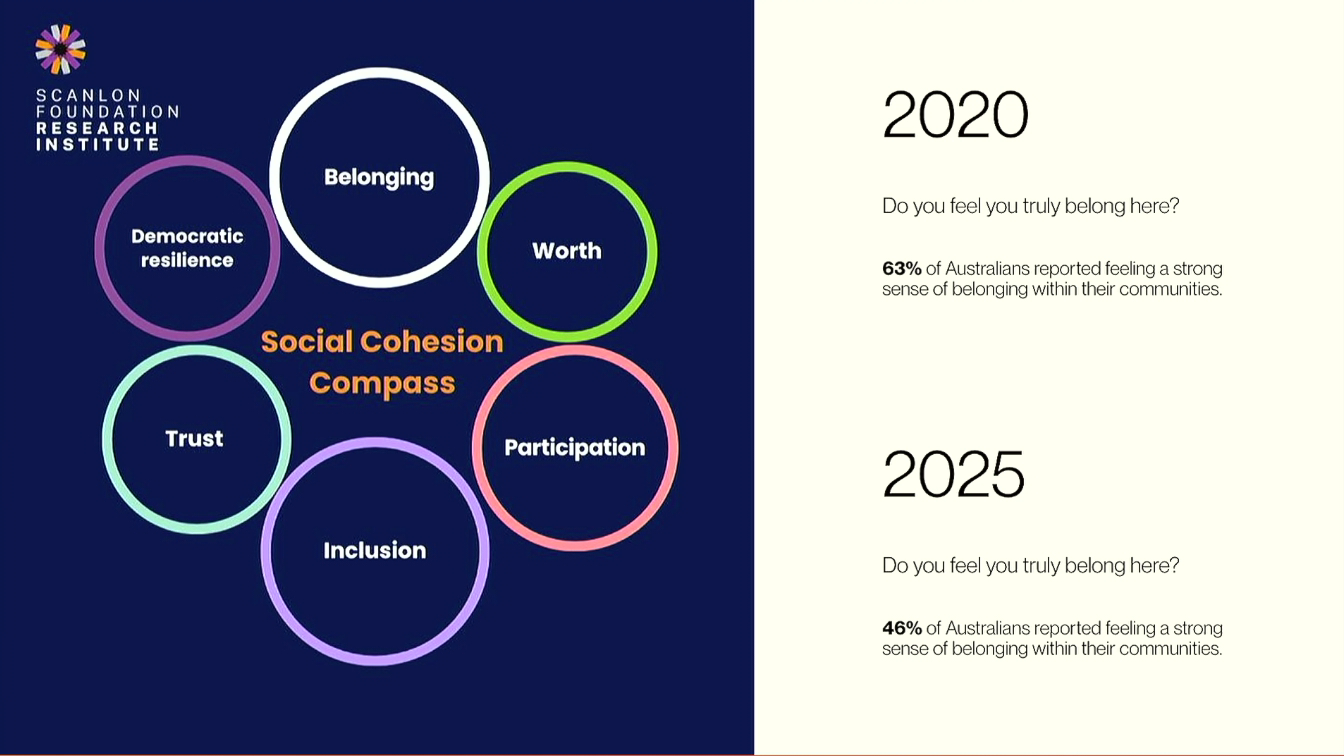
I've been doing that work for a long time now. And alongside alongside research for my PhD, which was on belonging. And what I came to see throughout my work is that care is actually the other side of belonging. It affords belonging. It's the infrastructure that props it up.
If we don't have care built into our systems, belonging becomes impossible. And I really saw this most clearly when my own stacker layers collapsed, becoming both a parent and a carer, neurodivergent diagnoses, studying and working, and then navigating the various systems that I had helped design.
So experiencing firsthand how structures build for efficiency so often fail the reality of human lives. So that's why I'm here today, something we all live. And yet, too often our systems are designed to ignore that fact.
I mentioned we already talked about how they're optimized for efficiency, speed, and output. But we don't live as humans in straight lines or quarterly cycles. We live in rhythms and relationships, in stories and context. That's how we make sense of our lives.
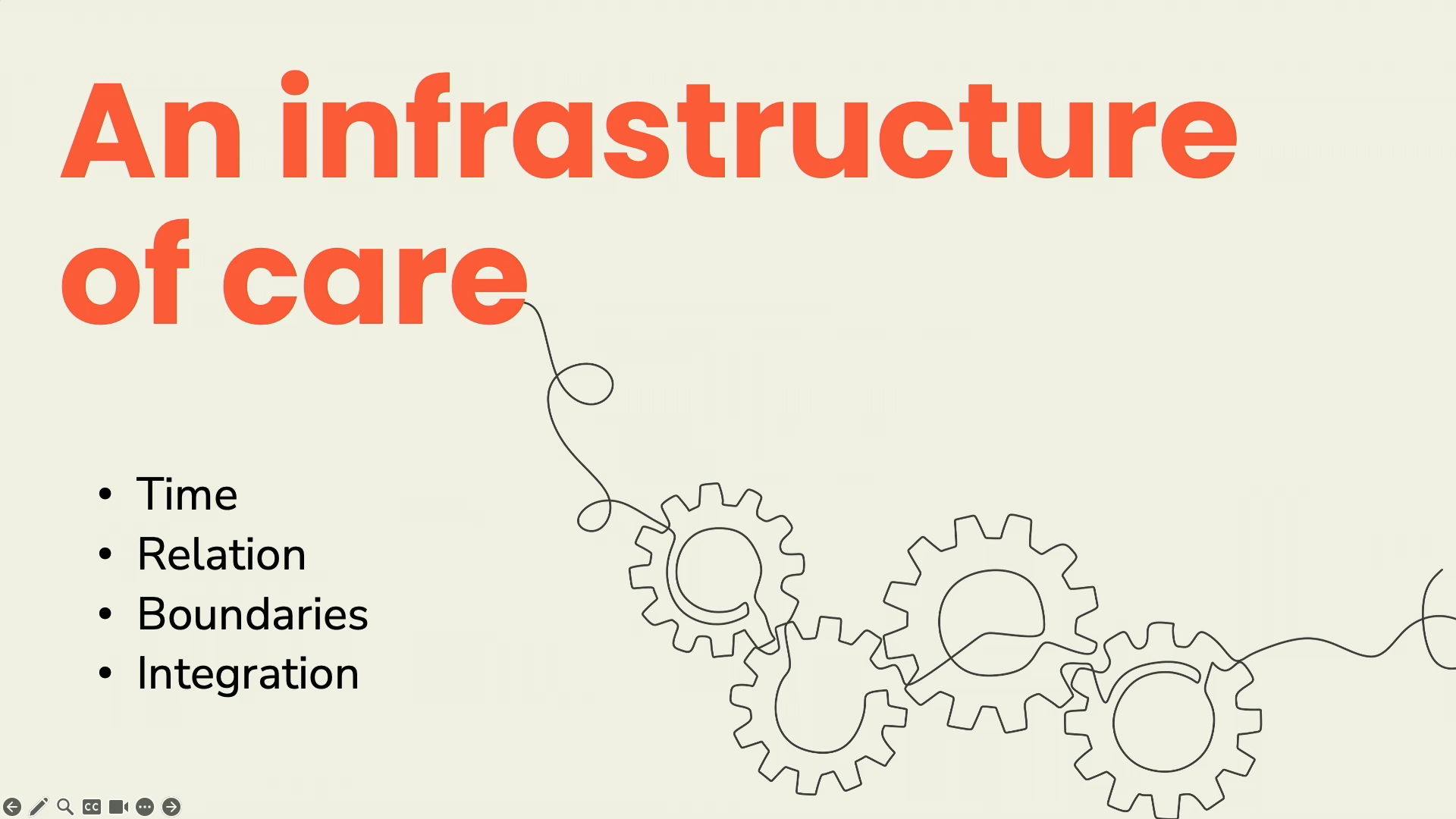
So I call this the infrastructure of care. And care being quite an abstract word, infrastructure is really something you can hook into, I think. It's the hidden ground of every service and workplace and policy when they work well. So when these elements are tended, systems become not just functional but humane and enduring.
And without them, care collapses. I mean, we all know the foundations of design that we stand on. There's John Norman's usability and Patrick George's pleasures and Liz Sanders co creation and context and design research. And as AI accelerates efficiency to new extremes, I believe we need to activate them as practices of care.
And as a starting point, I offer four dimensions, four anchors, if you will, for doing that. Time, relationships, boundaries and integration. Let's start with time. We often assume time is neutral, it's not. Time is a signal of value.
Time is money. The sociologist Hartmut Rosa talks about social acceleration, how modern life is compressed until it feels as if time itself is running out. Another friend of mine always mentions to me, he finds it funny how time runs out in podcasts because, hang on.
There's no end to this. Like, why do we have to stop? It's very true. So another thinker, John Trondeau, if you follow CareWork, she's quite, quite known for establishing that body of work. She's a political theorist.
So she's known for her work on the ethics of care. And she says and reminds us really that care requires attentiveness. And attentiveness, of course, takes time. So when I speak about time temporal infrastructure of care, I mean how we shape time inside our systems.
And we have perhaps not total control, but we do have some control over that. So if you think back to your reflection, perhaps your own life or your work or product you're working on, software, consider what would that look like. So rhythm. What are the natural cycles, perhaps for your users, maybe for your business? Instead of kind of artificially imposing it or expecting maybe there's a constancy expecting constant throughput.
Rest. Building in breathing spaces and not squeezing them out. I mean, hopefully, you you you also do these five minute buffers between meeting. I started to meetings. I started to do that. Can't say it helps that much, but it'll, you know, better than nothing. That's the idea. Right? You get it.
Recovery. Allowing time to rebound emotionally and mentally. And then also flexibility. A few of the wonderful speakers before spoke about that in terms of accessibility. So adjusting schedules around really human lives rather than forcing them into rigid structures.
So school times, I'm sure there's a few parents, in the audience, do seem quite inhumane at different times of the year. Just one example. So if we apply this thinking to your context, let's pause you again and ask, when does time in your system feel relentless?
Whose time does your system privilege? And what would shift if you would explore to adjust rhythms and rest and recovery if they were designed in? And we know it works. That's the good news. So in U. K. Hospitals, you may have you who works in the health space may have heard about Schwarz rounds.
They're structured sort of time slots and forums where nursing staff mostly come together, and they're giving protected time to reflect together on the emotional and social aspects of their work. And studies show there's numerous now. Studies show that when hospitals introduced these Schwarz rounds, staff stress levels dropped, compassion increased, teamwork improved, and most importantly, patient benefits patient outcomes benefited. We probably all have heard about Zappos customer service.
In The U. S, it's a bit famous for that. But unlike most contact centers, they aren't measured by how quickly they get off the line, but they're rewarded for building connection. So some calls can not just really quick, a couple of minutes, and some last for hours. And the outcome is loyalty, so customers who stay and advocate and trust the brand. So my point is that when we build and think ahead of time and build time into the infrastructure, Systems don't just run more smoothly, but they create endurance.
Relational care is about how we connect. We've had many wonderful commentary and also going deeper into how and why relationships matter and how we can design them in. There's an interesting piece around the reciprocity and kind of being dependent on one another in relationship.
So it's not just who, but how you relate. I was actually exploring making these nouns into verbs and because it's much more an active thing. I mean, many scholars have thought about this across the spectrum of care. The nurse theorist, Tilda Peplow, she reframed nursing not as a set of tasks, but as a co created relationship.
So it's not something that we necessarily see in health care, but it's very true when you think about it. And, Jean Watson, she speaks of transpersonal caring moments. So those encounters that transform both the caregiver or just the person, doesn't have to be in a care context, and the one receiving care. So there's a dependency on it.
And there's a psychologist. Her name is Carol Gilligan. She has looked into the ethics of care. She's working in ethics of care. And it's actually rooted in responsiveness to others and not in kind of notions of of duty. So there's a personal element to it. And of course, indigenous philosophies remind us that reciprocity is really the foundation. It's not optional.
It's the ground of belonging. So when I talk about relational care, I mean trust, so moving beyond efficiency to genuine understanding reciprocity, seeing care as an exchange, not a one way delivery. And presence so offering our full attentiveness and not a procedure.
Again, going to pause. Where do your interactions feel transactional, and what would shift? If you could, you might prioritize trust and reciprocity. And if that was actually baked into your outcome framework. In terms of product, does your product invite presence, or does it push transactions?
Where could systems reward listening instead of compliance? Couple of things to consider. Two lovely examples. One is, in the health care setting in The Netherlands.
Instead of a top down model, a few of you might have might have come across this, but it's kind of a model around self managed teams, small self managed teams of, nursing practitioners. And they co design care directly with patients and families.
And all the good outcomes that we like to see are greater trust, better health outcomes, lower overheads, and recognition as well, have shown it's an incredibly effective model. And, that really leads to much improved outcomes. Another example close to my heart, because I had the privilege of leading it in its inception, is in the public service in Queensland, Aboriginal and Torres Strait Islander Career Pathway Service, continues to live on and and thrive today.
It's essentially a leadership framework and service for First Nations leaders, now permanently led by First Nations public servants. And the program, is built on relationships, on, community relationships outside of work also, networks, and has now supported more than five hundred First Nations leaders into new opportunities, peer learning, sponsor meetings, placements, capability building, and cultural exchange. So there's a mutuality as well.
I drive what I would drive that program. If you want to find out more, happy to have a chat. Third one, boundaries. Not very popular, but important. So what does boundary based care look like in practice?
Clarity. So expectations that are clearly defined. Thea, you talked about this so wonderfully yesterday. Safety. Boundaries to be able to shield our well-being limits, knowing what is and isn't your responsibility. And containment, so protecting time, energy, and emotional capacity.
And for me, boundaries are really it sounds a bit abstract as well. But for me, boundaries are really the work of contracts and, you know, organizational tools, unions perhaps, or, you know, legal tools, really, that, are critical to achieve boundaries. John Toronto says boundaries are ethical necessities.
They're shaping what counts as care and who's responsible for it. So if you feel like you can't affect much around care in your own work, keep trying, but don't feel too bad about it because there is you know, can't change everything. That's that's what I've learned.
So it's important to protect yourself as well and and have boundaries around that. And, a good one to to look up for that is, Sarah Ahmed. She talks about how in the absence of boundaries, care work often expands invisibly. And, disproportionately, it's pushed onto marginalized people.
So boundaries don't limit care. They protect it. And without them, roles, of course, blur. So again, little reflection. Where are blurred roles draining trust or energy in your system? Does not have to be within personal relationships. It can be within perhaps an interaction.
I'm still trying to get that Australia Post visual out of my head. You diverged it here, and I definitely did not understand it. So think about this quite practically, really. What boundaries would safeguard care without closing it down?
So two great examples. Right to disconnect. You would have heard we now have law a law in a few other countries as well. But we now have a law here that protects workers from having to answer their phone or phone or emails and calls after hours. And another good one is BetStop, which is a national self exclusion register around gambling. And people can put themselves on that for a period of time. Three months, I think, is the time frame and also indefinitely.
So just two examples. Integration. So I think of this as alignment and coherence, but within the bigger system. And that's kind of where it gets tricky.
I mean, service design kind of exists for for that reason. But you can also look at this from a from a product lens or experience lens. So trying to look beyond your touch point. Great touch point and great product or service even in isolation isn't enough if the wider system is fragmented.
We know we all know that and have experienced it. And so true care can only happen or mostly happens when everything lines up, policies and practices and experiences, so people don't fall through the gaps in moments of need. So to design community, it's kind of it's kind of obvious.
But the opportunity there is actually to think about beyond what you can perhaps impact necessarily. And I'll give you two small examples of what I mean by that. So one, you may have heard about the Bogota care blocks. It's a wonderful project funded by the state government there city government.
Sorry. They're essentially neighborhood hubs that offer co located child care, elder care training, legal aid, etcetera, all within walking distance, particularly for for women and their children. When I say children, it's also adult children. And, quite a quite a famous example, highly effective.
Highly recommend you you look it up. But, essentially, it's designing for a holistic experience and a holistic life experience. So, you know, it would have been easy to kind of just put training into into a public building. But what they identified is that it's the moving around and the switching between organizations that causes the care burden.
And so to support this group in particularly, I think single single mothers were their initial, target group, they actually co located, moved physical locations, buildings into one block, hence care blocks.
Another example so I worked with Kids Help Line for a number of years, alongside their counselors to design, their digital service offering. Kids Help Plan, maybe you probably all know what it is, the twenty four seven mental health counseling service for children and young people and families.
And there were a couple of touch points. So as I worked with the team on the journey, a couple of points where people actually are not so much they're very well taken care of when they're within the what you would call the service. But issues are around early reaching out or even awareness.
So you would think, well, it's kind of more of a marketing problem. And then another point around just before they entered the service around waiting. So waiting can be around forty I think forty five minutes is the average, which can be very distressing to some young people and also is is a significant risk, when you have, children and young people calling with suicidal ideation and and so on.
So two examples just just from that work was for actually designing for outreach and going into, communities and how to kind of build grassroots networks that would enable sort of the referral pathway for that as part of the design of the service itself.
And another one was so this was in in concept testing. So I don't I don't know how whether they're implementing it in in which way right now, but was actually a distress button and, you know, sort of mixed reviews around, well, could you jump the queue and, you know, how would that be abused, etcetera.
But the idea being that there might be a fast way of getting people into the service even though they're not there yet. Within the context of their experience, it was actually more caring to do that and kind of deprioritize other other users. So that's how you can think about it, like how long before and how long after.
What happens within that journey. And perhaps you can build little hooks left or right into your service that might provide extra care. So for your own work, maybe your private life, what misalignments are there? Policy practice, lived experience?
What applies to your users? And how could you create coherence within the systems, within your own, but then also around it? So in closing, I want to echo everything that I've heard all the presenters talk about over the last two days and see if I can reflect this in the frame of care.
So in my view, one way to think about care is care is what we choose when we could choose otherwise. Yeah. It's a variance of speed and rhythm you design into an experience when you could choose just your own or, you know, the organization's preferred one. And it requires, though, a rhythm and a pause that's aligned with how humans exist in the world across all different neurotypes and setups and contexts. And that takes awareness and noticing and the ability to change, not just kind of keep going.
So it's also a trust decision when you could choose to have control. So one someone today mentioned around data collection. So I'm a big fan of really always always, really interrogating almost the team, you know, client team to say, why are we collecting this? I mean, especially government is quite fond of having more more data. And I always try to not do that and do the opposite, actively advocate for not collecting more data than we need to.
So it's a trust decision when you could choose control. And again, that requires human presence and the right skill, no pun intended, to navigate it. So care demands to design for boundaries when the common or the easier thing to do is perhaps to just accept the absence.
Oh, well, it's just how we do it. So that applies to the design of a font or color of a screen or clarity of copy. And finally, care is an act of alignment. Our users, whether they're doctors or farmers or public servants, they all live within larger systems that need translation.
And it's our opportunity to do that with them. So if we want our work to endure, we want our services, our software, our cities to flourish. Can't just give up, but we need to design with care. So to finish, one last reflection. Take just one minute.
Perhaps write down one place where you see care eroding in your world. More importantly, though, one action you could take to restore it. Thank you.
People
- Don Norman
- Patrick Jordan
- Liz Sanders
- Hartmut Rosa
- Joan Tronto
- Hildegard Peplau
- Jean Watson
- Carol Gilligan
- Sarah Ahmed
Technologies & Tools
- AI
Standards & Specs
- Right to Disconnect
Concepts & Methods
- Intersectionality
- Infrastructure of care
- Co-creation
- Design research
- Social acceleration
- Ethics of care
- Schwartz Rounds
- Transpersonal caring moments
- Reciprocity
- Service design
Organisations & Products
- OECD
- Zappos
- Career Pathway Service
- Australia Post
- BetStop
- Bogotá Care Blocks
- Kids Helpline