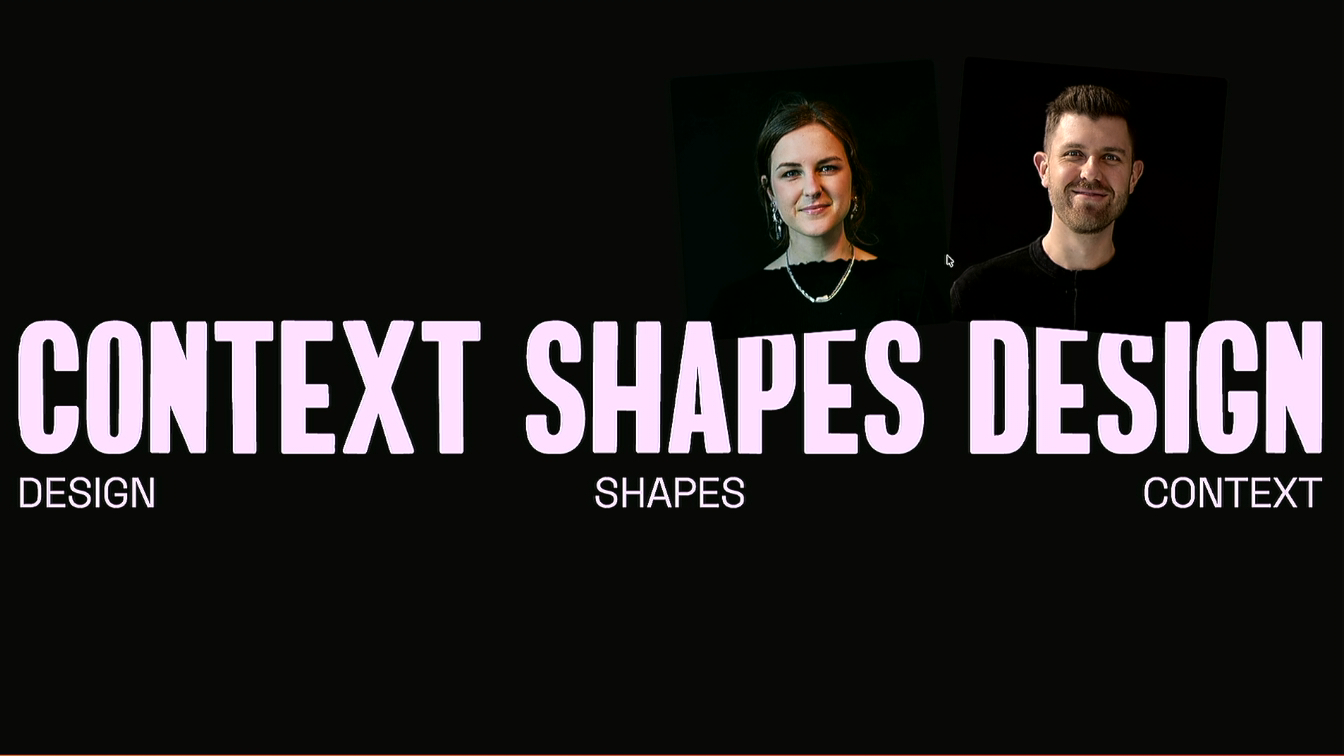
Design Shapes Context, Context Shapes Design
PESTO: Five Lenses for Understanding Context
Cornel Steyn and Jess Witt introduce design as both a response to context and a means of changing it. They explain personal, environmental, socioecological, temporal and organizational influences, then combine these lenses into the memorable PESTO framework.
Designing for Real People in Real Environments
The speakers examine how Uber's simple mode reduces cognitive load and how 1800RESPECT's video service supports people in vulnerable situations. Mining fieldwork and housing support projects show why designers must account for physical conditions, intermittent connectivity and moments of urgent need.
Cultural Meaning and the Hidden Costs of AI
Cornel explores how cultural context changes the meaning of color, using stock market displays as an example. He then questions what simple AI chat interfaces conceal and imagines designs that reveal resource consumption, encourage more considered prompts and credit creators.
Choosing the Right Moment to Intervene
Jess describes how driving focus settings temporarily reshape her environment to reduce distraction. Cornel introduces intelligent friction through banking safeguards and Instagram's nudity protection, examining how timely interventions can support safety while leaving difficult questions about platform responsibility.
Keeping Organizations Adaptable and Services Human
Jess uses a mountain-climbing analogy to show how fixed contracts can prevent teams from adopting better approaches during digital transformation. The speakers then describe a South Korean call center intervention that introduces staff through their families' voices to encourage callers to treat them kindly.
Turn Context into Research, Priorities and Requirements
The speakers recommend mapping assumptions, observing people in their environments and mapping context alongside journeys. Jess draws on Brutal Simplicity of Thought to explain how small interventions can address large problems, then proposes including context in user stories so it reaches the finished product.
Make Context Your Advantage as AI Changes Practice
Cornel and Jess close with three priorities: bring specific contextual understanding to teams, build trust around contextual data and adopt tools according to the value they create. They argue that faster prototyping should strengthen discovery and iteration while preserving design's focus on meaningful outcomes.
My name's Jess. This is my colleague Cornel. We're, as we said, so we're gonna be speaking about context shaping design and how design can also shape context. Ready?
So, yes, a bit about the origin story of this talk. We've given a version of this talk before last year at in Perth at UX camp. So around about the time this clicker is as slow as I am this morning. So, yeah, around about October last year and what we thought we we designed this talk from the perspective of what we thought we wanted to hear.
AI on your social media feeds, just colleagues always learning a new tool. You never have the full time to invest that time to learn the tools. You always felt a little bit behind and you felt distracted. Meanwhile, you're still probably busy with work that you're doing. So we thought how can we share some of our examples of the work that we do in a software consulting capacity, but also some found examples like and we've heard some brilliant stories shared this morning. So amplifying that again, some problems have been solved, how have they been solved and really connecting us back to that design is responding to a context.
But for us, the purpose of why we're doing it is to reshape that context and that was really the whole sort of background of this talk. AI feels like years are dating like dog years. Like October 2025 feels like in terms of AI, if you think about your personal workflows, things like that, what the heck? What's happened in the last few months?
It feels like. So, yeah, this talk just feels more and more relevant, you know?
Yeah. So in terms of AI years, it feels like it's been 10 since the beginning of the year. But we are going to be looking at the word context, which our industry has absolutely hijacked. So, if we're looking you might spend your day hearing things like context farming, context windows, context engineering, context MD files for your AI.
It's it's it's blown out, but we have to apologize for this word at some point in our career, but we're gonna be looking at sort of the more original, OG sort of way that we use the word context in, the context of our practice.
Yeah. So we thought how might we simplify a very broad topic of context and the different lenses and nuances. Again, we've heard some of that this morning already and simplify that into a takeaway, sort of a cheat sheet of something you can just quickly refer to. So we believe understand the full picture of design intervention that you might be embarking on, we need to understand the personal, environmental, socioecological, temporal and organizational context.
That's shape design. So what do all these words mean? Let's quickly define it. I'll go clockwise starting with identity. So the identity of the person in this example of who is using your services may be physiological, someone that may have had an injury. Are the effects temporary, are they permanent, are we unsure, is that recovery leading to frustration causing to a like potentially like resilience and frustration, those kind of things.
Someone's cognition, someone's emotional state when they're using your products, their accessibility needs. Then we look at that person within the environment that they find themselves in. Environment is not fixed. It's always changing. You've been in multiple different environments just this morning already. So your physical location. Is that location private for example?
Is it public for example? The modality or the surfaces is the new word for multimodal that I see emerging. So what device or surface are you using? Your connectivity, is that stable? Spoilers, mine is not, so some animations might be slow. The sound effects of the user and how that might influence their experience and also the lights.
Think of light and dark mode. There's many more environmental factors, but we'll just gloss over it for now.
So if environmental is everything around us, then the socioecological can be defined as everything between us. So if we think about our social company, you might be alone, you might be with a group of friends, you might be in a big theater at a conference, and so we need to think about how our designs can shape that and how our designs or other products can also help support those environments.
So looking also at collaboration, ethics, sustainability, and community, we've heard a little bit about that this morning already. So how can our designs help shape and grow community, as well as reflecting on how might some of the things that we're designing also hinder community. Then we are on to temporal. So temporal is really about sensing the right moment and sensing in time and anticipating needs, as well as the duration or potentially time of day. We might even have a cyclical need, so perhaps it's only seasonal, perhaps it's daily.
There could be a sense of urgency, could be a deadline, maybe I'm just in a rush, And then we can also look at frequency, so maybe things happen all the time throughout the day or maybe it is a daily occurrence.
And then the last one in our list is organizational. So in a consulting capacity, we thought it's it's nice to also relevant and bring this up. Maturity, that could be in terms of design. You might need to start where your environment or your cohort is at. Or with AI maturity or data maturity, look out for that because that shapes your practice.
I always like to say KPIs shape behaviors, so what gets measured matters. So consider which KPI's are at is influencing the kind of spaces you're in. Constraints, I refer to them as our givens. You can't do everything all at once all the time. I know you would like to and I would love to, but we just don't have the budget time people.
So consider the constraints and and really work with them. And then competition. Are you purely just following what someone else is doing for relevant or are you truly distinguishing yourself and filling a space, yeah, that might not be met. So again, oversimplifying that context, but if you consider these lists, so we're gonna share some examples of each.
Also, just again that sort of breath of fresh air like examples of them, but we thought it's not like you experienced one of them discreetly. We mentioned there was a lot of bubbles on the screen, a lot that weren't even on the screen, but we want to say consider that context again are sort of you experience them as a slice. So vertically here you might have even just us in this room today, we've got multiple of these.
So pay attention to the most relevant ones is kind of what we're trying to say, but that's a lot to remember, Jess.
Thanks, Cornell. Yeah. So if we try and think about how we could package this up in a easy memorable way, maybe stick it in a blender, take only the first letters of all of these words, you get pesto. So
How old If it's in your fridge in the tub.
How old is it?
How old
is it? Just think
about that, you know.
So we are going to now have a look at how some examples of how context has shaped the design and how the design has shaped the context through the lens of pesto.
Love it. So the first example here is back to that personal. So in the example of where cognitive load needs to be reduced for a certain digital product, here's an example of Uber's simple mode. I'm not sure if anyone has heard of this, but this is a very relevant example for me. On the example on the left is likely what the app in your pocket look like looks like today.
Lots of things happening. I always think home screens are the ultimate of iteration. They just everything belongs on the home screen. Uber simple mode and again, the whole goal is to reduce the cognition of finding a simple intent on the right, perhaps your last address and just the more more critical services. Since literally taking these screenshots October, I've just been using Uber in this mode. It's so nice.
So I I get this organizational factors at play, etcetera. If you look at a screen reader, the ultimate test for me is how many objects it chooses to announce. It's about 75% less on that screen. So I feel like already for multiple like, the success is clear. So it's just it's just a nice feature.
And then we come to think about how our design can also shape the context in a very personal way where we are looking at emotional, psychological, and physical safety. This is a project that Cornell and I did work on with one eight hundred Respect, so Australia's national domestic violence helpline. We help them launch a new video service where they can get immediate support by actually speaking to someone face to face on the phone, and so it was a really powerful piece of work and sort of one that I won't forget ever working on, But there it became so important to be explicitly clear on the instructions on how to use it, to be very concise, to enable things like anonymous two factor authentication, video preview, quick exit, and making sure all of those things were really, really clear to ensure that the person who requires this support is transitioning from a position where they might be extremely vulnerable, fear to one of hopefully just a little bit more support and a little bit less isolation.
The next we look at the context of Jess's many haircuts. So this is in the environmental context. So this is for Rio Tinto up in the Pilbara. If I look like a mining person, I don't know. It was very important for me to go out there and immerse ourselves in this context as well. So things like the temperature of a ruggedized device, they just don't cool the same way, styluses, gloves, things like that.
But your more traditional issues as well of current state systems, I prefer them over going like more mobile. But obviously, if there's mobility out in the field, that empowers sort of at the point of doing the work, especially when there's breakdowns, I think, quite critical to production. And on the right, it was extremely valuable for us to go.
That's actually an autonomous truck as well. And in the pit, connectivity is not like it's always working or never working. It's intermittent. So we reappropriated airplane mode to pit mode. But, yeah, it just is good to see what's the impact on that digital product in areas of mixed connectivity. Yeah.
Okay. So why are we looking at the wonderful Kerrigan family? Well, a a few a couple of years ago, I had the privilege of working with the Department of Queensland on sort of digital transformation strategy with them to try to increase their access for digital products for people who needed housing support the most. So we're looking at sort of rental grants or bond loans, and I think they had up to, like, 25 products and only one of them was actually available digital digitally, so everything was done on paper at that point, and they're so completely trying to change the context of someone's housing stability by offering them and and meeting them where they need these products in that those crucial moments where housing stability and your safety is of utmost importance, and it can truly shape the quality of of your life.
And then now we're moving on to socio ecological. So the concept here is about localization. So in certain East Asian cultures, the idea of red equating to the values of vitality is interesting if you bring it back to some people's here context about red might mean a deficit and green might be positive. So that is flipped.
So it's more specific in like, for example, stock markets and things like that where, yes, it increases red again because of Fortune. Some native like operating systems and things respond to that with localization settings as well, but the support still isn't fully there. But it was just an interesting example, especially if you're working on global products and things like that, color theory and other examples of localized context. There's lots of gestures, symbolism and things like that, which is, yeah, I'm not the expert in that at all, but it's just a a positive frame of that.
And the other example, think the the sort of interlude between the talks, so I was like, carry on because it's a good foundation for what we want to talk about. But again, in a room full of designers, we've got carry a lot of responsibility in our work. I've got more questions than answers, but this was just purely us just thinking about the sort of socio ecological impact of our work.
A lot of our work these days happens through a single chat interface. That interface is so simple. It's too simple. It hides the true cost of all the models that's been trained before. It hides the real impact of the socio ecological environmental impact of our work. So the chat interface, it hides a lot. So we want to live in a what's the word?
Apocalyptimist? Yeah. In an apocalypse I can't even say it. In that world, what does it look like? What if our AI, to our own detriment, but encouraged metrics to give you feedback around higher quality queries? What if it showed you how much energy you use today, just cooling data centers, just purely the compute power and cost? The companies reporting on this are the ones financially gaining from this.
So I believe the numbers reported seem very low. So unsure what that looks like. Wanna be sued today. And and then also the community data training pool. Where is this data coming from? Is it from destroyed books from authors who never get credit for the work or where does it come from? That's really powerful example. That's just text. Image generation can be up to 10 times more, so let's say resource exhaustive or whatever and video even more.
So let's say you weird people wanna see me with a mullet and you wanna generate an image for that. Like I was saying, how might we nudge higher quality queries? You should really be questioning your prompt here at this stage. Might you stop, oh, forgot that one thing. I forgot that one thing. Can I get a better quality prompt?
And again, what if it's purely just a question, the exact resources used, the exact creators who can be credit or financially redistributed for this work. Live in a utopia, but it was just an interesting concept for us to explore.
So now if we look at the temporal context, I mentioned before this is something about sensing sort of those just in time moments. So a personal thing that I do on my phone, I have a focus mode for when I'm driving because I want to ensure that while I'm driving, I am driving in the safest context. And that means no notifications, not me looking down at all of the red little badges that I have or my unread messages or any phone calls coming through.
I have it so that as soon as I'm driving, my phone recognizes that I'm moving and that I'm driving. It silences all notifications, and the people who I have selected that if they try to call me or contact me, my phone will automatically just send them a text back that I have by design written myself and it just says, I'll get I'll I'll get back to you when I get there.
So this is just it's not something that is for a very long time. It just temporarily changes my context for a short amount of time to improve my safety.
And now the temporal example where the design might shape a context. So we spoke about reducing friction in a digital world. In banking, this is one of the slides we updated was there's this concept of intelligent friction. So it is to prevent scams and fraud and that things. Platforms also have power to detect things. So this is an example of Meta or specifically Instagram's nudity protection feature. It's by default, understand it's on for teenage accounts.
You might say it's not relevant for Australia anymore, but the latest numbers I think shows up to just over seventy percent of teenagers who were on Instagram before the ban are still on it. So I think it's still extremely relevant. The feature works as such if on device it detects nudity in an image, it will send it as a blurred image, but when this feature is on, it'll provide this model.
So the latest statistics that I could find again, who reports the statistics, big question mark, question mark, question mark. Up to 40% of the images remain blurred. So if you think of that as a success case especially for like child sexual abuse material, I believe it's a fantastic direction that this is moving in. So for 40% of those images to remain blurred, means successful intervention by this sort of temporal intervention.
Flip the metric though, 60% are still viewed. So where does that line of responsibility lie? Is it with the platform? Is it someone potentially in a vulnerable state being manipulated to distribute or produce and distribute this illegal material? It's a very big topic. It's a very big question. I went on a rabbit hole reading about this. Just temporarily, sometimes friction can be added for better goal.
So organizational context. In this, we might need to consider where your organization or a organization's readiness is when they want to sort of approach digital transformation projects, especially in a fixed contract sort of realm. Cornell and I are very familiar with the perils of a fixed contract for organizational change and digital transformation.
And often, the thing that is sacrificed is the quality of the experience, not just ours, but the thing that we're trying to to design. And so if we consider or if I can compare this to hiking up a mountain, you start at the bottom with everything in your bag, and you've you've said, we've we've set the journey, we know where we're going, we've got all our resources strapped to our back, and we get halfway up, and then all of a sudden on the ground, it's like, oh, actually, do you guys just want a helicopter to come pick you up and take you to the top? And I'm like, But no, we can't because our contract said no. So now instead, we've still got all of our stuff, we've watched the helicopter fly past us, and we trudge all the way up the top.
We get to the top. We've got there, so we're out. We're on budget, on scope, on time, but look at the state of us. We are exhausted. The quality has been impacted dramatically. So something that we're trying and we haven't solved this problem. It's something we're always thinking about, and please talk to us later if you've solved this problem, but it's keeping the door open, especially in these AI years where new technologies, new processes, new systems are available to us all the time and it changes so rapidly.
How do we sort of explore ways to keep the door open a little bit so that the helicopter can come and pick us up if we need it?
And the last example here of the context to be influenced, this was a snappy little TikTok video. The example here is from a South Korean call center. So someone who might be waiting in a call queue for ages, they might get increasingly frustrated and that might yield in sort of like abuse of the call taker agents. I don't know if anyone here has worked in hospital or customer service and can relate.
What happens is if you're the next caller in line according to this video is this, let's say, it's this person who works there, their son might say, next you're going to talk to my dad. Yeah, he's the breadwinner of our family. He's going to try his absolute best to help you. Yeah. Please be kind to him or something like that.
I just thought that was the most delightful example of a small little service design intervention and I would like to see it more of it because that's quite cute. Again, how do we bring this into our practice?
Yeah. So ultimately, we need to sort of try and start with prioritizing context awareness. We already have so many tools that we use that do this, but this is more just a refresher and just a reminder of, to do the things that we do best and the things that we love. So map your assumptions. This can help obviously identify your gaps, where you might need to focus your attention, what you might need to validate, but ultimately context awareness, starts with awareness and ultimately awareness of where your own gaps, might be. Second one is get out of the building and validate those assumptions or validate your designs or just understand what the context is. We would never have understood or quite understood the pain of the miners in the pit with a tiny little device that we designed for them in 48 degree heat with red dust in their eyes and they're complaining that tap targets are too small, we wouldn't have really understood what they meant or we could hear it, but you can't make the right judgment from behind a desk.
Remember, pesto? So map the context, not just the journey. When you map the context, you sort of design for more multi modal experiences, not just for our screens, And just so that you don't forget, we made little glitter stickers with pesto, so if anyone wants them on the way out You
don't have to like them. We like them.
You can put them on the back of your laptop or the back of the bathroom door, whatever context you prefer. Jump to the next one.
Weaving the word context in there. That's nice. I like it. Thank
So design micro solutions for macro problems, and try to prioritize based on all of the things you've done before based on the impact. We're looking at the very first coin ever, I believe, to be designed, and I read this one of my favorite books. It's called The Brutal Simplicity of Thought where thinking back thousands of years ago, the biggest problem was how do we comfortably and functionally trade, and so the book asks the question, how do I fit a cow in my pocket?
And the answer is to invent currency. So sometimes design, at its best, it will distill complexity into something so deceivably deceivably small, and honestly, could really just sort of design and quietly reshape the world around you. Okay. So context as a requirement.
This is now about building it into our practice, so it's an end to end process and actually seeing this come to reality. We can do all of the research and all the activities that we like, but how do we actually bring this into reality? And so we are suggesting that maybe you can include it as part of your user stories.
Because when it's part of a user story, it'll be part of your product. So we have prepared one for you, and I'll just let you read it on your own.
Wait. Ollie. Confident. That's enough of the indulgent jokes. So in the future of context, I have a mallet. How good is that? And every surely, hopefully not, that every app in your pocket looks exactly the same. I think some of that is good to do with like kids bottles and stuff. I recognize the Tommy Tippi brand.
It's like why are you in the AI space? It might just be a happy coincidence. So in this moment in time, if you want a message of hope with how AI might reshape our practice and all of that stuff or if you're busy actively solving some of the risks or problems with AI and things in our craft, I think this designers' relevance, we believe, is more than ever.
So everyone has a version of this for themselves. So this is some three takeaways we try to summarize, yeah, in the in the realm of context. So AI is fantastic at classification and, yeah, quickly looking at those general cases and things like that. But as designers, your power is the specifics. So focus on that. Make context your advantage.
I think you the all the teams you work with, you can be that, let's use a word from today, custodian of context, and bring it into your practice because if it's not there, your the problem definition might be more generic, the solution definition therefore might be more generic, might not be adopted. So really bring that into your practice.
The next is more context. In today's world often means more data, which means more responsibility. So we believe those who create trust with all of this data are the ones that will have sort of long term success and viability, especially platforms who prioritize that transparency on device processing. So really start with some strong universally understood safety principles and trust principles in your work.
That's a really practical way to adopt this. The AI world, especially with consent of what you allow devices to track and see, it's still not quite as well understood by me. But that inference complexity also comes granting permission in one app versus not how do these things relate to one another. It's a deeply complex topic that I would love to learn more about. But yeah, use context to build trust.
And then the last one is that message of don't necessarily change what you do. I think the how is actively changing, how we are solving problems. If you can be better, be better. Adopt some of these tools. I think the what and the cost of prototyping is really collapsing. So if you can get versions out there quicker, go for it because I'd like to be glass half full and say that allows more iteration and maybe more iteration was always what this all was about. It is like that learning loop that you build into your practice. But, yeah, our practice doesn't change much in my opinion.
The discovery that you need to do is still there. The iteration loops that you will go through are hopefully still also there. And then that ultimate, like, let's just skip a few steps, but assuming something gets built that value focus. So always making sure that you're introducing tools and ideas and things based on that prioritization of value.
That's what we're all about or should be about or own a small piece of that in in that sort of broader symphony. So yeah, if we take these three lessons, I think there's a lot of excitement to sort of get from these new tools and it's a wicked ride. So that was us. Yep. Thank you.
Technologies & Tools
- Screen readers
- Two-factor authentication
- Airplane mode
- Generative AI
- Driving Focus
- On-device processing
Concepts & Methods
- KPIs
- PESTO
- Cognitive load
- Quick exit
- Digital transformation
- Localization
- Color theory
- Intelligent friction
- Assumption mapping
- Context mapping
- User stories
- Prototyping
Organisations & Products
- Uber
- 1800RESPECT
- Rio Tinto
- Meta
Works
- Brutal Simplicity of Thought