Lessons from Designing for Small Communities
A Designer with a Business-Side View
Kiri James introduces her experience across design, research, product management, quality assurance, training and operational teams. She explains that access to business information and relationships helped her understand organisations more deeply and produce better design. Burnout and questions about capitalism and the natural environment eventually prompted her move to a small community.
Meeting Margaret River
James outlines the interviews, observations, desk research and local projects behind the presentation. She describes Margaret River as a remote biodiversity hotspot experiencing rapid growth, with an economy shaped by wine and tourism. The story of a heavy-metal hairdresser who also surfs illustrates the community’s eclectic mix of artistic and conservative identities.
Relationships as Community Infrastructure
James maps the overlapping roles through which residents repeatedly encounter one another at work, school and community activities. She calls these multimodal relationships and argues that they generate unusually strong social capital. Drawing on Pierre Bourdieu, Esther Perel and Brené Brown, she connects relationships and information to innovation, organisational performance and resilience amid technological change.
Belonging and Reciprocity in Practice
James presents acknowledgment as a small but powerful way to create belonging, from greeting strangers at the beach to speaking with unfamiliar colleagues at work. She then contrasts gamified loyalty programs with the genuine loyalty created when a local supermarket supports community fundraisers and sports teams. Designers can build similar reciprocity by understanding and helping to solve business problems alongside customer problems.
Making Accountability and Conflict Personal
James finds that small local projects can create intense accountability because their participants personally know the people affected. She recommends increasing customer proximity and asking key stakeholders how a project can make them successful. For difficult conversations, organisations should combine formal structures such as retrospectives with explicit permission and boundaries that make constructive conflict safer.
Changing Status to Change Values
James explains that Margaret River grants status to people who volunteer, contribute and perform skilled work themselves. She contrasts these everyday signals with organisational values that appear mainly in recruitment materials and awards. By publicly celebrating strong design outcomes, practitioners can influence what colleagues value—as James did when a former team began routinely asking where the design was.
Collaboration Beyond the Tourist Season
James shows how collaborative events such as Cabin Fever and Open Studios helped Margaret River replace a boom-and-bust tourist cycle with more activity through winter. She attributes that economic improvement to community social capital. She closes by framing design as a way of working available throughout an organisation and urges people to build agency through small connections, relationships and genuine conversations.
Thank you for being here. As John said, we are down this is like the finishing stretch, so we're nearly there. I'm gonna just start with something a little bit interactive to get your blood going a little bit. So I am Kiri, and I am a designer. Who else here today is a designer? Put your hands up. Can we see? Okay.
Yes. Lots of designers. Who's a researcher? Who have we got? A few less researchers, but we've got researchers. Is there anybody here that's something else that is not a designer, not a researcher, Oh, anybody willing to put their hand up? Yes. One here. What are you? Accessibility writer. Accessibility writer.
That is good. Thank you. Thank you for being brave. So as I said, I'm a designer. I'm also a researcher, but I'm also somebody that's worked in the business. So I've had business roles, what they would call business roles or the service line. And I've run lots of teams like complaints teams, litigation disputes. I've run QA. I've run training, product management, so lots of different teams. And some people might think this is a bit unusual for a designer to have run these teams, but I think it's actually been a real privilege.
It's really sort of contributed to my work. And the number one thing that I would say from having worked in the business that I was really surprised about was it gave me access to an awful lot of information that I hadn't been privileged to have when I was working as a designer. So I was on the all the group business emails, and I was going to management meetings and talking about our performance and all of the activities that we were doing.
So I had access to information, but I also had really close relationships with our business colleagues. Okay? So all of that combined meant that I really understood our business better, something that Ruth was kind of talking about. I understood the business better, and it meant that I could do better design. But that's got nothing to do with designing for small communities. I will come back to that story.
So why is someone like me, who identifies as a business designer, talking about designing for small communities? Well, about four years ago, I was probably feeling a little bit burnt out by working in organizations, oh, when I was asking some of those really big questions like, what's going on with capitalism?
What's happening with our natural environment? And I kind of decided I needed a change, so I moved to a small community. And I think I was really looking for a bit of inspiration, and that's kind of what my talk is about today. It's some of the inspiration that I managed to find by by moving to a small community.
I've gone too far ahead. Okay. Cool. So there's a bunch of research and projects that I've done. So just to talk to these very quickly, I've worked locally with a not for profit called Nature Conservation. I've worked with the Southwest Innovation Hub locally. I've done a bunch of interviews. I did them specifically for this talk. Most notably, I spoke with the CEO of our local business chamber.
I've done lots of observations. Now now I think I'm a closet ethnographer after our talk on ethnography yesterday, and I've done lots of desk research. So I have fallen down an awful lot of Internet rabbit holes looking at community design. Still alive, though. It's good. So I'm gonna talk a little bit about the community I live in, bring it to life for you.
Not all communities are the same, just give you a sense of where it is. Weirdly, I live really quite close to Sash. Right? So I live in Margaret River in Western Australia. It's also known as the Wood Dandy Pibbulmunboodja. Three hours south drive from Perth, three to four hours direct flight these days from Melbourne. It's pretty remote. It might seem pretty remote to you, but it's actually getting more and more connected all the time.
And if you don't know anything about Margaret River, it is incredibly naturally beautiful. It's what they call a biodiversity hotspot. It's got these kickass beaches. We've got some natural caves, beautiful natural caves, and forests. So really beautiful natural environment. Right? And if that wasn't enough, we've got a shit ton of amazing wineries that make really great booze.
So with all of that going on, it's probably not that surprising that Margaret River is seeing a lot of growth. We've got 20,000, about 20,000 people now. But for the last eight or nine years, it's been growing at over 4% per year. And as a local, we see that all the time, right? Like there's housing development going in everywhere.
The roads are really busy. The infrastructure isn't quite coping with the amount of growth that we've got. But just to talk to the people a bit, on the left hand side of that graph, we're the light blue line. So we indirect, under index, over index on really young people, over index on people in middle age, so we assume people come and raise their kids in Margaret River, and then we massively under index on people in their twenties.
So they grow up, they get the hell out, and they go and have adventures somewhere else. That's a good thing. And then we look at the graph that's on the right, and that big light blue bar, that's the people that work in the wineries. So this is what people do for a living. That's them working in wineries.
In the next two graph spots we've got, we were also over indexed, and that's in tourism and accommodation. So big high level story here is it's a really beautiful place, high amount of tourism, and it's growing really very quickly. So who are the people? Tell you a little bit about the people.
Look. I haven't done personas. This gives you a sense of the people, but I would rather just tell you a story of what I found it like when I first moved to Margaret River. So one on the one day, I was talking to my friend James, the blacksmith, and I said, James, mate, I need a good haircut. Where do I get a haircut with attitude in this town?
And he said, you need to go see Ed. And I'm like, Ed? Who's Ed? And he said, Ed's scissor hands. Of course, Ed's scissor hands. And he turns around, he leans in, and he says, just don't let him give you a mullet. So I rock down. I go to see Ed's scissor hands, and Ed has his own mullet, like he's got this big shag, heavy metal mullet, and he's wearing his big heavy metal t shirt.
And I sit down, get my haircut, and Ed's English. So about halfway through, I turn around to Ed, and I say, what are you doing in Margaret River? And he says, oh, I'm here for the surf. And I never expected Ed Scissorhands, the heavy metal hairdresser, to also be a surfer. But that's what I found what people are like in Margaret River. It's kind of a bit eccentric eccentric, a little bit eclectic. People think it's a really arty community, and it is.
There's a lot of artists there. But it's also really quite conservative. We've voted Liberal for the longest time ever. So I just find it's really eclectic, and we get this great diversity of people that live in live in Marx. So when I was thinking about this talk today and what it was that I was gonna talk about, and I was thinking about those positive things that happened in our community and the negative things.
And what is it? What is the root cause that sits under a lot of that? And it's really about the relationships. So now we start to talk to Ryan's talk a little bit. We start to bring that in here as well. So I drew this map because it made sense to me to really be able to think about what was going on.
And those big yellow circles, they're all the roles or what Ryan was calling the containers that we have in the community, and people can have multiple roles. So just to bring that to life, I'm working at Mitre ten, and you come in and you shop for me. Right? So I see you in that context regularly. And then our kids go to school together.
So I see you on pickup, and we see each other in that context regularly. And then on Thursday night, we do a Macrame class together. Right? So I see you in that context again. And I call these multimodal relationships, but it builds an awful lot of social capital into our community. Right? So when Ryan's talking about those containers, we tend to have a lot of these containers, and we have a lot of them where we're interacting with people that we thought we had nothing in common with. But if you look at the evidence, it tells you something different because we've got all these things that we go to together. Now, anybody that's been in Marks for ten years or more will tell you that these relationships are changing because of that growth.
The social capital isn't as strong as it used to be. But for somebody like me that's come from an urban area, spending twenty five years living in Sydney, to me, that social capital is really still incredibly strong. And it's the positives of that that I'm gonna go on and talk about a bit more today. Don't look up there.
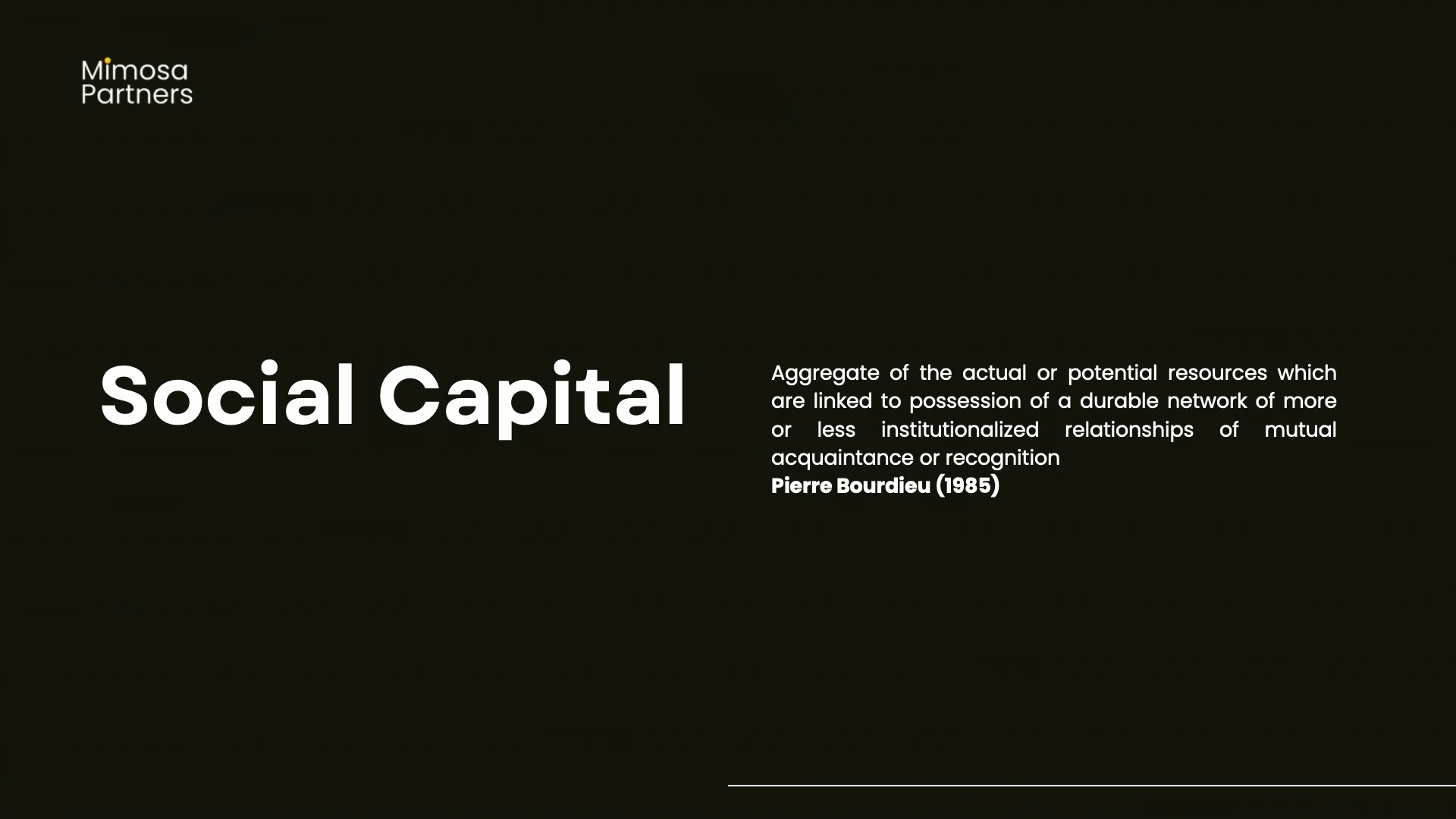
Anyway, social capital. What is it? Back to Beck and Sophie's talk from yesterday, they talked about this dude, Pierre Bourdieu. He's a very famous sociologist, and he defines social capital. But I like to really think about it as it's those relationships and the networks that we have in our community and the power we have in there that helps us as individuals and groups to go on and achieve our goals.
Right? So that's what the social capital is. And being a business designer, I needed to bring that into this talk. So I'm interested in how can we take the social capital that we see in a small community, and can we replicate some of that into our business environment? We do have social capital in our business environments, but is there something more we can learn from this environment that's got a lot of social capital? Now, why would we want to do that?
Why is there a reason to do that? So the academic research tells us it's a thing and that it creates value. So information capital, we have a lot of information in organisations. Social capital, they're very heavily intertwined. So just an example is we might have a relationship at work. We talk about things a lot, but we never write that content down. But it's important work content.
Right? So they're very heavily intertwined, those two those two things. Now when they come together well, we create new information or innovation, and that leads to better performance. So you can see here, this is the beginning of my talk, right? When I was allowed inside the business, I had access to more information, I was able to build better relationships, and I was able to deliver better performance, more value for the organisation.
Now there's a second reason we might want to do this. Ryan talked to it a little bit today about isolation. But, you know, so basically, our relationship experts, for want of a better term, they're telling us that we're not doing relationships very well right now. So Esther Perel says that we are suffering from social atrophy. So that means we're spending a lot of time looking at our phone, not enough time having conversations with each other, and having real conversations. She also says that we've become quite conflict averse.
So we don't want to have conflict. It makes us feel bad. It makes us feel bad about ourselves. So we're not doing conflict, which means we're not really doing relationships, because she also says conflict's inherent in relationships. Now the second one we've got there, Brene Brown, is about to put out a new book, and she brings AI into it a bit. So she says, in terms of AI, I hear a lot of experts trying to soothe people's anxiety around the pace of tech change by offering platitudes like what makes us human will ensure our relevance. Now, again, she says this is a little bit dangerous simply because we're not very good at what makes us human right now.
And she says organisational transformation must focus on fostering this deep connection. So I think the evidence is there that there's a good reason why we might be focusing on some of this social capital. And I just redrew this because, you know, the AI thing is really important. Right? Like, it is helping us synthesize a whole bunch of that information. It's bringing it down.
It's making it more accessible. We're efficient with the information. But we also need to be good at the relationships to result in better performance. So I come back to my small communities. Now I'm not expecting that we're going be able to replicate multimodal relationships. All right? That's not what we're going to look at.
But what I found in those small communities is there's certain behaviours and outcomes related to those relationships that I think we can replicate and that we can do to build social capital. Now, this isn't organisational transformation. Right? This is small acts of connection between people that can make a difference. So it's taking some of Ryan's stuff and really going, well, what's that next step?
Once we've got a container, what is it that we do? So here might be not really lessons from the small community, more insights, I guess, but here's my first one. So acknowledgment and belonging. Okay. So what we find in the small community is that everybody acknowledges each other whether they know each other or not. So when I go to the beach in the morning, it's like, good morning. Good morning.
Good morning. Good morning. And half of those people I have never met before. You always know when there's a tourist because they don't say good morning. And so this simple act of acknowledgment, it's weird. It makes me feel like I'm connected, I belong to that community, makes me feel warm and fuzzy inside.
And there is a growing body of evidence that says if you simply talk to people that you don't know, it builds a feeling of well-being, and it actually connects that community sorry, not just for the community, but for the individual as well. So for both. It has the effects of both. And this is something that is super easy, I would think, for us to be able to do in our organizations.
When you go to work, say hi to the receptionist. I mean, it's obvious, but, you know, say hi to people. Get in the lift. Talk to the people that you don't know. When you're waiting for coffee, say hi to people you don't know. Build that sense in your workplace of connection and belonging, and it can help lead to that extra social capital that can help us build and create outcomes.
Now my second one is around reciprocity and loyalty. So I'm going to be honest and say that when I worked in large organisations for a long time, I was always probably pretty dubious about the impact that any kind of grassroots activation would have in creating value for the organization. But I've changed my tune a bit, and this is what I've found. So one example for me is that my local IGA supermarket, they give, like, free sausages away to anybody that's doing any kind of, you know, I've I've got a fundraise, and we're gonna run a sausage sizzle, and they provide free sausages.
But the other thing that they do is they sponsor a lot of the local sporting teams. So when I go see my kid play hockey, there's an IGA sign there. And, it makes me feel pretty connected to the IGA, and it makes me feel like there's, you know, there's there's value here. There's loyalty. I feel loyalty to the IGA.
Now I was watching something online a couple of weeks ago, and they were sorry. I was it was just a post, but they were talking about loyalty. And what they were saying, loyalty programs aren't delivering in the way that we want them to. And the suggestion was that we needed to gamify loyalty. And if we gamified it, we would increase engagement and interaction, and that would lead to greater loyalty.
And I look at this, and I just think that kind of stuff, to be honest, is missing the point about what loyalty really is. If you want really true loyalty, I feel loyal to the IGA because they give to my community. So there's reciprocity. And when there's reciprocity, it builds that social connection.
Okay? We're building social capital. Now reciprocity is definitely something that we can access in our organisations. So as designers, we're normally pretty good at making sure the business is trying to solve problems for the customer. But I'm going to come back to Ruth's talk and go, okay, so how good are we at trying to solve help solve the business of problems? Do we understand the business' objectives?
Do we understand the business' pain points? And if we help them solve those kind of problems, then we can get a bit of runway. We can open up some space. Well, they'll allow us to get to our design outcomes, right? Because we've built some reciprocity and some loyalty with them in the business. Number three, accountability and performance.
So I don't think it's unusual that accountability and performance are linked. But what I was surprised about in the small community when I was working on some local projects was that I expected the person working on a small local project with you know, in a small organization to impact a small number of customers, I thought that would be way less stressful than somebody working for a big organization running a multimillion dollar project that's going to impact millions of customers.
But that's not what I found. I found the person over here on the small project, Some of them were more stressed. You know, not a great thing, but some of them were pretty stressed out about some of the projects that they were running. And a huge cause of that was actually this multimodal connection, and it was that they knew the people that they were delivering project for, and so that really increased the accountability that they felt.
They felt greater amounts of accountability. Okay? So I think, again, this is something that we can access a little bit in our organisations. Now, I guess, you know, the real surprise for me in that, though, is I think that when I always thought about accountability, I thought of it more about the what with accountability rather than the who. What am I accountable for?
A bit more than who I was accountable to. But, yeah, I come back then to we can access it in organizations. And one of the one of the things we do well as designers is that we do try to make sure that the business has accountability for the customer. Okay? We do that well. But the thing about this for me is it reminds me about how proximity to that customer is important.
We need to bring the customer to life. It's not just about it's not just about the insights and the customer models. I love to build a customer model, but it's about bringing that customer to life so that our business partners can feel closer to them, and they can increase the level of accountability that they feel to them.
It's also, though, something that we can access inside our organisations when we're thinking about if we're on a project, and we're thinking about our accountability on that project, who is our key stakeholder on that project? Who are we accountable to? And I would recommend sitting them down. Anthony Quinn once said this to me.
It's a great thing to say to people, for those who know Anthony. It's a great thing to say to people, how can I make you look good on this project? Right? If you're focusing on making them look good, you can increase that relationship. You build accountability. You build social capital. All right. This is my fourth one in just these This is the last one in this series.
And really, I'm looking at conflict resolution. Because one of the things that I did find in the small community is they can be pretty conflict averse. And if you're working in an organisation, sometimes you don't want to have that difficult conversation because you don't want to do that on Friday and then turn up at the farmer's market on Saturday and see each other again.
That can be pretty awkward. Right? So one of the things that I really found, they still need to have those conversations. Right? Like, they're important conversations. If you don't have them, you you get frustrated, and that starts to impact your culture. So the conversations are important ones. So what I found they really needed was they needed some kind of structure, some kind of container to have those difficult conversations within, but they also needed permission to have those conversations.
So permission for them in the small community, it looked much more like, hey, guys. We've got this time now. We're going to have this conversation. It's it's about work. It's about now. It's not gonna impact our relationships outside of this. So creating some boundaries for people about what that conversation was going to include. Now when it comes to organisations, I think we do the structures pretty well.
We do things like retros. We do we do performance reviews and all that kind of stuff. But I don't think we're so good about doing the permission. And when it comes to a situation like now where people are more conflict averse, I think it's important thing to say to people. Right? Like, when they're going to have that retro, just remind them, if you're feeling frustration about a particular issue, now's the time to have that conversation. And give them give them the thought that that conversation can occur. All right.
So we've spoken about the ways that we can build social capital. Now that we've built social capital, we can use that. Right? We can use that to impact values and status and help to drive outcomes. So what I found in Margaret River in the small community is that at a really high level, So they just they just look at status really differently.
I found it really interesting. When I was having conversations, I found status showed up really differently. So at that really high level, what we what I found is that if you if you volunteered a lot to the community and if you gave back an awful lot, then you had high status in the community. Everybody knew you you had high status.
But on the ground, the things that people spoke about on the ground were status was really derived from the DIY aspect of stuff. Right? So it's not that you've got this great renovation. It's that you chiseled the marble, and then you lay the tile. And now you've got a great renovation.
So that DIY element is what really just shifted the needle in Murray River. I found it really interesting. But it occurred to me when I was observing stuff like this that we can impact status, right, and we can impact values, and this can help change outcomes. So if we think about the organisation, the organisation sets at the top level a set of values.
They often recruit us against these values, and then they try to deliver some status against those values, and they do that by creating an awards. And you might win an award on a monthly or a yearly basis because you live those you live those values. Right? So that's how they derive a level of status. But that's not day to day what we see as valuable.
That's not the value we derive. That's not what we talk about on the Slack channel. It's not what we go to the coffee shop and talk about. Right? We talk about other things. And in those conversations, you can have an impact, and you can have a level of agency. And it can be just having a conversation where if somebody's delivered a really good design outcome, you talk that up.
You talk out the design outcomes that people in your teams are delivering, and you can impact the status. You can make that something that's desirable, which changes values. So the other thing for me that I found after I left the organization that I'd been working for, I met up with one of my previous colleagues one day.
And he said to me that my legacy from that organization, after I'd left that organization, is now in meetings when they had conversations, they often said to each other, what's the design? Where's the design? Have we got good design for this? And that wasn't something that they ever talked about before. Right? So it took me a while to realise that that was an important thing. And why it was important is because I had been able to impact the values in that part of the organisation.
And that's actually something that I'm really proud of. So not everything in a small community is perfect. It's by far not that, but I just wanted to give you some inspirational insight in how some things can be done, you know, finish off on a high note. And I wanted to just talk to this outcome from Margaret River because I find it totally inspiring.
Our CEO of the local business chamber is really proud of this. So Margaret River used to have a real boom and bust economy. So we're boom in summer, all the tourists are there, and you just hold on and hope that you're going to get through the winter without going bust. That's changed quite significantly.
And what happens now is that there are events that occur all through the winter. But the reason the events work is that there's collaboration across the community to bring them to life. Right? So we've got one event. It's like a food and wine event called Cabin Fever, and all of the venues take place, take part, and are involved in that.
There's another one we do, which is called open studios. And all the artists in the region, they open their studios. You can come and buy art, see their studios, etcetera. But these events wouldn't occur and wouldn't take place if it wasn't for the collaboration in the community, that social capital that's driving a better economic outcome for all of us.
And I think that's a really cool thing. So I'm I'm good on time, John. I'm good on time. I've got three minutes, and I've just got three takeaways. Good way to end a talk. K? So you don't have to follow the same path in the design. You can do you don't have to have design in your job title and be a designer.
You can do it from anywhere in the organization. Right? It's a way of working. Secondly, as we move forward, value isn't going to come just from the tech in our organisations. We've got to do relationships, and we've got to do them well. We've got to build that social capital. Thirdly, you have some agency over that. Right? You have some agency.
It starts with small connections and just having proper conversations with people and, you know, spending the time. That is it from me. So thank you for your time. I really appreciate it.
People
- Pierre Bourdieu
- Esther Perel
- Brené Brown
- Anthony Quinn
Technologies & Tools
- AI
- Slack
Concepts & Methods
- Business design
- Ethnography
- Biodiversity hotspot
- Multimodal relationships
- Social capital
- Information capital
- Social atrophy
- Acknowledgment and belonging
- Reciprocity
- Gamification
- Accountability
- Customer proximity
- Conflict resolution
- Retrospectives
- Performance reviews
- Organisational values
Organisations & Products
- Nature Conservation
- Southwest Innovation Hub
- IGA
- Loyalty programs
Works
- Cabin Fever
- Open Studios