What’s beyond the browser: the AI platform shift
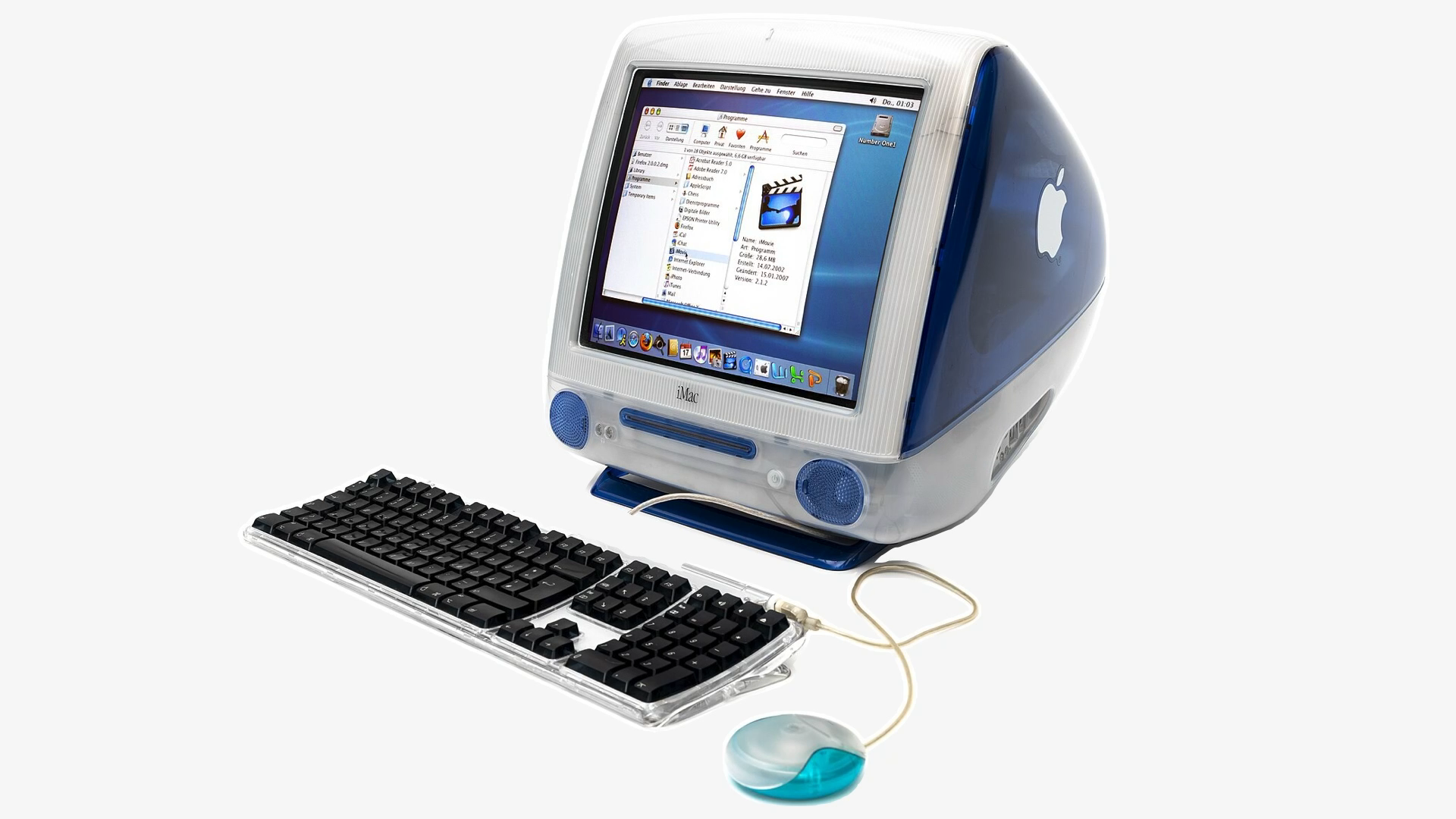
From Bits to Graphical Interfaces
Rupert Manfredi traces computing from bits and Boolean logic through ENIAC, punch cards, command lines, applications, and graphical interfaces. He argues that menus and buttons simplify interaction only because developers predefine nearly every action available to users.
Why Today’s Software Limits Us
As digital tools consume more of everyday life, people face overwhelming information, proliferating applications, and services whose incentives do not align with their own. Manfredi connects these problems to computers’ dependence on explicit instructions and users’ inability to reshape the software governing them.
Neural Networks as a New Computing Material
Manfredi contrasts deterministic logic gates with probabilistic neural networks that learn continuous patterns from examples. Using the evolution of the automobile as an analogy, he suggests that chat interfaces and computer-use agents are transitional forms attached to an older computing model.
Building Telepath from First Principles
Manfredi recounts his work with GPT-2 at Google Creative Lab, Mozilla’s Agentic Web research, and the startup Adept. He introduces Telepath, a company pursuing a computing experience designed from first principles for machine intelligence.
Demo: A Computer That Understands Context
In a live Telepath demonstration, Manfredi converses with a system that retrieves personal context, compares industry perspectives, recalls notes, and drafts collaborative work. The system turns loosely expressed intent into research and action without requiring navigation through separate applications.
Dynamic Interfaces and Personal Agency
Manfredi identifies dynamic interface composition, information synthesis, deep personalization, and background agency as defining properties of this proposed computer. He argues that past shifts from command lines to graphical interfaces, the web, and mobile—and the rise of capable local models—make another platform transition plausible.
From Monolithic Apps to Composable Services
Manfredi asks what an app-free computing environment would mean for the web. He predicts a move from predefined user journeys toward small, composable services orchestrated by user agents, reviving the web principle of small pieces loosely joined.
Repairing the Web’s Information Economy
AI systems need reliable, queryable information, but attention-driven publishing and AI-generated content are degrading the web’s knowledge base. Manfredi considers verified sources, Wikipedia-like communities, micropayments, HTTP 402, and the Semantic Web as foundations for a healthier information economy.
The Developer’s Role in the Platform Shift
Manfredi reframes software development as solving user problems rather than producing code or mastering particular frameworks. He recommends preparing for resource-oriented services while investing in human-centred design, information architecture, artistry, protocols, systems work, and specialized professional software.
Keeping the Open Web Alive
Manfredi warns that dominant AI companies could become advertising-funded super-apps, repeating the closed-network era that preceded the open web. He closes by urging developers to preserve user agency, interoperability, openness, and distributed services as AI transforms software and the browser’s role.
Precursor, I may be wrong or a fool or maybe both, but we'll find out. Ever since the dawn of computing, the fundamental unit underlying our entire computers has been this. This is a bit. We can represent it by this on/off switch. We have bits and we have Boolean logic that operates on bits.
[No thE audio] The state of a bit is 1 or 0, on or off. We can connect these bits with a logic gate. This is an AND gate. If we have two bits that are on, we will get this LED light up at the end. If one or the other are on, we will get an LED light up. This is one of the atomic units of computing, these sorts of gates, AND or OR gates.
Various combinations. And if we arrange enough of these gates in the right way with these bits, we can do computation. So this is a simple kind of computer that's doing some addition. And the only components on here are various logic gates and bits that are turning on and off. So when you scale that up, you get a general-purpose computer.
This is pretty much the first widely recognized general purpose computer, the ENIAC, ENIAC rather, and it was programmable. It was completed in 1945, designed for the US Army. And basically what's behind this is just a complex set of these circuits arranged in functional units like adders, accumulators, and multipliers, and you operate it by plugging in different parts of the machine, essentially like completing the circuit in various different ways, which is convenient because if you couldn't sort of patch these leads in, you'd have to just rebuild the computer every time that you want to do a different kind of computation. So this is our initial way that we instructed machines. We had these logic gates, and we needed to connect them in different formats. Over time, as we developed much more sophisticated and nice ways to instruct a computer, we developed punch cards, which were much easier than having to actually wire up different pieces, and you could transport them to different people, hand off a punch card to a computation lab to execute it.
And of course, the command line, which is the next big step, where you could have a terminal and actually run commands on a remote computer. But still, someone has to instruct the computer, rather, to do every little thing by essentially rearranging logic gates. That is all that is happening. We have a slightly higher level of abstraction here.
Where we're seeing text on the screen, but underneath it all, we're just rearranging these gates. And it's a very large learning curve back in the day, and it was a lot to ask for an individual user to have to instruct the machine to do every tiny little thing. And so we invented applications to solve this, alongside a simple graphical user interface. So experts, software developers, would understand, on average, a use case, a problem that a group of users were trying to solve, They would basically build all of the component parts of a solution to this problem, a graphical user interface that they could show in a rectangle, and give the user a small subset of actions and possibilities displayed on the screen that were much more easy to handle.
We represent these by menu bars. This is already starting to look a lot like what we have today. Menus, buttons, dropdowns, all these things that we use to interact with our computers all the time. And we like to think that we're in control when we're using a computer, but we're really just completing the last 1% of the instruction steps. All the rest of it is taken by the application developers, the operating systems, because under it all is the bit.
So we have to instruct the computer along the way. Of course, our computers grew up. Our entire lives have basically moved digital. Software has well and truly eaten the world. And I guess we're meant to feel really empowered by this at ease, cradled on our bicycles for the mind. I think instead, most people in my life, and me included, feel quite overwhelmed, frustrated and stuck.
I don't really feel like I'm in charge. I feel like I'm often wrestling with the technology I'm using because there is so much in there. I think if we really boil it down, it comes down to three fairly fundamental problems. The first one is that software is eating the world. There's just too much stuff in our computers.
We have these firehoses of information coming at us from being interconnected with everybody in the entire world. Thousands of emails, messages, photos, documents, subscriptions, et cetera. So meaning in our lives is buried in a litany of digital artifacts, much too much for any individual brain to comprehend. The second key problem is complexity.
Because everything has to be delivered in apps, we have way too many apps. We have a lot of apps, services, context, browser tabs, portals that we have to participate in and use in order to get anything done. And the burden of translation from the thing I want to do to the specific apps I need to use and the steps I need to take is completely on me as a user. So there are many layers of misdirection in this.
The third problem is misalignment. And that is that we're not really in charge. I mentioned bicycles for the mind before. There's this quote, We asked for bicycles for the mind, but we've got aircraft carriers instead. Bicycles are small, personal, modifiable lights. If you want, you could reconfigure it, clip different bits on, And aircraft carriers are industrial, heavy, they're manufactured, they are not in our control as a user to do anything with.
Far too complex for that. And I think there's a larger problem is that we've learned that our software doesn't necessarily have our best interests at heart. A lot of the services and products we use have ulterior motives that we really can't do anything about because we can't edit the source code. It's just like we have to take what we're given.
We have to accept the feeds that we maybe are not in our best interests. And this is restricting our agency and our options. And I think these are problems that couldn't really be envisaged in that early period of computing. But fundamentally, they all emerge, I think, from the fact that underneath the computer is this. This is what it's all about underneath.
Everything at some point needs to be explicitly instructed. Of course, that's not necessarily the case anymore. Neural networks came along. So this is a representation of a neuron. And like a logic gate, it has inputs and outputs, performs a computation on the input, and it gives an output.
And it's a building block to a larger, more complex system in a neural network. However, unlike a logic gate, a neuron operates on continuous values, not bits on and off, but rather a continuous spectrum. It isn't pre-configured ahead of time by having these different multipliers and adders. It's actually learned.
They develop learned patterns instead of being computed with rules. Systems like this are probabilistic, not deterministic. Instead of assembling a structure of logic gates for a particular task, you create a structure of neurons, and then you let it learn by showing it examples. Of what you want it to do. This means that where an algorithm, a traditional computer can only react to discrete inputs, a neural network can understand patterns that were previously beyond the realms of computers, such as images and sound, code, language.
Even recently, some folks at startup I met who were synthesizing scent. Which means that importantly for what we're talking about here, it can be trained to react appropriately to human intent without specifying in advance exactly how the language is to be structured or what it's meant to do. We've all experienced this now with language model products that we've used.
So this is obviously a great product angle to be able to generate text. But I think it's more than just a product. It's a fundamental shift from these discrete values to continuous values from structures we have to instruct along the way to things that can learn and adapt. So let's look at a similar fundamental shift, a new kind of material or technology that came along that revolutionized industry.
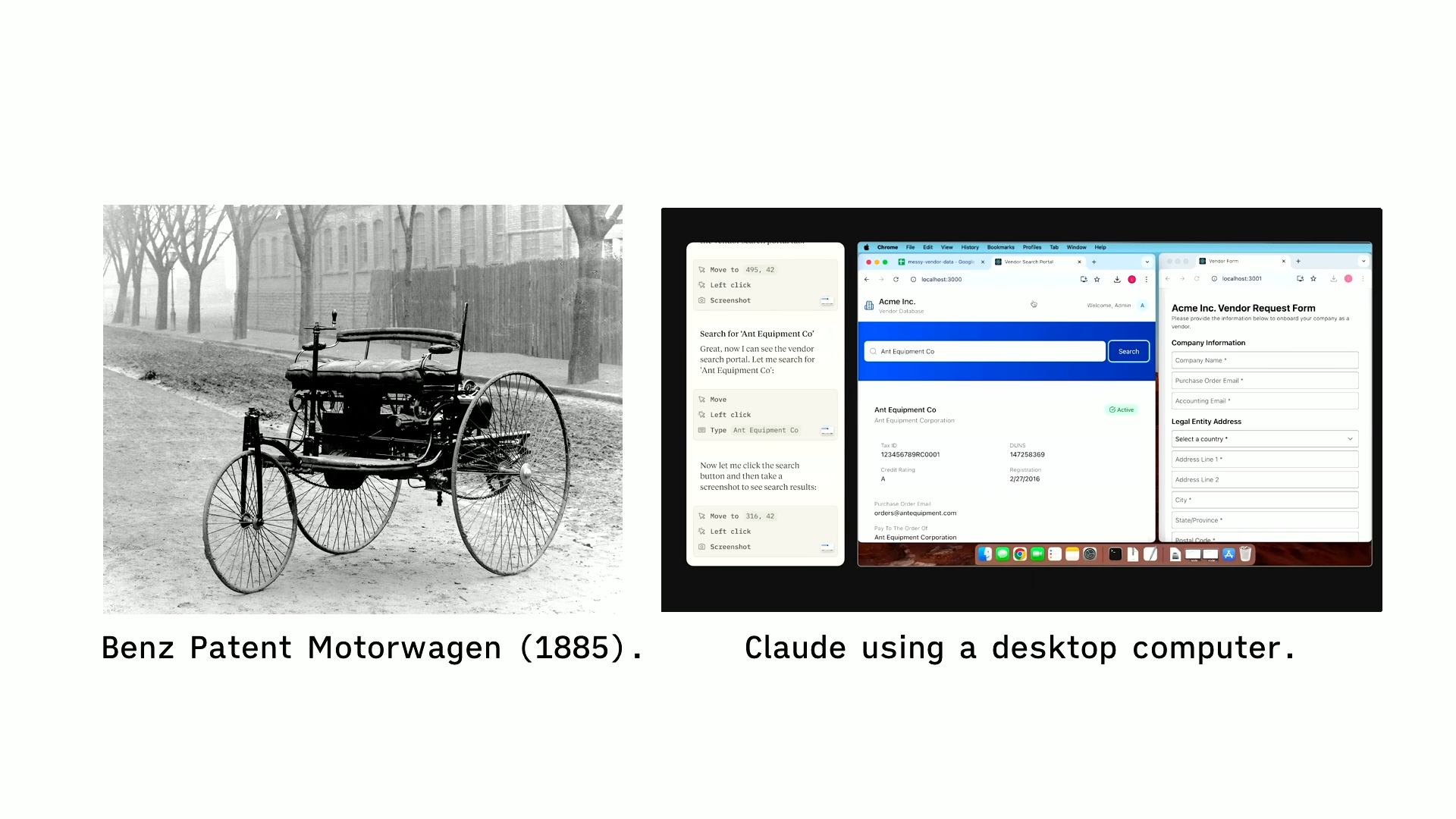
When combustion engines were invented, We just put them on the end of horse carriages basically. There's that like Ford quote, if I asked people what they wanted, they would have asked for faster horses. This is kind of like a faster horse, really. This is the first car. This is the Benz-Patent-Motorwagen from 1885. You can see it's got these huge wagon wheels.
Actually, you steer it with a yoke. There are no doors or roofs or anything like that. And so this basically gets you the same behavior as a horse carriage. Just runs on petrol, maybe it's cooler, you can show it to your friends. You have to water it. But it would take us 16 years to land on a design that we can start to recognize as a modern car.
This is the Mercedes 35 HP, about 16 years later. And you can see it's got these rubber tires, it's got headlights, a steering wheel. It starts to resemble a car that we have now. But the car today is as much a product of its environment as it's designed. So we also need to have motorways, gas stations, cultural norms around driving, the idea of jaywalking, for example, business infrastructure, road rules, regulation.
These are all the systems that have sort of supported what the car would then become and really revolutionize the idea of personal transport. So my point here is that once you have this core innovation, the the ultimate form of the Material, the ultimate form of the structures you can create with this Material, takes time to evolve.
But I think it always does eventually make its way there. We're in a similar spot right now with this new computing Material. Right now, we're taking our existing systems of windows and buttons and menu bars, and we're layering them with chat apps, sidebars, computer use agents, things like that.
This is kind of like strapping an engine to a horse cart. It's not wrong, it's a first step. But the desktop metaphor, Windows buttons, the way we distribute software, operating systems, apps, these are all created for a world where we need to program explicitly computers to make them do anything. And we're not necessarily in that world anymore.
So I think that means that a new kind of computer is coming and that it's going to be very different from the computers we have today. I've been working in this space for a while since 2018, when I started working with large neural networks for the first time at Google Creative Lab. We were fine-tuning GPT-2 to create user interfaces for writers.
I then worked at Mozilla on projects around the Agentic Web and Generative UI, worked at one of the first sort.
Of.
Agentic startups called Adept and spent the last year doing some R&D in this space. Now I'm working on a new company to develop these ideas further with two co-founders from Mozilla. This company is called Telepath and Telepath were explicitly focused on creating a new kind of computing experience built from first principles essentially for this machine intelligence era.
It's not enough, I think, to just like say that and get to work. We believe that it's also important to have some idea of where you're headed. And so we spent some time over the last few months thinking about a positive vision for this future, like what it might actually look like. And I want to share with you some of our early thoughts and a demonstration of what we think that looks like.
And also bear with me because we're going to try and live share this. Here we go. Okay. Now my computer is working. So I'm going to come up to my computer. I'm going to say, Hey, I got a few minutes. What's up?
The contractor for your home renovation project is waiting on you to choose new bathroom tiles. You have a demo scheduled right now, but you probably knew that. There's a sale right now that puts the Nintendo Switch in your target price.
Yeah, yeah. What's Mark Zuckerberg doing on my screen right now?
He was a guest at a conference where he spoke about a subject you're interested in. The personification of AI software. Zuckerberg said that the average person doesn't have enough friends and that in the future, AI will fill that gap for most Americans.
Okay, yeah, that is relevant to my interest. I think I hate that take. I feel like I was reading a book recently that made a similar point by Ethan someone.
Two months ago, you read Ethan Mollick's book, Co-Intelligence.
Yeah, that's right. He had something to say on this particular topic at some point in that book. Can you remind me what he said?
Malloc acknowledges that the personification of AI carries with it a host of valid risks and concerns. But at the same time, it's the most natural way to interact with today's AI systems. You made a note at that time saying that you understood his perspective but were uncomfortable with the compromise.
Yeah, that's right. I remember that now. I think this is going to be an important issue for telepath, and we should probably see what other people in the industry are saying. Can you source some industry perspectives and group it by foreign against please? Okay, that's too much. I think let's filter it by anyone who's talked about this in the last month.
It's John Borthwick. He's interesting things to say. Let's see what he said.
Your contact John Borthwick recently sent out a newsletter about this very topic. Borthwick says that designers should seek balance with AI, crafting interactions that feel intuitive without misleading users into believing that AIs can think or feel.
Yeah, no surprise, that's good stuff. Let's save that. And I just wanted you to save that Zuckerberg interview. We might need that later. Okay, also, what have we said about this internally at Telepath? Have we got any related notes?
In multiple meetings and in key company documents, you and the team have expressed a desire to build a system that is focused more on augmenting human abilities than automating them. That seems like a relevant perspective.
Yeah, I think that's right. It gives an idea. Please take a memo. Telepath leans against the personification of AI systems because we want users to not perceive computers as doing the thinking for them. We actually want computers to feel like they're helping users think even better. Okay, cool. I think it would be good to talk about this publicly. Can you pull all this information and get an outline and a draft ready for me, please?
Okay, great. That's awesome. I'm kind of in the middle of something right now, so I might need to come back to this a little bit later. But please save this and please let my team know and ask for some feedback.
Done.
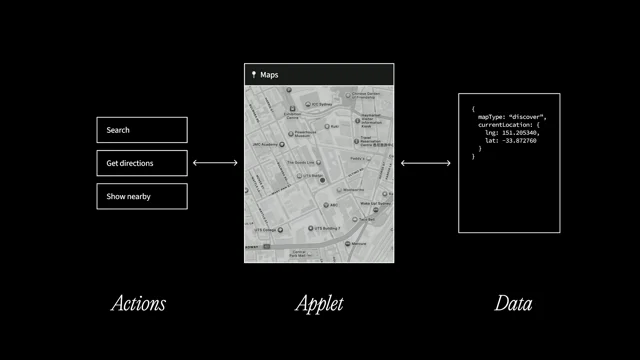
So this is a very different kind of vision for the future of computing. I want to talk to you about a couple of the things and pull them apart here. So the first one is that the interface here is very flexible. The user interface is dynamically composed, huge chunks of it are generated from scratch, and the idea is that they're morphing to fit the task at hand. There's no real conception of apps, of shipping these monolithic pieces of software.
Instead, the machine is composing the functionality according to what I want. The second thing to note is that the computer isn't just presenting me huge lists of files or notes or artifacts. It's actually making sense of them on my behalf. I don't have to browse things. I can get shown things that are relevant, what I'm talking about.
And that implies a level of deep personalization, which is another trait of this future machine. So you can't make sense of information unless you know exactly who you're making sense of that information for. Telepath is able to form a precise model of the user and their beliefs, their values, their current projects, their relationships, and deploy that for any task that's undertaking.
That's the only real way that a computer like this can filter the information that is presented. And because the user doesn't need to give the computer any explicit instruction, and because the computer has this model of the user, it means that it can go and do stuff on the user's behalf. So this computer is constantly working in the background.
So let me talk a little bit about why I think this will happen. As John mentioned, a lot of predictions of the future are wrong in important ways. There will be things that are wrong about this, but I do think something like this is going to pan out. I think we're just starting to unveil something like this.
The first reason is that we shouldn't fall into normalcy bias. These shifts happen all the time. In the 80s, it was the CLI to the GUI, which was a huge shift in computing. It was the web in the 90s, mobile in the 00s. These things are regular parts of being a developer and being in technology. And each time we see a similar pattern with this new core technology that emerges, and from there we get new capabilities, new business models, new ways of distributing software.
At first, we always retrofit to the reality we know now, and then we sort of start to evolve to the true form. I think given this fundamental nature of this shift from bits to neurons, we should expect a big change coming. We already basically have this core technology, and it's delivering user value today, just for the programmers in the room, or people who aren't us your nearest developer.
People are using this constantly, this idea of being able to translate their intent into actions they would otherwise be taking manually. This is leading to a more delightful experience, increased productivity. This is just something that is already showing usefulness in certain domains. I think we can spread that much further. Another reason is that the trends are accelerating towards smaller, more capable local models that can run on device.
The hardware is catching up and there's a lot of money riding on solving some of the outstanding problems in this area. And it's being built now, whether it's us as telepath and a lot of others in the industry, the shift is underway. It's been something that we've been thinking about in the computing industry since basically the'50s, maybe earlier, and there are already multiple companies racing towards something like this.
So I've made the case, I hope convincingly for this new kind of computer, But you might notice that there are no browsers here. So what does this mean for the web? Like, does this kill the web if it actually pans out the way this might be happening? I think if you look at the web today, it's a platform for shipping applications and for information.
Often we bundle these two things very tightly together. And I think both of these areas are going to be faced with upheaval. So there are no apps in this telepath computer. It's generating opposing interfaces and functionality based on the user interface and the task at hand. And this is basically a native consequence of this material. I think what we'll see in the web is that instead of shipping these monolithic apps, which have all of these predefined user journeys ahead of time, we will start to move towards smaller, more composable pieces and services, where we can let the user system and their intent work out what to combine in which ways.
This is a very web-like idea, actually. The user agent originally this idea was having a program that could mediate interactions with many services and do so on your behalf and advocate for the user. There's also this motto in the web of small pieces loosely joined. I think this actually has a lot to do with the the values that made the web great in the first place.
The other side of this is information. So the telepath computer is constantly querying information, and it needs to have high-quality information that it can query constantly to back up the interfaces and the things that it is saying for the user. So what does information on the web look like now? It's a disaster. It's not great out there.
So the incentives that we have on the web right now, optimizing for attention, that worked at first to create an open web that could be accessible for everybody. But now that misalignment is starting to become really clear. We're optimizing for attention and we're starting to get degradation in information on the web as a result. And of course, as AI slop intensifies, this is getting worse, not better. We now have 50% of articles, according to one report, that are AI generated on the web, which is staggering.
And simultaneously, as new clients emerge that control this view layer, the ad-supported web is becoming increasingly unviable anyway. This is an emerging crisis, one we're not really dealing with appropriately right now. So I think we need to reconsider what information is on the web and the economics of it.
We need a rich network of queryable, high quality, verified sources, documents, structured data sets to allow our machines to make correct inferences. One way to achieve this is like some centralized subscription service, the new Encyclopedia Encarta or whatever. I think this is a very un-web-like way. How we do this on the web right now is we have true seeking communities like Wikipedia, And I think another potential solution here might be direct micro payments so that we can transfer value directly in the market to people that are providing a high quality information.
These are also very original web-like ideas. So the web was originally about content, not about shipping apps. That's the origin at CERN. Also, the 402 payment required header was part of the original HTTP spec, which is still reserved for future use 35 plus years later.
Berners-Lee tried to implement this, but it was much too complex and expensive to do it with banking back in the day. I think that might not be necessarily true anymore. There are a few different viable paths. And this also reminds me a lot of this vision of the semantic web of a machine readable internet. So I think the web is facing huge upheaval with this change.
We have new ways of thinking about how to ship software to users, probably brand new economic models, the idea of maybe serving headless information, probably a lot of other things I haven't thought of or mentioned. What does this mean for web developers? For us, like, my start in technology was through web development. I think our job has never been to write lots of software or to master React hooks.
The ultimate job is to solve problems for users using software. And I think that's still the job of developers. The solutions are going to look very different, but we're also an adaptable group. So I think there's nothing really to do yet. This shift hasn't happened yet, but looking ahead, I think it would be important to think in terms of resources and services instead of thinking about monolithic apps being the way that we ship software in the future.
Human-centered work is going to be increasingly important. So stuff like information architecture, designing and crafting the critical paths, a deep understanding of the user and business problems, even things like artistry and taste that are very difficult to be synthesized. And so will deep technical work. So lower-level systems work, building these actual platforms, the protocols, and probably also professional software packages that are less likely to be a good fit for this on-the-fly generation.
I think another critical role here for everyone in this room is to keep the mission of the web alive and the values. A lot of money has been invested in this space currently, and I think a big chunk of that is riding on the idea that we will basically have OpenAI and other large companies turn into these huge super apps that capture all of our user value and can then serve us ads.
At InfiniTerm. And that is very unlike the web. But yet again, this is not our first rodeo. Compose, serve, and AOL were the dominant forces in the internet before the open web came along. So we've done this before, and the web has won in the past. I think we're currently in the early Compose, serve, AOL phase, and we need to ensure that open wins this time again.
So just to wrap up, here I showed you a computer that works very differently from the computers we have today. One that understands this human intent, composes functionality, mediates our relationship with information on users' behalf. And it represents a dramatic shift in the way we think about software and how we distribute it, which I think will make huge ripples in how the web works, even if it doesn't pan out exactly like this. It'll upend a lot of things that we take for granted.
The web is HTTP, HTML, CSS, JavaScript, but it's also a set of ideals. And I hope if you take away anything from this, it's that while we're probably up for a period of a huge amount of change, this is also something that we should be able to get really excited about. This is, if we do it right, a path for a better, more user-aligned form of computing, one in which that harkens back to the original principles of the web, of user agency, and smaller, more composable, interoperable, distributed services.
So maybe the web in its current exact formation is dead, but it's definitely not the end of the chapter and long live the web.
Thanks.
People
- Mark Zuckerberg
- Ethan Mollick
- John Borthwick
- Tim Berners-Lee
Technologies & Tools
- Logic gate
- ENIAC
- Punch card
- Command-line interface
- Graphical user interface
- Neural network
- GPT-2
- Local models
- React Hooks
Standards & Specs
- User agent
- HTTP 402
- Semantic Web
- HTTP
- HTML
- CSS
- JavaScript
Concepts & Methods
- Boolean logic
- Agentic Web
- Generative UI
- Normalcy bias
- Micropayments
- Information architecture
Organisations & Products
- Benz Patent-Motorwagen
- Mercedes 35 hp
- Google Creative Lab
- Mozilla
- Adept
- Telepath
- Wikipedia
- CERN
- OpenAI
- CompuServe
- AOL
Works
- Co-Intelligence