What’s beyond the browser: the AI platform shift
From Logic Gates to Programmable Computers
Rupert Manfredi traces computation from bits and logic gates through counters, ENIAC, punch cards, and the command line. He shows how each abstraction made general-purpose computers easier to instruct while preserving the same rule-bound foundation underneath.
How Applications Created Scale and Friction
Manfredi explains how the Apple Lisa and graphical applications let experts package common tasks for ordinary users. As software expanded into every part of life, that model also produced overwhelming volume, excessive complexity, and systems that are often misaligned with their users.
Neural Networks as a New Computing Material
The speaker contrasts deterministic logic gates with neural networks that learn patterns across images, sound, code, and language. Using the evolution from an engine strapped to a cart to the modern car, he argues that adding chat panels to existing applications is only a transitional form and that AI will produce a more fundamental computing architecture.
Demonstrating Telepath’s AI-Native Computer
Manfredi demonstrates Telepath, an experimental computer that draws on personal context, retrieves relevant sources, organizes competing views, and helps develop an idea into an outline. The demo shows an interface assembled around the user’s intent rather than a sequence of fixed applications.
Principles and Momentum Behind AI-Native Computing
Manfredi identifies four qualities of the demonstrated system: dynamic interfaces, collaborative sense-making, deep personalization, and proactive background work. He then connects this direction to recurring platform shifts, today’s useful developer tools, and rapidly improving models and hardware.
Rebuilding Web Applications and Information
The talk considers what an application-free AI environment means for the web. Manfredi proposes replacing monolithic apps with composable services and resources, then argues that AI agents will also require a healthier information network built on verified sources, community curation, and new economics such as micropayments.
Preserving the Web’s Open Ideals
Manfredi links AI-native computing to HTTP 402, the Semantic Web, and the web’s original role as an open information system. He outlines durable roles for human-centred and deep technical work, warns against a new AOL- or CompuServe-style enclosure, and closes by calling for an interoperable, accessible ecosystem that acts on the user’s behalf.
Hey, good morning. So from pretty much the dawn of computation, this is this has been the thing that's underpinned everything, which is a bit. It has two states here representing it by an on off switch. It can be one or zero. Electricity flowing or not flowing. And this is basically the foundational building block of all computers along with logic gates. This is a logic gate.
This one is called an and gate. There are various types of these things. Essentially, this is taking two bits and if they're both on, you're gonna get this light pop up. And if only one is on, it will not. And if they're both off, you also won't get a light. So this is an and logic gate. It it applies if if a and b are both on.
And that's kinda not super interesting by itself. It's a very simple circuit. But when you scale it up and you combine a bunch of these gates, or gates, on gates, you know, NAND gates, all these various different types of combinations, you get a very basic unit of computation. Here we have a counter that is managing to count from zero to nine. And there's, you know, some abstraction here, but basically all that this diagram is showing is a bunch of logic gates and some bits flowing around.
And so this is sort of the essence of a computer. If you get a whole bunch of these, you arrange them into various different adders, subtractors, multipliers, etcetera. Then you get the first general purpose computer, which is here. This is ENIAC. And that's all this is. It's a bunch of circuits with these various logic gates inside them.
And with this, you can do a lot more complex computation. Of course, you know, you don't wanna have to rebuild your computer every time you want to like compute something different. That would be very impractical. So what's happening here is that these humans, computers back in the day, they were called, are actually patching in the various circuits to each other in order to do different kinds of computation.
So this is the first way that we really instructed computers beyond rebuilding the circuits every time. We got better ways of instructing computers. This is it's a punch card. I can now hand this to somebody. They can take it down to the mainframe or whatever and do a computation. And then we got more abstract with command lines.
Now, this is much more convenient than having to plug in a bunch of do a bunch of punch cards or plug in a bunch of circuits. But underneath the hood, it's really just doing the same thing. It's translating my instructions into a bunch of different configurations of these logic gates to do some kind of computation. And I should also say before we move on, that's kind of like a lot of work for any individual person to have to know all the incantations with this command line and control every single piece. So that brings us to something like this.
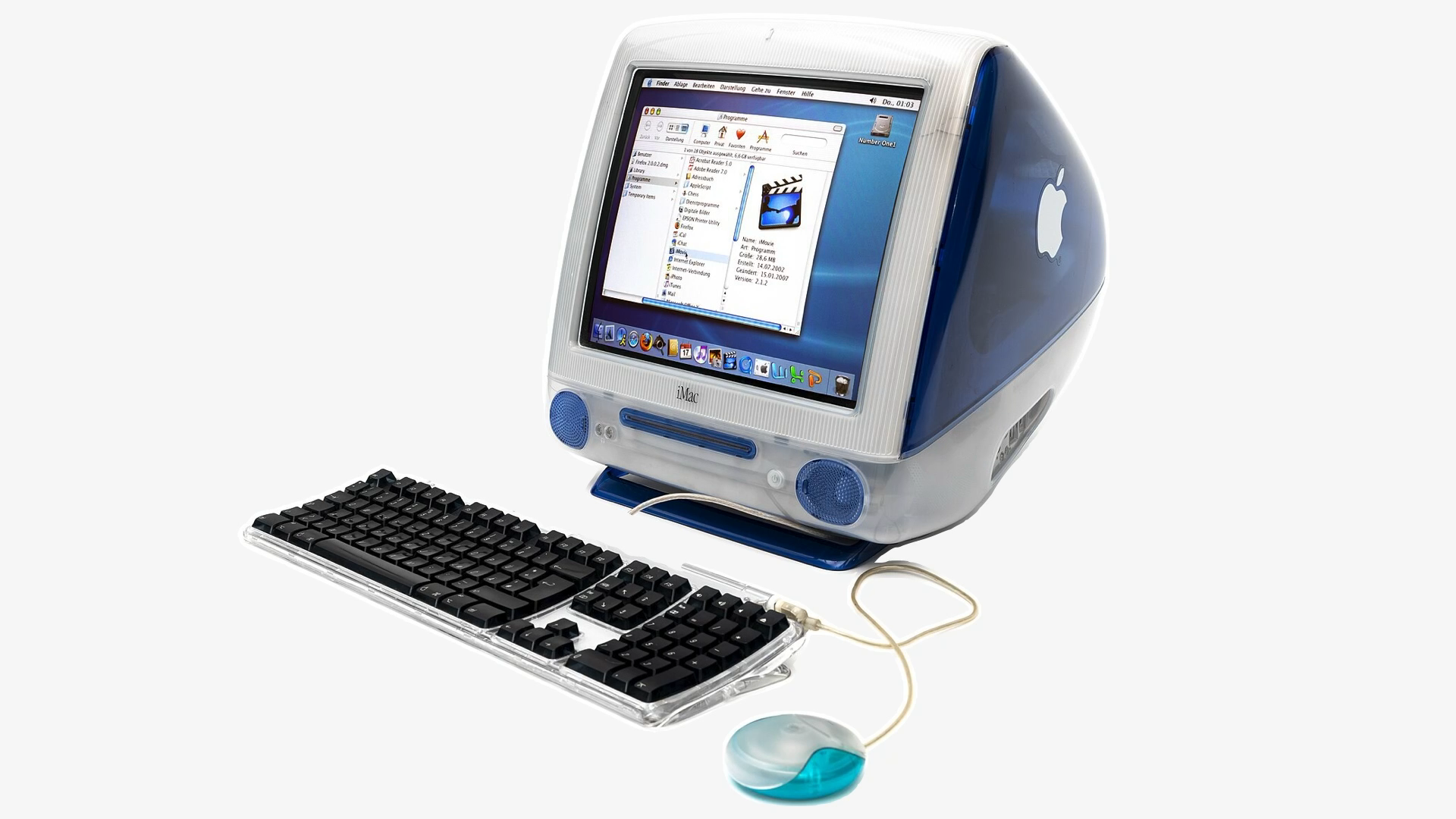
This is the Mac Apple Lisa. And this sort of had basically the first commercial graphical user interface. And this notion of applications was born around this era of computing. And an application basically was we would get a bunch of experts who knew what they were doing with computers to do a whole bunch of the programming for us.
They would take average use cases of groups of users and ship a piece of software. And then as users, we got some subset of commands that we could do. We couldn't, like, program the whole machine anymore. But that was better for us because it's, like, way too much work to do that anyway. So we'd get a bunch of drop downs, buttons, other GUI elements.
And that's our way of basically like taking this instruction in the last 1% of what we want the computer to do. So we're not as much in control in this world of applications, but we can get a lot more done because we have this high level of abstraction to deal with. So our computers grew up and our entire lives moved into this digital realm. Software genuinely did eat the world.
And yet, while I think we're meant to feel at ease and empowered by the power at our fingertips, at least in my life, most people I know that use computers regularly and frankly myself as well, feel often overwhelmed, stuck, very frustrated with the limitations that we're running into. And I think we can boil this down to three core problems. The first one is volume.
There is too much stuff. Our entire universe is in our digital. We have thousands of files, messages, emails, photos, documents. I have a folder on my computer called inbox, which is like 1,000 files deep at this point that I try not to look at. And so all this meaning in our lives is buried in this litany of tiny individual artifacts.
The second problem is complexity. There are basically now too many apps. There are too many ways to interact with the computer. There are too many gotchas. In order to do any task, in order to achieve my intent, I have to the burden is on me as a user to basically navigate these multiple apps, services, contacts, passwords, authentication, browser tabs, all of these kind of like buckets that my stuff can be in.
And there are a lot of layers of misdirection here for me just trying to achieve something. The third one is misalignment. So there's this quote, we asked for bicycles of the mind and we got aircraft carriers instead. Bicycles of the mind was this kind of metaphor for having having this incredible power, being able to have such energy efficiency, travel such distances with our minds, be able to achieve so much.
But where bikes are personal and modifiable light, aircraft carriers are industrial, heavy, manufactured, and I can't go and alter them in any way. I can't really control an aircraft carrier. And so we've learned that often these applications, the software that we use, doesn't they don't necessarily have our best interest at heart and often work at cross purposes for what we want them to do.
We don't really trust or we shouldn't trust the software that we use on a daily basis, which is a bit of an issue. So I think all of these three problems really emerge from this. The fundamental thing that is underneath all of our computers is the bit and the logic gate and at some level everything has to be instructed. Everything has to be placed in a very specific way.
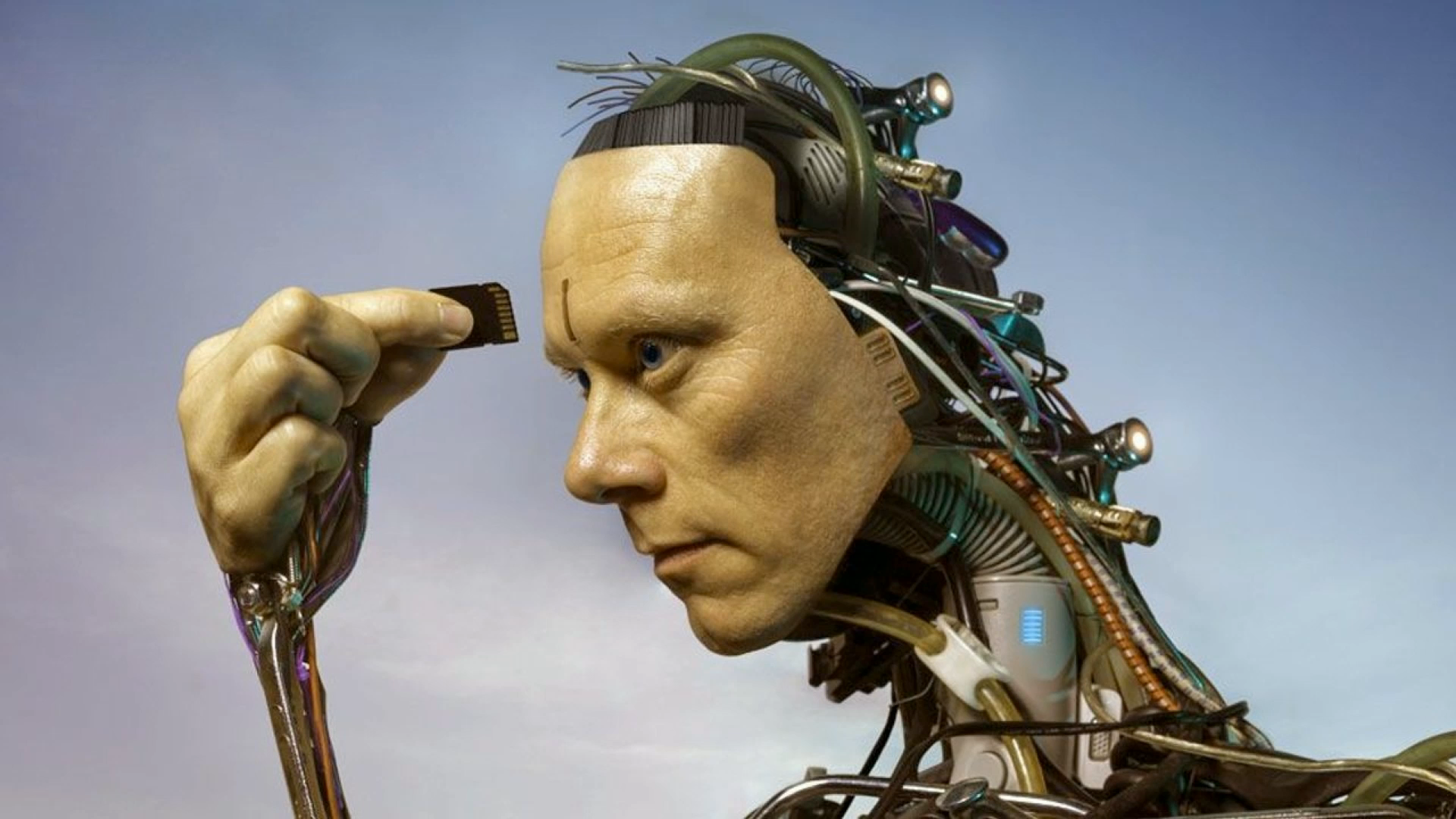
Inputs have to be incredibly well specified and somebody has to tell the computer what to do at every step of the way. And this is it. Like, this is our main form of computation. On or off. Now then neural networks arrived. This is a representation of a neuron and like a logic gate, it has inputs and outputs.
It performs a simple computation and it's a building block to a larger whole system. However, unlike a logic gate, it operates on continuous values and it learns patterns. We don't pre configure it with rules ahead of time. So it's probabilistic. It's not deterministic and instead of assembling a very specific circuit for a computation, we create a structure of neurons and we let it learn from data.
We showed examples and it learns patterns. So that means that where an algorithm can only react to very discrete inputs in a preset way, a neural network can understand patterns and images, sound, code, all of these areas that were previously completely off limits to regular computation. And the most important for this purpose right now, I guess, would be language. So because machine learning model can understand human language, it also means it can start to understand human intent and react appropriately without me needing to specify in advance exactly how this is meant to work. This is, as I'm sure many in the room are aware, a pretty fundamental shift.
It's not what what I want to argue here is it's not just at the layer of like, oh, how helpful ChatGPT is now as an app on my computer. It's a fundamental architectural building block for computers. It's a huge shift in how we think about what a computer can do and what its capabilities are from the ground level.
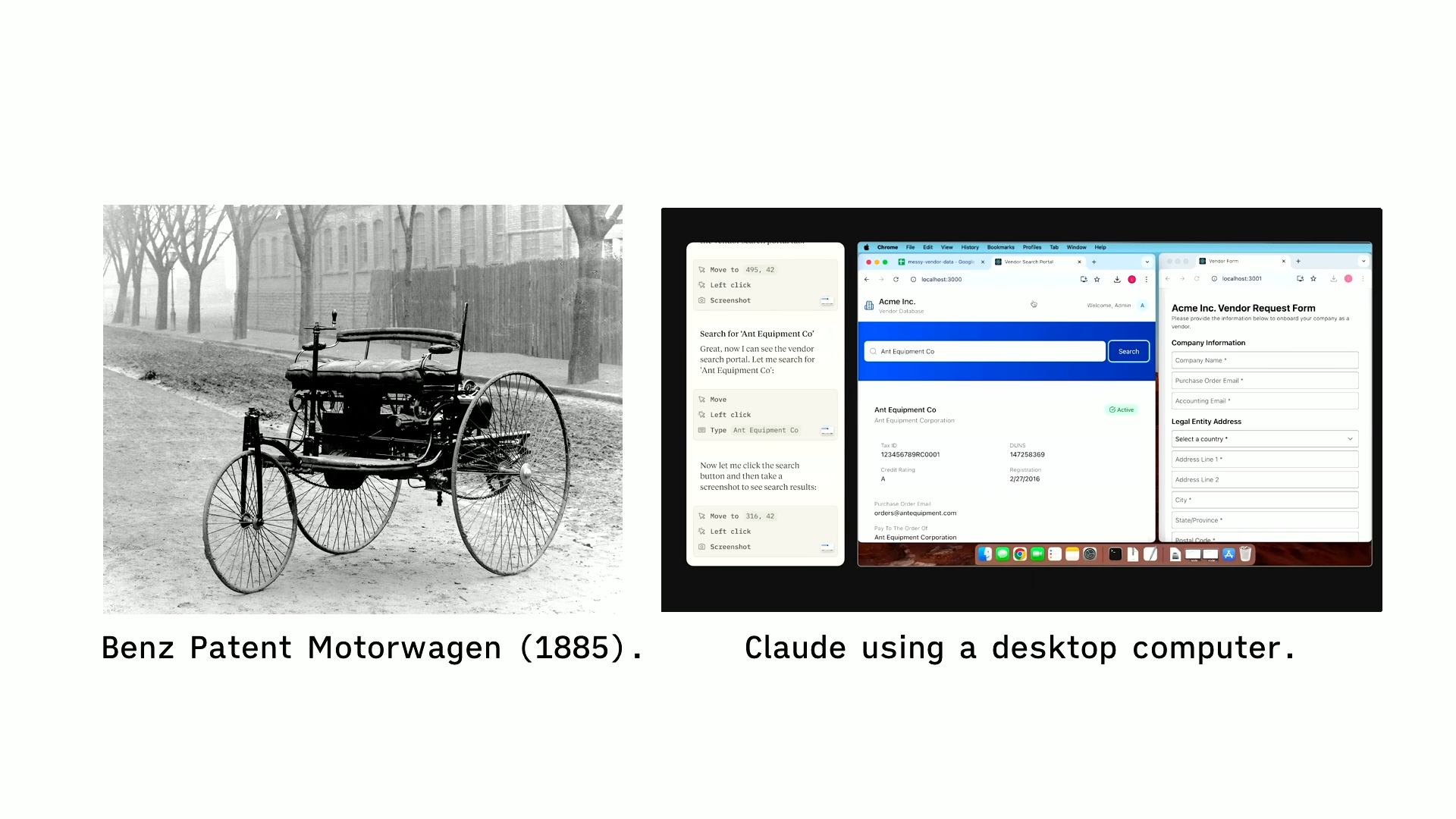
So let's look at a similar huge architectural shift shift, the invention of an another kind of core material like this. When the internal combustion engine was invented, first off, we literally strapped them to horse carts and then we created the first motor car which is here the Benz Peyton Motorwagen.
And you might notice that this doesn't look really much like a modern car. We've got these like huge wagon wheels that I believe are metal rimmed. You steer this thing with a yoke. You sit up on this like bench seat up the top. There are no doors. There's no roof. And it would take us about sixteen years to land on something that we start to see as the origin of a modern car. This thing now has tires.
It's got headlights. It's got an actual steering wheel. So we're not no longer gluing the engine onto a the cart that we had. We're creating a design that is more native to this material. And, of course, it's not just the design. The modern car we have today is a product of an environment as well. So motorways, gas stations, cultural norms around driving and where you can walk as a pedestrian, business infrastructure, road rules and regulation.
All of this stuff is supporting what the car has now become, which is this very revolutionary personal mobility machine. It's essentially that, you know, most of us use on a daily basis. If it's not ours, we use Ubers or cabs or whatever. So the argument here is that the ultimate form of the material takes some time to evolve from the initial innovation, But I think it always does. We always make it there eventually.
And we're in a similar spot right now with this new computing material. Right now, we're taking our existing systems and we're kind of just like peppering them with chat apps, sidebars, computer use agents, things like this. This is basically like strapping an engine to a horse cart. The desktop metaphor, Windows, buttons, software distribution, operating systems, applications.
The all these things were created for a world where we had to instruct a computer what to do at every step of the way. But we don't live in that world anymore. And I think as a result, a very different kind of computing experience is coming. Very unlike what we have today. So at Telepath, where I'm leading design, we're focused on creating a new kind of computing experience, one that is built for an era of machine intelligence. But I don't think it's enough to just say that and start making it.
I think, you know, to really leap forward, we believe we need a positive vision of what this kind of future looks like. Maybe not exactly, but at least the general qualities and traits that we see emerging from this material that we think we can apply to a better user experience. So I wanna share with you some early thoughts we have, and this is a demonstration that we built over the last couple of months to bring some of these ideas to life and imagine what this computer will look like.
So let's see if I can swipe over here. Cool. Okay. So you can imagine that I've just walked up to my computer and I'm gonna sort of demonstrate this now. I have a few minutes. What's up?
The contractor for your home renovation project is waiting on you to choose new bathroom tiles. You have a demo scheduled right now, but you probably knew that. There's a sale right now that puts the Nintendo Switch in your
Okay. Wait. Wait. What's Mark Zuckerberg doing on the screen?
He was a guest at a conference where he spoke about a subject you're interested in, the personification of AI software. Zuckerberg said that the average person doesn't have enough friends and that in the future, AI will fill that gap for most Americans.
Okay. I mean, I'm interested in that, but I think I hate that take. I feel like there's a I read a book recently by Ethan, that guy Ethan. What was that book again?
Two months ago, you read Ethan Moloch's book, Co Intelligence.
Yeah. That's right. I I think I remember there was a section in this book related to that. What what was that section about?
Malik acknowledges that the personification of AI carries with it a host of valid risks and concerns. But at the same time, it's the most natural way to interact with today's AI systems. You made a note at that time saying that you understood his perspective but were uncomfortable with the compromise.
Yeah. That's right. I remember that now. Okay. So this is gonna be important for telepath and I think I wanna just get a bit more research of the field in general. Let's get can you get some opinions from other people in the field that I like and and organized by for and against? Okay. I think that's a bit much.
Can we narrow it down to last month? Oh, yeah. John Borthwick. Okay. I'd love to hear his take. What's he got to say?
Your contact, John Borthwick, recently sent out a newsletter about this very topic. Borthwick says that designers should seek balance with AI, crafting interactions that feel intuitive without misleading users into believing that AIs can think or feel.
Okay. I like that take. Let's save that in the Zuckerberg interview for later. Okay. Alright. What have we said internally about this in Telepath?
In multiple meetings and in key company documents, you and the team have expressed a desire to build a system that is focused more on augmenting human abilities than automating them. That seems like a relevant perspective?
Yeah. I think so. I've got an idea. Can you take a note, please? Telepath leans against the personification of AI systems because we want we don't want users to perceive their computers as doing the work for them and the thinking for them. I think instead we want them to feel like their computer helps them to think better.
Okay. Cool. Let's pull this stuff together. I'd like an outline, the source I saved, and and we might start writing a post. I'd like to speak about this publicly. Cool. That's great. Let's maybe take this take a beat because I'm kind of in the middle of something. So we'll save this for later and share it with my colleagues to get some feedback at Telepath.
Done.
Okay. So this is a very different thank you. So, yeah, this is a very different kind of computing experience. And I wanna break down with you guys exactly why I think that is and the the parts of this that I think we base the experience on.
So the first thing you'll notice is that there is no fixed application UI UI here. Everything is dynamically either composed or generated on the fly based on my intent. There's no conception of apps. We're not shipping apps here. This is like a very dynamic system, which helps me to work better, helps me to make sense of all this information.
And that's the next part of this is that this computer is actively sense making with me and for me. So it is able to understand what I might find important, have access to all of the data that I have, and then be able to mediate my interaction with this data. So I don't have to go to every individual file, note.
It can the system is supporting me as this kind of cognitive prosthesis through this process. In order to do that, it has to have a really good understanding of me. This machine is deeply personalized. It knows what I read recently. It knows who the sources are that I might find interesting whether I like them or not And it has an idea of my beliefs, my values, the projects I'm working on, who my colleagues are, etcetera. And it has to deploy this understanding of me to any task it's doing. That's the only way that the computer can effectively filter this information on my behalf.
And finally, you might have seen briefly the beginning and end, this computer is kind of constantly surfacing things. It's working in the background on my behalf. So because it understands me and it knows what I'm working on, it can start to be proactive. It works while I'm away from the machine. I don't have to be constantly inputting every single action that I want it to take.
So I think that we are heading towards a future where computers look more like that example than what they do today. And I'm also aware that most predictions of the future are wrong in important ways. But I wanna give you an idea of why I think something like this is coming. So the first reason I think something like this is coming is that it it something like this always comes.
Platform shifts are predictable than normal in this field of technology. They're just a part of the process. So, you know, we had the CLI to the GUI in the eighties. We had the web obviously in the nineties and mobile. And each time we see a similar pattern, is we have a new core technology and then the shift happens, is new capabilities emerge, new business models shift as well, and different ways of distributing and consuming software. And each time, just like now, we retrofit to what we know at first and then we discover the the true form of what we're dealing with.
So given how fundamental this shift is from a bit to a neural network, I think we should anticipate there will be a fundamental big shift as well. The second reason is that we kind of already have the core technology. This isn't the huge sci fi vision of the future like, you know, there are various approaches of this sort of thing years ago. Now we have this core technology.
We kind of understand what it does and it's already starting to deliver user value. So, you know, the best example of that right now is probably developers. If you ask your nearest programmer, they're probably using ClawCode or Copilot. And, know, part of the reason is that we found a small domain where this idea of being able to translate your intent to the computer instead of having to do every single manual thing is an incredible productivity lift and it's a more joyful experience as well for the user. Our job is to apply that more broadly.
And so the third reason is this technology is rapidly improving. We're getting smaller, more capable local models that can run on device. The hardware is catching up. A lot of the outstanding problems in the field are being worked on very aggressively. And so we're gonna see this sort of stuff. We're not when we're thinking about it, we shouldn't think about what the capabilities we have now.
We should think what we're gonna have in two or three years' time. Just like when we were thinking about the origins of computing, we shouldn't think about having to patch in cables. We should think about when everyone has a computer in their home. So whether it's us at Telepath or others in the industry working on this problem from different angles, this shift is underway and there's a lot of people racing at it right now.
So something is happening. I hope I've made a case that there is this new kind of computer coming. Let's explore because we're at web directions next. One particular consequence which is like there's no browsers here in the system and there's no apps. So what does this mean for the web and the way we ship software at the moment?
If we look at the web today, it's a platform for shipping applications and information. And often, right now, we kinda couple those things very closely together. So we build these big apps, portals. We we sort of like have new sites, etcetera. All of this stuff is coupled. And I think both of these areas are gonna be decoupled and faced with some degree of upheaval.
So like I mentioned before, there are no apps in Telepath. It's generating, composing interfaces and functionality on the fly. And this is a native consequence of this new material. So when we're thinking about shipping software, I think we're gonna move from thinking about a monolithic app where we specify everything to composable parts that can be assembled and generated on the fly based on what the user is trying to do.
This is confronting, but it also reminds me in a small way of our transition to responsive websites. We're giving up control, but we're greatly enhancing flexibility and user experience as a result. And it's also very web like. The original idea of a user agent on the web was this thing that would interact with the network on your behalf and present the data as you needed.
And this motto of small pieces being loosely joined, there was another sort of early web thing. So I think this is very native to the sort of principles that we like in the web, this idea of having the user be in charge. Another part of it is the information side of things. This is where it gets really interesting because I think, you know, we have this implied world here where telepath can be constantly querying rich source of information on the fly and using that to give answers and to synthesize views for the user.
So what does information on the web look like now? It's a disaster. Right? It is like we have a whole bunch of problems with how we present information and and and get to it. So the first is this incentive structure we have. We're optimizing for attention and not quality or what the user actually needs. So it worked at first to keep the web open and now we have a clear misalignment that is playing out, which is we're not optimizing for quality information.
And it's only getting worse as the AI slop intensifies and now we have this feedback loop where you can generate a website just to get clicks. Simultaneously, that ad model is starting to become unviable as more and more traffic is consumed by autonomous systems and represented to the user according to their preferences as opposed to being web pages. This is an emerging crisis of the business models on the web. So I think this is something we also need to blow up. We need a rich network of queryable, high quality, verified sources, documents, and structured data sets to allow our machines to make useful and correct inferences. And, you know, one way you could achieve this would be to create some service that then charges you a subscription fee for, like, all the information.
But I think that's both like not gonna work long term, but also it's not really what we want, like when we're thinking about the principles of the web. So the way we do this right now on the web is through truth seeking communities like Wikipedia that do a really good job of curating large amounts of information with with this crowd source model.
And I think we also need a new kind of economics on the web to support this, which is probably through something like direct micropayments where we can actually transfer value based on good information versus having to do it via ad an ad network instead. There might be other solutions to this and, you know, that might be something we can discuss after the talk.
And again, this is very in keeping with the original web principles. Originally, the web was for content. It wasn't for shipping apps. And I'm not sure if you're aware, but there was a initial part of the http spec which was about payment being required. Berners Lee tried to implement this in the late nineties, but it was too expensive. But essentially, this was like there's a resource you're after and you have to pay some money to get to it.
So this is like part of our thinking around the web from the very beginning. And it also ties in with this vision of the semantic web, a web that is for computers to peruse as opposed to humans. So the web is facing huge upheaval for this change. We've got new ways of thinking about how we ship software to users, new economic models, the idea of serving like just headless information to these clients, and probably many other changes that we can't foresee yet. What does that mean for people working with the web, shipping software to computers, making businesses around them?
I think everything's gonna get kind of weird for a while, but we're gonna remember what the core job that we have is. Our job is to solve problems for users. It's never been to write lots of software or like create a great design system or master React Hooks or whatever. We're here to make solutions for users and I think these solutions are gonna look different, but we're also very adaptable in technology.
I think we should start thinking in terms of services and resources and not necessarily apps. This is a longer term thing. It's gonna take time for the transition, but it's something that we could start thinking about now. And in terms of work, I think two aspects are gonna be incredibly valuable. One is the human centered side of things, information architecture, designing and crafting the critical parts of experiences, a deep understanding of the user and business problems, artistry and taste as well.
And the other part is deep technical work. So lower level systems work that's fundamental, building the protocols and the platforms themselves, making infrastructure. And also, you know, I think one thing that will be late to this generative software game is gonna be professional software packages that require a lot of precision and kind of turn into learned instruments over time. That will be a sort of separate challenge.
And then finally, I think another critical role for everyone in this room is to keep the mission alive, the core principles of the web. A lot of money has been invested in this space of, you know, consumer and professional AI tools. And I think a big chunk of that money is riding on the idea that all of this user value will be captured and someone will come up with the super uber mega app that then everyone is part of and can be we can extract value from them forever through ads.
And this isn't the future that I wanna live in. And, you know, this is almost what we ran into with the web up until the mid nineties before the web rose to prominence. Our experience of the network, networking with other computers online was AOL CompuServe. It was through one corporate controlled environment. Obviously, web came along and it won, and it was much more diverse and much more interesting.
So I think we're currently maybe entering that CompuServe AOL phase where we think about these AI tools as like one company's place that we go to. And we need to ensure that open wins this time around. It's more critical than ever that this becomes an open ecosystem and not something that one company controls. And that's all about business.
So here I showed you a computer that works very differently from the computer we have today based on this fundamental shift from neurons to from bits to neurons. And it understands our intent. It composes functionality. It mediates information and computing on our behalf. I think this will have huge ripples throughout computing now, what we take for granted and the web as a whole.
But the web right now is it's a set of technologies, but it's also a set of ideals. And I hope you can take away from this talk that while this represents a lot of change, it's also something we can all get really excited about. If we do it right, it's a path for a better, more user aligned computer and one which really harkens back to the original principles of the web that make it great in the first place that we've come to cherish.
Something that is more open, something that acts on the user's behalf, something that has interoperability as core and accessibility. And I think that's something that we should all get really excited about. Thank you. You can learn more about Telepath. We've got a mailing list and yeah. Thank you.
People
- Mark Zuckerberg
- Ethan Mollick
- John Borthwick
- Tim Berners-Lee
Technologies & Tools
- AND gate
- ENIAC
- punch card
- command-line interface
- graphical user interface
- neural network
- internal combustion engine
- Claude Code
- React Hooks
Standards & Specs
- user agent
- HTTP 402
- Semantic Web
Concepts & Methods
- responsive web design
- micropayments
Organisations & Products
- Apple Lisa
- ChatGPT
- Benz Patent-Motorwagen
- Telepath
- GitHub Copilot
- Wikipedia
- AOL
- CompuServe
Works
- Co-Intelligence