Avoiding Enshittification: Causes, Consequences & Cures
What Enshittification Means
Tim Hardaker introduces enshittification as the deliberate worsening of a digital platform for users to increase profit. Cory Doctorow’s model moves from attracting users, to neglecting them, to exploiting them.
The Product Manager’s Conflict
Product managers sit between user needs and business objectives while balancing growth, revenue, cost, churn, technology and compliance. The competing priorities make degradation easy even when no one intends it.
Recognising the Trap
Examples of digital products show how short-term optimisation erodes trust. Hardaker argues that disappointing people only at a tolerable rate is not a durable strategy because users eventually leave.
Avoiding and Reversing the Damage
Businesses can prioritise trust, subscriptions, real user involvement and ethical design, while users can use controls and resist dark patterns. Reversal requires listening, embracing policy, reinvesting in human service and disrupting oneself.
Three Golden Rules
Hardaker closes by balancing users and stakeholders without pretending perfect equilibrium is possible. Integrity, empathy and genuine care are presented as the essential product-management safeguards.
Thank you, John, for the intro. Maybe if we can't have Cory Doctor o, you can have the Timu Cory Doctor o. So so we've had a lot of really awesome talks this morning about some pretty lofty stuff, and I'm gonna drag us down into the to the dirt talking about Institification.
So first probably five slides are now completely ruined by the intro that John gave, but I'll I'll do my best. So just to start with, I want to acknowledge the traditional owners of the land on which we meet today, the Gadigal people of the Eora nation. I myself live and work on the land of the Wadi Wadi people, which is part of Darrawal Country South Of Sydney. And I would like to pay my respects to elders past, present, and emerging. So hello.
My name's Tim. I'm a group product manager at at Your ABC just across the road here in Altamonte. I've I've been in digital media for over two decades, and I like to think of myself as, yeah, that that sort of jack of all trades, but a master of none. So I've worked in sales and content, marketing, social, and now I find myself in in in product management.
And, yeah, I I I am a a tragic over 30 fives division four soccer player, and I'm also pretty obsessed about Lego, hence the Lego version of myself there. I'm I'm really kind of I guess the core of my career has just always been about understanding how audiences discover, consume, and then share content through their digital experiences.
So that's kind of my North Star and the thing that has always dragged me forward. I've been at ABC for ten years. I started at Triple J. I was the first product person at Triple J. And and I now oversee what's called the enabling platforms group. So that's all of the services that essentially plug into all of our audience facing product experiences to hopefully improve them, connect them together, and make them better.
So things like profiles, personalization, and and recommendations, search, and and marketing technology. So I reckon I'm the only person today that's gonna show you a photo of them with pretty famous Lady Gaga. This is me with a terrible haircut in 2008.
And the reason I include this here is that this popped up on my Facebook on one of the, you know, off chances that I actually opened the app earlier this year. And it's the only copy I have of this photo now. I do not know what phone or digital camera it was taken on. And, you know, obviously it brought back a whole bunch of memories of, you know, careers gone by.
But it sort of also triggered this this memory and realization that, you know, what we used to use Facebook for has pretty dramatically changed over the past, I mean, not even just few years, but it's been a pretty dramatic decline from from when it kinda came out in that sort of mid two thousands era when you would do things like share, you know, these amazing experiences and memories and moments in in your life.
I'll get into kind of shitting on Facebook more as the talk goes on. Oh, I just wanna say as well, opinions today are my own, not those of my employer. So in shitification, as John said, it's a real word. It's not something that I made up. It was first kind of bandied about in 2022, and it struck a chord with people and was added to the dictionary in 2024.
I don't know if that's actually a big kind of claim to fame because this year's word of the year was six seven. But, yeah, I ended a game of, know, with my daughters the other night because they started doing that and yeah. Anyway, in summary, instantification is when a digital platform is made worse for its users to order to increase profits, and I think we can all resonate with that concept.
So today, I'm hoping to be able to unpack what some of those root causes of inchitification are, what the consequences are that can result for it from it for both users and the businesses behind those inchitified products. And finally, you know, can we answer the question, can you cure it? Can you actually come back from it? So this is the guy that invented the word, Cory Doctorow.
He's a Canadian journalist and and cultural critic, media personality. He's got a really long history of of really insightful, inviting commentary on tech and culture and I definitely recommend you you search him out. He has very literally written the book on this topic. So again, if today you find this an interesting topic, I would I would hunt that down.
And this is probably one of the most recent pieces of work that that is worth searching out of his, which is a podcast that came out earlier this year called Who Broke the Internet? And definitely recommend that you check that out if this concept of insutification is is compelling to you. So Doctor O has described the process of insitification as happening through twiddling. So it's generally not like one big update and everything just goes terrible. It's it's kind of the continual adjustment of parameters and systems in the search of those sort of really marginal improvements to profit or engagement without regards for any other goal.
So it's kind of very literally death by a thousand cuts. It's not kind of just one thing that goes wrong that that sort of upends it all. So, yeah, I guess as a comment here, you know, are you there to serve your customers or are you there to squeeze something out of them? You know, who are you really trying to please?
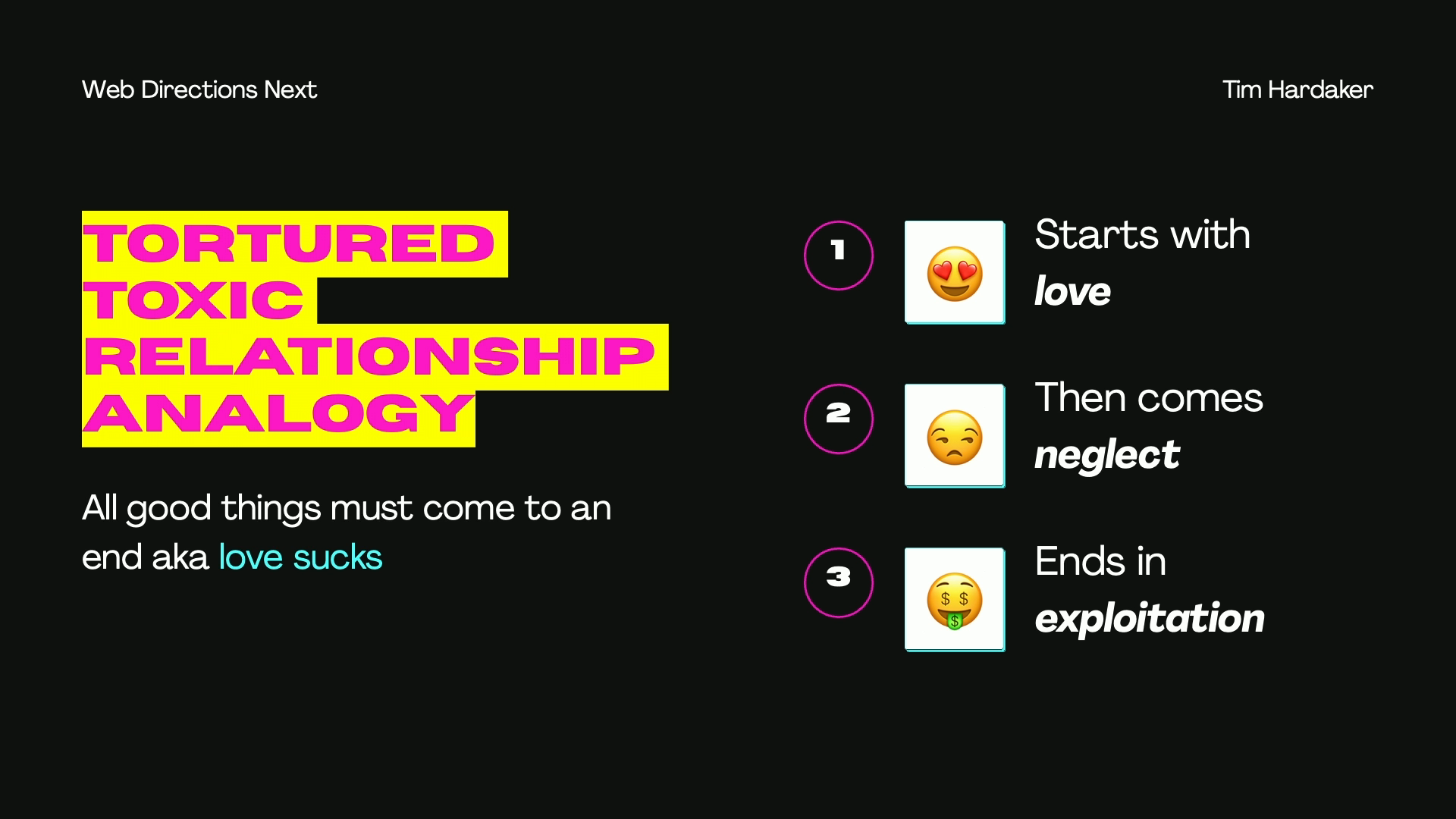
So I'm gonna use an analogy here that was given to me by someone earlier this year of of kind of in stratification or the the journey towards it being a bit like the sort of classic toxic relationship. First of all, you know, everything you meet someone new, it starts with love. You know, this product, it's charming, it's useful, it's respectful, it gives you more than it takes.
It's fast, it's free, it's generous. You feel very valued and maybe you even feel a bit spoiled when when you're kind of using and engaging with it. That second stage, neglect. So that attention starts to fade. The support begins to slow. The relationship starts to feel very one-sided. Features are suddenly disappearing, ads are sneaking in, and clearly the priorities of of that business that that are bringing you that product are starting to shift. So the product, it's it's generally it's no longer listening to you. It's probably not improving and it's coasting on your your loyalty. And finally, third, exploitation.
So the product is now openly extractive. Users are no longer are no longer partners. They're they're generally just data sources or someone to target an ad to or, you know, hopefully a a wallet to extract subscription revenue from. So just like a toxic relationship, you're probably not gonna leave immediately once, you know, you move beyond step one.
You you probably stay hoping things are going to get better until finally one day, hopefully, you walk away from it or or move on or maybe you don't and you still have Facebook on your phone. So very quick hands up. Just wanted to know what sort of people we've got here today. Who who works as a product manager or or in a product type role? Yep. Engineers?
Yep. And design? I'm really reducing the whole industry into three types of roles there. I guess I'd put this together initially as a talk pitched at at people who work in product roles, but really I think it can apply to anyone that works on a product. So, you know, take take from that what you will.
So couple of, like, little visual aids here. But, yeah, I guess we all know that, you know, working on a product, it's it's a difficult job. You need to balance, generally speaking, your user needs with your business objectives. It's not lost to me here that I've made users the angels and and business needs the the devil.
You know, we still have challenges at the ABC. So, obviously, you need to not blindly serve one at the expense of the other. You know, users want intuitive, delightful, respectful experiences. Businesses need to grow. They need revenue and they need efficiency. So, you know, a really great product team is gonna live in that tension and make decisions that create value for the user and not necessarily always just through the user.
So maybe that one wasn't perfect. Another visual aid. I'll give it a go. Here here we have the user and the business. Perfect harmony, perfect balance. But, you know, where are you as as the person responsible for that product? Where are you sitting in the scenario? So terrible, maybe you're the moon.
I guess that's not quite right. So I'll have a third go. If you've never gotten lost in a a rabbit hole of watching Indian military parade acrobatic shows on YouTube, like, look look that up. It's it's pretty wild stuff. So, you know, it's a lot it's a lot more challenging than just, you know, an angel and a devil.
You've got you know, your product, does it successfully meet the needs of a well defined market? Is it solving a problem? Do you have a strategy for achieving growth for scale? Possibly more importantly, do you have a model for actually generating revenue as part of that and making your business sustainable? How competitive is the market that you're entering?
Are there more dominant or established players? What is your cost base? Is it as efficient as possible? Are you acquiring new users faster than you're losing them? Are you keeping people engaged? Are you pushing a new technology that you need audiences to learn or adopt before you reach scale? And are you compliant? Have you got policies in place for data, privacy, security?
It's all pretty hard. You're there kinda holding on for dear life. You know? It's it's really, really hard. It is a real it's a real challenge. But it's not impossible. So building a sustainable product and by extension being, you know, a really vital member of a a a product team is is hard, but it's not impossible.
How can we ensure sure that we don't find ourselves entering that really inchitified territory trying to balance all of those competing priorities? So we're gonna take a couple of minutes now to explore some of the more obvious examples of instantified experiences. And the the best part or most depressing part of this is that I guarantee you've probably got all of them on your phone right now. So I know it's like rule number one at conferences, don't sit there on your phone, but I'm gonna ask you all, please take out your phone.
Open up your home screen, scroll for a second and I'm guaranteed that you will probably find something that in the eye of the beholder, in your opinion, when you actually think about it, is probably an inchified experience. And, you know, I'm gonna ask you today to think about why you continue to use that. But some of the more well known or or kind of broadly discussed examples of incitification in in some of the biggest experiences that we're probably all using almost in our daily lives.
Google search, you know, previously used to be fast, accurate, ad free results that were ranked by relevance. It's now, you know, generally got top results that are increasingly dominated by ads, SEO spam, AI slop, low quality content farms. You know, users are continually reporting the need to append their search queries with, you know, whatever it is you're looking for plus Reddit or Quora so that you can actually get through to to hopefully some real answers. I'm just dumping on Meta a lot, but Instagram, a clean photo sharing app that was focused on friends and creativity.
It now prioritizes algorithmic reels. You know, it's becoming kinda TikTok. It's got, you know, ads everywhere, shopping. It buries content from your actual friends behind, you know, everything else that gets in the way. So, you know, many argue it's become a TikTok clone. It ignores what made it special. Twitter. I kinda refuse to call it x.
I guess we can have another debate about that. But, yes, a fast moving real time microblog for breaking news and social commentary, you know, then. And now post Elon, you know, changes include broken verification, pay to play for visibility, and I think the less said about sort of chaotic moderation, the better.
And, you know, many users and brands have fled due to those erratic policies and just the general degradation of the platform overall. And I'm actually not gonna go into Facebook because we already spoke about it, but I think we all have a probably a personal experience there of of kind of what that product has become in in our daily lives, which is, generally speaking, quite irrelevant.
So all of this kind of draws me back to this leadership principle actually that I felt like I had hammered into me at a period of of my life, which was this idea of disappointing people at a rate they can tolerate. So when you think of that balancing act and needing to to manage a product and striving to avoid intratification, you know, it's it's it's really easy to be idealistic about it and say that, you know, there's a perfect way to do it, but none of this exists none of us, I should say, exist in a value vacuum.
We can have the very best intentions to build the most useful, the most ethical, and the most purposeful product, but there is always going to be things that get between a really great user experience and the goals of your business. So I guess this is like giving us permission to know that you will disappoint your customers and you will disappoint your stakeholders.
But I guess having that understanding of what the limits of each of them are is ultimately the key. So how can you avoid the trap of intrudification? Because what's bad for users is eventually gonna be bad for your business as well. So when trust erodes and that experience degrades, users leave and there's generally not many metrics or hacks or, you know, kind of growth tricks that can bring them back for for long or for any full meaningful engagement.
So a couple of ideas here on on how we can avoid the trap of incertification, first of all, for businesses and then for customers or for users. So for businesses, you know, prioritizing long term trust over short term gains is is a really key thing here. So don't trade your audience's or your customer's goodwill to get that little quarterly bump and that that sort of sugar rush that that comes from from meeting a KPI.
So design with integrity, avoid dark patterns and deceptive nudges, treat audiences and customers like people, not like metrics. Like, you know, think of your customer as your mom. It's something that I kind of very often are doing. You know, think in years, not just in quarters or months or sprints. Subscriptions over surveillance.
So, you know, earning revenue through delivering value and not through user exploitation is is kinda key here. So respect that privacy is it's a human right. It's not a resource that should be mined by by tech companies. Be transparent about what you're collecting and why and what what it might be used for. And probably most importantly, don't take and store and hold more than what you need.
Number three is don't optimize or over optimize your conversion funnel. So when everything is a KPI, the experience is going to become a chore. So resist that urge to sort of squeeze every single ounce of engagement out of every single interaction or or conversion and leave room in the experience for delight, for exploration, and even a little bit of friction if it helps your audience or customer feel like they they have more control over the experience as a result.
Number four, build for usability, not just for growth. So don't make engagement your only success metric. Make usefulness, you know, a a kind of much more important benchmark to strive for. So you need to invest in those boring but essential parts, reliability, performance, and and accessibility.
Sorry. I shouldn't even call those things boring because it sounds sounds like I'm I'm making a judgment on that. But, you know, there's there's reasons why those things are the building blocks for really, really great experiences. Ask yourself, you know, would I use this product if I weren't the product manager that was paid to to to use it?
And number five is involve real users early and involve them often. So use your own product. If it annoys you, it is absolutely going to annoy the intended customer or audience for it. Talk to your users continuously, not just during your research cycles, and make feedback loops visible and valued.
So if you can show your your customers that you're listening to them and that their voices are helping shape your decisions, the rewards will will be there for both of you. And then for users or customers or audiences, whatever term you you use within your your context, choose ethical technology when you can.
So, you know, use yourself as one person who can support those services that respect your time, your data, and your dignity. Number two is use blockers and use filters and use settings. The little cog is there for a reason. You know, use ad blockers. Don't accept to be tracked across apps and experiences.
Turn off autoplay if it annoys you and notifications. All of these things are kind of I guess they're ways to juice your your engagement, but you do have some element of power and control over whether they are in in there for your daily life. Push back on dark patterns. So speak up when a company abuses your trust.
Leave negative reviews. Submit feedback. Vote with your wallet. Cancel subscriptions. Be a digital Karen is the thinking there. And then fourth is be intentional and not addicted. Like, really easy to say, but obviously it's hard to to live by this one. I know I'm addicted to my phone, so, you know, I I don't have a a leg to stand on here.
But, you know, use products because they're helpful, not just because they are there. So, you know, continually kinda trying to remind yourself and and check-in with yourself, like, is this experience improving my life or is it hijacking my life? Really good way for me to know that is when my three year old starts yelling at me to put down my phone.
Number five, finally, support and share the good stuff. So, you know, those better products and experiences only survive when we can help help them to grow. So if you find something great, tell people about it. Subscribe to things. If they're they're worth your money, yeah, sustainable products do need your support.
So what happens if things have already gone off the rails for you or for your product? And, you know, is it possible to get things back to a good place? Can you make things truly great again? Yes. I think you can. So to reverse the damage of insitification, well, you know, to start with insitification happens when we lose sight of what we are who we are building for and reversal will start the moment that you remember that that customer is is kind of why you're here.
So some some tips here for reversing the damage. Yes. You can go back and and users will thank you for it. You can actually create more of a reciprocal and and sort of open dialogue with them as a result. It's not always permanent. And and, you know, many users are forgiving if you show that you're listening and making change.
And a really good example of this one was Reddit. A couple of years ago, they made a big announcement around charging for use of their API. They had a huge a huge amount of of pushback from their community, and they made a decision to reverse on that or at least change what what they were rolling out and and strengthen the bond with their community as a result of that.
Talk to your customers often and and actually listen to them, I guess, is is more important. So don't do user testing and research kind of as as lip service. So embed that that that culture of listening into your product. Show them how their input shapes the road map. And, you know, if they see themselves in your product, they're going to fight for it too.
A really good example of this is Slack. In its earliest days, it was it was kind of built from direct and continuous user feedback and engagement, not just from kind of looking at analytics and and and building a product from there. The third one is don't skirt sorry. Don't skirt policy and regulation.
Embrace it. So compliance isn't just about how you navigate through red tape. Compliance actually reflects a growing expectation that we have from all users who are using digital products. So a really great example of that would be Apple. Anyone who has an iPhone or or or Apple device, there's this ATT or app tracking transparency policy that they introduced a little while ago that really made privacy a brand value, not just a checkbox.
So gave audiences or gave users of their products that control over how they're tracked and and marketed to through experiences on their devices. Number four is explore new platforms, explore new business models. So, you know, you need to disrupt yourself before your competitors do. Don't wait for someone else to build the product that your users actually want. You know, you need to be the one to do that. So if your business model is requiring you to degrade your product to increase revenue, you don't have a product problem.
You've got actually a problem with your business model. So, you know, testing of alternative revenue streams and empowering your teams to sort of propose what those radical projects and optimizations might be is key. My thinking here is New York Times is a perfect example of this. So, you know, they've pivoted away from media being entirely ad supported in the digital age to successfully scaling what is probably one of the most, yeah, successful media news media subscription products available globally. And finally, reinvest in the human touch, which maybe seems a bit counterintuitive based on a lot of what we've heard this morning. But, you know, automation is great until it isn't.
And AI and bots should support humans, not replace them. I think Rupert said it perfectly this morning about augmenting human experiences rather than replacing them. It's definitely something that that I agree wholeheartedly with. Great example here was Klarna. They made all of their customer service team redundant and replaced them with chatbots and and AI respondents and then found that that was going terribly and replaced them all with humans again earlier this year.
So, yeah, you know, human in the loop well, not human in the loop, but, yeah, using AI and automation to make humans do their work better and faster, big tick. But replacing humans, I think, is is definitely a risk. So just to summarize and end things. Listen to your users, not just your stakeholders and and vice versa.
Perfect balance. You know, it's it's a myth. So, you know, you need to aim for just slightly off kilter and you're always kinda gonna be in there in the middle of that that chaos riding the motorbike while everyone's spinning around you. And finally, you know, you need integrity and you need empathy to build these amazing experiences and you need to give a shit to avoid gentrification. So thank you.
People
- Cory Doctorow
Concepts & Methods
- enshittification
- product management
- dark patterns
- user trust
Organisations & Products
- Slack
- Klarna
Works
- Enshittification