The State of the AI Engineering Job Market in Australia
AI Job Market Overview: Site Data and Role Categories
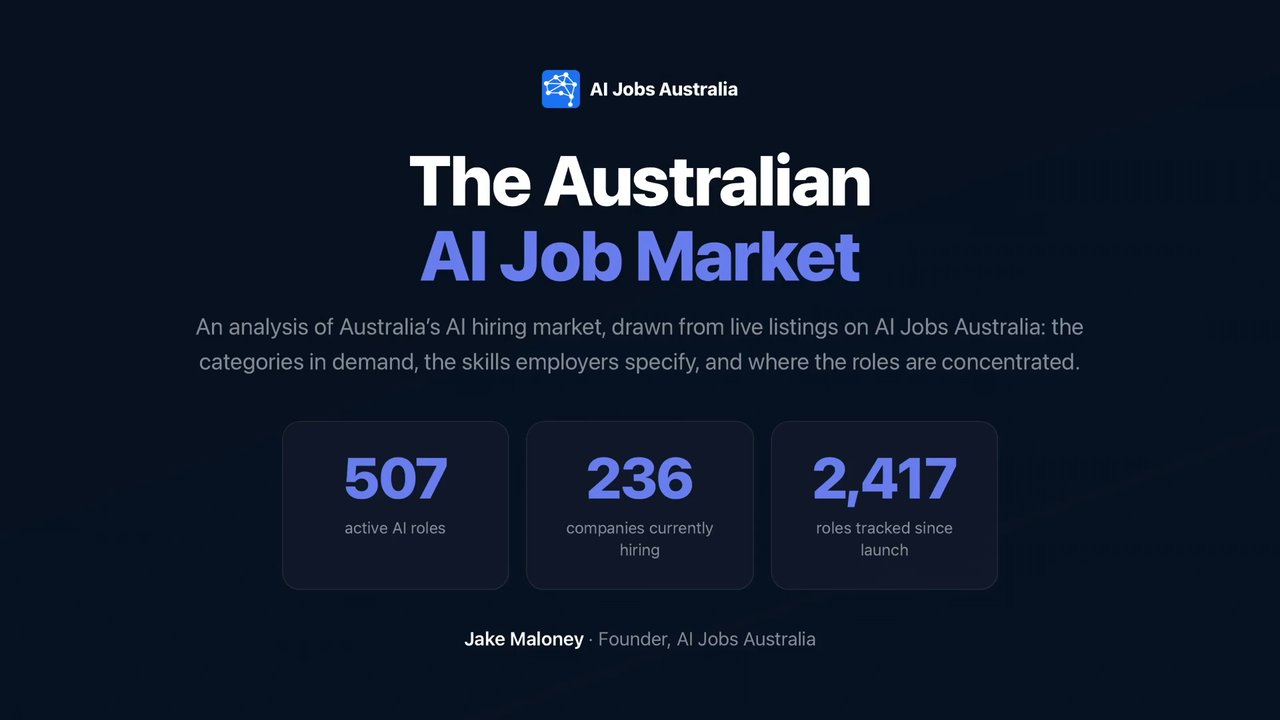
Jake introduces data gathered from an AI-focused job listing site covering approximately 2,400 roles across 700+ companies. He outlines the three main role categories seen on the site — AI/ML Architecture, Machine Learning, and Data Science — and highlights two emerging categories: AI Governance (nearly 10% of roles) and AI Automation (7%), both of which barely existed a year ago.
Most In-Demand Job Titles and Skills in AI Hiring
Jake breaks down the most common job titles, noting that Data Scientist leads listings while AI Engineer sits in second place with around 47 active roles despite still lacking a standardized definition. He then covers the top skills employers are requesting, with Python at 47%, agentic AI at 39%, and LLMs in third, followed by cloud platforms, generative AI, SQL, and RAG. The AI engineering stack is also detailed, highlighting retrieval (RAG at 19%), embeddings, vector databases, and orchestration tools like LangChain with OpenAI and Claude as the most common model providers.
Rising and Declining Skills, and the Career Path Framework
Jake identifies the fastest-growing skills — agents up 8.5 percentage points, Responsible AI up 6, and RAG up nearly 5 — while noting declines in traditional ML staples like Python specificity, TensorFlow, PyTorch computer vision, and NLP. He presents a skills framework for each career path, emphasising that Python and agentic/LLM skills now rank in the top three across every engineering role, not just specialist positions.
Location, Work Patterns, and Top Employers in Australian AI Hiring
Jake reviews geographic and work arrangement data, with New South Wales accounting for 61% of roles and Victoria growing significantly from around 10% to 35% since the site launched. Most roles (71%) are hybrid, 22% are on-site, and only 8% fully remote. Top hiring employers include major banks like CommBank with 38 active roles and Canva with 24, alongside new entrants like OpenAI.
Thank you. Thanks so much. Thanks so much for having me, everyone. So, yeah, I've just gathered some data from the site over the past month. We mainly post roles on there in the AI space, and so I thought I'd put this in the presentation today to give a bit of a beat of what's happening in the AI space in terms of hiring.
And so so just kind of a brief word on how these figures are compiled. So the way that sort of these roles are brought to the site is we kind of aggregate them from career pages. And, you know, if employers want extra visibility, they're able to post their own jobs as well. And so to date, we've had about 2,400 jobs in the AI space posted on the site for around 700 plus companies.
And, yeah, that's kind of some of the data that I'm gonna be going through today from the last month. So we'll begin with some of the roles and categories. And so we we try to do our best. So really sort of honest kind of caveat with this is before with the categories that we put on the site, we try to categorize them as best we can because a lot of the roles, unfortunately, aren't sort of standardized at the moment, you know, with AI engineer being spread across various different types of work.
And so there are sort of three main categories that we keep seeing repeated on the site, and that is around sort of AI, ML architecture, obviously, machine learning, and data science. And so these so AI, ML architecture is sort of people who design how AI systems fit together and sort of architects, ML solution architects, principal AI engineers, forward deploy engineers.
We sort of categorize them the AI ML architecture category. Machine learning is sort of building and shipping the models themselves. So that that falls on a machine learning engineers, ML op engineers, applied scientists, and then, obviously, data scientists, you know, turning the data into decisions. And these are, you know, data scientists, decision scientists, and quantitative analysts.
And so the two kind of to watch on this category is AI governance, which is close to 10% of the roles that are categorized on the site. And so the people that this basically involves people that are keeping AI safe, essentially, at workplaces, compliant as well, and, you know, using sort of responsible AI practices.
And AI risk and policy managers, they sort of fit in that category too. Model risk and AI ethics specialists. And so, yeah, that kind of category really didn't exist, you know, about a year a year ago, so it it's a growing category. And then there's AI automation, which is really starting to pick up a lot of steam.
It's at 7%. And over the past few months, we've noticed a lot more AI automation roles being posted on the site. So this is obviously building agents and, like, automating workflows with, you know, working with LLMs. And so this encompasses things like AI automation engineers, agentic engineers, AI solution consultants. And so, yeah, these are two sort of categories that are growing that we didn't really see too much of a few weeks ago, a few months ago.
And so these are kind of the titles that we see a lot in in the space. Obviously, the the patent's pretty clear. Like, data scientists do take a majority of the are sort of involved in the majority of the AI roles that are published. But the noticeable development is the role in the sort of, you know, second place, which is AI engineer.
And so it's currently got about 47 active listings this month for this role. And, you know, this title, I guess, is still sort of loosely defined. I think, you know, a lot of people can sort of agree with that. And so we're hoping that it starts to become a little bit more standardized because different companies hire for AI engineers expecting, you know, an AI engineer to do something that is not necessarily what another company is expecting an AI engineer to do.
So that standardization is obviously gonna take effect a bit more in the future. And so we just look at sort of the specific skills that we're seeing the employers that are posting these job ads. So this is kind of a very high level overview. So, obviously, Python is right up there. 47% of all AI roles require Python.
And then in second place, sort of agentic AI skills are really important. This sort of goes back to the original category of how, agents, sort of automations is starting to really kick up. And so that sort of falls under agentic AI, and a lot of companies are hiring for this. So roughly 39% of the listings at the moment are agentic AI roles. And two in every five a r AI roles, obviously, now sort of specializes in agents, and that is also building as well a year ago. We didn't didn't see that.
And so behind it, sit sits LLMs in in third and then major cloud platforms, generative AI, SQL, and RAG. And so this is sort of a summary of the most requested roles from job ads that are posted on the on the site. So this is kind of a more specific AI engineering stack that we're seeing. And so the largest single layer is obviously retrieval.
So Rag appears in 19% of of roles that we see. Embeddings is in 12%, and vector databases is in 8%. And so orchestration is led by Langchain and Langgraph using providers like OpenAI is actually the most common, and then Claude. And and then Gemini is sort of the third.
You know, depends on the race at the moment, you know, obviously, Codex has come out with a really good new model. But these are, yeah, these are sort of the most popular models that are being used. And so around those sit evaluations and guardrails, ML Ops platforms, Databricks, SageMaker, Bedrock, and PyTorch is there underneath as well.
And so the pattern sort of is worth drawing out is that the demand is in the app layer, l l l m engineering. So retrieval agents, evaluations, writing models together together. And so not kind of building serving building serving infrastructure from scratch.
So sort of low level serving such as VLLM, Triton, and Ray. They barely appeared in sort of Australian listings before. And right now, fluency in this orchestration and retrieval layer is what sets a candidate apart. And so there are also some fast rising skills that we're seeing and some, obviously, some declining ones.
The demand so on the left, can see skills that sort of agents are up at about eight and a half percentage points from previous month. Responsible AI is up about six points as well from last month, and Rag is nearly up five. And so and on the right, we kind of see sort of the declining skills. Obviously, Python is really, really popular, but it's I think it's just coming to the point where it's, you know, an inevitable skill that you must have.
And so we've also got the the the direction is so, yeah, it's it's the the classic machine learning stack is sort of Python, and the overall skills would not and TensorFlow as well, sorry, and PyTorch computer vision. Sorry. I'm just trying to get these these skills out. There's so many of them.
Natural language processing has also fallen as well in terms of what's being put posted out in job job descriptions. And so here's the three most requested skills for each career path. So for data science, it's Python and SQL. So for machine learning, Python, LLMs, and PyTorch.
And for architecture and automation, it's agents predominantly, looked at in in that sort of role. And so two constraints emerging is Python, obviously, features in every path, and agentic and LLM skills now rank in the top three for every engineering role, not only specialist positions. And and so, yeah, I guess, we'll sort of this is the kind of a framework to to prioritize.
So the foundational skills are the prerequisites, you know, that you have to consider. Obviously, Python, one cloud platform is important when you're, you know, looking to apply for roles. Having SQL capabilities is super important, and knowledge of working with a specific LLM is, yeah, gonna put you ahead of the crowd, basically. And so, yeah, looking at sort of the locations and working patterns of some of the most sort of AI posted roles around the country. New South Wales obviously leads with 61% of most of the roles in Sydney. But, you know, Victoria has about 35%, and Victoria has increased quite a lot over the past year.
I think when we first when I first started the site, it was at about 10% of all roles. So Victoria is definitely creeping up there with AI specific roles that are being posted at the moment. And so one working pattern is 75 71% of roles are hybrid. So, obviously, if you're open to hybrid, there's plenty of roles out there in the hybrid space for hybrid arrangements, specifically on-site 22%, and only 8% is fully remote, which, you know, is unfortunate, but that's just the the lay of the land right now.
And and so looking at employers, the top employers at the moment are some of the major banks. So your com banks, they post, you know, 38 active roles. And some of the largest companies in the tech firm are, you know, Canva as well. They posted 24 roles in the last month and and other tech companies like OpenAI and that that are coming into the stage.
So that's pretty much it, guys. If you'd like to check out the site, you can scan the QR code. And, yeah, there's roles posted on there every single day. You can sign up and get a weekly, alert from me as well. And, yeah, that's pretty much it. Thank you. Awesome. Thanks very much for that, Jake.
No worries. Fantastic. We'll start getting our next presentation up and
Technologies & Tools
- Amazon Bedrock
- Amazon SageMaker
- Claude
- Codex
- Gemini
- LangChain
- LangGraph
- Python
- PyTorch
- Ray
- SQL
- TensorFlow
- Triton
- Vector databases
- vLLM
Concepts & Methods
- Agentic AI
- AI ethics
- AI governance
- Computer vision
- Embeddings
- Generative AI
- LLMs
- MLOps
- Natural language processing
- RAG
- Responsible AI
Organisations & Products
- Canva
- Databricks
- OpenAI