The Software Engineer Who Don’t Code
Speaker Introduction and Audience Survey on AI Coding Habits
The speaker opens by acknowledging a company change since submitting the proposal — they've moved from Zendesk to Caraboo — and frames the talk as personal reflection on a fast-moving topic. They survey the room, finding most attendees are developers, with roughly half still writing code manually, setting up the central tension of the talk.
A Confession: Stepping Back from Manual Coding
The speaker confesses they've largely stopped typing code by hand, delegating even single-line edits to Claude, and notes this behavior is shifting from minority to mainstream. They point to accelerating model quality and rising GitHub AI-authored code volumes as evidence that something fundamental is changing, while expressing measured skepticism about whether all industry layoffs are truly AI-driven.
What Software Engineers Actually Do Beyond Writing Code
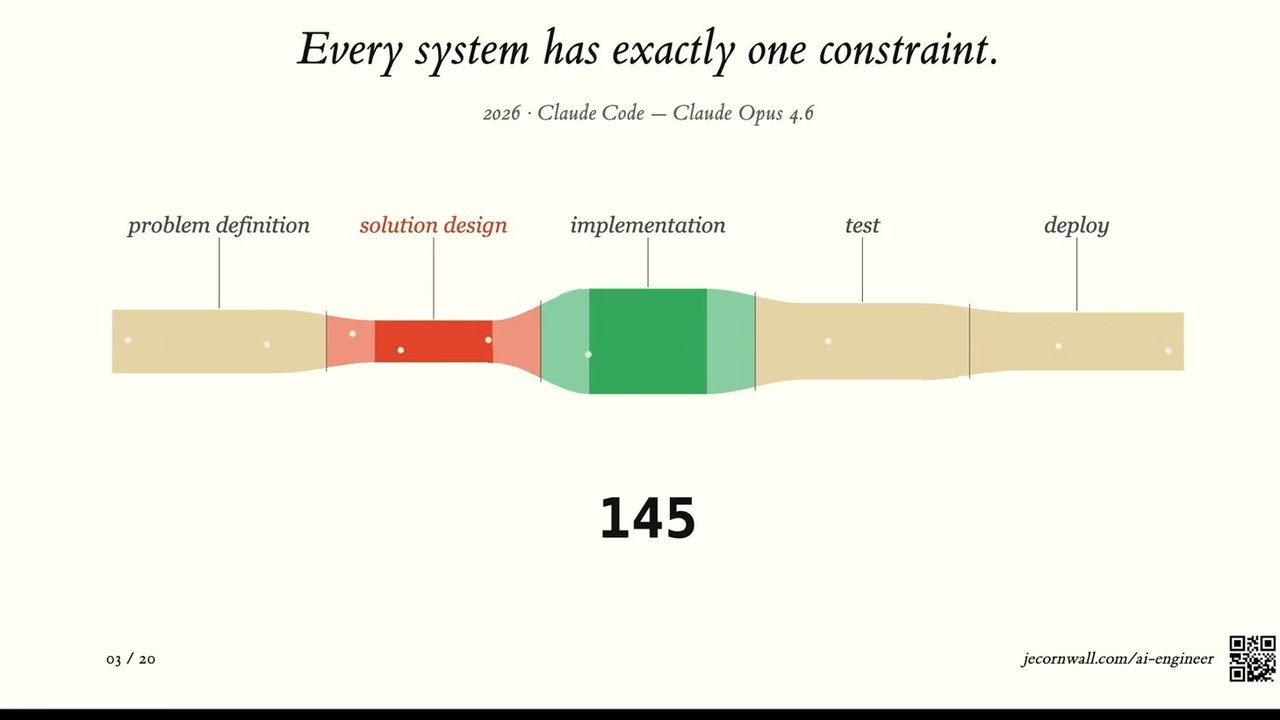
The speaker argues that coding was always just one part of engineering work, and that AI now handles it well — but only when given precise, well-articulated requirements. They highlight the benchmark chart showing rapid model improvement and reframe the core question: if code production is cheap, where does engineering value actually live?
Agency, AI Engineering Roles, and the Future Job Market
The speaker makes the case that high-agency engineers who can leverage AI tools effectively are now significantly more productive, and that building better harnesses for AI models is itself valuable engineering work. Drawing on their own recent job switch, they observe that AI-adjacent roles are in high demand even as general tech postings decline, and close by encouraging fellow engineers to embrace the moment as a builder's opportunity.
Post-Talk Setup and Informal Conversation with Next Speaker
Following the talk, the event host and the next speaker — Kanesh Gosai — have an informal backstage exchange while sorting out cables, screen mirroring, and timing logistics. The conversation touches on how Kanesh heard about the event and his experience attending the full day, capturing the candid atmosphere between sessions.
Hey, folks. So it was a small mistake on my part. So since I submitted the proposal of Change Company, so I'm no longer at Zendesk. But, yes, I used to be at Zendesk. I'm now at a company called Caraboo. My apologies. So I should have updated you folks. Alright. So, yeah, so I'm I'm a software engineer. I've been a software engineer in one form or another for more than a decade. It's the only thing I've known.
It's what I've done for like paying my bills, but also for fun and whatnot. So this was something very close to me. So when I did this proposal, this was like a few months back. And at that time, it was like, think now things because every every week, everything changes with AI, as you know.
So at that time, I was thinking about this. So I thought, like, yeah, maybe I just, share my thoughts and, you know, you know, have a discussion, you know, just clarify things in my head. But anyway, this is just my thoughts. So, you know, take it as you may. So before we start, like, in the room, how many of you are, like, software engineers or developers or alright.
So most of you. That's cool. So how many of you manually, write code, say, in the last month? Cool. That's, like, I would say about half of it. Yeah. Cool. So I guess, cool. I think with that, like, I guess I have a bit of a confession to make.
So I haven't been really manually editing code, like just typing for like quite a while now. So, I would say about seven, like not like not a line or whatever, generally I don't. And I try to think of myself like as like a bit of a lazy engineer.
But sometimes there would be like a line I wanna change and I would just ask Claude to change it. And I feel like this used to be like very minority thing, but I feel like it's kind of becoming like very common now. Like you'll be like fiftyfifty here. I think about if I ask the same question from you folks, like about six months back, a year back, I think the answers would be quite different.
So clearly things are changing, and we are seeing all these awesome models, even awesome harnesses, and all these awesome products shipped. And they are definitely delivering some sort of value. So in in that, you know, in that space, like, I think it's worth asking ourselves as engineers, is is software engineering dead?
Like, is, you know, is there like a future for other career, right? Like, and clearly there's like all these companies doing layoffs and they all claim it's because of AI. And I think like at least some of this is probably because of AI, but at the same time I feel like some of this is maybe not AI, I'm a bit skeptical, but you know, let's not get into it, but it's a fact that these layoffs are happening. And you know, this chart, I saw this in the morning during one of the awesome talks and this is like, you can see like most of the code coming to GitHub now.
Like the vast majority of it is just like AI offered. The quality of it is like, know, I mean, who knows, but yeah. Alright. I just realized like I I had this text selected there. So because I got like, Clo to generate these slides and they look awesome and I'm I was like, why is it looking blue?
But yeah.
So, but like, when I think about like, what I do as a software engineer at work and what I have been doing over the years, obviously things have changed over the years, like, you know, as per the job, the title, the company, the domain, whatever. But I feel like coding was like one of the things I did, right? It's not like the only thing.
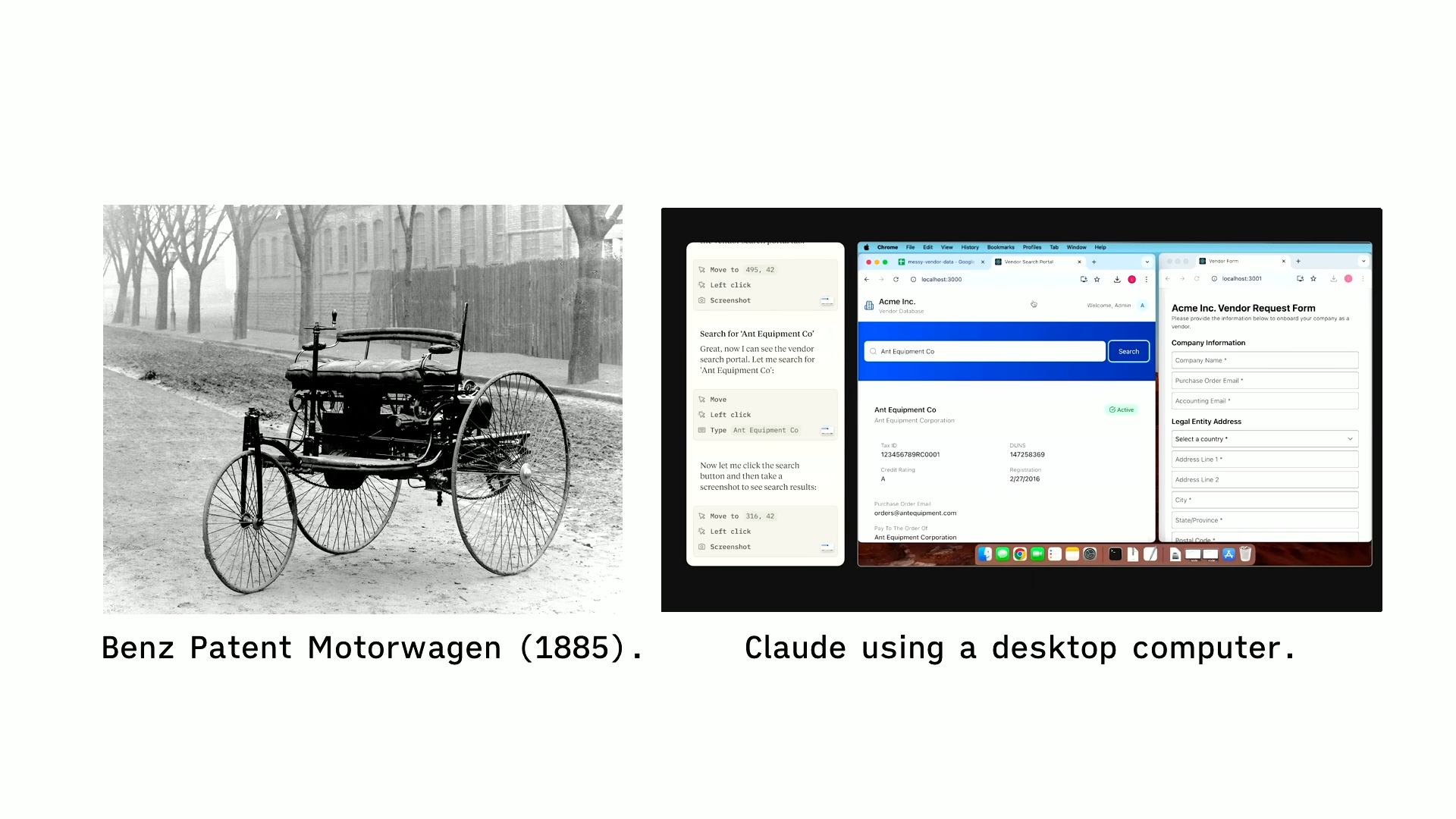
And I think at this point, it seems like not 100 solved, but it seems to have been automated quite a bit. Like, Claude, I can't really say like, you know, I know anything better than Claude when it comes to like x programming language. So if I narrate my problem clearly, articulate my problem clearly, my requirements clearly to code Clone and ask you to do something and implement a solution for me, you know, 99 times out of a 100, you'll do like a better job.
But the tricky part is like communicating exactly what I need. Because Claude knows everything but or like whatever your favorite AI model is, but it doesn't, it can't read your mind, it doesn't know your context. So I think this is another famous chart, so I think I saw this chart at least in two talks with.
Basically you can, I don't know if you spot the mythos, which is not available to public yet? But you know, these models have been getting really really good recently. And you know, they've been like a bit of an inflection point or inflection points depending on who you talk to, but I think you can't really argue that the models are getting better.
The harnesses are getting better. And if producing code is cheap now, then what is valuable? Where does the value lie? I think, you know, this is the question. So if if we define software engineer as someone who just, like, translate specific requirements to code, I think maybe our value is now, like, you know, can we can be maybe replaced entirely by some LLM and a good harness, you know, that has all the right context. But I I believe, like, we do a lot more hidden work other than just, like, translating requirements in a code.
And I think that's where the value lies like. One thing is agency, right? Like we all have access to the same tools, right? I mean, not Methos, obviously. I think only some of us maybe have access to Methos, but most people don't. But however, like, you know, we each do different types of work, different amounts of work and you know, we have like different impacts. So like, what's making that change?
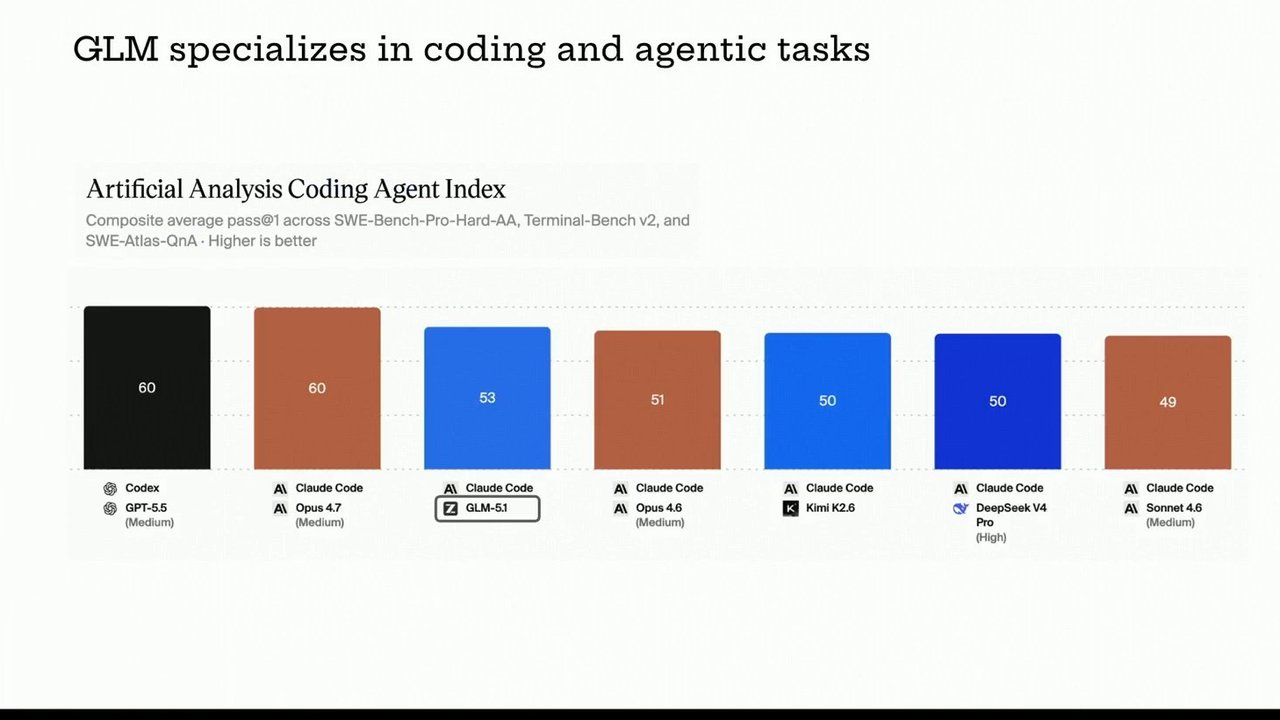
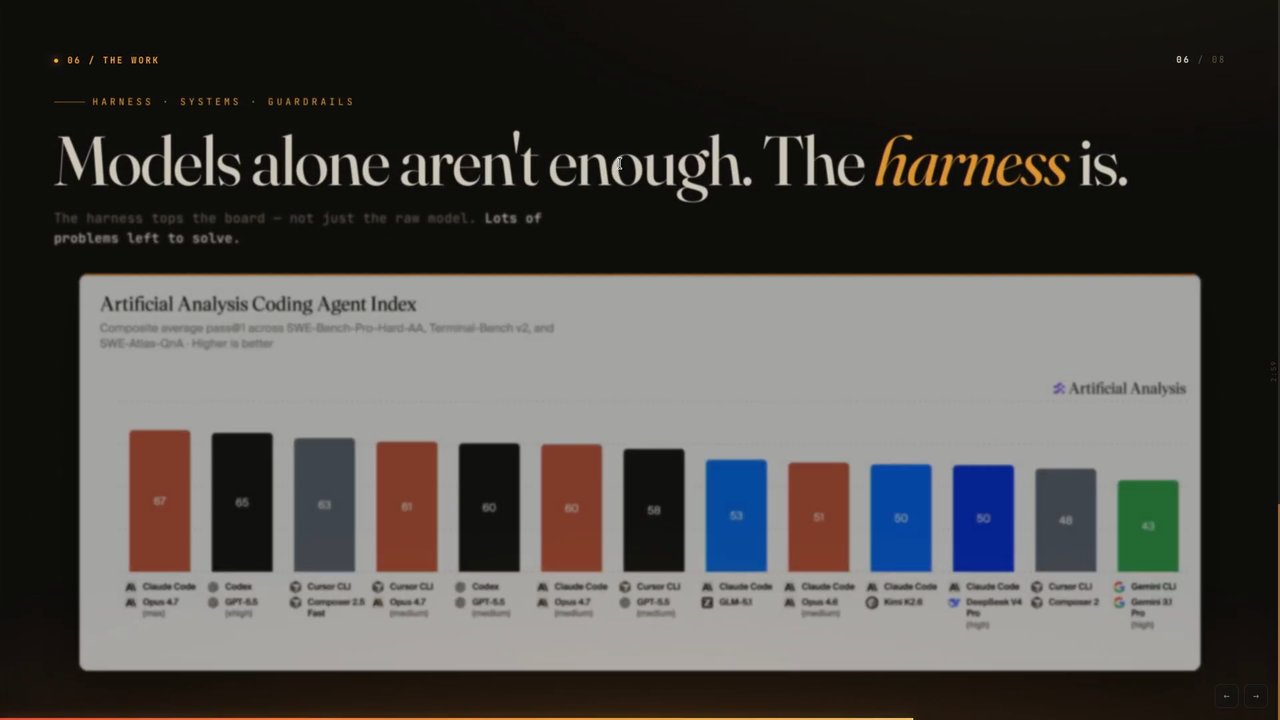
It's not agency alone of course, there's like multiple factors but agency is now one. So if you are a high agency individual, I think now you have the power to do like a lot more. You can solve a lot more problems. And also I think one thing we have seen is like, there's another chart, but essentially what it's showing is like, you can see that the same model when coupled with like a better harness performs better. So the harness is essentially like you know, cord.
You have to like create it like engineers like you and me create it. And this is a coding harness, but if you look at the wider picture, you're seeing sort of like AI is kind of like easing the world in a sense like every SaaS app, every vertical like low health, whatever, you have these new AI startups that are like reinventing how things are done.
Not just like applying AI into what that's there. So and all this work needs, you know, engineers to do it. Like, maybe the term we call them is like AI engineer or something else, but engineers are still required. You know? So I think this is where the opportunity is and this is where the future is.
In the brief talk, you know, before the keynote today, I think there was a similar chart, but we can all see that and I suppose feel that tech job postings are going down. I think there was a talk before this about like the state of the market. But I switched jobs like about three weeks ago, and I can tell you folks that jobs with AI are in high demand.
Although, like, you know, hiring for AI positions are I think like pretty broken. Let's not get into that, but I think, know, if you are experimenting with AI, if you're like, you know, using these tools to deliver value, actual business value, I think there's like a huge demand. Now it was gonna be the state in like five years. Like, I I I don't know.
I I got to be honest with you. But then the way I like to think about it is like, I'm not gonna be able to like change, you know, what like open AI does or what what happens in the world. Right? So as an individual, I think what I can do is like react to this stuff. Aside of all the implications on my career and all that stuff, like, I have to say like, it's been insanely fun playing around with these models and just creating stuff.
Like, if you're a builder, like to build stuff, you like to experiment stuff, build stuff. Now it's like easier and cheaper than ever. So as fellow engineers yourself, yeah, I'd say like, you know, have fun and yeah, make a bank with all these cool tools. Yeah. Alright. That's it.
Cheers.
I'm doing good. I am Kanesh. Yes. That's how I pronounce it. Kanesh? Yes. And What's the last name? Gosai. Gosai. Yeah. No. It's No. And and and and and You have a c cable as well. Right? And we have a c cable? Yep. Yeah. That's just power. Oh, perfect. No. I don't need power.
Just the don't tea. We got that. About four minutes. No. Okay.
That's not the case? This is charging. Alright.
Start metering. Once we're ready. You have three minutes. How you doing, man? Yeah. Yeah. We got we got some time, and I'll do a little intro for you as well. Alright. What do have written down? I have oh, yeah. I should check if if this is alright. Yeah. Yeah. One's You still working there?
Yeah. Okay. Cool. Yeah. Yeah. I was the last guy. He was like, oh, yeah. I don't work there anymore. I was like whatever and then yeah. Yeah. Perfect. So Yep. That's me a 100%. Sick? Yeah. That's good. Anything you wanna add? Wait. I'll okay. You're extending it. Yeah. But that should be fine. Instead of that, I just duplicate it so that's easier for me.
Yeah. Unplug it.
Oh, I don't have to unplug it. My bad. No. Sorry. Oh. You can just go here and press change. Okay. Let me let me share once we stop. Tada. Look at that. My big name. Sweet. It's good, man.
It's good. How are doing today, man? How'd you hear about this? Because of my team. Yeah. I kind of knew about the content support. Yeah. Yeah. Yeah. That's it. Been following. He's the YouTube channel for a while. Yeah. He's a good place to, like, know, they didn't speak to work out and then it's like, yeah. I mean, I can speak.
Yeah. I see. It's cool, man. It's cool. It's cool. And this is yeah. This is what you do full time? Yeah. I am. I'm in. Oh, there's a lot screen. It's just like Oh, we're looking today. Ever in the neighborhood already? Yeah. Sick, man. It's cool.
Nice. Nice. And you have you been here all day? Yeah. I came pretty early because we have a stand next to me. Yeah. This is why we're there. We have people, new people. Yeah. It's the best time to talk to people in our in our. Yeah. It's crazy that how, like, some people are going too extreme and some are just not doing what it needs.
You know? Yeah. Yeah. Yeah. So it's good to be around who are Yeah. The the people getting amongst it. Yeah, man. I'll give you your
Technologies & Tools
- Claude
- Mythos
Organisations & Products
- GitHub
- OpenAI