Auslan and Access in UX
A Deaf Advocate’s Cross-Cultural Perspective
Shawn Phua introduces his work as a Deaf advocate, consultant, tutor, and digital accessibility tester. Drawing on his Malaysian, Australian, Deaf, and hearing-world experiences, he explains why Deaf people should teach Auslan and participate directly in co-designing inclusive products.
Auslan as a Living, Regional Language
Phua defines Auslan as a language with its own grammar and a history connected to British Sign Language. He demonstrates how signs vary across Australian states and communities, stressing that the world has hundreds of distinct sign languages rather than one universal system.
Deaf Culture, Identity, and Visual Etiquette
Phua contrasts cultural Deaf identity with the medical model of disability and explains distinctions such as capital-D Deaf and lowercase-d deaf. He describes visual communication practices—including eye gaze, lighting, facial expression, physical distance, and attention-getting—and clarifies cultural differences in directness and social cues.
Communication Barriers and the Cost of Access
Phua challenges assumptions about lipreading and describes how educational barriers, interpreter shortages, and costly captioning restrict access to information. He explains why organisations should fund appropriate communication support instead of expecting Deaf participants to spend their personal NDIS allocations.
When Employment Funding Falls Short
Phua examines the limits of the NDIS and Employment Assistance Fund in workplace settings. Using his own employment experience, he shows how eligibility rules and rapidly exhausted interpreting budgets can exclude Deaf employees from meetings, professional activities, and workplace social life.
Co-designing UX with Deaf People
Phua sets out practical principles for involving Deaf people in app testing, beta testing, and product development. He advocates simple English, readable interfaces, thoughtful icons and colours, paid consultation, and qualified interpreters, while showing how inaccessible processes and weak organisational commitments perpetuate exclusion.
Designing Visible and Valuable Access
Phua explains how platforms, dashboards, and videos can present Auslan access effectively through well-sized, high-contrast picture-in-picture interpretation. He also calls for fair remuneration and attribution of Deaf expertise, distinguishes hearing and Deaf interpreters, and introduces tactile signing for Deafblind people.
Resources, Respectful Contact, and an Invitation
Phua points audiences toward national and state-based resources and asks organisations to contact Deaf people through text rather than inaccessible phone calls. He teaches the sign for “thank you” and closes by encouraging attendees to overcome communication anxiety and engage directly with the Deaf community.
Okay. Hello, everyone. As John mentioned, my name's Sean. Thanks for that introduction. It's the first time I'm here presenting at ACME for your conference. I'm from Brisbane, Queensland. I know you're probably very tired being here all day. Thank you for coming to my presentation to learn.
I'm a bit tired myself, but I'm very passionate about Auslan and the deaf community and to be here today. Just to introduce myself briefly, my pronouns are he, him, his, and I'm profoundly deaf. I'm 33 years old, and I live in Brisbane, Queensland. I work under a number of hats.
I'm a deaf advocate. I work in the deaf community as a consultant, as a support person for people in the NDIS, for different technical companies, and I have worked in the past for BHP and for a railway company. I have done some app testing for different organizations, and I'm involved in the digital space.
I set up my business because last year, I was at the Deaf Sydney Festival. And there was a lot of deaf people there and people who were not deaf that were saying to me that they wanted to learn Auslan at a number of different places. But sometimes when they did learn Auslan, they they used it in a culturally deprivational way.
And deaf people, because they've grown up with a struggle to learn Auslan, they sometimes make up signs. For example, the word computer, computer, people would be taught the wrong handshape or the wrong movement.
And that's why it was important to have the opportunity for deaf people to teach their language. And a bit like getting a white person to teach an Aboriginal language being inappropriate or rude, it's better to use people from that community to relay the nuances of that community.
I was born deaf. I have parents who are not deaf. I was born in Malaysia, and we moved to Australia when I was a baby, when I was nine months old. And I had to work out the different cultures compared to my parents and also the deaf world and people who are in the hearing world. As long as well as that, working between the Malaysian culture and the Western culture.
So I've worked, I guess, in a whole lot of different avenues and operated in a whole lot of different spaces. And that's been difficult to navigate at times. I present workshops and activities, and I'm also a tutor, and I also create resources for people who are not deaf or for people who are in the NDIS, so that deaf people can get access.
Often, I'll see in UX businesses hearing people who don't have the expertise. They may not have a lived experience of being deaf, and they might develop apps that don't suit people who are deaf. So my goal is to make apps inclusive so that it's done through co design, and equity is then the end product.
I focus in Australia. I don't work internationally. And you'll come to realise why. The deaf community in Australia uses Auslan. It's the language of the community here. And Auslan is short for Australian Sign Language.
It's a cultural language within Australia used by deaf people, and was recognised in 'eighty seven as a language in its own right, for education, for access. In the past, people were told they were not allowed to sign. They had to use their voices and speech. Auslan is a language in its own right, as I said.
It has a grammar of its own, similar to BSL, British Sign Language. It was brought to us from the British, but it has changed over the years. Auslan has different signs in all of the states in Australia. There's regional signs. Melbourne and Queensland signs are sometimes different.
Sometimes I'm very polite, but in a Melbourne, I might sign the sign, Hungry, which is this sign, but in Queensland, deaf people get offended if you use that sign because it means sex. And so if you say that you want something to eat and you're hungry, it can be taken the wrong way.
In Victoria, the sign for after is very different. And it gets very confusing when you're trying to communicate with each other. But deaf people can work it out. There are regional differences, and they work out the structure between themselves.
There is not a universal sign language throughout the world. There are over 300 sign languages throughout the world. And I'm, as I said, from Brisbane. There are regional signs there. There are different signs in Townsville and Cairns to those that are in Brisbane, even in Toowoomba. Some signs are different.
For example, in Melbourne, in Victoria, they sign differently. Rural and city people sign much slower in the country, just like, I guess, people who speak. They might speak slower if you're from a rural area.
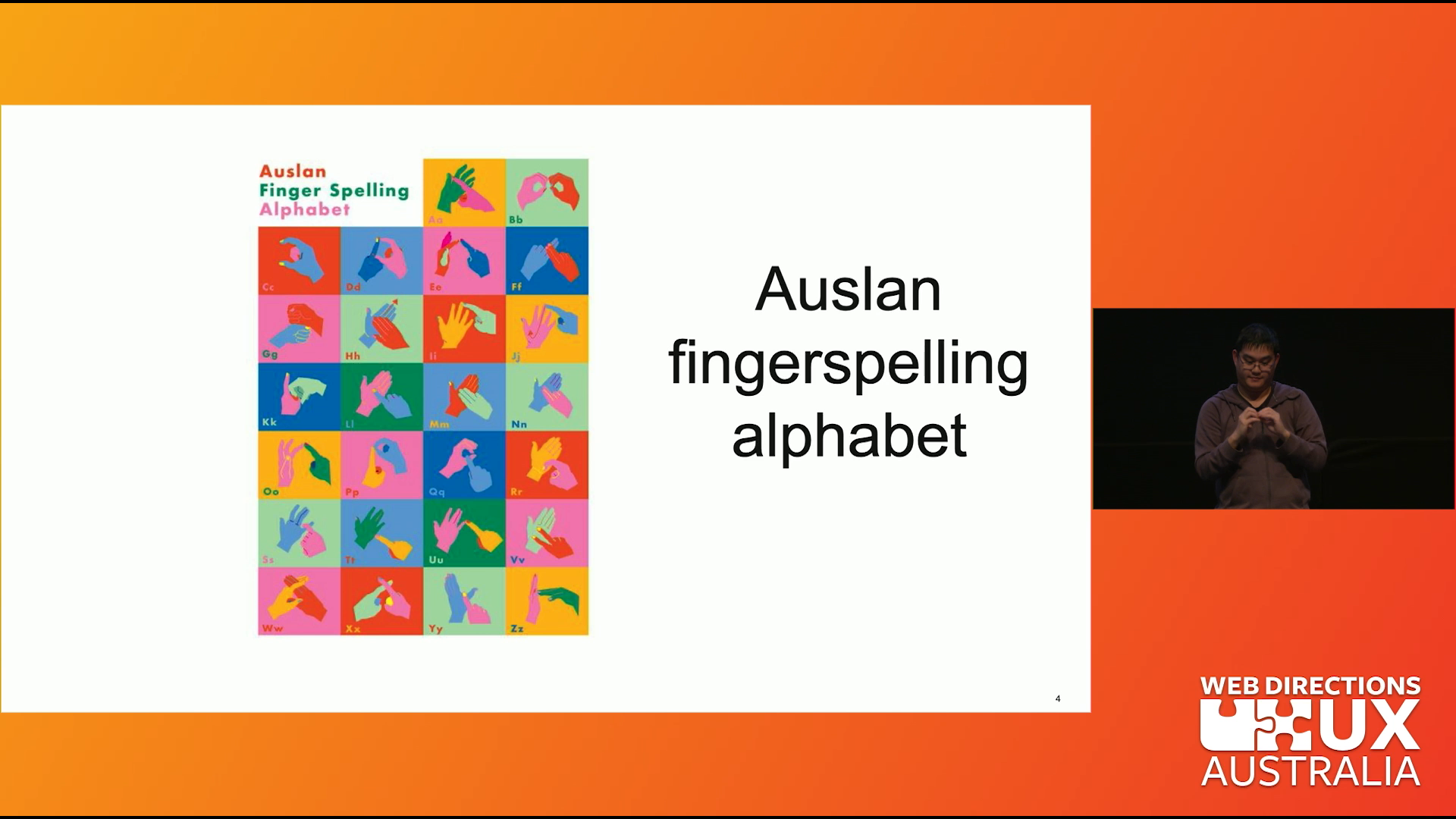
This is just a summary. I'm not going to teach you any signs today because we're limited with our time. But if you're wanting to know a bit more about Auslan, come to my desk. I'm happy to show you the fingerspelt alphabet. But the fingerspelt alphabet is used all over the country. The identity of deaf people in Australia you might wonder why the identity of deaf people is a cultural one, not one that's of a disability. They don't want to be seen as some people to be fixed, as the medical model suggests.
Technological advances certainly help, but they're not a remedy for a deaf person to then become suddenly hearing. In Australia, we also have indigenous sign languages that are used by different rural areas. In the Northern Territory, there are sign languages used there which are different to those in Far North Queensland.
And a lot of people say to me, Why isn't there just one sign language? Well, the background of each person in each area is different, and it evolves. Most deaf people who sign will consider themselves a capital D deaf person, part of the deaf community. Those who are hard of hearing will perhaps consider themselves lowercase d, not part of the deaf community.
Most people don't like the term hearing impaired because it's a detrimental word. Sometimes people will say, What percentage deafness have you got? And I'll say, Well, I can hear some in one ear and some in the other. And each deaf person is different, but the important thing is that you maintain eye contact with somebody who is deaf.
Maybe you might have autism, and it's hard for you to have eye contact with the person you're speaking to. That's okay. We understand that. But in Western cultures, it's important that you maintain eye contact, and it's not the same in all cultures around the world. But for deaf people, it is important that you look at them.
If you want to get their attention, a gentle tap on the shoulder and coming into their eye gaze. Not right into their face and being rude, but making sure there's an arm's length distance between you and the deaf person so you can communicate with each other. And lighting is very important. Just to let you know, these lights are giving me a headache, but I'll put up with them so that you can see the PowerPoint and me. We always make compromises in life.
But it's important that facial expression and body language is visible to the deaf person, Because it's the way that we get what is the feeling in your voice. We get it from what you look like, what you're doing with your body or your face. We're very respectful of our elders, deaf people who have come before us.
Sometimes deaf people are blunt. They can be right at the point, right to the point, and deaf people will say, oh, you're getting old and fat. But in the hearing world, people will say, oh, you're a bit plump now. And it's deaf people tend to be very blunt, and it's not being rude.
It's just saying it how it is. It doesn't have a malicious intent. Social cues sometimes are not the same in the deaf community as they are in the hearing community. There's certainly etiquette, and that's not always visible to the deaf person.
In terms of access to information, not all deaf people use their voice to communicate. Sometimes it's very hard to lipread. You only see 30% on the lips when you're trying to lipread. The rest is guesswork. Most deaf people will say that they can't lipread foreigners, and it's better to write, to communicate, or use text messaging.
Seven out of 10 people will say, Many words look the same on the lips. So they're trying to work out what is being said. And then if you're an American, the way that they pronounce tomato, for example, is different. So forcing somebody to lipread you can be seen as quite rude for somebody who finds that a struggle.
Not all deaf people have had a good education. There have been discrimination and barriers for a lot of deaf people. And even though we have an interpreter today, sometimes they're not available, sometimes there aren't enough. It's quite a high demand for interpreters. And after COVID, and the drama of interpreters being on the TV all the time, a lot of people wanted to have sign language tuition, and wanted to have more education to become interpreters.
But it takes you many, many years to become fluent. And often, organisations won't pay for interpreters to work to provide access. The NDIS provides some funding, but usually it's for social events and community events. So sometimes having access can be difficult.
When you're reading captions, you're getting the words, but you're not getting the intonation. It can cost up to $350 per hour for captioning of a workshop. So it's quite expensive.
And then if there are public holidays and weekend charges on a Sunday, it's very hard to afford to pay for an interpreter if there is one available. It's important that people are aware that the NDIS does not cover the cost for everything.
They may only provide interpreters for what the deaf person has stipulated in their goals. So today, I should have had an interpreter that was paid before by another organisation, but they weren't able to provide the interpreter. So I was able to use some of my NDIS funding to get an interpreter to talk with you today.
So it's important for organisations to book interpreters when they need to consult with deaf people, so that they can get the information that they need from the experts, and not expect them to use the limited funding that they get from the NDIS. The NDIS stipulate that you can only have funding if it's related to the goals that you've set out.
So it's very limited. For example, I used to work for a UX organisation, and the organisation said to me, please use your NDIS funding to book the interpreter for any event. And I said, no, the NDIS will not allow me if you, as a company, can afford to do or pay for the interpreter.
If I was to go to a wedding of one of my colleagues, certainly I could use the NDIS funding because it's social and it's outside working hours. So as you would all probably know, the NDIS is cutting back. Another funding source is the EAF, the Employment Assistance Fund, and that's through job access. And that's for deaf people who use Auslan or captioning. But there's been a problem with the EAF.
They might use captioning or an interpreter, but they can't pay for both. Which is a bit of a problem, because you only get very limited funding, and you can use up your interpreting funding in a month. But you get funded all that money for a year. Unfortunately, all my funding got used up in a month or two at my job. So I had to work out which was most important for me to book interpreters, so I missed out on a lot of work meetings and social events, such as Christmas and Easter parties. And I couldn't talk to anyone because I didn't have the access.
Other things with deafness awareness funding is, or through the EAF, is things like flashing lights and technological advances. For people who have the EAF have to have a minimum of thirteen weeks of employment, and they have to work a certain amount of days per week.
You can't get the EAF funding if you're only a casual. Unfortunately, it's a big problem, and it's a huge responsibility for any company to have to pay the bills of an interpreter. I have to pay my tax, and I guess that's where we have to think about what's important in terms of equity.
In the workspace, and for projects, just general principles I'd like to cover now if you're undertaking UX projects with deaf people. Making sure that they're involved in your, say, app testing, beta testing, and so on. Make sure you use simple English, because English for deaf people is usually a second language.
Making sure that the font size is big enough and easy enough to read and navigate on any systems. For example, WebEx can be quite difficult, and Figma can be quite hard. And so I've been challenged navigating that.
Agile or scum is important for deaf people to access. And often, places like that will say, Oh, well, never mind. But if you get deaf people involved, as those that have the lived experience, and work with them, just like you would people who are indigenous or from any other culture, then you can be inclusive.
Icons and colors need to be thought out and respecting different disability groups, because some disability groups might be offended by particular icons or colours. Having deaf friendly access is quite important, because we are living in an auditory based world.
So UX companies often will say to me, we're too poor, we can't afford interpreters, we can't afford to consult with you. And I remind them that the Disability Discrimination Act from 1991 is there to provide that equity. The Disability Act is quite weak, because companies can say, we can't afford it, and then it's okay.
Some companies will spend mountains of money on furniture, but a little bit of money on access. So it's important that when you're designing access, getting people involved, making sure that they can be part of that diversity at different levels.
You can consult with people who have a lived experience in different ways. It's not always PowerPoints, it's not always particular parts of technology, but depending on what your needs are, deaf people can be traumatised because of the abuse that they've had in their lived experience.
Sometimes people have said, Oh, we're not going to get an interpreter. You're too stupid to provide any information to us. And I remember when I worked at BHP, I was appointed with a very, very new interpreter who had no idea of the intricacies of the work that I was doing.
And I complained about that. And then finally, they got me a higher level interpreter that was understanding exactly what was going on in the terminology of my workplace, which was quite a complex situation. Considerations for access in your companies with platforms, software, dashboards, ensuring that they're deaf friendly, they're accessible.
Sometimes you can use Auslan videos that are picture in picture. You can use an interpreter on the screen. The interpreter can be deaf or hearing, but you have to make sure that there's contrast between the interpreter and the background, and that it's not too small, that picture.
I've seen a lot of things that have been translated, and the box is so tiny that you need a magnifying glass to even see the interpreter. You just cannot understand what they're signing. So having a third of the screen sometimes is a really good guide, and it's important to provide that access and to pay people for their time. I've been involved in projects for UX for, oh, I'd say, over the last ten years.
And I'm often asked to volunteer my time and not be paid. And it's really not very fair, because we are providing our expertise. So I would recommend that you find a way, and the funding, to be able to raise the labor costs, because a lot of technical companies will value the information that is given and not always recognise where it's come from. Sometimes ideas have come from the deaf community, so it's important to recognise them.
Currently, people with disabilities do get frustrated because sometimes businesses give gift cards to avoid having to worry about the tax burden. So I would suggest that your organisations think about remuneration in different ways. Maybe it's not finance.
Maybe it's different aspects. Because if deaf people are accessing your services and there's too much jargon, they're not going to understand it, so make it simple. There are hearing interpreters who listen to the English and put it into Auslan and then back the other way, whereas deaf interpreters will translate information from other sign languages into Auslan, or they might transcribe from written text into sign language onto video.
So there are different skills and different abilities. Also, deaf blind people use tactile signing, and deaf blind people feel the interpreter's hands to get the information. I've worked as a communication guide with deaf blind people in the past. So there are some resources here I wanted to share.
We're short of time now, but there's national and Victorian based resources. If you're wanting to know specific resources for specific states, please feel free to get in contact with me. You can contact me via Facebook or LinkedIn or online, and make sure you text me.
One thing that really annoys me is when people, businesses, call me on the phone. I'm not gonna be able to answer, even though I've told them I'm deaf, and they think I can hear, so they give me a phone call. I'm not pretending to be deaf, so please, please text me.
This is the sign for thank you. One easy sign you can learn. Thank you. Thank you very much. If you're right handed, it's with the right hand. If you're left handed, it's with the left hand. And just remind you all, don't be nervous. Come up and see me at my desk, and I'd be happy to have a chat with you.
Deaf people generally don't bite, and a lot of people get scared because they don't know how to communicate. But it's really important that you feel that you can be a part of our world just as we wanna be a part of your world. So in summary, I know that we're running out of time. We've got three minutes left.
And perhaps, John, you can organize, I think, maybe one or two questions, if anybody has any. And if we run out of time, feel free to get in contact with me or come to my desk, and I'm happy to have a chat by text. And thanks, everyone, for your time. John, would you like to ask people?
People
- Deaf interpreters
- communication guide
Technologies & Tools
- captions
- Figma
- picture-in-picture
Standards & Specs
- Auslan
- British Sign Language
- Indigenous sign languages
- Disability Discrimination Act
Concepts & Methods
- Deaf community
- co-design
- fingerspelling alphabet
- medical model
- capital-D Deaf
- lipreading
- sign language interpreting
- Agile
- Scrum
- tactile signing
Organisations & Products
- NDIS
- BHP
- Employment Assistance Fund
- JobAccess
- Webex
Works
- Deaf Sydney Festival