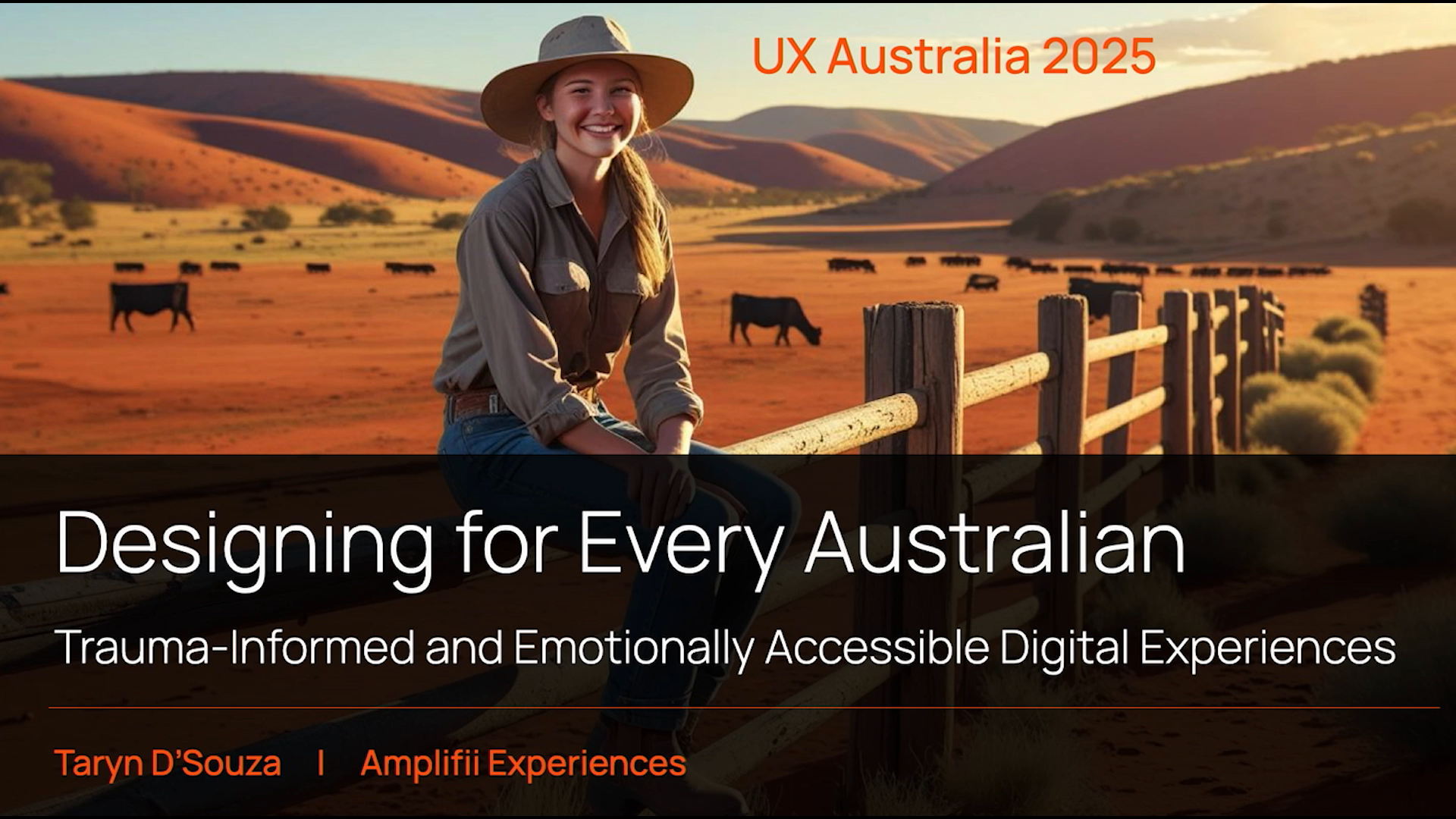
Designing for Every Australian: Trauma-Informed and Emotionally Accessible Digital Experiences
Why Designing for Lived Trauma Matters
Taryn D'Souza introduces the need to design for lived trauma and to adapt established methods for rural and remote Australia. She gives a content warning, then uses national bullying statistics and its projected economic and mental-health costs to establish the scale of the problem.
Researching the People Falling Through the Cracks
D'Souza recounts an anti-bullying foundation’s effort to connect young people, educators, families, and communities with support. After analytics, audits, comparative research, and synthetic AI personas fail to reveal core needs, she recruits people across remote Australia and hears confronting firsthand accounts of bullying and distress.
Trauma, Isolation, and Broken Safety
D'Souza explains how trauma changes attention, memory, trust, and the ability to connect with services. She connects these effects to long waits, high costs, stigma, limited infrastructure, and round-the-clock digital bullying in rural and remote communities, then argues that conventional heuristics and accessibility guidance do not adequately address psychological pain.
Building a Trauma-Informed Framework
D'Souza introduces her trauma-informed digital experience framework, grounded in her experience as a parent, psychologist, designer, and researcher. She begins with researcher self-care: anticipating emotional harm, allowing recovery time, arranging support, recognizing triggers, enforcing boundaries, and using restorative practices.
From Despair and Shame to Safety and Hope
D'Souza presents design principles organized around safety, connection, belonging, and trust. She asks designers to move beyond despair, detached empathy, fear, intellectualization, shame, chaos, and professional comfort toward hope, compassion, genuine understanding, dignity, clarity, and engagement with difficult realities.
Crisis-First Support and Emotional Connection
D'Souza outlines guidelines for clarifying available help and designing crisis pathways that work at any hour. She advocates multimodal emotional support—including content, video, chat, and calls—and stories that reassure people they are not alone.
Designing for Rural Context and Limited Access
D'Souza shows how imagery and content can reflect rural lives rather than defaulting to metropolitan settings. She recommends mobile-friendly and offline resources, plain language, hopeful visual design, direct navigation, and cognitive accessibility for people experiencing stress or using older devices and unreliable connections.
Agency, Adaptive Research, and Human Impact
D'Souza closes with agency, empowerment, and research practices that adapt to participants’ schedules, devices, privacy needs, and connectivity barriers. She urges practitioners to look beyond roadmaps, KPIs, and conventional product goals and evaluate the human impact of their work.
Thank you so much, John. And thank you to Steve and John for creating this space and providing this platform, really. I attended my first UX Australia back in 2010. So, yeah, it's it's been a long way, really. And I'm really privileged, really honored to be here today to talk to you about trauma informed design and to really consider the needs of every Australian when designing experiences. So, what I'm going to be talking to you about today really is, why designing for lived trauma matters, why adapting methods for rural and remote needs?
Because they're very different to the needs of those living in metro areas. Why it's important to actually adapt our processes and methods? I'm gonna share my framework that I've come up with. Because when I started this work and I looked around, was not a lot. So I came up with a framework. And this is based on work that I've done in the UX product, service design, and user research space for a bit over twenty years now. It's based on work I've done with government organizations, foundations like the Alana and Madeline Foundation, going out into schools and low socioeconomic suburbs, speaking to educators across the country, speaking to young people, parents across the country who've been impacted by bullying.
And it's really based on my experience with a number of different clients. But primarily it's based also on my experience with a key project that I worked on last year and I'll talk to you about it. Before we kick in, want to say that the talk today contains references to bullying, trauma and mental health.
Please look after yourself. If you need to step out at any point, feel free to do so. And if you need to talk to someone, I've put a few numbers on the screen over there, but I'll also be available after the session today. I've tried my best to ensure that I'm not causing any secondary trauma, but I understand something may be triggering.
So please feel free to check-in and step out if you need to. This is a really confronting stat. I'm not sure how many people know that bullying in Australia is endemic. It's part of the culture. Australia is the second highest country in the world for bullying in the OECD nations. And here are a few stats.
There's a heap more available, but these are just a few. One in four students are bullied every few weeks or more often. Three in four students with disabilities experience bullying or exclusion. And it's reported that it's going to cost the economy 1,800,000,000 for every student cohort in Australia.
That 1,800,000,000 is based on work done by PricewaterhouseCoopers, the Alana and Madeline Foundation, and it covers lost productivity and mental health impact in the long term. So this is my story about how I came up with my framework for trauma.
But I understand bullying is not the only way that people experience lived trauma. This is just one lens that I'm bringing to trauma informed experiences. So sometime last year, a prominent anti bullying foundation that works with Australians across the country in rural, remote and regional Australia reached out. And the reason they reached out is because their community, the people they serve, were unaware of the services and support they provided. And they had no idea, even though this foundation was doing brilliant work, they had no idea the people they served had no idea that those services and the support was available.
So they wanted to create an experience that connected people to their services. And who are the people they served? They served young people, educators across the country, community groups, and parents as well. So when I kicked off the project, I asked them for information about their user needs.
They didn't have any. They'd been around for five years. They'd not done any kind of qualitative research. So I started off with a bit of desktop research, analyzed everything that they could give me, their Google Analytics, did a audit, heuristic analysis, looked at other peers in the industry both in Australia and globally. And someone spoke to me about synthetic AI personas.
So I was like, okay, let's do that thing as well, synthetic AI personas. I did that as well. And there was a ton of research, I did desktop research, but it did not tell me what the core needs were. I felt like I was missing out on understanding who I was actually designing experiences for. So I convinced my client and we put a call out on their social channels, offered a $0 incentive.
And trust me, I've done that so many times over the last few years and it's worked. So we put a call out, $0 incentive because foundations can't offer incentives. And from the cattle ranches of Western Australia to the boarding schools of Queensland, people wanted to share their stories.
Grandparents reached out. Parents reached out. Step parents reached out. Carers reached out. And I was there. I was sitting in my house at seven, 8PM at night, having calls with people working as cattle hands in Western Australia or students in boarding schools in Queensland, parents in remote Queensland or New South Wales. And it was hard, and I wasn't prepared for what I heard. It was so hard.
And I learned that based on other research as well as what I did in that study, that bullying harms mental health. It increases the risk of depression, anxiety, PTSD, low self esteem and a whole heap of stuff. Bullying And actually also causes long term trauma.
I learned that trauma survivors live in constant internal threat. They're in a constant state of fight, flight, freeze, fawn, so they're not fully present. And trauma actually impacts how people think, how they process information, and how they connect with and receive services, because safety feels impossible.
So sorry. And these are the lifelong effects of bullying and trauma. It alters brain development, damages trust, affects memory, focus, increases PTSD and heightens vulnerability to drug addiction and other stuff which I'm not going to go through right now. This is a very high level overview of the impact of bullying on mental health and trauma, but this is how I came up with my framework and the guidelines.
Now because I was conducting research with people and this experience was going to be for people in rural and regional areas, I also came to realize that because of the geographic distance and isolation that it's really hard to connect with other individuals, and it's really hard to access services. Wait times for mental health services to see a counselor, to see a psychologist ranges from six months to two and a half years. And that two and a half years, I mean, that's something that somebody told me in an interview, and I went back and I checked it online and it was true.
It's really expensive. It's not like the city and metro areas. It's really expensive. Face to face consult consultations range from 600 to $900. And there's a heap of social stigma around mental health in rural, regional, and remote parts of Australia. That's just the yeah, that's just a little fraction of what I learned. What I also learned is that bullying is twenty four seven now because of our digital experiences.
There are no safe spaces for young people. And it's really hard for them to access support. So how do we actually design for someone in crisis? The heuristic that we have and YCAG don't cover the trauma. And when I was out there looking last year, I did not actually find guidelines for designing with pain.
Our brains are wired for connection from the time we are born, from the time we are babies, but trauma rewires them for protection, and that's why healthy relationships are actually difficult for wounded people. So how do you get people to connect with a service when that person actually needs to feel safe and they're constantly feeling unsafe in their body? How do you get them to connect when that safety is broken?
And who are we really designing for? That's a question I have to ask myself. And I realized that for almost twenty years, I sat in fancy offices designing for people living in metro regions, and I hadn't actually focused on the overlooked ones, the forgotten ones, the ones falling through the cracks, the ones that actually really need our help?
How do we help them feel safe, feel seen, feel heard, feel understood, and feel supported? How do we get them to connect and reach out when their sense of safety is broken? These were questions I was asking myself. And at that point, I realized I had to just adapt what I knew as my process.
My rule book had to change. I had to throw my rule book out, and I had to adapt to an Australian context focusing on people living in rural, remote regional parts of the country who are psychologically wounded. And that's how I came up with the trauma informed digital experience framework. It was based on my lived experience as a human, as a parent, as a psychologist, as a designer.
And it was also based on me just digging really deep. And the basis, the starting of the framework really is the strategies for self care. So there there is a self care component to it because as researchers or designers, when we are stepping into the space, it's a really intense space.
And what I heard in those user interviews hit me like a ton of bricks, and it took me weeks to recover. And I've since realized that going in to do this kind of work, you need to be ready for the suck because it's going to suck. So I came up with the strategies for self care, a set of trauma informed design principles, and trauma informed design guidelines as well. So the strategies for self care are simple.
Know that it's gonna hurt, and it may re traumatize your own trauma. So you've got to build an extra time to process your emotions between sessions or during the project. You've got to organize your support system and resources in advance to help you recover. You've got to be so aware of yourself, your boundaries, your triggers, and know your boundaries and triggers.
And you have to know when to say, this is enough, I need to walk away, or you need to compartmentalize as well. You've got to be kind to yourself. Keep things that restore you and fill you up close by when you're doing this kind of work. That's going to help you bounce back. And be compassionate and lean on people that are going to pull you through. And when you're having emotions that overwhelm you, just let it flow because it's part of processing what you're hearing.
And it's impossible, I would say, to design an experience for people who are impacted by trauma without actually experiencing some of their trauma. That's my personal opinion. So these are my design principles. It's built on safety, connection, belonging and trust. And the first principle is beyond despair to hope.
Can we design an experience that does not perpetuate despair and hopelessness? And can we show them what it's like to have positivity and joy in an experience? So instead of like an example could be if there is a website about supporting people with anxiety, can we use imagery that it does not perpetuate that?
Beyond empathy to compassion and connection, as designers, as UX designers, service designers, we're taught to have empathy. But really, we need to have connection when we are doing this kind of work. And what does connection look like? Connection looks like sitting with the person who's opened up to you and saying, I understand.
Beyond fear and brokenness to safety and trust, so that these people who feel broken, they actually believe that they're going to be safe. Beyond intellectualization, sitting in our fancy offices to true understanding of what they're going through. I'm a bit emotional. Beyond shame to I am enough.
Beyond chaos to simplicity and clarity, and beyond what's easy and comfortable sitting in our fancy offices into the uncomfortable and the what's confronting. And it's really important if we really want to help these people connect, the vulnerable people connect to services, we have to be able to see what they're they're feeling and to feel what they're feeling, yes, but to connect deeply as well.
And the next part of the framework is trauma informed design guidelines. There's a lot to it. I'm not going to go through it in a lot of detail, but if you want them, send me a message on LinkedIn and I'll be happy to share them. I'll give you a high level overview though. So it's really important when designing experiences for people who are impacted by trauma. It's important to have clarity of purpose, help them understand clearly what's available to them, what support is available to them.
It's important to design with crisis first in mind, crisis first. If someone is here in a crisis, how do we get them to the right support? How do we get them to the right person to talk to? How do we get them to the right numbers, even if they are scrolling their phone at twelve or 3AM in the morning?
Trust and safety, how do we help them feel safe, protected and respected? Emotional support across channels, or you could also think about it as multimodal emotional support. And this is really how do we understand where people are and connect help them connect in a way that's comfortable for them.
So some people may just need a video or content. Some people may need a chat. Some people may need a call. So how do we help them to connect in a way that's emotionally comfortable? How do we create connection and belonging? The number of times I heard in the interviews, I wanna know I'm not alone. I want to know I'm not alone.
I want to hear stories from other people like me. I want to see little stories, no preaching, just like I want to know other people have gone through this and come out the other end. So how do we how do we bring that element of connection and belonging in? Context awareness. How do we help people know that we see them, we understand them, and their lived experiences?
And what I mean by that is they told us, and they told me, I don't want to see fancy pictures of the city. I want to see kids in acreage, on their dirt bikes, and a cattle ranch. They want to see in their experience, they want to be connected through imagery and through content as well. People in rural and regional parts of Australia, they don't have good infrastructure and tech access.
They primarily use mobile devices that are older. And how do you help people access support easily on a mobile device? How do you provide offline support? Imagine I was talking to somebody who works in a cattle ranch in Western Australia, she said for two weeks, DELLstra went down, and she did not have access to the Internet for two weeks.
If you could have just provided me with some PDF downloads so that I had access to those resources, it would have helped so much. Something simple, PDF downloads, who even thinks about stuff like that? But there are a lot of other ways of providing offline access. Content tone and literacy level. Literacy levels in rural regional Australia at the grade five level.
A lot of people drop out of school and because of bullying and mental health, it kind of impacts their ability to continue with schooling. So how do we help people through simple language that's easy to use and no preaching, just get straight to the point? Crisis visual design, so how do we use hopeful design, hopeful imagery, hopeful words, calming colors, rounded corners?
How do we help people find information easily? Not reams and reams and pages of content. How do we get them to the content they need easily through navigation and content design? Cognitive accessibility is basically again, when people are under stress, they're not going to think the way you'd expect people who are not stressed to think. So how do we get them to actually access the information they need? And technology constraints.
So a lot of technology constraints, a lot of internet, digital constraints. So how do we help people access support no matter their tech? And also the language they use to describe tech. One parent told me she thought there was a hotline. I haven't heard that word hotline for twenty years. So just thinking about things like that. Agency and empowerment, how do we help people take control of how they seek support? Adaptive research throughout the research rule book, how do you actually adapt your research processes?
I took interviews at 8PM at night. I took interviews when people were just on their phones in a car. I took interviews with people who were not using, their videos on. I just had to adapt at the last minute because the kind of technology barriers you come up against are so varied and different. And beyond traditional UX, so my entire career was based on roadmaps and KPIs and meeting product goals.
And when designing for people who have been impacted by trauma, we need to throw that out and think about the human impact we are having. I'm at time. Thank you. I'd love to continue the conversation. If you want to get in touch with me, those are my details. And, yeah, ready to take questions.
Technologies & Tools
- Google Analytics
Standards & Specs
- WCAG
Concepts & Methods
- trauma-informed design
- heuristic analysis
- synthetic AI personas
- qualitative research
- post-traumatic stress disorder
- fight-flight-freeze-fawn response
- trauma-informed digital experience framework
- researcher self-care
- trauma-informed design principles
- crisis-first design
- multimodal emotional support
- context awareness
- offline support
- content design
- cognitive accessibility
- agency and empowerment
- adaptive research
- roadmaps
- KPIs
Organisations & Products
- Alannah and Madeline Foundation
- PricewaterhouseCoopers
Designing for Every Australian: A Trauma-Informed Approach to Digital Experiences
Australia ranks among the highest in youth bullying within OECD nations, profoundly
affecting mental health, particularly in rural and remote communities. This session
explores how trauma-informed design can bridge the gap between standard
accessibility guidelines and the complex realities faced by Australians dealing with
bullying, addiction, and mental health challenges. Drawing from real-world work with
a leading Australian charity focused on youth mental health and anti-bullying, and
remote user research conducted across communities in Western Australia and
Queensland, this session demonstrates how embedding empathy, trauma awareness, and
cognitive accessibility into digital experiences can lead to transformative outcomes
for vulnerable users.