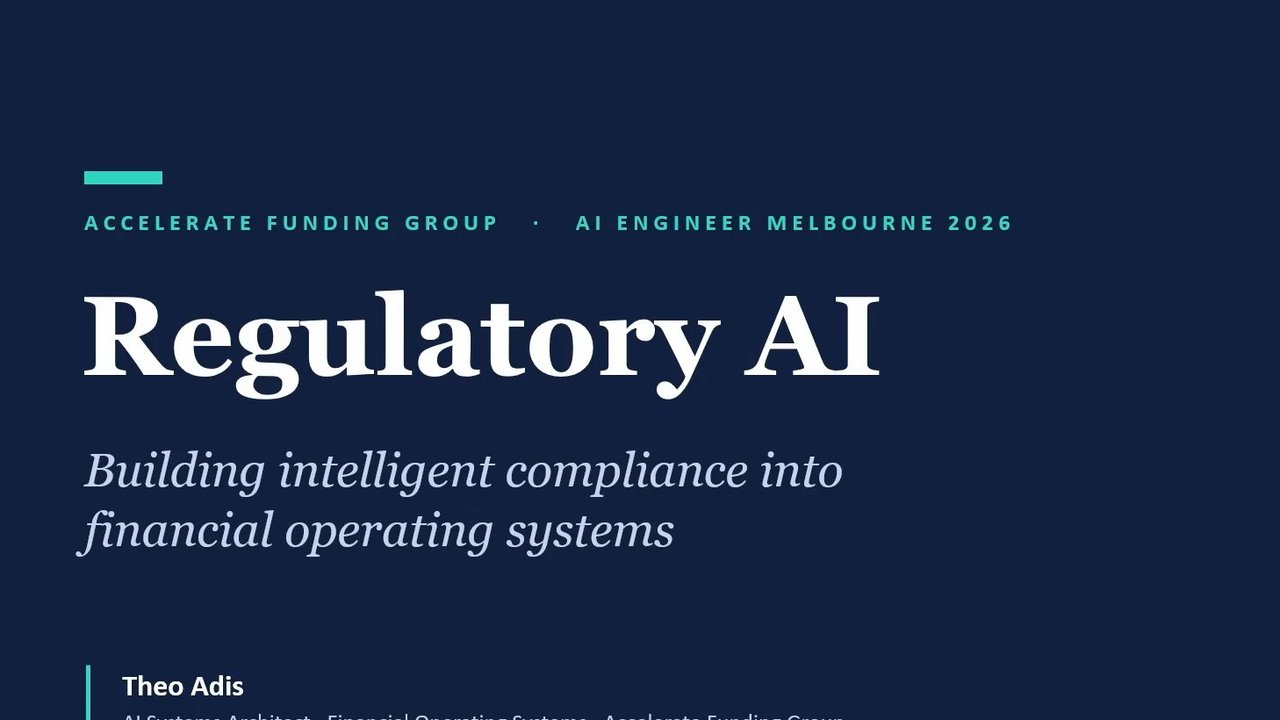
Regulatory AI: Building Intelligent Compliance into Financial Operating Systems
Speaker Background and Journey into Fintech
Speaker B introduces themselves, describing three decades in IT and architecture consulting, primarily in finance across Australia, the US, Europe, and China. They explain how this experience led to creating a banking-as-a-service fintech platform for neobanks and small mutuals, followed by becoming a licensed broker specializing in private, non-regulated funding.
The Rise of Private Funding and the Need for Built-In Regulation
Speaker B explains that over 40% of loans now come from non-regulated private funders, a trend they expect to face increasing regulation. They outline their platform's goal of connecting clients to over 2,000 private funders (compared to a typical broker's 80-90 banks) and describe their philosophy of building governance and compliance into AI-driven funding solutions from the start rather than adding it later.
Building Compliance and Governance into the AI Platform
Speaker B details their technical approach to embedding regulatory compliance, describing how their system ingests policies and regulations, tokenizes funder products, and works with a partner company (Coco) to ensure data integrity and privacy. They explain the RegTech-inspired logging and quality-rating system that continuously reviews AI outputs to ensure client solutions meet regulatory and ethical standards.
Evidence-Based Compliance and Ethical Lending
Speaker B contrasts 'bolt-on' compliance with their evidence-based, traceable decision-making workflow that satisfies regulators like APRA. They emphasize an ethics-first approach, stating their success is tied to client success, and highlight how AI helps clients discover funding options they wouldn't otherwise know existed.
Self-Discovering Regulatory Knowledge and Market Challenges
Speaker B describes how their platform's regulatory knowledge base self-updates, using the example of recent CGT and negative gearing law changes to show how clients can get personalized impact forecasts. They also discuss the conservative nature of Australian finance, noting resistance from small banks to adopt fintech innovations due to perceived risk, despite regulator pushback on pricing.
Combating Unethical Lending Practices
Speaker B explains their workflow's self-learning capability and core lending criteria: affordability, client benefit, and ethics. They share a stark example of businesses trapped in predatory payday loans with daily interest and credit hits, and describe their mission to use forecasting expertise to help such clients qualify for traditional bank loans within 6-12 months.
Platform History and Architecture Overview
Speaker B recaps their career trajectory from consultant to CIO to founder of Fintion Orbis and now Accelerate Funding Group, noting they've passed proof-of-concept and MVP stages with five active use cases. They introduce the psychological aspect of client meetings, noting it typically takes three meetings to uncover a client's real financial needs versus their preconceived expectations.
AI-Driven Client Discovery and Forecasting
Speaker B details how they use LLM chat and avatar-based conversations (leveraging ChatGPT's psychological strengths) to uncover client needs, then automate credit and financial history checks via APIs. They describe their proprietary forecasting model that predicts a client's earnings, debts, and credit over twelve months to ensure funding solutions address future risks, culminating in a human-guided negotiation process.
Summary: Compliance Maturity Levels and Future Direction
Speaker B summarizes their approach as 'trusted injection' with compliance and governance embedded throughout, generating necessary regulatory reports. They outline a maturity model for AI adoption—from basic levels to structured, enablement, and adaptive stages—positioning their platform as moving toward the enablement phase that scales client solutions competently.
Audience Q&A: Overcoming Client Skepticism About AI
In a Q&A with Speaker A, Speaker B discusses how banks like NAB and ANZ have cut thousands of IT jobs expecting AI to fill the gap without capturing institutional knowledge, predicting this will backfire and create new consulting opportunities. They explain their strategy of avoiding the term 'AI' when pitching to conservative finance clients, instead framing their product as a deterministic, automation-focused solution to avoid triggering skepticism.
Just a bit of bit of context. So, yeah, I've been in the industry for about three decades, primarily starting as a consultant from the IT and architecture side. But because of the last twenty or so years, it's all been in the finance space, whether it's banks here in Australia, overseas in The US, Europe. And one of my last engagements was in China, one
of the
biggest IBM shops in the world. And after spending so much time in the consulting space, I found that I've got something to give in the finance space. That's And where I created my first fintech which was a complete banking system, banking as a service, as a SaaS offering for neo banks, for small mutuals and so forth because I saw that they had a a big need for, you know, the latest technology without having to spend a lot of money.
So I did that for several years and I thought, that's good. Now I wanna go on the customer side even though I created a bunch of workflows and so forth, a complete banking system, one of I became a broker, a licensed broker. I did a variety of loans, everything from mortgage loans, business loans, and then I became a bit of an expert in private funding.
So these are loans which are not regulated which I found were becoming more and more popular. Currently less than 60% of loans are through banks and because they're so heavily regulated they're going to non regulated options and if used properly, ethically, then they're a great option.
But what I want to do today is show you what my definition of regulatory AI is and some practical examples of what I've produced but also where I think it's going to head in the future. So at the moment, what AI delivers is much faster analytics, automation, but I've seen over the last six to nine months, the rate of productivity for a developer, for a an architect in the banking system has been huge. So what in my product that I'm developing now, which is, a funding platform, it connects clients, whether they're brokers or businesses, to different types of funding.
Most brokers will have maybe 80 banks, five or six private funders. I've got over 2,000 private funders and I've extended that to helping startups like my peers in where I'm working at the moment to raise capital. The next thing I'm gonna do is helping them getting grants. So because I've spent so much time in the regulated space, I decided that as we move forward, all of these non regulated funding methods are going to be highly regulated.
So my approach is don't wait till the end of your solution to build in governance and adhering to government policy and so forth. Build it in from the beginning. So that's where I am at the moment and one of the challenges was how do I make sure that, what I'm producing is correct, it's suitable. So I'll just take you through that thought process.
So from the very beginning, knew what are the policies, procedures, the government bodies that are involved in in this in this industry, then built that in using different AI methodologies. So for compliance, there's a set number of regulations and policies and rules that my ingestion component breeds and it updates it on a regular basis and that's fed in as rules to my database.
Now there's there's a company that I'm working with, Coco, who are experts in this field. So I thought, let's not reinvent the wheel and they've got their own techniques for ensuring that what we're ingesting isn't going to corrupt the database, isn't going to break any data privacy laws and so on and so forth. So I've got that in my repository.
It gets put into a transitionary database, QA'd before I put into production. Alongside, I've been working with them and teaching them that to to tokenize the actual products and services that these different funders offer.
Especially in the non banking space, in the private space, they've all got their specialty, their requirements. None of them really have a decent CRM, which I'm building into my product. And it's a very long process. But with with the way I've approached it, it's a hybrid solution so that way, when I do offer the clients three plus options, it's I'm making sure that it meets their requirements, adheres to the regulations and actually improves their position rather than making it worse.
RegTech is a good one because I've bought a inbuilt RegTech type technology. The idea is as you are as this solution is working, it's logging what is happening, it's rating the quality, it's making exception reports, and then that's reviewed on an ongoing basis currently by myself or an AI agent which is quite simple to make sure that what we're producing is best fit for the client.
So this is the crux of it. By designing the compliance, the adherence upfront, it's a lot more effective because we know that the way APRA is going, the regulatory body, they're going after more and more non banking funders.
And this can be in any industry. So I've built in the controls and the information right from the beginning and ensuring along the way that it's accurate. So when I say bolt on, this is where we have a workflow that starts, decisions can or cannot be reconstructed.
There's the traceability of the lineage from the source information, audits and compliance, but the way I'm going is more evidence based. So all along the way, there's checking and the decision making is built in so that, it adheres to the to the, you know, the the requirements by government law.
And also this is where ethics come in too. So when Aubrey was talking about ethics, the way I've approached it is I'll be successful when the client is successful. Most clients, most people don't have any idea about what kind of money is available out there. There's so much money available but you need to understand what the criteria is, what the different offerings are and that's why I thought it was an easy win using AI to do a lot of the analysis for me.
So at a high level, this is the process. So there's an initial controlled environment that takes in the information. At the moment, it's hard coded, you know, from where the inputs come from, whether it's the funder site, the lenders, the capital raising companies, soon to be grants from the government.
But then I wanted to to self discover as we go on. So I'm not sitting there telling it what to do. And I found that that was a lot easier to do than I thought. So that took a lot of the burden off me as the as the architect here. So therefore, the regulatory knowledge base gets continually updated.
And as an example, you know, when they changed the GS the CGT laws, taxation laws for, negative gearing recently, that put a lot of people a lot of people got really, confused, despondent, how does this impact me? Whereas if you run it through something like this, then a future impact can be provided to the client.
So where I come so for my background, it was all about workflows for the client to understand what the requirements were and then marry that to the options. Now we've gone from 80 or 90 options to over 2,000 options both here and overseas. So what I found is we don't need to run fast.
I think AI is running fast enough for us, and it comes down to what components of my solution do I want to use AI for and how to use it. Now finance is a very regulated, very conservative field here in Australia. And what I found with my previous fintech was whilst I got a lot of consulting work, a lot of the small banks apart from the neos were not keen to try it because they thought the risk was too high.
Even though I had a working platform and plus the regulator thought it was probably, you know, five times too cheap. So we had to work with the regulator to, you know, meet their expectations which some of them was, you know, a bit surprising. So as part of my workflow, as I said, we're using, documents, websites that have been preauthorized by the funders themselves or the government has a self learning capability.
And it's all the decision making from beginning to end goes through this process to ensure that the key criteria for when you're lending when you're lending, to a client is does it can they afford it? Does it make life does it make life for them even better? And, you know, is it ethical?
I've seen so many unethical approaches, especially in private funding where I go to assist a business, very healthy revenue, but they've got themselves trapped with these things called payday loans where they're they're paying interest daily and if there's nothing if there's not enough funds in the bank on a daily basis in their bank account, they get a credit hit. So these guys get credit hits once, twice a week.
They can't get funding from anybody else unless they pay a fortune, so they're stuck with them. Whereas what I've found and I come from a forecasting modelling background is we can provide a solution for them that is beyond their expectations and offer a service not yet through this AI, but, you know, through consulting services as a broker that will position them so that six to nine months, twelve months, they can go get a bank loan and they're pre positioned for that loan.
But at the moment out there, it's carnage. And at this stage of my career, my life, I wanna give back and it's much easier to have that kind of a goal and be successful than try and do the Silicon Valley approach, which is go, you know, go out there and make as much money as you can without really thinking about it.
So started as a consultant, created a platform for a particular neobank. We've got their license. I was the interim CIO, created Fintion. Orbis, the product which is the complete banking system and now under the banner of Accelerated Accelerate Funding Group is where created this product.
So I've passed the proof of concept, I've passed the MVP and now I'm looking at five use cases on behalf of three on behalf of three brokers. And this is the architecture of the solution. Now, whilst we've talked about regulations and funding options and so forth, what I found from a psychological point of view is it usually takes me about three meetings with a client to understand what their real position is, what their real need is and once I have that, then the process, the workflow continues from there to the point where we can start working out on solutions.
So nine times out of 10, either the client has a preconceived idea of what they can and can't do, they are very optimistic about what kind of loan they can get and many times when they can't achieve that because of reality, get pissed off and try elsewhere and they come back about two, three months later.
So my use of AI here is either through a chat, an LLM chat that's been trained by myself or it's done through an avatar asking questions and then doing the psychological stuff that ChatGPT does so well, not so much Claude, to get to the real need.
Once I have that real need, it becomes a lot easier. I can then behind the scenes what I've done, I've automated the workflow through APIs to do credit checks, to do financial history checks, to find out, you know, what property they do own and don't own and put that picture together without them going through a pretty severe process of telling me everything.
So all I need is part of this program, is their identity, then I'll take it off then I'll go take it from there. And this is and what I've done is I've built in all that knowledge into the this workflow. The law says you've got to give them three scenarios and then it's up to them to pick the one that they want.
Now for me, it's bit easier because the user of my software could be a broker, a consultant for raising funds, or a business owner. So they do their own due diligence at the end once I present them. Now what I've built into this is given my background, starting with statistical forecasting and then building my own machine language model to forecast a person's earnings, predicted earnings, predicted debts and credit check over the next twelve months and do it month by month.
I've used that in here so that whatever we provide to them will fit their needs moving forward or at least highlight what, what risks they have coming up. And if there are risks there, how am I addressing it built into this? And the human aspect towards the end of this is once the client understands what I'm what the offer is and they've chosen, then that's when if it's currently, it's myself, but down the track, it could be, you know, a broker, for example, teaching them that here are the here are the process for negotiating better deals for their client.
A couple of examples there is if you just use the CRM that the software that comes to the broker through the registration process, negotiate 22% off from that. So it's adding that human aspect towards the end.
And the idea is in this in this space is to keep these clients going forever and a day, keep them happy and help improve their their wealth, basically. So we've talked about that. So in summary, it's trusted injection.
The decision making is done through the whole process and it's all about compliance and governance. And out of this comes a lot of the reporting that's required for reporting back to the regulator. So my question is we know where AI is now.
There's plenty of functionality. There's questioning around how do we make sure that it's not hallucinating and so forth. There's techniques around evals, the concept of judges as well. But the approach I'm taking is slowly but surely to make sure that this is gonna get to the end game.
Most people are at level one or two. Big jump is the structured approach, which is what I did in my last fintech, and now we're going into enablement and then down the track adaptive. Enablement for me means that we can provide the client the solution it needs he needs he or she needs a lot more competently and it scales.
These are the key ideas here. And, a few minutes to go. I'm a bit I'm a bit old school in that I've written a paper, take a paper that explains this very, very detailed. I'll load up the, presentation to here and, I'll be around outside here for most of the rest of the day and yeah, come and ask any questions or you can, shoot me some commentary through LinkedIn.
That's great. Thank you, Theo. I might just get you to move over here with me. We'll get Balram, sort of getting ready to kinda set up. We got a little bit of time, so I might just ask you a couple of questions.
Yeah.
So you're obviously working in a very heavily regulated space. You know, we know the banks from a technology standpoint have typically been at the front end of kinda, you know, compliance and, you know, provable evidence. And so how are you finding as you're going in and talking to your clients and kinda, you know, plus your history in working in finance, how are you finding the messages landing?
When you're kinda talking about things like nondeterministic systems and kinda, you know, understanding the impact of AI within their businesses, are they open to this idea or are they kinda, you know, that it's just all pushed back and, you know, not a lot?
It's unexpected. They've got so for example, here in Melbourne, we've got the NAB and ANZ, massive IT teams. About three months ago, they let go of three and a half thousand IT employees on the premise that AI is gonna come and make things more efficient. So they're moving forwarding and they're ready for AI, but in reality, what they're missing out on hang on.
You've just got rid of all your all of all your knowledge, all your experience. How can you go from I've now lost 15% of my IT workforce expecting AI to come without actually capturing that knowledge, without capturing that learning. And that's where they're gonna fail moving forward.
They're not gonna get the type of benefits they want, and that's when consultants come in because they have to hire either the same people back or other consultants. So I think they're being too optimistic, but then when you say when you say AI, that sort of work out, well, what the hell are you talking about? What are you using?
So when I'm looking at pitching my product, I don't talk about AI. I talk about this as a deterministic product. It's the advantages are you've got much more understanding of the system's got much more understanding of what you require. It's a lot more automated. You don't have to sit there and fill out 5,000 forms.
And from the funders perspective, I've made it so that it's a lot easier for them to upload their own information which creates more business for them. But if I start talking about AI and this and AI and that, they're gonna turn off. They're not interested.
Three content boxes are shown. The first box has a lightning bolt icon, the second has a shield icon, and the third has a gear icon.
Three distinct panels, each with an icon at the top: the first panel shows a lightning bolt, the second a shield, and the third a gears icon.
DEFINITION
Regulatory AI is operating-system design — not compliance automation
Most AI conversations collapse three different ideas into one. Regulatory AI overlaps all three, but is broader: It is where AI, workflow design, policy rules, data lineage, human review and regulatory assurance come together.
AI for compliance
 AI for compliance
Models that search policy, summarise obligations and draft reports.
AI governance
 AI governance
How an organisation governs its own use of AI.
RegTech
 RegTech
Technology that helps manage regulatory obligations.
The key idea
 The key idea
Regulatory AI turns compliance from an after-the-fact burden into a live operating capability.
A horizontal flow diagram illustrates "The Operating Model". It starts with a controlled environment (depicted with a lock icon), followed by inputs and discovery (magnifying glass icon), then a regulatory knowledge layer (database icon), leading to AI workflow and reasoning (gears icon), and finally resulting in faster decisions and proved control (shield icon). Below this main flow, a section titled "Evidence-by-Design - The Control Spine Beneath Every Stage" shows five elements with associated icons: source lineage, decision records, human review, audit trail, and monitoring and reporting.
A diagram illustrates a five-step process flow. Each step is represented by a box with an icon and text: 'Controlled environment' (lock icon), 'Inputs & discovery' (magnifying glass icon), 'Regulatory knowledge layer' (database icon), 'AI workflow & reasoning' (gears icon), and 'Faster decisions + proved control' (shield with checkmark icon). Arrows connect the steps from left to right. Below this, another diagram titled 'Evidence-by-Design' shows five circular icons, each with descriptive text: 'Source lineage' (interconnected circles icon), 'Decision records' (document icon), 'Human review' (person icon), 'Audit trail' (shield icon), and 'Monitoring & reporting' (line graph icon).
A three-step process diagram with arrows showing progression from "Source documents" (represented by a document icon) to "Managed knowledge" (represented by a branching diagram icon) and finally to "Applied to the workflow" (represented by a gear icon).
A diagram showing three interconnected stages in a lineage. The first stage, labeled "Heritage," features a building icon and describes an Australian neobank. An arrow points to the second stage, labeled "Predecessor," which features a stack of blocks icon and describes "Finteon • ORBIS." Another arrow points to the third stage, labeled "Today," which features an icon of three connected figures and describes "Accelerate Funding Group." Below these stages is a text box with a checkmark icon, titled "The lesson."
Three white cards, each with a blue circle containing a number (1, 2, 3) and an icon. The first card shows a balance scale, the second shows a handshake, and the third shows a line graph.
A teal vertical bar highlights the heading "The Regulatory AI question".
The slide features three distinct sections or cards: "Track" is accompanied by an eye icon, "Model the impact" by a binoculars icon, and "Route to review" by an icon of a person examining something with a magnifying glass. A rectangular call-out box at the bottom contains a warning triangle icon.
Three boxed sections are arranged horizontally. The first box has an eye icon. The second box has a pair of binoculars icon. The third box has an icon of a person with a checkmark. Below these, a horizontal yellow box has a warning icon, which is a triangle with an exclamation mark inside.
A five-stage maturity model for Regulatory AI, depicted as a horizontal progression of five numbered boxes. The stages are Experimental, Managed, Structured, Embedded, and Adaptive, each with a brief description. An arrow below the stages visually connects "Informal AI use" on the left to "Embedded regulatory intelligence" on the right, indicating the direction of progress.
A QR code is displayed, linking to Theo Adis's LinkedIn profile and a regulatory AI paper. Below it, the text "Theo Adis" is accompanied by the LinkedIn logo.
People
- Aubrey
- Balram
Technologies & Tools
- ChatGPT
- Claude
- LLM Chat
- Machine Language Model
Standards & Specs
- CGT laws
Concepts & Methods
- Banking as a Service
- Compliance Automation
- CRM
- Deterministic Product
- Evals
- Judges
- MVP
- Negative Gearing
- Nondeterministic Systems
- Payday Loans
- Proof of Concept
- RegTech
Organisations & Products
- Accelerate Funding Group
- ANZ
- APRA
- Coco
- Fintion
- IBM
- NAB
- Orbis