Don’t Be Cheap: AI and the Appearance of Engineering
Defining a Particular Kind of Stupidity
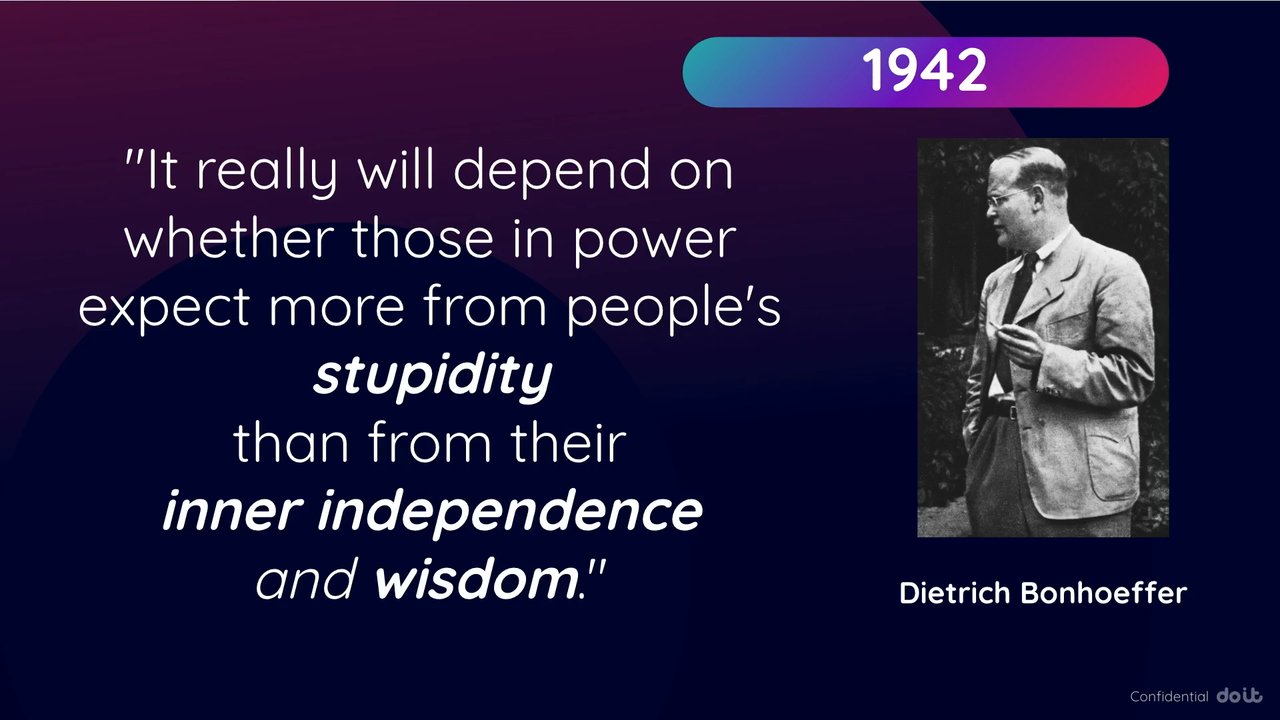
The speaker opens by framing a specific type of stupidity — not one rooted in lack of intelligence or education, but one that can befall anyone. Drawing on a 1942 quote from Dietrich Bonhoeffer, the speaker connects this idea to how people become 'mindless tools' under the influence of power, while noting Bonhoeffer's consoling insight that this condition is not permanent and depends on whether leaders expect more from people's independence and wisdom than from their compliance.
A Brief History of Dumbing Down: From Turing to Waterfall
The speaker traces a recurring pattern of oversimplification through the history of computing, starting with Alan Turing's nuanced 1950 imitation game being reduced to the blunt 'Turing test', then moving to Winston Royce's 1970 paper on software development lifecycles, whose iterative diagrams were misread as an endorsement of waterfall methodology. The speaker highlights that simplification is inevitable and not always bad, but consistently strips out the substance of original ideas.
Agile, Scrum, and the Pattern of Cheap Practice
The speaker fast-forwards to the 2001 Agile Manifesto and its subsequent dilution, citing Martin Fowler's term 'flaccid scrum' and the 2017 concept of 'zombie scrum' — processes that look like the real thing but lack genuine engagement, user contact, or continuous improvement. The same pattern, the speaker notes, appears across DevOps, SRE, blameless post mortems, and other practices that lose their demanding core in adoption.
Cheap Engineering as the Real Deadly Enemy
Drawing on Bonhoeffer's concept of 'cheap grace' — getting the comforts of faith without its demands — the speaker proposes that 'cheap engineering' is the true threat to the field, not AI. Cheap engineering means artifacts and velocity metrics look good on the surface while engineers lose genuine connection to their work and impact. The speaker sharply distinguishes this from frugal engineering, which protects what matters most: the uniquely human investment of attention, effort, and judgment that makes an engineer irreplaceable.
Thank you. That just gave away my talk, but it's good because we don't have much time. I'm really worried about the time. So please, you need to fill in all the good bits because I had to take them out and all the connective tissue between slides if they don't make sense, fill it in. And your conclusion and yes, okay.
So my talk is called Don't Be Cheap. But what I really want to talk about is a particular kind of stupidity. Not stupidity like being unintelligent. No, it's not actually like about any sort of defect that you might be born with at all. It's also not about your level of education. It's actually a kind of stupidity that can befall any of us at any moment. And it's very similar to what is very easily recognizable by us in LLMs, but much harder in humans and especially in ourselves. We're almost completely blind to it.
And it's been written about a lot. So I want to start with a quote. Not sure if anyone recognizes this quote, but it says, under the overwhelming impact of rising power, the stupid person is under a spell, blinded, misused, and abused in his very being. Having thus become a mindless tool, the stupid person will also be capable of any evil and at the same time incapable of seeing that it is evil.
Now this is not about AI, it's actually about people and it's not even from this era. This was actually recognized before technology as we know it today was a thing. This was Dietrich Bonhoeffer in 1942, few months before he got arrested. So that's that's a movie about him.
I heard it's not very good. But so, yeah, very, very serious circumstances. Obviously, not comparing those. But but the interesting thing is that despite those really, really dire circumstance that he was in, he actually had some consoling words for us. He did not say that the stupid person is forever doomed. He did not say that we are forever doomed to live with them. No. He actually said that it really depended on whether those in power expected more from people's stupidity than from their inner independence and wisdom. Now when you see those words, those in power, I do not want you to think of other people.
It's us. We're the leaders in the room no matter what our title is. It's up to us. Don't wait for anyone or anything else. And I could stop the talk there, but that's really the question I want you to walk away with like, are you expecting more from people's stupidity or from their independence and wisdom and of yourselves?
So if you have a few more minutes to stick around, seven minutes, I want to show you that this is actually something that our field has been struggling with for basically since the beginning, since roughly 1950 you could say that sort of around the start of the field of computer science, Doctor. Alan Turing, often seen as the father of computer science and AI.
And it's interesting because even back in 1950 when he published this paper, which I realized is not too small up there, it was called Computing Machinery and Intelligence. So even back then, were already discussing like can machines think? And he thought that wasn't actually a very useful question. So he decided to change the question and he came up with this thing called the imitation game.
There's a movie about there's a movie called that, but it's not really about that. It's more about his work during World War II. But if you have time, read the paper. There's also a paper that is linked to from Wikipedia about how this imitation game, which is basically a person talking through kind of like what we would think of as a chat interface to two other humans that he can't see.
One's a man, one's a woman. They're both trying to convince him that they are the woman. He needs to work out who's trying to fool him. And then what happens if you replace one of them with a machine? Like would he be fooled more often or less often? That got dumbed down a lot to what these days people refer to as the Turing test.
And obviously that's become like a bit of a benchmark and used in discussions about AGI. And that's sort of I guess my point. Like things get dumped down. It's not something we can really avoid. And it's not always bad like the contribution is still there. He's still done a lot of good stuff. But yeah, let's fast forward.
So 1970, this guy, does anyone in this room know Doctor. Winston Royce? No, probably that's fine. But you might recognize when I show you another page of this paper. So again, think it's amazing, 1970 he was already talking about managing the development of large software systems. It was already becoming a thing and he was the first to actually describe the development life cycle and included this diagram.
Yeah. So this is the thing, right? So people saw this diagram and they say, that looks like a waterfall. Right? And yeah, some people think he actually coined the term waterfall, that he promoted waterfall. It's not true. First of all, he never used the word waterfall in his paper. And secondly, he actually said, yeah, well this is sort of in theory what needs to happen, but in practice it doesn't actually work like this.
But you know, people miss that, at least some people missed it. And then he went through like multiple iterations in his paper and you know, there's like some you know sort of iterative like feedback and all that. If you were to scroll or at that time I guess on paper, flick through the pages to the very last page and rotate it because the last page is in landscape format, you'd actually see something like this.
Now this is the kind of diagram I think you were expecting at an AI engineering conference, right? Doesn't this look like an agentic workflow? Doesn't this look like, know, spec driven development or something? Anyway, I just thought it's cool. Yeah, like I said, you have to fill in the connective tissue. Fast forward to 2001, this is like the anti waterfall event.
Bunch of guys met on a mountain in Utah and walked down the mountain with this manifesto. We all know what happened to Agile. Not that, right? It didn't actually take that long for even one of the signatories, Doctor. Martin Fowler to realize many times, yeah, we're doing stand ups so we're agile and that's pretty much it.
All the other sort of demanding practices underneath gone and he called it flaccid scrum. All the XP stuff, all the good stuff that these people liked had become very optional. And then in 2017, we got zombie scrum, same idea. Like it looks like scrum from the distance, but it lacks the beating heart. That's the idea. Like no contact with the users, no adapting from feedback, no real ownership anymore, no continuous improvement.
If I had time, could give you more examples from DevOps, from SRE, toil, error budgets, all that kind of stuff, great ideas, blameless post mortems. In practice, they don't always turn out as intended. But interestingly, the guy we met at the beginning, Doctor. Dietrich Bonhoeffer, he saw the same pattern in 1937 in his church and he called it cheap grace.
So because he saw that people could get like the superficial comforts of their faith without actually putting any demand on themselves to live any differently. And I would like to propose that so by the way, this is what he called the deadly enemy of his church. And I would like to propose that our deadly enemy is not AI, it's cheap engineering.
So same thing, you know, the artifacts appear, the processes look mature on the surface according to some velocity metric, your teams are getting faster and faster. But you're no longer really connected with the work, you're no longer connected with the impact. Like it's the works passing through the process, but not really through you anymore. You're not really absorbing, you're not really forming yourself the way you used to.
And just wanna make a really quick distinction. Cheap engineering, bad. However, frugal engineering, absolutely not the same thing. Because frugality means protecting what matters. Like it means not wasting your precious resources, your time, your attention, your effort, everything that makes you uniquely human. You should absolutely be frugal with that, right?
Whereas with cheap engineering is the opposite. You're wasting all of that, everything that makes you special. And so if you engage in cheap engineering, that's what makes you replaceable. But being frugal is what makes you you. So I invite you to all think about that. Like what does engineering and being an engineer mean to you? And on that note, please don't be cheap.
Thank you.
Yeah. Cool. Alright.
Thank you.
Sitting right there. Yeah. The clock will count down to you. Should we start? Yeah. Countdown to you. Alright. So
you can see you'll be able to see
your screen at the top there. Yep. So if you have to drag Actually yeah. Screen. Where is my screen?
I don't know which way it is.
Alright. Well, I need to get out of the full screen mode first. Exit full screen. Alright. Where is it? Yeah. Oh, that way. No. Maybe that way? Actually, let's just go. I'll just reconnect this. I'll just do, like just share my screen.
Stop. No. I'm fine. How do I enter screen?
People
- Alan Turing
- Dietrich Bonhoeffer
- Martin Fowler
- Winston Royce
Concepts & Methods
- Agentic Workflow
- AGI
- Blameless Post Mortems
- DevOps
- Error Budgets
- Extreme Programming
- Scrum
- SRE
- Turing Test
- Waterfall
Works
- Agile Manifesto
- Computing Machinery and Intelligence
- Imitation Game