Inclusive design for audiences with alcohol and other drug challenges
Why exclusion is bigger than time and money
Ally Tutkaluk introduces her work in alcohol and other drug services, mental health, and digital healthcare research. She argues that blaming limited time or money for exclusion normalizes it and conceals deeper structural and cultural barriers.
Designing for overlapping barriers
Tutkaluk defines inclusive design around the diversity of people’s abilities, circumstances, cultures, and emotional states. Using ConnectWell, she shows how health challenges, device instability, limited internet access, privacy, digital literacy, socioeconomic conditions, and stigma intersect to compound exclusion.
Words that signal who belongs
Tutkaluk explains how interface language carries experiences from physical healthcare into digital environments and can reproduce coldness, stereotypes, and stigma. Examples from Designed with Care, Adobe Spectrum, and ConnectWell demonstrate how careful wording can communicate warmth, preserve dignity, and avoid shame.
Practical foundations for inclusive language
Tutkaluk recommends language guidelines, readable content, audio and visual alternatives, community interviews, and testing. She also examines her own mistaken assumption that everyone seeking alcohol and other drug support identifies with the diagnosis “substance use disorder.”
Choice across the digital divide
ConnectWell offers online and face-to-face pathways rather than imposing a single delivery model. Tutkaluk describes implicit tech bias and argues that privacy fears, surveillance, past institutional harm, substance effects, connectivity, and digital literacy require genuine choice and person-centred digital inclusion.
Guidelines are a starting point
Tutkaluk surveys universal, accessible, trauma-informed, and condition-specific design guidance while warning that broad guidelines cannot supply every contextual detail. She recommends combining adjacent standards, case studies, research papers, customer conversations, and testing, including research that informed ConnectWell’s abstract substance icons.
Making inclusion a shared practice
Tutkaluk identifies organisational barriers such as assigning inclusion to one specialist, recruiting unrepresentative research participants, failing to report outcomes back to communities, and siloing inclusive design. She distinguishes accessibility from the broader work of inclusion and argues that both require shared responsibility across the product lifecycle.
Reflexivity as an inclusion practice
Tutkaluk closes by presenting reflexivity as a practical way to confront personal biases and assumptions. Continually questioning oneself and the work helps teams locate points of exclusion and act against them.
Hi, everyone. It is so nice to be here in person because when I last presented at UXA in 2020, peak COVID, I was sitting in my dining room desperately hoping that no one could hear the sound of my very noisy husband in the next room on just a never ending cycle of work calls.
I don't know if anyone remembers at the time there was a a Twitter post or a meme or something, and it said, working from home showed me I'm married to circle back guy. I also am married to a circle back guy. They are a interesting species. So anyone connecting from home or from work online, I I hope you are in a calm environment with an absence of corporate jargon coming from the next room.
But since 2020, other things have changed for me too, apart from, you know, being here in the physical space. So back then, I was working at a cancer organization, and I am now at an alcohol and other drug and mental health organization. In this time, I've also started my PhD, as you do. And my proposed thesis is looking at the inclusive design and the equitable access of digital health care products.
And in this time, it's sort of become apparent to me that although inclusive design has made some really awesome progress over the years, there are still some groups who are not seeing its benefits. And then in turn, us as practitioners, we're still facing barriers in how we practice inclusive design. Some of these barriers are within us, sometimes they're in other people, and sometimes they're more systemic.
Right? So today, although I will be talking about designing inclusive digital experiences for people who use alcohol and other drugs, I'm also going to look at it in sort of a broader framework of, well, what barriers are in our way of designing these inclusive experiences, not only for this audience, but for whoever you may be working with.
Because I think what we often do when we blame something for not doing inclusive design, we usually go for two things, time and money. But the thing is, even though sometimes that's true, if we're always blaming time and money, we're actually normalizing exclusion. Because you start to frame it as, like, this inevitable thing rather than inclusive design being a nonnegotiable right from the start.
We're also oversimplifying a very big systemic issue, which in turn can be hiding deeper structural, cultural issues as well. So what else is in our way of designing inclusively? So I'm gonna frame a lot about, you know, the work that I do, working in the alcohol and other drug and mental health sector, but I'm pretty confident there's gonna be some shared learnings that will be applied to, you know, no matter what sector you work in. Now before we get into it, very quickly, what are we talking about when we talk about inclusive design?
So Viv touched on a lot of these yesterday. It's about the diversity of a product's users. Right? So we might consider education, abilities, cultural background, language, even if they're stressed or in crisis. Edge case was used a lot yesterday. I would like to ban the phrase edge case along with the phrase, let's circle back, because when you think of edge case, you kind of picture just this one person just hanging out, you know, by themselves. And it can make it seem like when we practice inclusive design, we're just helping this one lone person.
But we know that's not true because one of the awesome things about inclusive design is that its benefits are extended to everyone. Oops. I went too far. Accessibility, kind of. So things can be accessible but not inclusive, and things can be inclusive but not accessible, which I'll get into a little bit more later.
Okay. So we've established that. So what is getting in our way of designing inclusively? First of all, thinking of inclusion barriers as just singular bubbles. What do I mean by that? Okay. So if we think about barriers to inclusion, they are not just a neat little bubble where just one thing needs to be explored. Right? There are multiple bubbles, and they overlap.
And I know these bubbles look very dodgy. I'm obviously not a UI designer. I'm so sorry. But you get you get the metaphor. So when I first started work at Lives Lived Well two years ago, we started working on a new digital health product called ConnectWell. Grab me afterwards if you would like to know more about ConnectWell, especially if you're from a PHN or a government funding body.
But, anyway, when I started working on ConnectWell, I initially thought, okay. The main thing we need to think about here, if we wanna design inclusively for our clients, is their health challenges. Because sometimes people who use alkaline other drugs can have significant impacts on memory, on their attention. They can even get some physical impacts as well. All very important considerations when designing for a digital health product, of course. But in time, we quickly realized we needed to think beyond this. Device access was another barrier.
So we found that many of our clients could often lose phones or were often changing their phone number. So you can start to think, okay. This now has implications for, you know, the device they're using. That has flow on effects for multifactor authentication, privacy. Where are they accessing content in the future?
Are they using a shared device? Similarly, quality regular Internet access is another thing we needed to consider. So, again, we have to think of site speed, offering resources offline. Stigma is unfortunately a very big considerate a very big barrier for people, so therefore something we really need to consider.
Because stigma can affect not only whether someone seeks care and support, but it can also negatively impact the care and support they receive. So we need to think of how are we addressing stigma in our content, our language, even our imagery. And then what happens is when some of these bubbles combine and when, you know, other bubbles not pictured here combine, barriers and challenges are actually compounded even further.
So we have to look at everything holistically. We have to look at all of the bubbles. An example of this at play. So if we think of someone who might have low, poor Internet access. So we think, okay. Let's offer resources they can download and view them later. Brilliant. We should do that, and that is a good start.
But what if they also have poor digital literacy? What if they're also from a lower social socioeconomic background? So can people quickly and easily download the resource for finding it later? Do they know how to do that? Do they then know how to access that resource again in the future? Right? Can they access it privately?
Are they using a shared device? Are they using a community device? So all of a sudden, the problem very quickly changes when these challenges when these bubbles start to stack up. So it's really important to think of these numerous overlapping bubbles. And it's also important to even make sure that, like, the bubbles even get made in the first place.
Make those barriers really visible to your team. Don't be like every toddler in the world when they are handed a bottle of bubble solution. What do they do? They yep. I'm You know. They tip it out every time. It's make the bubbles, my friends.
Make them. Okay. Next up, let's talk about the power of words and how they can both help exclude and include people. So this is another barrier to inclusive design that is just so pervasive. Its roots are just everywhere. That can seem so daunting, but we can also flip it.
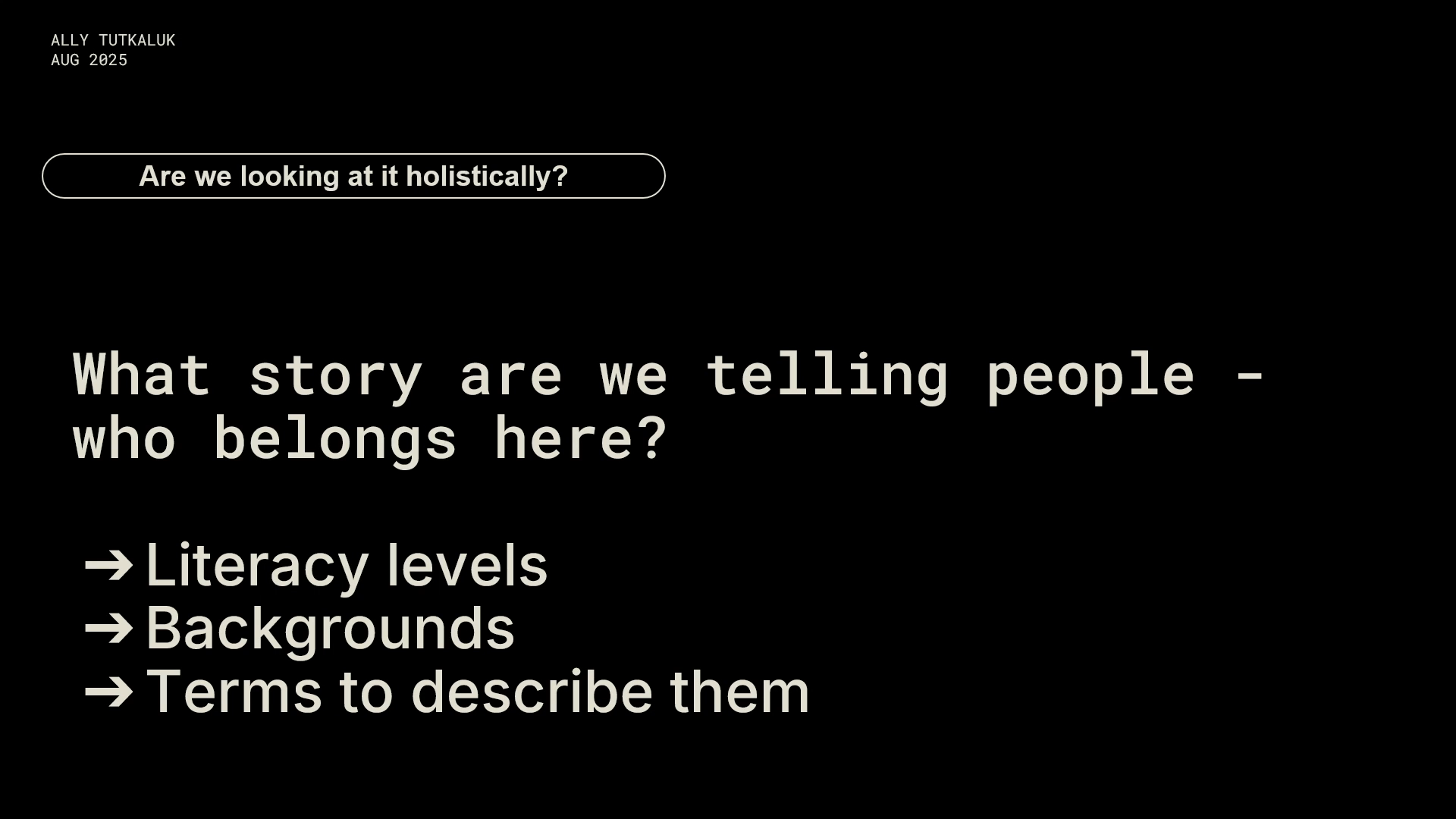
We can see it as so many opportunities to course correct. We need to think of what story are we telling people about who belongs here. So on our interfaces and our products, the words we use, what story is that saying about who belongs there? If we're not considering things like literacy levels, cultural backgrounds, we're literally excluding huge groups of people.
I remember Tia yesterday, she also talked about neuro inclusion, right, creating those safe, validating environments where people feel seen. And then what about the words we use to describe people, to describe our customers? Are their identities being captured and represented in an accurate way? Is it actually how they wanna be represented?
I also like to think of this, that people bring their experiences with them. So we have to design for that in mind. I've got a quote here from the very, very good book called Designed with Care. It's a book about creating trauma informed content. And one of the chapters, Owen Lee writes about how he was talking to some website users for a health clinic website, and the users kept saying, oh, you know, the website's academic and sterile and cold. And interestingly, it actually reminded those people of those cold experiences they had in physical health settings, which were a cause of stress in the past. Now, you know, academic, sterile, cold, these are terms that are unfortunately used a lot when describing health care.
Our clients say it a lot as well. You know, if they're reviewing some digital content for us, it always comes up that, of course, there should be a level of professionalism in that, but they don't want clinical, certainly don't want cold. There needs to be that warmth there as well. And I find this really interesting because a lot of these experiences that people are taking with them, they're from the physical space.
Right? But they're transferring over into digital and vice versa. Right? Okay. So we've spoken about the stories that we're telling about people. Now what about the stories that other people are saying? Right? What about the narratives that people are given by others?
What does the media say? What do stereotypes say? What does stigma say? In not thinking of these social impacts in language, that can be really excluding. So stigmatizing language is a massive barrier to inclusivity. So it's something we think about a lot at my work.
And this is because the language used to describe people who use substances is often incredibly negative. It is very misinformed. And this is problematic because it has a huge impact not only on how people perceive themselves, but also how others perceive them. And this has a further flow on impact.
Right? So stigma can actually impact policies and systems. This can, in turn, negatively impact on opportunities for people who use substances. It can impact on access to health services. If we don't use strengths based language when we talk about people who use substances, if we are always painting a negative picture, policies can then focus on punishment or control rather than the support that's available. And this is really unfortunate because it diverts attention away from the many wonderful support programs that are out there.
And, of course, once again, excludes a very large group of people. I also like to always think of the worst case interpretation of your words. There's a snippet here from Adobe's Spectrum, their design guidelines, And they give an example on inclusive language.
Right? And they say, instead of saying, just buy more storage, which is a bit of an assumption on someone's economic status, you can rewrite that to say, view additional storage options. And I love this example because it shows you how you can rewrite something to be beautifully inclusive, but it's still clear.
It's still a call to action. So we think of the worst case interpretation of our words quite a lot. Not only do they words help fight stigma, but words can also help build someone's resilience, and they can make someone feel welcomed. This was a bit of a learning experience for us. Okay. Fine. We stuffed up.
You made me say it. So on the left, my right, your left, that one. On that one, an early design version of ConnectWell had, you know, greeting, good morning, and then it's great to see you again. And one of our wonderful peer workers actually pointed out that a phrase like this could actually send someone down a very negative path.
I miss, like, a bit of a shame spiral. You know? Well, they're back again, and it's not actually great to be back for a lot of people. So we changed it, and now it just says welcome because that's all we want people to feel. Okay. So what can we do if we want to have beautiful, inclusive language? Well, if you work in the alcohol and other drug sector or the mental health sector, we're very lucky because there are some wonderful language guidelines from organizations like Mindframe and NADA.
But any sector, any organization will always benefit from being aware of reading levels as a first step, particularly because in Australia, about half of Australian adults have low literacy levels. It's very easy to just run your copy through an online tool, and it will check the reading level for you. But then also not assuming everyone wants to read, so think of multiple ways that people may consume content.
Maybe that's a read aloud tool. Maybe that's using more imagery, more infographics as well instead of just long form all the time. Now for any sector, of course, testing and interviews is hugely valuable, especially with language, because we can work with communities to see what terms resonate with them, what terms they feel actually represent them accurately.
And finally, I think being aware of your own assumptions is really important here. And, again, another learning experience for me. So when I started at Lives Lived Well, I assumed that anyone using our services coming to us had substance use disorder.
Right? That's like the medical term. It's in the DSM something something, the diagnostic manual. Now this actually isn't true. Okay? So not everyone actually meets the diagnostic criteria for substance use disorder. If people do, sometimes they don't actually see themselves as having substance use disorder. And, of course, not all substance use is problematic as well. And this has been a very valuable experience for me also in my studies.
It kind of kills me because when I was early in my research journey, I had a paper, and all through it, substance use disorder, substance use disorder. And I just, like, I just cringe thinking of that, because it's just not an inclusive term in some instances, of course. So on our website and on our ConnectWell platform, we would never refer to the people using it as people who have substance use disorder because it's not inclusive, and it's actually not even true.
Language is free. Someone I work with says this, and I love that because it's so true. Right? It's the cheapest, It's the easiest way that you can work towards making everyone feel welcome. Okay. Next, I wanna talk about delivery methods because often they can be a big barrier to inclusivity. So ConnectWell, although it is an online service, it does not replace our face to face services.
One of our screen questions, which is oh my gosh. It's a bit pixelated. Once again, not a UI designer. In this little screening email here, it gives people a very easy option. If they don't want online services, they don't have to do that. They can stick to face to face. They can do both. Right? They've got that choice.
And choice is really important, especially in digital health products, because there's something called implicit tech bias. So this is where you have, say, a health care professional, a clinician, and their unconscious perceptions of someone's digital literacy or their access to tech can actually influence whether they even enroll a patient or a client in a digital health program.
Obviously, a huge barrier to inclusivity. And similarly, it's often assumed that people with low digital literacy don't don't want digital tools, don't want the digital option. This actually isn't always true. Many studies have shown that even people with low digital literacy are very motivated to use digital tools.
So we can never assume which delivery method is best. Right? Choice is key. And if you can do it, multiple methods is really key as well. Because we need to remember, a lot of the barriers people have to digital access are not ones they have chosen. Right? Someone may have experienced a data breach in the past.
So there's fears around confidentiality, around privacy. They may have had a bad experience with a government or a health care organization. They could be under surveillance. Someone could be monitoring their device access. We also think, in my work, of the effects of certain substances. So certain drugs can cause heightened, you know, paranoia and fears around privacy. And there's many other challenges.
Like, make no mistake, there is still a very big digital divide in Australia. Right? So many issues contribute to that. It is not simply a matter of, although it is an issue and many Australians do not have Internet access, it is not just a matter of, oh, people don't have Internet access or they have low digital literacy. There are many systemic factors that are still contributing to mass amounts of digital inequities in Australia.
So if we can understand that these challenges that people may have in accessing and using tech are really quite varied, it can actually really help more people understand, like, the nuances of this issue. And, hopefully, in turn, that can maybe help the industry on the whole to better craft more effective solutions that address people's needs.
And we can actually look to improve digital inclusion and make the product fit the person and not the other way around. Now another barrier is thinking that good design takes care of inclusivity. Sometimes. But where this gets dangerous is where we rely just on design guidelines. Now lots of good design guidelines sound quite inclusive.
Certainly, I've got a couple of snippets here. The top is from Ben Schneiderman, and Ben talks about the importance of recognizing diverse users. Cool. On the bottom, the Center for Universal Design, which is based, in The States. I wanna say the University of North Carolina. I am so sorry if I've gotten that wrong.
They talk about, you know, being aware of someone's concentration level. Right? I love that. And, of course, there's many awesome resources coming from both industry and academia, Microsoft, Adobe Spectrum, I mentioned before. The government has got some awesome inclusive design resources. WCAG. We all bow at the altar of WCAG.
Of course, we love WCAG's resources. Spelled chain, pronounced Chien. They are a global organization, and they have very comprehensive trauma informed guidelines. Of course, we heard from Taryn yesterday in her wonderful trauma informed design framework. And there's lots coming out of academia as well. We're seeing more targeted design guidelines for health conditions like dementia, like autism. And I know what you're thinking.
But, Ali, is there one for alcohol and other drugs? No. There's not everyone, and I'm so glad you asked, because that is one of the suggested outcomes of my PhD. So hopefully, in two years, I will have that because I've, kind of promised people that I would. Watch this space. But the thing with guidelines okay.
We need to remember, by nature, they're broad, and that's fine. That is all good. They're a base, so we need to treat them as such. Right? They're a starting point. So what else can guide us? So I really love looking at adjacent guidelines, you know, multiple guidelines in the absence of a guideline for people with alcohol and other drug challenges. I found looking at CHIEN's guidelines, looking at WCAG's cognitive accessibility guidelines super helpful because there's a lot of parallels there.
And think outside the box, like, case studies from the sector, reports, academic papers. I know they are dry. Trust me. I know. But they are actually a very, very helpful source of you know, a bit of a starting point or sometimes to help use in combination with those guidelines. We did this recently at work, actually.
We were starting to design some little icons to depict each substance type, and we found a paper that talked about how depicting substances in an abstract way can actually help with stigma because it keeps it scientific. So So there you go. It can be very helpful. And, of course, talking and testing.
We know this. We're at a UX conference. Right? We know that talking and testing with our customers is one of the best ways to give some extra nuance and some richness to those guidelines. Okay. So I'm at my final point. Now this is about barriers within our workplaces and our teams. And And it's not about pointing fingers.
Okay? But we do need to recognize that a lot of barriers to inclusive design lie within our teams and our organizations and how we work. Often, the responsibility falls to one person with inclusive design and accessibility. I'm sure many of us have been there. Right? An issue crops up. Everyone kinda goes like this. Because whose responsibility is it?
Is it the devs, the UXers, is it the designers? The truth is it needs to be a shared responsibility. Right? Because if it's not, it either doesn't get done, or you've got one poor person managing inclusivity of every phase of the product cycle. That's not sustainable. That's not fun. And I bet you they are not getting paid enough to do that.
Now often, we do the right thing where we work with our participants in testing and interviews. This is brilliant. However, sometimes they're not always representative of a diverse customer pool. So a paper I read recently noted that, they were looking at evaluating digital health tools, and they found that many studies required participants to have their own phone.
So this obviously leads to a very limited sample of participants, biased studied outcomes, and some of the most at risk participants could be excluded. Similarly, often, in participatory work, unfortunately, for many, many years, and it is still happening, we tell people stories, and we, you know, have their insights taken, and then nothing kind of happens.
It's really important that we circle back. I did not wanna say that. Damn it. It's the most fitting phrase for this. We need to circle back and share back with our participants how their expertise has actually helped outcomes. Because if we don't, not only do we sort of fall into the cycle where people probably don't wanna participate again, but then people can really feel quite dismissed.
Right? And we don't want that. Okay. Inclusive designers often siloed or part of company culture. Is it in position descriptions, right, on job ads? Is it in the company style guide? Is anyone talking about it at lunch and learns if you do them? Is anyone writing about it on the company blog if you have that? This can all lead to better education, which kind of leads into the last point on the slide, which is that inclusivity is still confused with accessibility.
Accessibility is a component of overall inclusive design. And the trouble is when they get confused, often neither thing gets done well. It's problematic going both ways. So you then have an accessible form, which isn't inclusive because, maybe the way the gender question is worded and the options are given is not totally inclusive.
Or you have one of the examples like what Viv gave yesterday, where maybe you have a fabulous image, and it shows all of your diverse customers, and it's awesome, but screen readers just read it out in a very disruptive way for users. Now, I said that was my last slide in my fibbed. This is my last slide, but it's an important one because it's about what we can do to help fight inclusive design barriers.
This is about reflexivity. Now Sophie and Beck, you will remember, talked about this yesterday. They love reflexivity in academia. You know, they love a cute little positionality statement. So I've been trying to get better at it. It's awkward. It's so, so awkward. It's a bit eek because in reflexivity, you're questioning yourself.
And you're saying, do I have biases? Do I have assumptions? And although this is really hard, it's a really important muscle that we need to keep exercising. Because if we can't question ourselves, how can we question others? How can we question the work? And it's only through this sort of continuous process of questioning that it can actually help us look for points of exclusion and then fight against them. That's it.
Thank you, everyone.
People
- Owen Lee
- Ben Shneiderman
Technologies & Tools
- multifactor authentication
- read-aloud tools
- screen readers
Standards & Specs
- DSM
- WCAG
Concepts & Methods
- digital healthcare
- inclusive design
- equitable access
- accessibility
- digital literacy
- trauma-informed content
- strengths-based language
- substance use disorder
- implicit tech bias
- digital divide
- digital inclusion
- trauma-informed design
- cognitive accessibility
- participatory work
- reflexivity
- positionality statement
Organisations & Products
- Lives Lived Well
- ConnectWell
- Adobe Spectrum
- Mindframe
- NADA
- Center for Universal Design
- Microsoft
- Chayn
Works
- Designed with Care