Conffab by Web Directions
  • Speakers
  • Presentations
  • Conferences
  • Live streams
  • Topics
  • Pricing & Plans
  • Browse
  • Signup
  • Sign In
  • Speakers
  • Presentations
  • Conferences
  • Live streams
  • Topics
  • Pricing & Plans
  • Browse
  • Signup
  • Sign In

Search Conffab

Search presentations, speakers, transcripts, slides and topics.

Searching Conffab

ES6 Symbols, What They Are and How to Use Them
Clark Pan at Code 2015
Sign up for Conffab Free to watch this and hundreds of other videos for free
  • Details
  • References
  • Keypoints

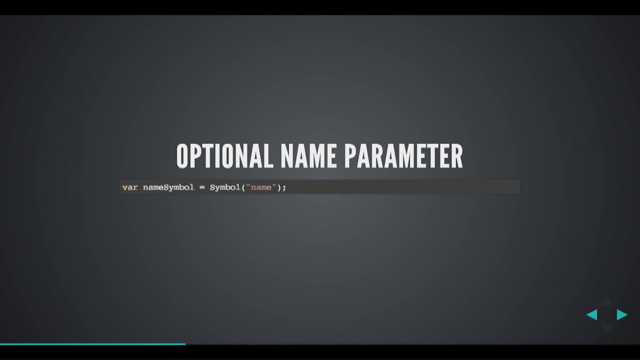
With ES6 ratification coming in June this year, now would be a great time to look at some of the new language features. Symbols are a lesser talked about new language primitive that underpins some of the new metaprogramming capabilities of ES6. This talk will give you a brief overview of what they are, and how they might affect your code.

clark-pan.github.io/Symbols_WDYK

To understand symbols you need to go back to basics of how objects work… and not work!

The ways js handles objects and strings can create unintended effects (presso shows example with values being overridden).

Symbols are a new primitive type – ie. Calling typeof will return “symbol”.

Symbols protect the values they contain and require you to access them via the symbol.

Use cases?

Because symbols are unique, there is no risk of collision. This makes them useful for storing state within web components; and can be used to make private values – that is, avoid polluting your public API. It is much like using jQuery’s .data but simpler.

ES6 has also defined built-in symbols. They allow you to hook into language features being exposed in ES6:

  • for of loop (discrete from for in, doesn’t need to access index)
  • symbol.iterator
  • instanceof
  • more to come as the language evolves

Biggest use case is encapsulation without (ab)using closures. The people consuming your code don’t necessarily want to see everything, you don’t want everything in your public API. To hack this, we have been closures to make things psuedo-private. That has lots of side effects – hard to unit test, hard to debug, bad for code re-use, small performance penalty.

Symbols solve encapsulation nicely, letting you set a const and refer to it via symbol. (see slide for pattern)

Browser support – great except for IE 🙁 Useful in io.js or node with the –harmony flag
 

You may also be interested in

Thumbnail for Pop-up Accessibility

Pop-up Accessibility

Rhiana Heath

Code 2015

Thumbnail for What Comes Next for the Web Platform?

What Comes Next for the Web Platform?

Alex Russell

Code 2015

Thumbnail for Console Dot

Console Dot

Warwick Cox

Code 2015

Thumbnail for Back to the Future with Web Components

Back to the Future with Web Components

Jonathon Creenaune

Code 2015

Thumbnail for Crossing The Streams

Crossing The Streams

Simon Knox

Code 2015

Thumbnail for Dawn of the Progressive Single Page App

Dawn of the Progressive Single Page App

Mark Dalgleish

Code 2015

Thumbnail for Eliminate JavaScript Code Smells

Eliminate JavaScript Code Smells

Elijah Manor

Code 2015

Thumbnail for What Does HTTP/2 Mean for Front End Engineers?

What Does HTTP/2 Mean for Front End Engineers?

Mark Nottingham

Code 2015

More presentations from Code 2015

Thumbnail for The State of the Animation

The State of the Animation

Rachel Nabors

Code 2015

Thumbnail for What Comes Next for the Web Platform?

What Comes Next for the Web Platform?

Alex Russell

Code 2015

Thumbnail for Async and Await

Async and Await

James Hunter

Code 2015

Thumbnail for Async Frontiers in JavaScript

Async Frontiers in JavaScript

Domenic Denicola

Code 2015

Thumbnail for Classing up ES6

Classing up ES6

Andy Sharman

Code 2015

Thumbnail for Canvas Cold War

Canvas Cold War

Simon Swain

Code 2015

Thumbnail for Current Best Practice in Front End Ops

Current Best Practice in Front End Ops

Alex Sexton

Code 2015

Thumbnail for Stop the Fanaticism – Using the Right Tools for the Job

Stop the Fanaticism – Using the Right Tools for the Job

Kassandra Perch

Code 2015

© 2026

  • About
  • Speakers
  • Presentations
  • Conferences
  • Contact
  • Sign in
Sign Up