How Futures Design practices can strengthen research output
Why Valuable Research Fails to Inspire Action
Sheree Hannah traces her path from graphic and web design through UX and strategic design to futures design and strategic foresight. She identifies a persistent research problem: even strong insights can disappear into decks and inboxes unless designers create an emotional connection that prompts stakeholders to act.
Signals, Stories and Multiple Futures
Hannah introduces signals, provocations and storytelling as ways to make research insights more resonant and memorable. She defines futures design as a strategic, design-led practice for exploring, prototyping and preparing for multiple possible futures—not predicting a single likely outcome.
Making Climate Futures Tangible
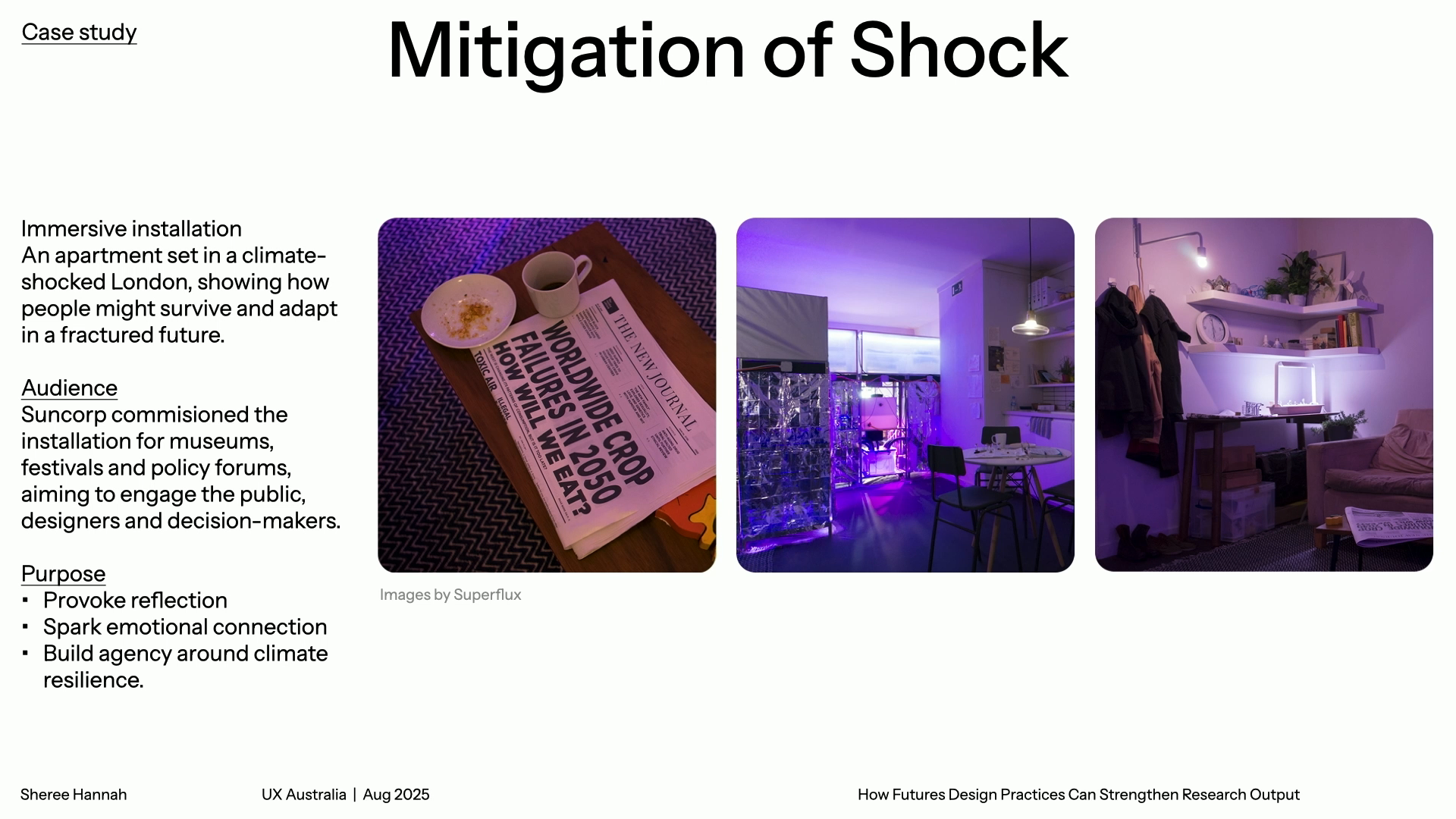
Two installations demonstrate how speculative artifacts give physical form to abstract possibilities. “Mitigation of Shock” immerses visitors in a food-scarce London apartment in 2050, while the 99¢ Future Store uses playful everyday products to invite the Brooklyn public into co-designed futures.
Care Work and Climate Action in the Near Future
Hannah examines a speculative film that challenges assumptions that assistive technology will replace care workers, revealing instead their indispensable judgment and workarounds. She then explores IKEA’s multisensory Action Speaks Summit, which contrasts a dystopian New York with a hopeful future supported by real climate-positive initiatives.
Turn Findings into Stories and Artifacts
Hannah translates futures practice into accessible research techniques: replace an executive summary with a short future story, frame action as achievable and create simple speculative artifacts. She also recommends testing future artifacts with users to discover how people interpret and respond to potential change.
Backcasting, Signal Gathering and Future Framing
Hannah explains how backcasting works backward from a desirable or undesirable future to identify enabling or mitigating actions. She closes with lightweight signal gathering, contrasts between present and future experiences, and future-oriented questions that broaden conventional next-step thinking.
Thank you, everyone. I was just gonna say I was taking take inspiration from yesterday. So if you feel like after a kind of long stretch to to sort of stand up and move around for a moment while I do my introduction, please feel free. Awesome. Okay. So I as John was just saying, I'm the design director of Design It, so I've been doing this for not this particular job, but working in design for the last eighteen years with clients across new government, not for profit, health and education arts.
So I'm working with Design It at the moment in my current role. So we are a global experience innovation consultancy. So started about thirty years ago, and we're a Danish company, which I love that about them, so that's pretty cool. But my personal background, I kinda started out in graphic and web design. Spent a lot of time moving pixels around in Photoshop and, thankfully, it wasn't too long before I realized people actually have to use these use these designs and they weren't there to appreciate how pretty I thought they might have been.
So I moved to to UX a long time ago, and then I would say my my practice has been in strategic design probably for the last sort of five, six years. So with that, I'm always trying to kind of expand my practice in strategic design. So looking at different business kind of operations and other sort of practices to get inspiration from, you know, like around business strategy, learning about the business goals and and their problems and operations and all the processes and services that go into that around, you know, commercials and and finances and those types of constraints.
And an area that I'm super, super excited for and and have been doing a little bit of work in is around futures design and strategic foresight. And what I kind of love about this practice is it certainly opened my eyes to a lot of new kind of practices and tools and and ways of thinking that I think can really sort of help UX designers and and researchers really kind of enhance the the impact of their own work.
So hence, the presentation topic today is how we can use futures design practices to strengthen research output. Alright. So I feel like this might be a deja vu slide. I think the last one about research was hitting the wall. So let's talk about research for a moment, and certainly the challenges of it, which I'm sure a lot of people are familiar with in this room. You know, as practitioners, we we interview and we test and we synthesize.
I spend a lot of time and effort kind of really kind of finessing our insights both to sort of ensure, you know, that they're fair and accurate, but also, you know, so they're easy to understand for, you know, the stakeholders or whoever we're presenting them to. But what sort of happens is those insights are forgotten. Maybe they're in a deck buried somewhere in in someone's inbox.
Perhaps the execute execution of them moved to a different team. The stakeholders didn't like what they heard or worth. They didn't even care. So and it's not about, you know, there's anything wrong with those insights. They're probably fantastic and really valuable. It's just that there could be an opportunity that we have as designers to help make them them stick then stick and get people to act upon them.
So how can we make people act? So clarity is obviously something that's the the foundation sort of of our work, but creating that connection, for people with the work is what will then turn it into to action and make that change happen. Alright. So when insights needs to resonate deeper, future design can give us some new tools.
So just a little bit of a diagram here on the side. I'll start with a couple of questions when we when we look at insights. So one of the a major sort of practice in futures design is looking at signals. So signals are basically a very, very early look at, you know, things that might be happening. They're definitely not a trend.
A trend is a lot more evolved, but it's a very early signal. So it could be a new technology. It could be a new product that's being created. Perhaps it's a, like, a scientific discovery. It could be something very macro, you know, sort of like the impacts of climate change or economics or new policies, these types of things. They're all very early signs of things that may affect us and the organizations that we work with in the future.
It's also about thinking about, like, how does this insight, how might it how might it shift in the future? So rather than necessarily presenting everything as kind of conclusion conclusions, but kind of changing the thinking to provocations and framing that insight as kind of a living thing that could become something else if the conditions are changed. And I kinda asked the the audience to lean in and imagine rather than just kind of sit there and feel what might be missing.
And lastly, what stories can help others feel this? So rethinking how we frame our our frame our insights into kind of a a bit of a narrative, and that storytelling helps people to connect to and also remember what was actually being said. Alright. So what actually is futures design?
So this is just a bit of a definition that we tend to sort of use. So futures design is a design led approach to exploring. So it's exploring what our futures might look like, imagining, so it's actually prototyping those futures, and so what they could look like, what they can feel like, and also preparing for those futures.
One of the things that there's a lot of kind of misconceptions around futures, and especially if you kind of see people with, you know, this kind of futurist that's come popular on LinkedIn. Everyone's got lots of people in that in that kind of title. So I think it's important to kind of talk about a lot about what it actually is not, because it's actually a very strategic kind of, practice. So it's definitely not about predicting the future.
No one can actually predict the future. We've got no idea if, you know, AI is gonna take over all our jobs in the next few years. None of us have a clue. But what it is about is exploring multiple futures. So looking at what it could be in in positive lights, in negative lights, if we, you know, kind of, looked after things, if we don't look after things, these sorts of things.
One of the it's not about finding the most likely outcome. Instead, it's looking at lots of potential outcomes and futures. There's a thing called the futures cone, and it starts sort of wide as to what our possible futures is, what the plausible ones is, and what our preferred future is. It's definitely not blue sky ideation.
It's it's a strategic practice. It's grounded in these change signals, and it's not reserved for innovation teams. They definitely have probably more of an appetite for it than a lot of other teams, but this is something that's useful across an entire organization that everyone can benefit from because we're all going to be affected by the future. So just a summary.
So futures design gives form to the abstract. It kinda shifts it sort of makes things tangible so that you can imagine it. It encourages new perspectives and shapes the discourse around that as well, builds a consensus and a bit of a shared understanding with the people that we work with, and equips us to act with intent rather than just kind of go on with with BAU, and and it helps us to kind of, if there's, you know, kind of negative futures, to mitigate against these and for the positive futures to to help enable these.
And one of the strongest aspects is that it's about form. So when we go ahead and and create our futures, the way that we actually do this in practice is that we create it in a really kind of physical, tangible way so people can see it, they can imagine it. A lot of times, they can even kind of touch it and feel it and be able to respond to it.
So I've got a couple of case studies here just because I myself am a very kind of practical and visual learner, so I find that theory kind of means nothing without some seeing it in action. This particular project here is called, mitigation of shock. Essentially, what it was, it was a installation, and it was set up like an apartment.
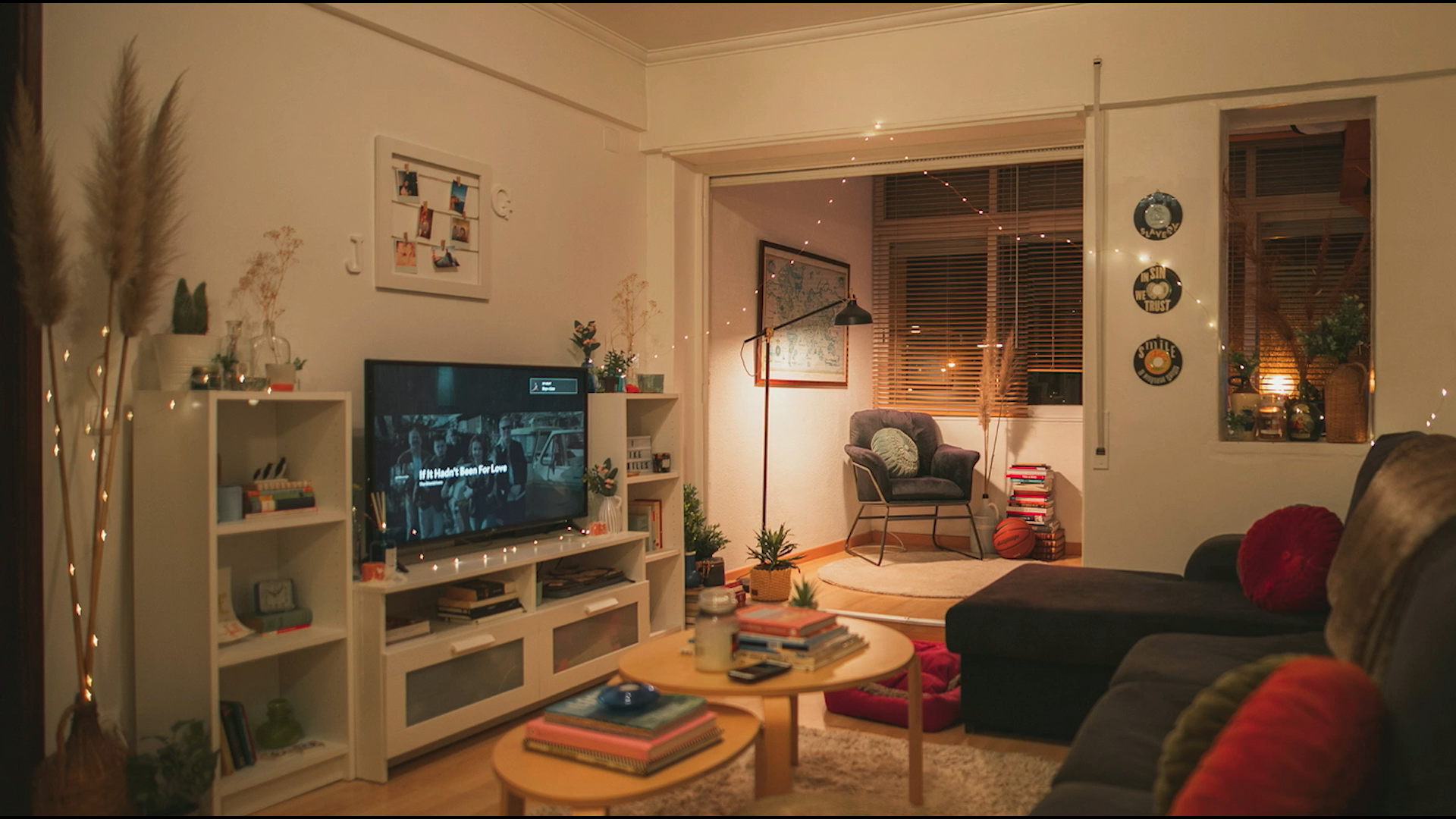
It was set up in London. So it was a London apartment that could move around, and what it did is set up and showed what a '20 what it would look like in 2050 if this, you know, kind of we're in this kind of had to kind of reconfigure someone had to reconfigure their apartment to be able to survive in this space where it's a climate driven kind of food scarcity situation.
So there's all these kind of objects. People can go in and and walk around there, and there's kind of they're using, like, everyday objects, for instance. Like, there's, like, this DIY food growing system, but that's all made out of, like, IKEA shelves and things like that. And there's objects that people are familiar with that are different. There's mushrooms that are starting to sprout from, like, plastic boxes.
There's smart devices, so it's kind of indicating that the networks had been down for quite some time, but they're still trying to kind of these devices are still trying to connect to the network. If you look through the window, it was a bit of a a kind of dystopian sort of view of London where there's lots of unfinished projects and buildings and and no one outside.
And then they'll just, like, simple things. So, like, a newspaper just sort of showing, you know, the the headline, like, how are we gonna survive in 2050 when all the food has run out. So, really, yeah, it just kind of helps people to sort of because they can kind of feel it and and because it's in there in a tangible way, they can imagine it and actually, you know, hopefully, work together to kind of help with the problem.
So this one here is called the ninety nine Future Store. So I was actually lucky enough to study futures design at at Parsons. So the guy who actually ran the course, his name was Elliot, and I've completely forgotten his last name. But he runs this kind of lab called an ex it's called x four I can't I can't read it from here.
Anyways, he runs this lab, and he does some really, really cool projects from it. And this one here was actually usually, these kind of projects are done, you know, within organizations, but he wanted to run this as kind of a a public sort of co designed future. So, essentially, what it was is he took over in Brooklyn, this, like, 99¢ store, so, I don't know, like, one of our $2 stores sort of thing.
And they put in objects of what might exist in the future. So just like these things as, like, everyday objects. So few examples, like, the one on the right there was, like, a spacesuit lining. It was your replacement your replacement kit for that. There was also, like, a Mars survival kit.
You could pick up your home organ transplant kit, and also, like, rare earth remnants. This one's a bit more about art and having a bit of fun with it than it than it was about really kind of achieving anything, but a bit of inspiration to and and to work with the public with these sorts of things. Excuse me. So this one here, this is a really great example, and it's set in not like the others, it's set in the near future. And and when futures is used in practice, it is typically looked at at sort of five to ten years away because that can kind of be conceived.
Anything sort of beyond that starts to get a little bit too unrealistic. But what it was about was for the UK National Care Service, and they have the same, you know, challenges that we have here in care. You know, there's a lot of understaffing. There's not enough funding. They've got an aging population.
And this is all, you know, a really huge burden put on care workers. But there was kind of this kind of, I guess, view that was going around that because, you know, there was assistive technology for some of these things that the need for for carers in the future was going to going to reduce. And, of course, you know, for the actual carers who were using this and and could see what was coming, they knew the job.
They knew that that wasn't gonna be true and they weren't gonna be replaced and rather that they needed to to be supported. And so they made this speculative film in the future where they just kinda do, like, a day in the life of a care worker, and they could see that, you know, the actual users of this tech, they find glitches, you know, they have kind of workarounds that they have to do, and there's so much more to a care worker and and what they do.
And, really, that was for, you know, sort of policymakers and and to help them kind of understand that this was a problem that was not gonna go away. And the last one I've got is a immersive exhibition. It was actually commissioned from IKEA, and they did it for New York Climate Week in 2023.
It was called the Action Speaks Summit. And what they actually did was they had multiple floors that you go in and experience different futures. So you start at the 1st Floor, which is that orange one there, and that's basically a room covered in, like, a three sixty view of the New York skyline being affected, and it's kind of very dystopian, and it's all, like, orange and smoky, and they kind of made it multisensory as well, so you could actually smell all the smoke and that sort of thing.
As you got up to the 2nd Floor, like, total actual contrast to that, this was, like, the hopeful future. And that had, like, you know, interactive sounds and scents and and all these screens that you could look at. Lots of greenery, very sort of beautiful. And then as you made your way up to the talks, which were on the next floor, what they did as you move through is they showcased over 30 sort of real science backed climate positive initiatives that you could actually go in, learn about.
A lot of them, they had the actual products there so you could touch it and just kind of expose people to, you know, what was what was happening and what the possibilities were and and the importance of working collectively to make change. Okay. So bringing this all back to research, I've got a few ideas just with the last few slides of just how we can actually take this back into our practice at work and and see if we can use futures there.
I will tell you, I wrote the the title for this talk a while ago. It has some of these don't fit very neatly into research. They do kinda start to move on to ideation, but full disclosure of that. So the first one is is, of course, a lot around storytelling. So this first idea is about sort of replacing your executive summary with a story. So super, super simple but a 200 word, you know, story about a user in the future who has been shaped by your findings. And this is, you know, depending on kind of what angle you wanna take, whether it's a more positive angle or the more negative. It depends, obviously, on what you're trying to achieve.
That helps really people kind of start and and sort of feel before they kind of begin to analyse the findings. Another idea is about making action kind of feel possible. Sometimes, you know, like, when you're presented with problems, they can just feel so hard to actually go ahead and make change and these sorts of things. So the example here is just, you know, taking it from users expect more proactive digital experiences to where services once solved problems, they now anticipate needs.
So shaping it in that future sense, you start to kind of, like, remove a bit of that burden from people. Some more ideas around making it real and making things more tangible. So the first idea is just bringing and creating a simple artifact, and it doesn't obviously, showing, like, exhibitions and stuff like that.
No one has that kind of budget in reality, but it can be, like, super, super simple ideas, like taking a product and then making it in the future. It could just be, you know, a package, an object, a wearable. It could be communications, let's say, like a poster, a social media post, even like a public sign, like a service or a system, some kind of interface that you could be using, you know, a touchpoint, like a form that you're interacting with, or it could be, you know, a law or a policy or even a protest sign.
So just something to show what's the future. So the example here is just like, you know, a transport app in that example. The next idea is just, like, testing rather than so much of using it as output, but actually testing a future artifact with your users. So similar to kind of, like, concept testing, but thinking even few even further into the future and then seeing how that lands and seeing how people respond to it.
Looking at things and shaping them around that future kind of perspective. So one of the a a big kind of part of futures design or a tool that they use is back backcasting. So it's kind of like a like a planning tool. So, essentially, whatever these futures are, you're kind of looking ahead, and then we'll move backwards.
So say if it's, you know, you know, a really positive future, you what steps do you need to take backwards to kind of enable that? If it's a negative one, what steps can you take backwards to to kind of mitigate against it? And another is to just even just as a practice, it doesn't have to be for out output either.
Just creating sync just kind of collecting signals and having a space for it. Even if you're not acting on it or or doing any kind of practices, just looking at there's really kind of early signs that come through that could potentially impact impact your organization and just being aware of it and and having discussions around that.
And lastly, around sort of contrasting. So looking at, you know, what is the what is the current what's currently happening, and then contrasting against that what the future might look like. So the first idea is just talking about sort of the inaction and kind of pointing that out that if we don't if we don't sort of respond to these problems, what's that gonna look like in the future?
Another idea is kind of making contrast across time feel real. So using you know, how we would use a quote in a in a, say, for a research deck to try and get our point across, kinda contrasting that with the future one as well. So the example here is, you know, now it's like it takes forever to get my documents approved in the future.
You know, I remember when you couldn't just, like, voice submit something to the app. So just giving that kind of emotional payoff as well again to kind of feel like change is already kind of happening, and it's not such a it feels kind of more believable and not so burdensome, like, not such a burden. And the last one here is around sort of expanding that kind of next step thinking.
So using future framing to guide what happens next. So, typically, we would use, you know, how might we use that sort of thing, experimenting with with a different way and thinking about the future. So if this stays the same or if this transforms, then asking that question and connecting or, I guess, expanding people's thoughts and and the way that they look at a situation or a problem.
Alright. And that's it from me. Thank you so much for for having me. I've got I'm really, really interested to see you know, it's a it's a space that's very much in its infancy here. So if anyone's kind of using these practices or or plans to use these practices, I would love to hear how you go with them or if you have any questions.
Just reach out. And I'm also just putting together a newsletter as well exploring futures in sort of the community care and health space. So if you're interested in that, please subscribe. But thank you so much for having me, and I hope you've been able to learn something or take something away.
Technologies & Tools
- Photoshop
- Assistive technology
Concepts & Methods
- UX
- Strategic design
- Futures design
- Strategic foresight
- Signals
- Trends
- Storytelling
- Futures cone
- Speculative film
- Future artifacts
- Concept testing
- Backcasting
- Signal gathering
- Future framing
Organisations & Products
- Designit
- IKEA
- Parsons
- UK National Care Service
- New York Climate Week
Works
- Mitigation of Shock
- 99¢ Future Store
- Action Speaks Summit
This talk explores how UX research can draw inspiration from futures design
practices to transform insights into narrative-driven stories that engage and
inspire both stakeholders and team members. Through examples from global case
studies and Designit’s own work, this session addresses the common challenge many
researchers face – ensuring their insights don’t get disregarded. By leveraging
practices like design fiction, speculative prototyping and visual storytelling,
research findings can become powerful catalysts that foster empathy, drive
innovation, and spark meaningful change.