Conffab by Web Directions
  • Speakers
  • Presentations
  • Conferences
  • Live streams
  • Topics
  • Pricing & Plans
  • Browse
  • Signup
  • Sign In
  • Speakers
  • Presentations
  • Conferences
  • Live streams
  • Topics
  • Pricing & Plans
  • Browse
  • Signup
  • Sign In

Search Conffab

Search presentations, speakers, transcripts, slides and topics.

Searching Conffab

Beyond HTML5

Chaals McCathieNevile at South 2012
  • HTML
Sign up for Conffab Free to watch this and hundreds of other videos for free
  • Details
  • Keypoints

HTML5 is Yet Another Buzzword for “the state of the art in Web technology”. It is also a detailed technical specification fundamental to the “Open Web Platform”. Who is developing all this technology, and where are they trying to take us?

This talk will look at the future of HTMLincluding HTML5, HTML.next, HTML “the living standard”, where the “Open Web Platform” is going and what is holding it back, as well as key directions for browsers and other large players, and what we can do about it.

Where are we?

  • HTML5 “plan 2014” – it’s gunna be ready soon(er than 2022)!
    • …and they did that by saying anything that wasn’t ready didn’t go into 5.0, it went to 5.1
  • W3C is working on HTML 5.1
  • WHAT-WG keeps going on their living standard
  • The web is more than HTML

W3C HTML

In feature freeze and wanting to patch WHATWG bugs; they’re making extension specs for 5.0.5.1/… controversial things are being postponed. That’s problematic because accessibility features are being deemed controversial if they don’t work 100% of the time – problem is most accessibility stuff doesn’t work 100% of the time. HTML5 has to go through a Last Call 2, for patent issues.

WHAT-WG

The living standard is huge, 6meg of HTML is truly gigantic. In fact it’s too big to read. Almost nobody has read it end to end; not even the editors.

While WHAT-WG is problematic it is still the biggest source of ideas at the moment.

HTML EXTENSIONS

Proposed:

  • Encrypted media (DRM)
  • Media Source (adaptive streams)
  • Responsive Images
  • Headers/Outlines
  • <maincontent>
  • @longdesc

If you want to influence these decisions, get involved and give feedback. Tell the editors what works for you as a developer. It turns out the people in the room have a lot more say than those who aren’t saying anything; and things move faster when the editors aren’t guessing.

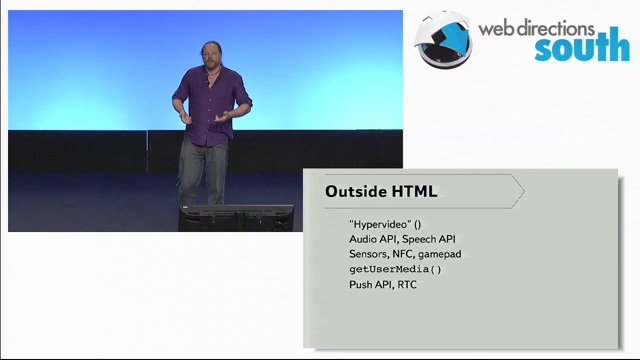
Outside HTML:

  • hypervideo – allowing videos to link to other videos more akin to html
  • Audio API – commonly demonstrated
  • Speech API – not so commonly demonstrated, people do talk to their devices!
  • Sensors, Near Field Communications, gamepad
  • getUserMedia()
  • Push API, RTC

Inside:

  • Web Intents – revolutionary, came from google, going to work out how to do plugins on the web. This time, instead of actual software plugged in; you’ll use a service on the web to do what that downloaded plugin would have done.
  • Web components – ability to make your own markup, much like XHTML used to be extensible, except this time to make it actually work. Ability to collapse common features down to custom markup that shorthands whole sets of CSS and JS.
  • Web Animation
  • Fullscreen
  • Clipboard
  • 3D (and printing)

Getting input:

  • pointer events
  • gesture
  • speech
  • IMEs

DOM 3 events almost done.

Where does all this lead? To making an Operating System! The web can be an operating system, and that’s where all this work is heading.

But there are a few curious issues – eg. The web has no concept of a file system. Things the web runs on have file systems but the web itself does not.

Building a network hits i18n issues like multilingual web – even just getting keyboard shortcuts to map to different layouts turns out to be very very poorly done and flaky.

Identity on the web is still a pain point – we don’t have a good, single solution. Currently people mostly just re-use a specific service login (Facebook, Twitter). The useful case is wanting to vote online – you need some way to be reasonably sure each vote really came from one person.

“What we do with Moore’s Law is what we do with freeways – we build more of them!” We download much higher-resolution images of cats. We forget that we will fill the capacity doing the same thing with bigger files.

Ecommerce is curious – you can almost but not quite get a whole homeloan online; you can do small payments, but not a genuine micropayment of less than $1 without an ongoing relationship. In developing countries with low incomes this is a really big problem. The ability to transfer phone credit between phones has led people in Kenya to think of a mobile-phone based bank.

When lots of money starts getting passed around in a visible form in such a nation, the government can – often for the first time – start to tax their population’s cash flow. Which suddenly puts the government into peoples lives, when previous they were largely decoupled. Then, people start reacting to the government… and when that happens, you can get genuine revolution.

That’s the exciting – and scary – part of where technology is taking us… it can change the world.

[My writeup doesn’t do justice to the conclusion. You had to be there.]
You may also be interested in

Thumbnail for Customisable and the friends we made along the way

Customisable and the friends we made along the way

Jake Archibald

CSS Day 2026

Thumbnail for The goose and the common

The goose and the common

Bruce Lawson

CSS Day 2025

Thumbnail for Performance Driven HTML

Performance Driven HTML

Mandy Michael

Dev Summit ’24

Thumbnail for Web Components: Another Tool in your Toolbox

Web Components: Another Tool in your Toolbox

Ben Taylor

Summit ’23

Thumbnail for Native HTML elements you should already be using: building without Javascript.

Native HTML elements you should already be using: building without Javascript.

Harrison Broadbent

Web Directions Code 2025

Thumbnail for Native modals with the new popover API

Native modals with the new popover API

Zach Jensz

Dev Summit ’24

Thumbnail for Building a Next Generation Mobile Browser Using Web Technologies

Building a Next Generation Mobile Browser Using Web Technologies

Adam Stanley

South 2012

Thumbnail for More to give than just the div: semantics and how to get them right

More to give than just the div: semantics and how to get them right

Hidde de Vries

Access All Areas 21

More presentations from South 2012

Thumbnail for Building a Next Generation Mobile Browser Using Web Technologies

Building a Next Generation Mobile Browser Using Web Technologies

Adam Stanley

South 2012

Thumbnail for Business Models Panel

Business Models Panel

Alan Duncan

South 2012

Thumbnail for The Basics of Three

The Basics of Three

Alex Danilo

South 2012

Thumbnail for Roll Your Own (Style Guide)

Roll Your Own (Style Guide)

Arunan Skanthan

South 2012

Thumbnail for Passion and Purpose

Passion and Purpose

Avis Mulhall

South 2012

Thumbnail for In Conversation

In Conversation

Mike Cannon-Brookes

South 2012

Thumbnail for Better than MVC

Better than MVC

Damon Oehlman

South 2012

Thumbnail for Programming Style and Your Brain

Programming Style and Your Brain

Douglas Crockford

South 2012

© 2026

  • About
  • Speakers
  • Presentations
  • Conferences
  • Contact
  • Sign in
Sign Up