Reports of code’s death are greatly exaggerated
March 23, 2026
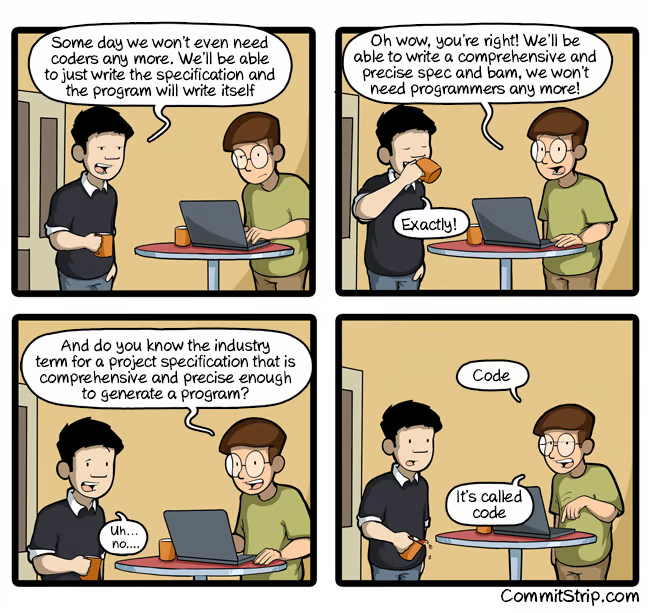
Until probably late 2025, I would have largely agreed with the sentiment of this comic. Having been working professionally as a software engineer for decades, having studied software engineering in the 1980s at university, I’ve seen the promise of high order abstractions replacing Human programming in languages like C or Java or Python or people of the language of your choice touted over and over again.
Whether it was 4GLs in the 1980s, or low-code, no-code more recently, the holy grail of programming seemed to be getting rid of programmers.
Time and again it turned out that unless you very meticulously specified what you wanted a system to do, it didn’t do what you wanted it to do. And very meticulously specifying what you want a system to do is, or has been until very recently, indistinguishable from programming.
That’s not empirically true anymore. It’s baffling. It’s almost unimaginable. But reasonably imprecise descriptions of what you want a system to do can get you very close to the system you had in mind.
Theoretically, it’s hard to imagine. It flies in the face of decades of theoretical and, in reality, empirical experience.But, as Galileo was supposed to have said when provided with all kinds of effectively theological arguments against a heliocentric model of the solar system, *Eppure si morve*–”but it moves”.
Coming to terms with the empirical reality of how large language models work, what they do is a singular challenge. Not just for software engineers, but for many people with the knowledge of their field.
This is one of many such examples.