How To Use AI for the Ancient Art of Close Reading – fast.ai
January 22, 2026
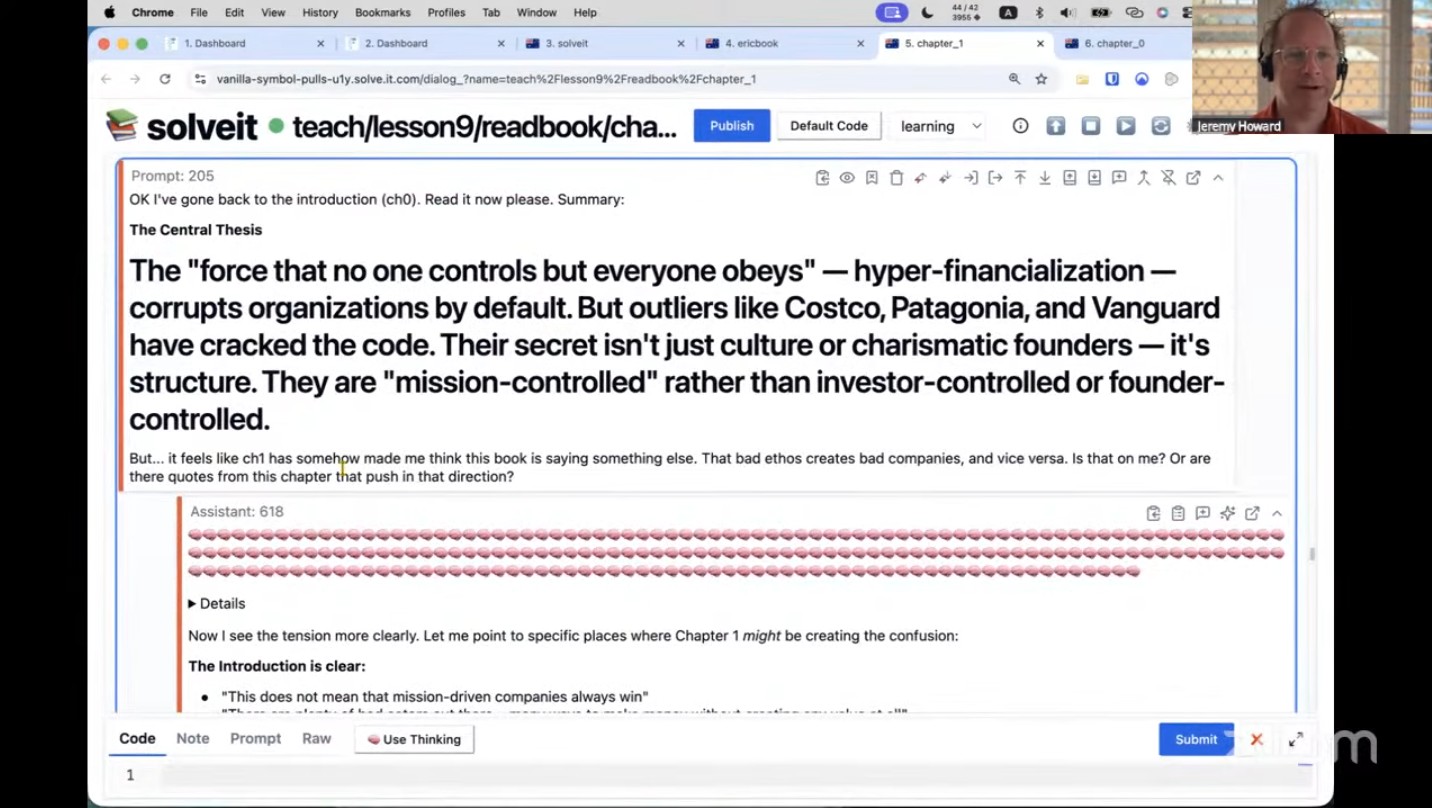
Close reading is a technique for careful analysis of a piece of writing, paying close attention to the exact language, structure, and content of the text. As Eric Ries described it,“close reading is one of our civilization’s oldest and most powerful technologies for trying to communicate the gestalt of a thing, the overall holistic understanding of it more than just what can be communicated in language because language is so limited.” It was (and in some cases still is) practiced by many ancient cultures and major religions.
It might come as a surprise that a technique associated with such a long history could now see a revival with the use of Large Language Models (LLMs). With an LLM, you can pause after a paragraph to ask clarifying questions, such as ‘What does this term mean?’ or ‘How does this connect to what came before?’
At university, decades ago now, I studied English Literature among many other topics and was introduced to the concept of close reading. So this from FastAI caught my attention.
We often see concerns that AI and large language models are reducing people’s capacity to reason deeply and think extensively. There are many concerns about the impact on education, and I don’t think those should be dismissed out of hand. But approaches like this—using a large language model as a tool to aid processes like close reading—give me some optimism for more positive outcomes.
In my own experience over the last few weeks, I’ve been reading Anil Ananthaswamy’s wonderful Why Machines Think, about the mathematics of machine learning and AI.
Now, I also studied mathematics—indeed got a degree in the subject—at university, again decades ago. And while the mathematics in that book doesn’t go into real depth, I wanted to make sure I really understood the key concepts, particularly Bayes’ theorem, of which I had a general understanding but which Ananthaswamy looks at in some detail.
I used the technique of photographing each section of the book as I read it, uploading it to Claude, and then having a conversation about that section. When I wasn’t clear on a particular aspect, I asked for more detail and clarified my understanding.
It certainly took longer, but I came away with a much deeper understanding than I would have if I’d simply worked through it in my own head.
We’re at the very early stages of these models’ capabilities. I believe they will get significantly better than they are today, even though by 2023 standards they’re already remarkably capable. But beyond that, we’ll develop new techniques, new approaches, new patterns. We’ll learn how to work with these tools, and this is one of what I think will be many examples.
Will people lazily use these tools to churn out slop? Hastily write essays about topics they don’t really understand? Yes, all of the above. But will this enable people who work intelligently with these technologies to learn more, to understand more deeply? I absolutely believe so.