Do AI-enabled companies need fewer people?
March 9, 2026
About a year ago I made some predictions about the effect of AI on programming jobs. Block laid off 40% of its staff claiming AI made them more efficient. Is that really true or did they just over-hire? Let’s look at some data and see what’s really happening.
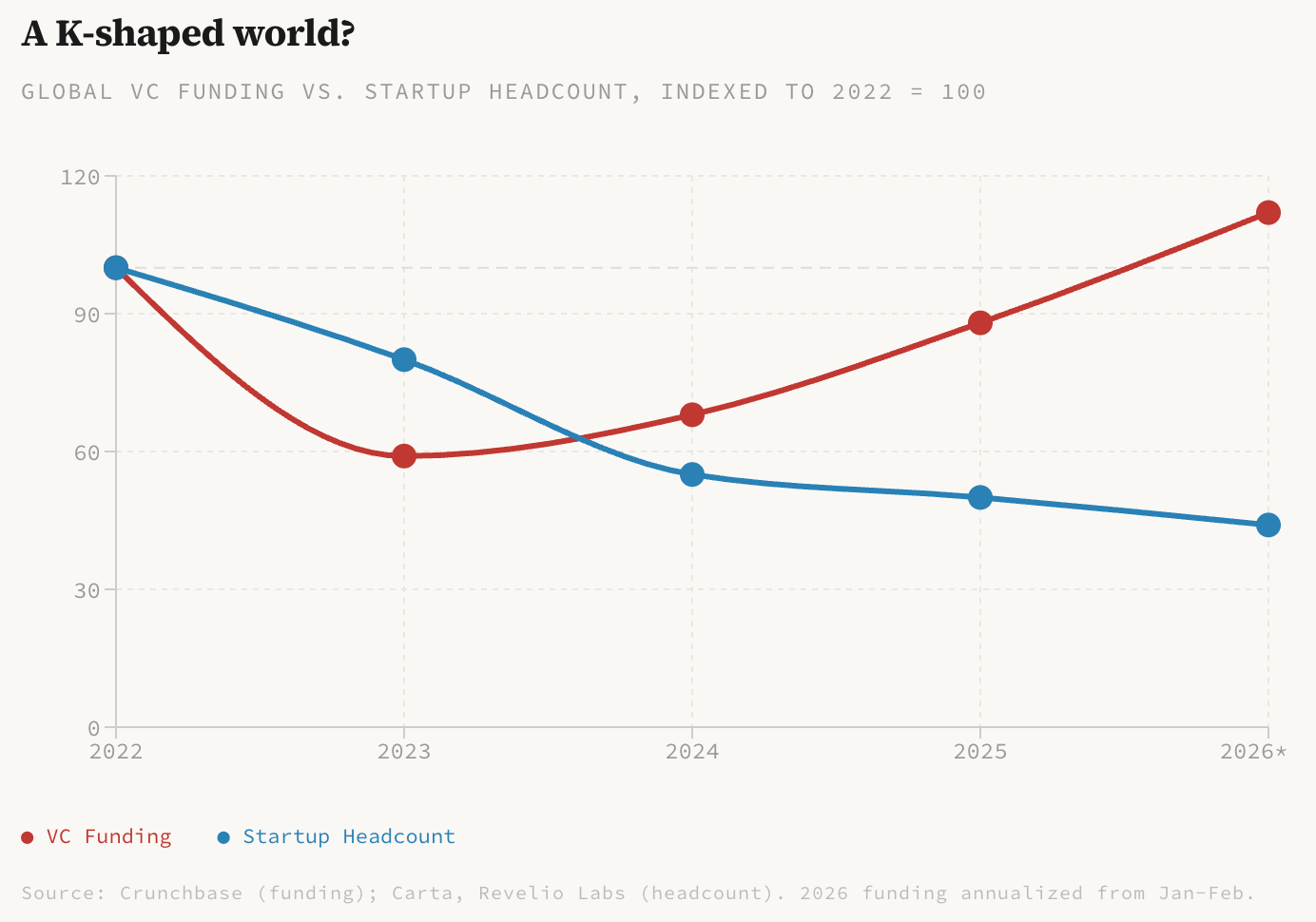
In February 2026, global venture capital hit a single-month record: $189 billion flowed into startups in 28 days. Three companies got 83% of that funding: OpenAI, Anthropic, and Waymo. Two months into 2026, startups have already raised more than half of what they raised in all of 2025. There is an unprecedented amount of money going into startups, partly because AI is capital-intensive in a way other technology boom cycles have not been. So if you looked at just “headcount per dollar raised” it would definitely look like AI startups are more headcount-efficient. But is that really what’s going on?
My read on this is: the startup economy is undergoing a structural transformation here. Startups are substituting compute for labor at an increasing rate. I still remain optimistic that this is going to result in a lot more companies doing a lot more things, but so far it hasn’t happened. But companies’ claims that they can get by with way fewer people in the age of AI does seem to be true.
Laurie Voss takes a bit of a deeper look into the impact of AI on employment levels, particularly in technology companies, in the wake of Block’s recent layoff of 40% of its staff, claiming that was due to AI efficiencies.
Is that the case?