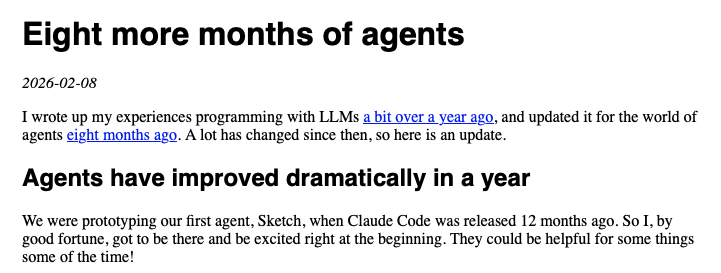
crawshaw – 2026-02-08
March 5, 2026
A huge part of working with agents is discovering their limits. The limits keep moving right now, which means constant re-learning. But if you try some penny-saving cheap model like Sonnet, or a second rate local model, you do worse than waste your time, you learn the wrong lessons.
I want local models to succeed more than anyone. I found LLMs entirely uninteresting until the day mixtral came out and I was able to get it kinda-sorta working locally on a very expensive machine. The moment I held one of these I finally appreciated it. And I know local models will win. At some point frontier models will face diminishing returns, local models will catch up, and we will be done being beholden to frontier models. That will be a wonderful day, but until then, you will not know what models will be capable of unless you use the best. Pay through the nose for Opus or GPT-7.9-xhigh-with-cheese. Don’t worry, it’s only for a few years.
Right now, I think we’re very much in an empirical phase of discovery about how to work with large language models as software engineers. And one important source of information are the reports of those who have been working with their technologies longer. and the lessons they’ve learned.
Here is a collection of thoughts based on working for around a year which at the moment is essentially a lifetime with agentic coding systems that could be very valuable in pointing out the direction you might take as you explore how to do the same yourself.