Code as Commodity
January 19, 2026
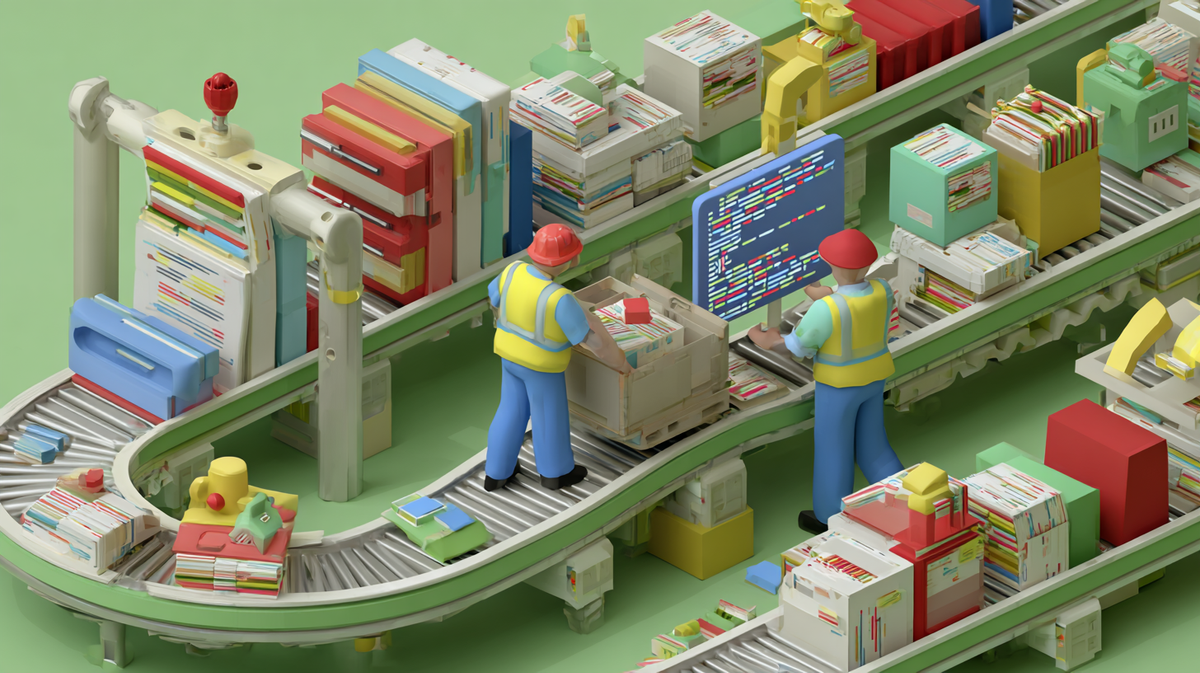
Thanks to generative AI, code is following a similar pattern. Projects that would have been uneconomic through traditional software development are now just a prompt away. Those 500+-products-per-day on Product Hunt? Not all of them are good, but that’s what abundance brings.
But this doesn’t mean developers are obsolete. It means that the locus of value is broadening as this exclusive skill becomes more widely accessible.
Thus, the real question isn’t “will we be replaced?” but, “what becomes valuable when code itself is cheap?”
Over the course of the last three years, I’ve worked extensively with large language models to write code. I started in late 2022 when ChatGPT first emerged, working with it to help write Bash scripts that would allow me to better take advantage of FFmpeg to automate aspects of a workflow that had been very manual—getting clips from videos at particular timestamps.
Looking back, I probably could have done this just as quickly without using the LLM, certainly not a lot more slowly. But something about it felt compelling. Over the last three years, I’ve continued and increasingly worked with these tools and have seen them get better and better, sometimes on exactly the same task.
Somewhere around the middle of 2025, I started to feel that we might be on an S-curve with the capabilities of the models, at least when it comes to coding. An S-curve is one which looks exponential in growth but then plateaus—it approaches an asymptote. And it felt like we might have been plateauing. We had very good models, and even if they never got much better, they would still deliver a tremendous amount of economic value.
Toward the end of 2025, particularly with the launch of Opus 4.5 and Claude Code (which is how I now work with that model), it felt like we had a huge leap forward in capabilities—not just in what the models could do step by step, but in their longer-term approach to solving a problem. It was no longer a turn-by-turn affair; I could set up a task and the model could run for an extended period and, more or less in a single shot, create something that even six months before might have taken hours of turn-by-turn work to refine and ensure it worked the way I wanted.
At the beginning of 2025, Dario Amodei, one of the founders of Anthropic, predicted that by the end of the year 90% of code would be written by large language models. Midway through the year, that looked like a ludicrous prediction, and there were numerous mocking references to it. By the end of last year—certainly by now—I think it’s plausible. Anthropic themselves claim to have built their new Cowork feature in ten days largely this way, and certainly in my experience, 90% of the code I would have written by hand three years ago is now written by a large language model. I know as much as almost anyone about front-end development and the code that goes behind it: best practices, accessibility, performance. I wouldn’t hand-write just about any of this anymore, except when it comes to maintaining legacy systems. The next step for me is to see how well Claude Code and Opus 4.5 will do at helping me maintain some quite significant legacy systems I built over a period of as much as twenty years.
The assumption underlying this essay by friend of Web Directions Chris Messina—that code is essentially a commodity now, and not just code but actually software, and indeed entire products are—is at least a decent working hypothesis to explore. For someone who has invested 40 years of their life getting pretty good at writing all kinds of code, this could be terrifying. My work is commodified; my knowledge is a commodity.
If we look through history, when these things happen—a famous example being the weavers in the first part of the 19th century, who went from being artisans, incredibly well paid by the standards of the day for manual labour, to being commoditised within years by mechanical steam-powered looms—history teaches us we should perhaps be concerned.
Here Chris asks the question: “What can be our value when code itself is a commodity?” If you write software, or design software, or work in the development of these systems as a product manager, you should sit down and read this essay and explore that question for yourself.
Related Speakers